US Tax Filing and Compliance
S Corporation Salary vs Distributions: How Owners Should Pay ThemselvesS Corporation Salary vs Distributions: How Owners Should Pay Themselves
Written by Shubham Jain
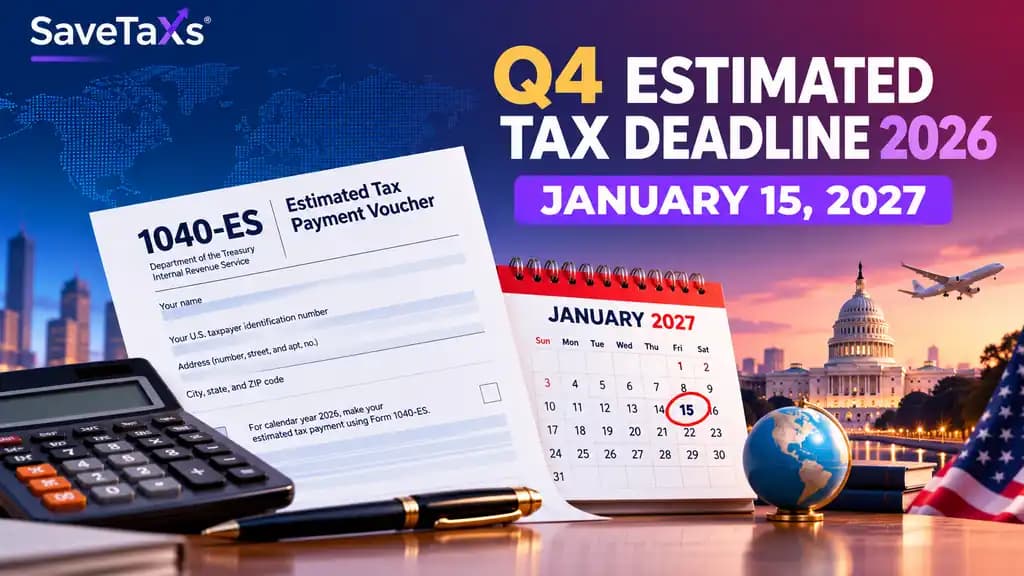
The fourth-quarter estimated tax deadline for 2026 is January 15, 2027, for most calendar-year individual taxpayers required to make federal estimated tax payments. This installment generally covers income received from September 1 through December 31, 2026.
If you expect to owe federal income tax on income that is not sufficiently covered by withholding, check whether you need to make a Q4 estimated tax payment before the deadline. Qualifying taxpayers may also be able to file their 2026 federal income tax return and pay their remaining balance by February 1, 2027, instead of making the January installment.
This guide focuses specifically on the fourth installment deadline, the available filing exception, payment instructions, and what to do if you miss the January due date.
| Detail | Information |
|---|---|
| Tax year | 2026 |
| Q4 estimated tax payment deadline | January 15, 2027 |
| Income period covered | September 1–December 31, 2026 |
| Individual estimated tax form | Form 1040-ES |
| Alternative filing-and-payment deadline | February 1, 2027, for qualifying taxpayers |
| Special farmer and fisher deadline | March 1, 2027, for qualifying taxpayers |
The deadline is established in the IRS 2026 Form 1040-ES instructions.
The fourth installment generally covers income received during the final estimated tax payment period, from September 1 through December 31, 2026.
Unlike regular payroll withholding, estimated tax payments allow taxpayers to pay federal taxes directly when their income does not have enough tax withheld.
A fourth-quarter payment may be relevant if you received additional freelance income, business profits, rental income, dividends, interest, or capital gains during this period.
However, receiving one of these income types does not automatically mean you owe a January payment. Your annual tax liability, withholding, previous payments, and applicable exceptions determine whether an installment is required.
For the complete explanation of estimated tax eligibility, payment calculations, and safe-harbor rules, see our IRS estimated taxes guide.
You may need to make the fourth-quarter installment if your expected federal tax liability is not adequately covered by withholding and applicable refundable credits.
This can include:
Freelancers and independent contractors with income not subject to sufficient withholding.
Business owners whose profits create an additional federal tax liability.
Investors who realize taxable capital gains or receive investment income.
Landlords whose rental income increases their expected tax liability.
Employees whose withholding does not meet the applicable estimated tax payment requirements.
The general estimated tax rules commonly involve an expected balance of at least $1,000 after withholding and refundable credits, together with a required-payment test based on current-year and prior-year tax. Special rules apply to certain taxpayers.
You do not need to recalculate the entire estimated tax framework solely because the fourth installment is approaching. Start with your existing payment calculation, update it for any changes in income or withholding, and confirm whether another payment is required.
For eligibility criteria and safe-harbor calculations, consult the complete estimated tax payment guide.
Yes, if you qualify for the IRS filing-and-payment exception.
Qualifying calendar-year taxpayers can generally avoid making the January installment by filing their 2026 Form 1040 or Form 1040-SR by February 1, 2027, and paying the entire remaining balance due with the return.
January 31, 2027, falls on a Sunday, which is why the applicable deadline moves to the next business day.
Before relying on this exception, remember:
You must file the applicable return by the deadline.
You must pay the entire remaining balance due with your return.
The exception does not automatically remove penalties for underpayments from earlier periods.
Your filing circumstances must meet the applicable IRS requirements.
Example: Suppose you would otherwise make a fourth-quarter estimated tax payment on January 15, 2027. If you can file your 2026 federal return by February 1 and pay your full remaining balance, you can generally use this exception instead of making the January installment.
Review the IRS Form 1040-ES instructions before choosing this option.
Eligible farmers and fishers have special estimated tax rules.
Generally, taxpayers whose gross income from farming or fishing meets the applicable two-thirds test for 2025 or 2026 may qualify to file their 2026 federal income tax return and pay the entire tax due by March 1, 2027, instead of making the usual estimated tax installments.
Eligibility depends on the applicable income test and other IRS requirements. The exception does not apply automatically to every agricultural or fishing business.
Check the IRS's farming and fishing estimated tax guidance before relying on this deadline.
If a January installment is required, use an available IRS-authorized payment method.
IRS Direct Pay: Make an electronic payment from an eligible bank account using IRS Direct Pay.
IRS Online Account: Review available payment options through your IRS Online Account.
EFTPS: Use the Electronic Federal Tax Payment System if enrolled and eligible.
Card or digital wallet: Use an IRS-authorized payment processor; processing fees may apply.
Mail: Send a check or money order with the appropriate Form 1040-ES voucher, following current IRS instructions.
When making your payment, select the correct tax year and estimated tax payment type. Keep the confirmation number or other proof of payment.
For current instructions, see the official IRS payment options.
If you miss the fourth-quarter estimated tax deadline, review your payment requirements and act promptly.
1. Check whether the installment was required. Your withholding, credits, tax liability, and prior payments may affect whether a penalty applies.
2. Pay any outstanding amount promptly. A late payment may reduce the period of underpayment, but it does not necessarily eliminate a penalty.
3. Review the filing exception. Determine whether you qualify to file your 2026 return and pay the remaining balance by February 1, 2027.
4. Check for earlier underpayments. Paying the fourth installment does not automatically resolve a shortfall from an earlier payment period.
The IRS may calculate an underpayment penalty based on the amount underpaid and how long the amount remained unpaid. Certain exceptions and alternative calculation methods may apply.
For details, see the IRS underpayment of estimated tax penalty guidance.
Before January 15, review your expected 2026 tax liability, withholding, and estimated payments to determine whether you need an additional installment.
Savetaxs can help you review your tax position, understand applicable payment requirements, and identify questions to discuss with a qualified tax professional.
Need help assessing your estimated tax obligations? Contact Savetaxs for personalized tax guidance.
For a broader explanation of payment calculations and safe-harbor requirements, read our IRS estimated taxes guide.
This article is for general informational purposes only and does not constitute tax, legal, financial, or investment advice. Laws, regulations, rates, and procedures may change over time and may vary based on individual circumstances.
While SaveTaxs makes reasonable efforts to keep the information accurate and up to date, readers should verify applicable rules with official authorities or consult a qualified professional before making decisions based on this information.
Shubham Jain is the Founder of SaveTaxs and has extensive experience in Indian and NRI taxation. He advises individuals, NRIs, and businesses on tax filing, tax planning, capital gains, DTAA benefits, fund repatriation, and compliance matters. He regularly writes about taxation and related financial topics. His focus is on making complex tax concepts easy to understand. Through his articles, he helps taxpayers stay informed, avoid common mistakes, and stay compliant with Indian tax laws. See Full Bio

Want to read more? Explore Blogs