
US Tax Filing and Compliance
U.S. Taxation of Foreign Life Insurance Policies
Written by SaveTaxs Editorial Team
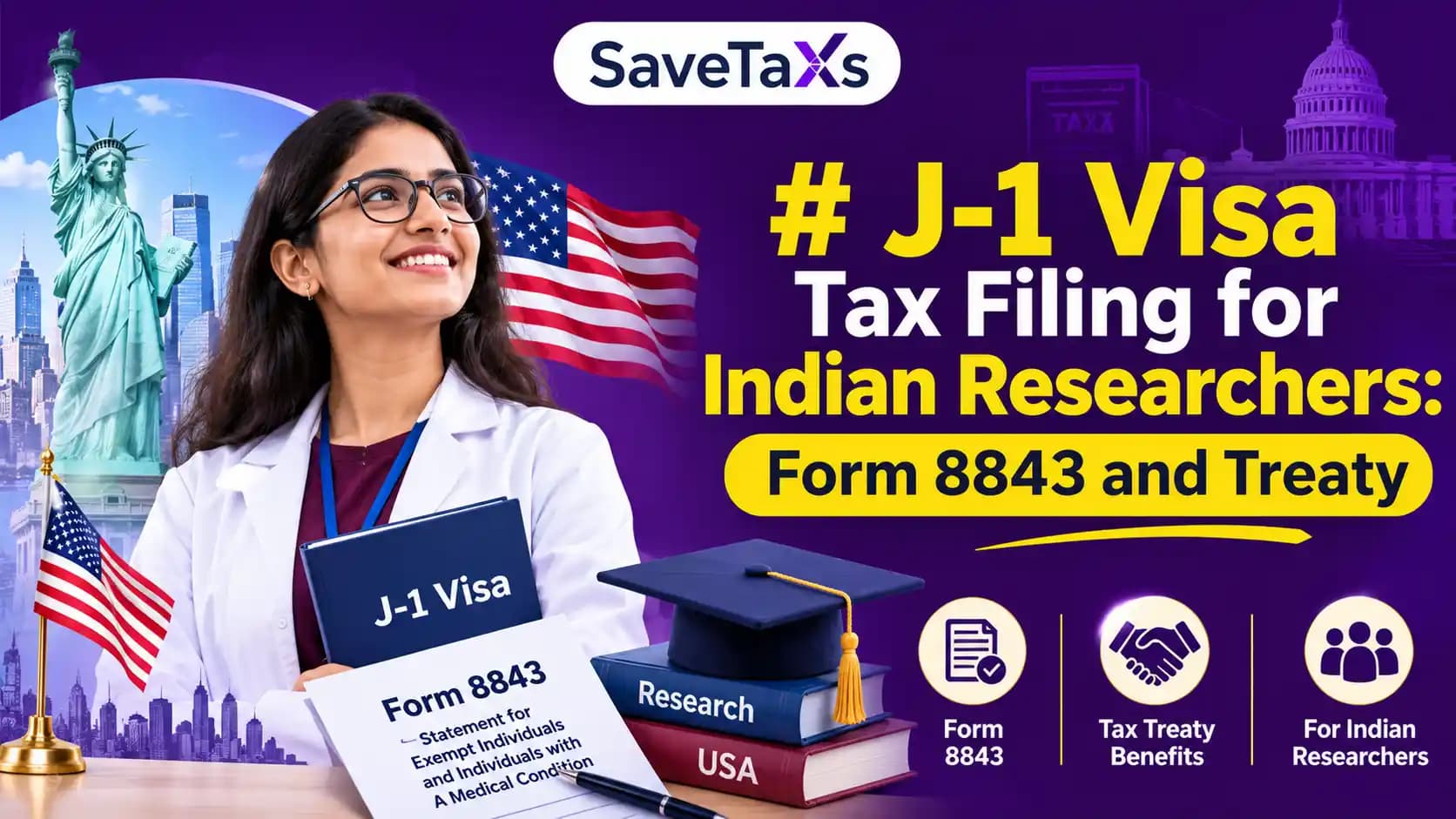
Most Indian researchers on a J-1 visa are treated as US nonresidents for their first years in the country, so you file Form 8843 every year and a nonresident US income-tax return for any year you had US income. The visa itself doesn't settle your tax status. Your days in the US, your earlier J-1 or student visits and the kind of payment you receive do that. Your Indian residential status for FY 2025-26 (AY 2026-27) then decides whether the same US pay also belongs on an Indian return, and whether you'll need a credit for the US tax already taken from it.
For a researcher in the early years of a J-1 program with university pay, the usual path is Form 8843, a nonresident return, a treaty claim if your pay fits the treaty's teacher and researcher article, and an Indian return only if you're still an Indian resident that year. The condition that most often changes this is your past US presence. Earlier J-1 or student years use up the period in which your days are left out of the count, and once that period is gone you're tested like any other foreign national.
Your US tax residency is decided by a test that counts your days in the country, not by your J-1 visa, and while you're an exempt individual your US days don't count toward that test.
Your J-1 status says why you're in the US. Tax residency asks how long you've been here and how often. A researcher can hold a valid J-1 and still need to determine separately whether the US tax rules classify them as a resident alien.
The substantial presence test (the IRS's day count for people who aren't US citizens or green card holders) adds your US days in the current year to a reduced share of your US days from earlier years. Pass it and you're a resident alien, taxed on your worldwide income. Fail it and you're a nonresident alien, taxed only on income from US sources and income tied to US work.
An exempt individual (someone whose US days are excluded from that count) includes a J-1 teacher or researcher for a limited number of calendar years. That period isn't fresh for every program. Earlier years spent in the US on a J or F visa within the lookback window use it up, so a postdoc who did a PhD in the US on an F-1 visa has often spent part or all of it before the J-1 even starts.
That is where filings go wrong most. A researcher assumes a new J-1 program restarts the clock, keeps filing as a nonresident and skips income the resident return would have caught. Unwinding that later means amending, and if you've already filed on the wrong form, see how to fix a return filed on the wrong US form.
When the applicable exemption no longer applies, reassess your US tax residency using the federal day-count rules. Pass the test and you're a resident alien for that year, with the switch year carrying its own rules for the part of the year before and after. From then on, the treaty and India sections below still matter, but the US return you file changes.
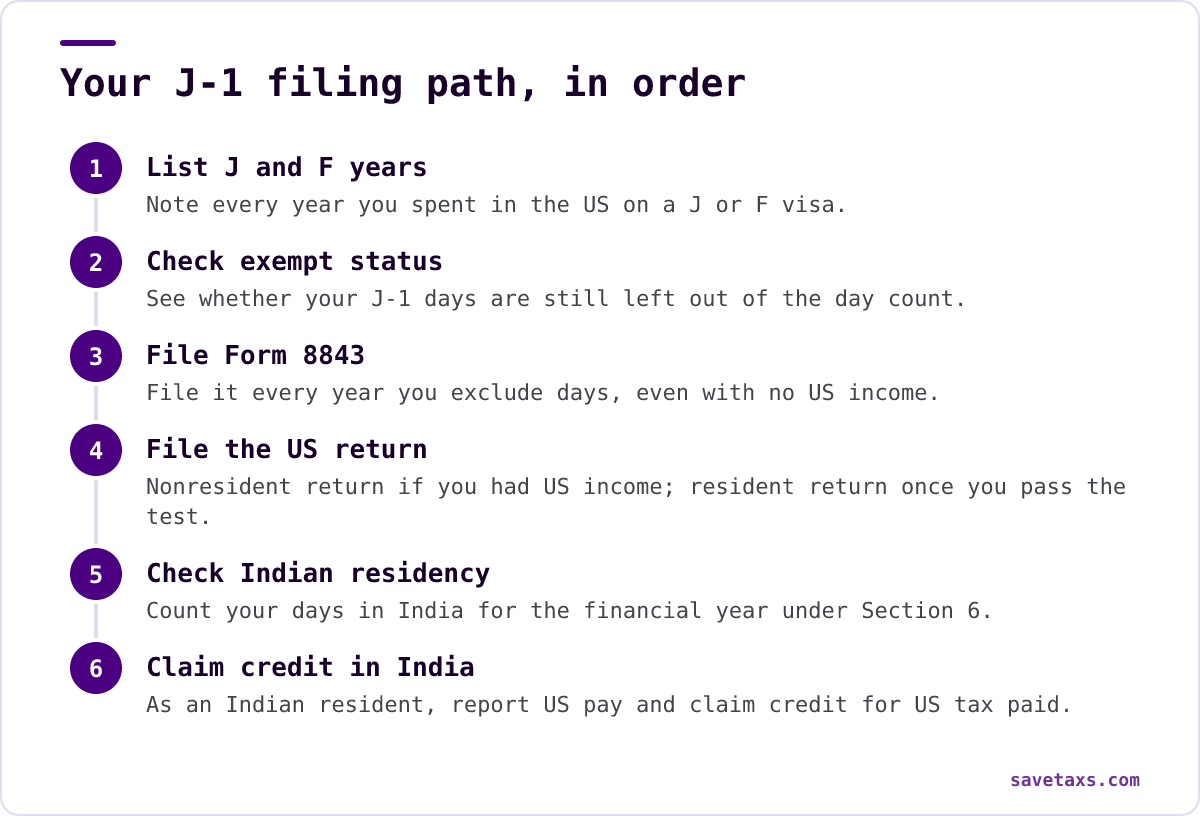
An alien individual must file Form 8843 to explain why days of US presence are excluded, and being an exempt individual is one of those reasons. So every year you're in your exempt period, you file one, whether or not you earned anything in the US.
Form 8843 isn't an income-tax return and it doesn't claim a refund. It's a signed statement that backs up your day count. You'll give your identification details, your visa type and entry dates, your days in the US for the current and earlier years, the name and address of your J-1 program sponsor, and the years you previously spent in the US as a teacher, researcher, trainee or student.
When you file a US return, you attach the form to it. When you have no return to file, check the Form 8843 instructions for the required standalone submission method and timing.
Skipping the form because you had no income is the usual slip. It leaves no record supporting your exempt status, and that record is exactly what you need if your residency is ever questioned. Our step-by-step Form 8843 filing guide walks through each line.
A nonresident J-1 researcher with US wages, a stipend or a taxable fellowship files the nonresident version of the US income-tax return, while a resident alien files the standard resident return.
Not every payment is taxed or reported the same way. Pay for research or teaching work is compensation for services, so it's wages. A fellowship or grant with no work required of you is treated differently, and the part spent on tuition and required course costs is handled differently again from the part that covers living expenses.
Your university sends a statement at the end of the year for each type, and nonresidents commonly receive a separate statement for treaty exempt and scholarship payments. Those statements are what you build the return from, so match every one before you file.
Form 8233, Exemption From Withholding on Compensation for Independent (and Certain Dependent) Personal Services of a Nonresident Alien Individual, is what you give university payroll to stop tax being withheld from pay the treaty exempts. Payroll needs it before the money goes out. Once tax has been withheld, the only way to get it back is through your US return, which means waiting months for a refund you didn't need to wait for.
A treaty exemption on your research pay isn't automatic: the income tax treaty between India and the US exempts teaching or research pay only when your visit, your work and your time in the US all fit the article for visiting teachers and researchers.
That article covers an Indian resident who comes to the US at the invitation of a university or a recognised educational or research institution, to teach or do research there. It exempts the pay for that work for a limited period from your arrival. The exemption doesn't extend to research done mainly for the private benefit of a particular person or company rather than in the public interest, so a project funded and owned by a sponsor needs a close look.
The treaty also has a separate article for students and business trainees. That one covers payments for your maintenance, education or training, and it's the article that fits a fellowship given for your own training rather than for research you deliver.
Picking the wrong article is the error that costs the most here. Claiming the researcher exemption on a training fellowship, or on industry funded research, means the exemption fails when the IRS reviews it, and you owe the tax that should have been withheld. Whichever article you rely on, you name it and the exempt amount on your US return. See our India and US cross-border tax planning guide for how the treaty and foreign tax credits work together.
Whether your US research pay also goes on an Indian return is decided by your Indian residential status for the financial year, which Section 6 of the Income-tax Act, 1961 works out from your days in India.
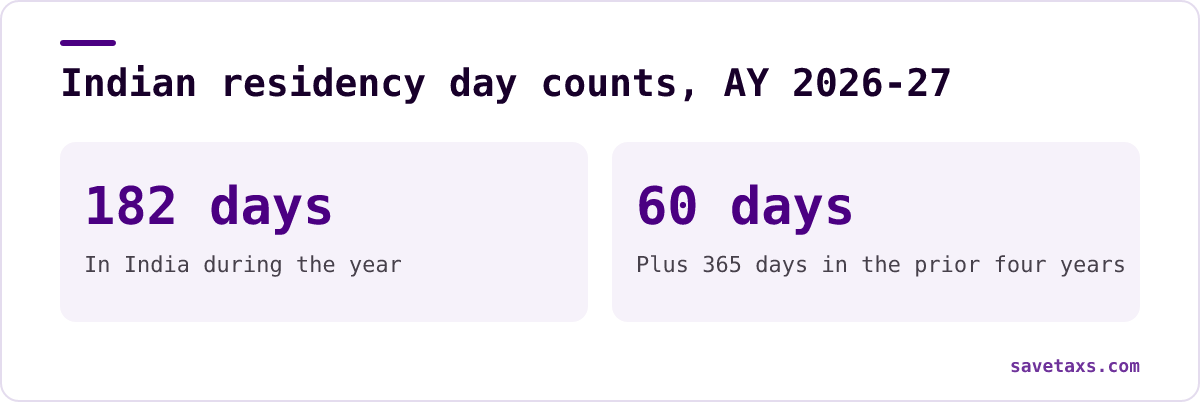
For the Indian assessment year AY 2026-27, you're resident in India under Section 6 if you were in India for 182 days or more during the year, or for 60 days or more during the year and 365 days or more during the four years before it. For Indian citizens and persons of Indian origin visiting India, that 60-day test is replaced by 182 days, and by 120 days in some cases.
A resident pays Indian tax on worldwide income, so your US pay goes on the Indian return. A non-resident is taxed only on income earned or received in India, and the US pay stays off. The Indian year runs April to March, so a US salary year is split across two Indian years.
Example: Meera Iyer, a protein chemistry postdoc now living in Madison, Wisconsin, left Pune and arrived in the US on November 15, 2025. She was in India from 1 April 2025 to 14 November 2025, which is 228 days, and from her arrival to 31 March 2026 she earned $36,500 in university salary with US tax withheld. She assumed that moving abroad made her an NRI and planned to leave the US salary off her Indian return. What she has to settle is her Indian residential status for FY 2025-26 (AY 2026-27). Section 6 makes her resident because she spent 182 days or more in India during the year, and 228 days clears that on its own. So the $36,500 belongs on her Indian return, and leaving it off would understate her income and leave her with no claim on record for the US tax already withheld from it.
If you are an Indian resident who paid US tax, check the applicable Indian foreign-tax-credit rules for the same income. You claim it by filing the prescribed foreign tax credit statement with the Income Tax Department alongside your return, backed by proof of the US tax paid. File that statement with your return, not after it.
A foreign tax credit is relief for tax paid twice. A treaty exemption works differently: it stops the income being taxed in one of the countries at all. When you rely on a treaty position in India, you'll need a tax residency certificate from the country where you're resident, plus a prescribed self-declaration with the details the certificate doesn't cover. When you're an Indian resident filing from the US, SaveTaxs can prepare and file your Indian income-tax return with the US income and the credit claim set out correctly.
Keep one folder per tax year that covers both countries, because the US return and the Indian return draw on overlapping records and different years.
Your US and Indian deadlines don't line up. Your US return covers the calendar year and is due in the spring that follows. Your Indian return covers April to March and falls due later in the year after the financial year ends. Put both dates in your calendar the day you collect your US statements for the year.
Bring in a cross-border tax professional when your exempt years are ending, when you've switched visa or status, when you're claiming a treaty exemption, or when you have income in both countries in the same year.
Before you open any form, list every year you've spent in the US on a J or F visa. That list tells you whether you're still exempt, which return you file and whether Form 8843 is still needed. If your PhD or an earlier exchange was in the US, expect your exempt period to be shorter than you think. Then count your days in India for the financial year, because passing India's residency day count puts your US pay on your Indian return as well.
This article is for general informational purposes only and does not constitute tax, legal, financial, or investment advice. Laws, regulations, rates, and procedures may change over time and may vary based on individual circumstances.
While SaveTaxs makes reasonable efforts to keep the information accurate and up to date, readers should verify applicable rules with official authorities or consult a qualified professional before making decisions based on this information.
How we write and review our articles: Editorial Standards

Want to read more? Explore Blogs
Yes. In a year when you're an exempt individual and had no US income, Form 8843 is the only federal form you file. It isn't a tax return and claims no refund. It's a signed statement explaining why your US days are excluded from the residency count. When you did have US income, you attach it to your return instead.
Yes, but only through your US return. Payroll stops withholding on treaty-exempt pay when you give it Form 8233 before the money goes out. Once tax has been withheld, you name the treaty article and the exempt amount on your return and wait for the refund, which takes months. Giving payroll the form early avoids that wait.
No, not on its own. US tax residency comes from the day-count test, not from your visa label. What changes is whether your days keep being excluded. Once you're no longer an exempt individual, your US days count, and if you pass the test you're a resident alien for that year, with special rules for the year you switch.
No. Form 8843 is a signed statement that backs up your day count by explaining why days of US presence are excluded, for example because you were an exempt individual. It doesn't report income or claim a refund. You still file a nonresident income-tax return for any year you had US income, and attach Form 8843 to it.
You are if you spent 182 days or more in India during that financial year. A researcher in India from 1 April to mid-November has already passed that mark, so US pay earned before 31 March goes on the Indian return for that year, with a credit claimed for the US tax withheld. With fewer days in India, the other Section 6 tests and their exceptions decide it.