US Tax Filing and Compliance
J-1 Visa Tax Filing for Indian Researchers: Form 8843 and Treaty
Written by SaveTaxs Editorial Team
An NRI living in India who inherits a US 401(k) or IRA should identify the account, beneficiary category, US tax status, and distribution deadline before requesting money. The inherited account is handled separately from later withdrawals, which can trigger US withholding and Indian tax reporting. The account type, owner's date of death, required beginning date status, and relationship to the owner determine distribution rules; your US tax status determines the payer forms and US filing requirements.
A non-spouse beneficiary in India who inherits a US retirement account generally follows inherited-account distribution rules rather than having to withdraw the money immediately.
Key points:
The answer also changes between a traditional account, a Roth account, and a 401(k) whose plan document may offer narrower distribution choices.
Start by obtaining the plan administrator's beneficiary packet and confirming whether the account is a traditional IRA, Roth IRA, 401(k), or another employer retirement plan. An inherited account is transferred or made payable to you after the owner's death; a later withdrawal is a separate distribution event.
Before requesting money, confirm:
For deaths in 2020 and later, an eligible designated beneficiary generally includes a surviving spouse, a minor child, a disabled or chronically ill individual, or an individual no more than 10 years younger than the owner. A designated beneficiary outside these categories is generally a non-eligible designated beneficiary.
Your Indian NRI status doesn't tell the payer your US tax status. You might be an Indian non-resident and still be a US citizen, green-card holder, or US resident alien. US nonresident aliens face different withholding and filing rules.
Check the 401(k) plan documents and administrator's beneficiary procedures before choosing a distribution method. Ask whether the plan permits an inherited-account transfer to an inherited account in your name, scheduled withdrawals, or a single payment. Don't request a full distribution until you know how the payer will classify you, what documents it needs, and when the account must be distributed.
The inherited-account schedule depends on the beneficiary's category and the owner's required-beginning-date status.
For a death in 2020 or later:
The 10-year rule generally requires the account to be fully distributed by December 31 of the tenth year following the owner's death. It doesn't require the same annual payment for every beneficiary. The owner's status at death and applicable IRS distribution rules determine whether annual payments are also required. The plan administrator's written options matter for a 401(k).
Traditional and Roth accounts have different tax treatment:
Example: Meera lives in Pune, India, and inherited her father's traditional IRA after his death on 18 March 2026. She is 35 years younger than him, isn't disabled or chronically ill, and isn't his spouse. She is not an eligible designated beneficiary, so the 10-year rule generally applies. The account must generally be fully distributed by 31 December 2036.
If her father had reached his required beginning date, annual required distributions may also apply. Meera can't simply retitle the account as her personal IRA. She must ask the administrator for the inherited-account options and applicable distribution requirements. Taking the entire balance immediately could also create a larger taxable distribution and withholding amount than scheduled withdrawals.
Confirm the required distribution schedule and address any missed distribution with the plan administrator and relevant tax advisers. The administrator's beneficiary packet should state the available schedule but might not explain the Indian consequences. Keep the death-date valuation, beneficiary designation, account statements, and every distribution calculation.
An inherited retirement account and its later distributions are separate tax matters in India. The tax treatment of receiving inherited property differs from the treatment of income arising from or distributed by the retirement account. For the broader inheritance question, see inheritance tax for an NRI in India.
The account type still matters after inheritance:
Your Indian residential status also matters. For tax year 2026-27, Section 6 of the Income-tax Act, 2025 determines residential status using applicable day-count tests, subject to special rules and exceptions. Section 5 sets out the scope of income:
For earlier income years, including FY 2025-26 (AY 2026-27), the Income-tax Act, 1961 applies. (Income-tax Act, 2025, Sections 5 and 6)
That status affects the Indian return and the income you must report. Keep the US distribution statement, the exchange-rate calculation used for the Indian return, the US tax withheld, and the account's basis records. Do not treat the inherited account statement as proof that no Indian income arose.
Example: Arjun lives in Hyderabad and receives a $40,000 distribution from an inherited traditional IRA on 12 September 2026. He is an Indian resident for tax year 2026-27 under the applicable residence tests, and the payer withholds $12,000 in US tax. The inherited label doesn't automatically make the payment tax-free in India. Arjun must classify the distribution under Indian rules based on his residential category and preserve the US withholding record for any eligible foreign-tax-credit claim.
A retirement-account distribution paid to a US nonresident alien is generally subject to 30% US federal income-tax withholding unless valid documentation establishes US-person status or an applicable lower treaty rate or exemption. The payer applies the withholding rules based on your documented US tax status, not simply because you live in India. Withholding is not necessarily the final tax liability.
Before payment, the payer generally needs the appropriate tax-status form:
Confirm with the payer which information return reports the distribution and any US tax withheld. A payer may issue Form 1099-R when the payment is documented and reported under US-person rules. Keep whichever form you receive and match it to the gross payment and tax withheld.
The US–India tax treaty treats periodic private pension payments differently from single lump-sum payments:
Treaty relief and domestic-law taxability are separate questions. A treaty claim might reduce US withholding on an eligible periodic payment, while Indian law might still tax the distribution. A foreign-tax credit may then address double taxation, subject to treaty and Indian credit limits. US citizens and residents must also consider the treaty's saving clause.
A US nonresident alien who receives a US retirement distribution might need to file Form 1040-NR, particularly when the payer withheld more tax than the final US liability or a refund is being claimed. A US citizen, green-card holder, or resident alien follows the applicable US resident return rules instead. Establish your US status before choosing the return.
Form W-8BEN, Form 1042-S, and Form 1099-R document the payer's position, but they don't settle the final tax. Compare the gross distribution, US tax withheld, and treaty position before filing.
That status and ownership of other foreign accounts also determine foreign-account reporting:
Foreign-tax-credit records must connect the US payment with the Indian income. Retain the payer statement, withholding certificate, treaty paperwork, bank receipt, exchange-rate working, and Indian return schedules. The credit isn't simply the amount shown as withheld; relief is subject to Article 25 and applicable domestic rules.
Before requesting a distribution, complete these steps:
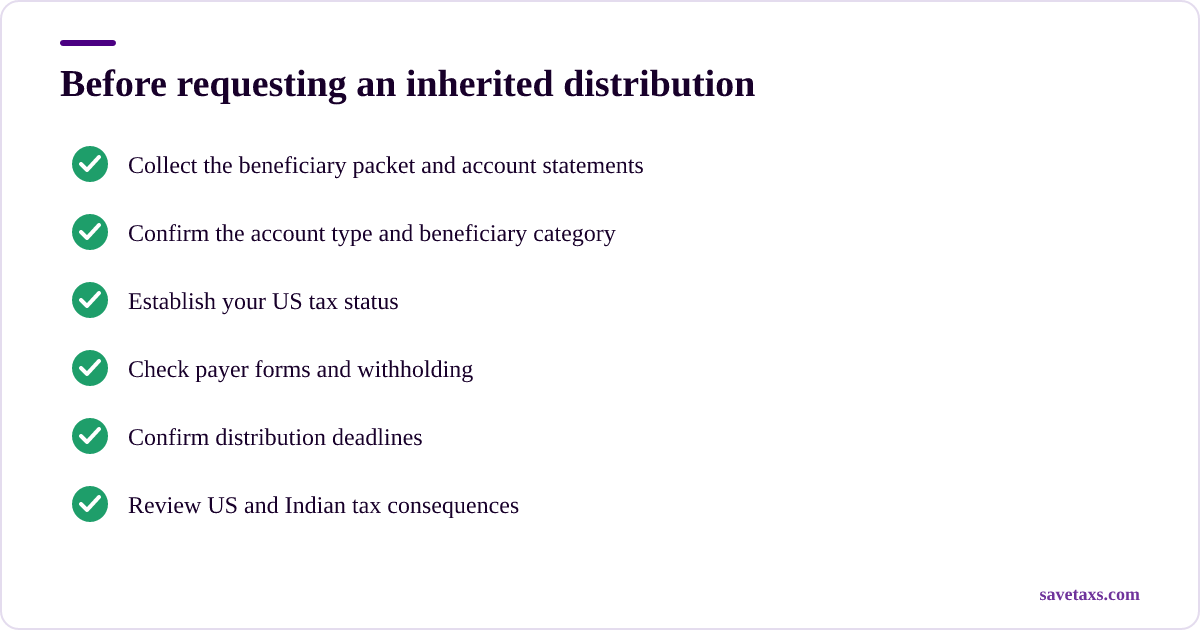
Keep every statement and withholding record for the US and Indian returns.
Seek professional review before payment when the balance is large or the payer can't explain its withholding position, particularly for a treaty claim, Indian foreign-tax credit, or residency question. Your first decision isn't simply whether to withdraw or wait. Verify the account, beneficiary category, tax status, and deadline, then choose a documented distribution schedule.
This article is for general informational purposes only and does not constitute tax, legal, financial, or investment advice. Laws, regulations, rates, and procedures may change over time and may vary based on individual circumstances.
While SaveTaxs makes reasonable efforts to keep the information accurate and up to date, readers should verify applicable rules with official authorities or consult a qualified professional before making decisions based on this information.

Want to read more? Explore Blogs
Yes, an inherited 401(k) or IRA may be transferred to an inherited account in the beneficiary’s name when the provider and applicable rules permit it. The beneficiary should not retitle the account as a personal IRA. Before moving assets, ask the administrator which inherited-account transfer method it permits and what beneficiary documents it requires.
Yes, the beneficiary may be able to leave the inherited account with the original US provider, but the available choices depend on the provider and, for a 401(k), the plan document. Request the beneficiary packet and ask whether the plan permits scheduled withdrawals, an inherited-account transfer, or a single payment before selecting an option.
No. An inherited 401(k) is not treated exactly like an inherited IRA because the employer plan may offer narrower distribution choices and its administrator’s procedures matter. Both accounts can be subject to inherited-account distribution rules, but the account type, plan document, beneficiary category, and owner’s required-beginning-date status can affect the available schedule.
No. The 10-year rule does not apply in the same way to every NRI beneficiary. For deaths in 2020 and later, a non-eligible designated beneficiary generally follows the 10-year rule, while an eligible designated beneficiary may generally use life-expectancy distributions. Annual payments may also depend on whether the owner died before or after the required beginning date.
Inheriting the account and receiving a later distribution are separate Indian tax questions. The inherited account itself should not be treated as proof that no Indian income arose. When money is distributed, the account type and your Indian residential category affect classification and reporting, and the US tax treatment does not automatically determine Indian treatment.