US Tax Filing and Compliance
Reporting Foreign Pension Accounts to the IRS
Written by Hatim Dudhiyawala
Foreign life insurance policies can create U.S. tax questions for Non-Resident Indians (NRIs), U.S. citizens, Green Card holders and other U.S. tax residents who own insurance policies issued outside the United States. For example, an Indian policyholder who moves to the U.S. may continue holding an endowment, whole-life, money-back or Unit Linked Insurance Plan (ULIP) policy in India.
However, a policy treated as life insurance under Indian law does not automatically receive the same tax treatment under U.S. federal law. Its legal structure, cash value, premium terms and benefits can affect how the IRS classifies it.
The U.S. tax consequences may arise when the policy accumulates cash value, is surrendered, reaches maturity or pays a death benefit. Some foreign cash-value policies may also create separate financial-account reporting obligations.
This guide explains how the U.S. taxes foreign life insurance policies and what NRIs and U.S. taxpayers should consider when retaining an Indian policy.
Foreign life insurance policies are not automatically tax-free or taxable in the United States. Their treatment depends on the policy structure, the type of benefit received and the policyholder's U.S. tax status.
U.S. citizens and U.S. tax residents generally report their worldwide income, including taxable income connected with foreign financial arrangements. Therefore, an NRI who becomes a U.S. tax resident may need to consider the U.S. tax treatment of an Indian life insurance policy even if the policy was purchased before moving to the United States.
For example, an Indian citizen who moves to the U.S. and becomes a U.S. tax resident may continue paying premiums on an Indian endowment policy. The fact that the policy was issued by an Indian insurer does not, by itself, determine how the IRS will treat its cash value or future proceeds.
No. Indian residential status and U.S. tax residency are separate legal concepts.
A person may be:
U.S. tax obligations depend on the person's U.S. tax status and the applicable rules for the relevant tax year. A nonresident alien generally does not have the same worldwide-income reporting obligations as a U.S. citizen or resident alien.
An Indian citizen who has moved to California and meets the U.S. substantial presence test may have U.S. tax obligations relating to an Indian cash-value policy. An Indian citizen who remains a nonresident alien for U.S. tax purposes will generally have a different U.S. tax position.
Understand the tax implications of your Indian life insurance policy.
The U.S. tax treatment depends on whether the policy qualifies as life insurance under U.S. federal tax law and what happens to the policy during the tax year.
Some foreign life insurance policies build cash value over time. Examples may include whole-life, endowment, money-back and certain investment-linked policies.
For U.S. tax purposes, the policy's classification is important. Under Internal Revenue Code Section 7702, a contract must be a life insurance contract under applicable law and satisfy either:
A policy's classification under Indian insurance law does not automatically establish that it meets these U.S. requirements.
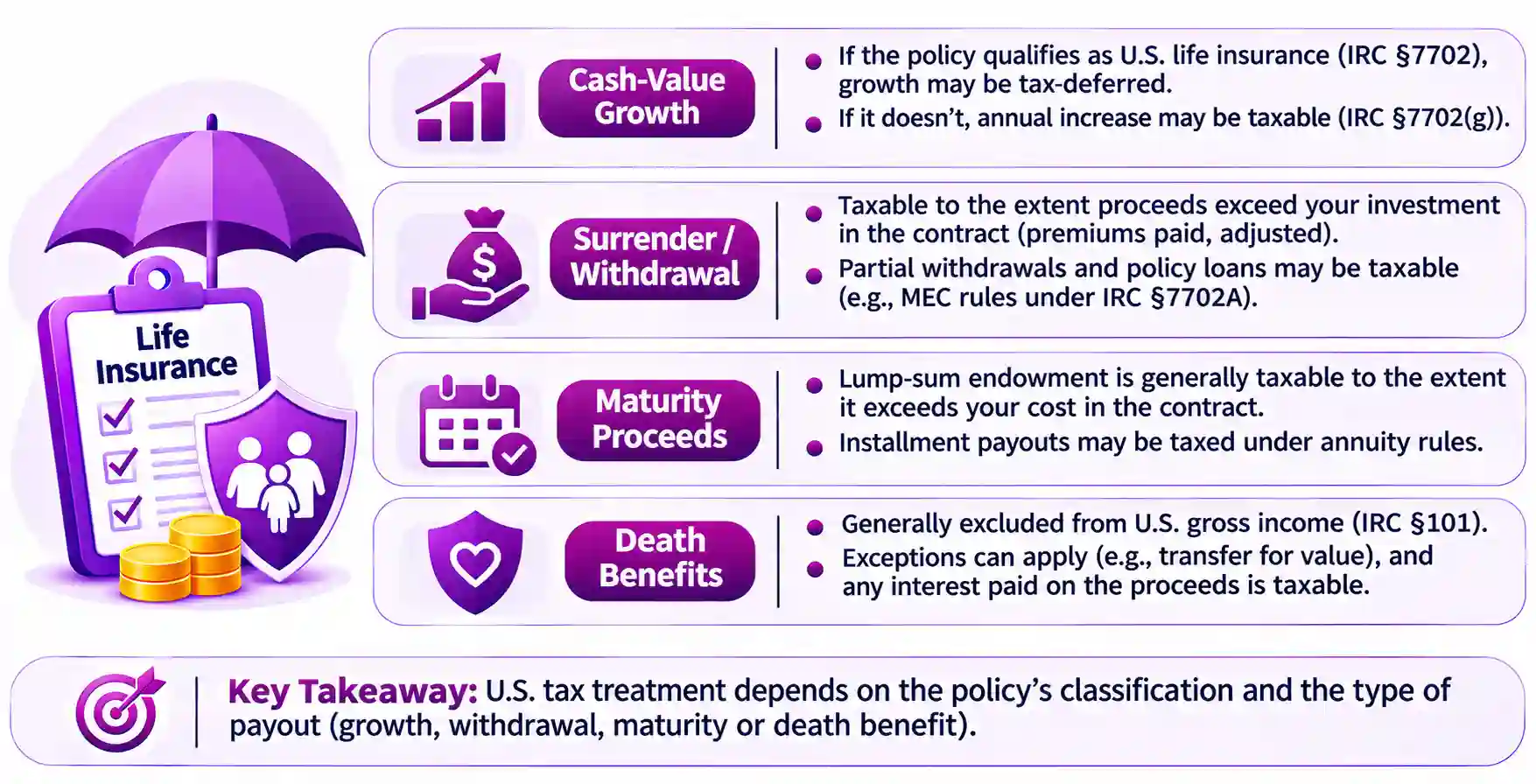
If a contract qualifies as life insurance under the relevant U.S. rules, increases in its cash value may generally receive tax-deferred treatment while the policy remains in force, subject to applicable distribution and other tax rules.
However, where a contract is treated as life insurance under applicable law but fails to satisfy the federal requirements of Section 7702, Section 7702(g) generally requires the policyholder to include the statutory income amount in ordinary income. The calculation takes account of changes in net surrender value, the cost of life insurance protection and premiums paid, as prescribed by the applicable rules. Certain variable contracts may also be subject to the investment diversification requirements of Section 817(h). Other nonqualifying arrangements require a separate classification review.
An NRI living in the U.S. owns an Indian whole-life policy with an investment component. The policy's cash value increases during the year. Before deciding whether that increase creates current U.S. taxable income, the policy's contractual terms and qualification under U.S. tax rules must be reviewed.
If a policyholder voluntarily terminates a life insurance policy and receives its cash surrender value, the amount received may be taxable to the extent it exceeds the policyholder's investment in the contract.
In general, the investment in the contract is based on premiums paid, adjusted for relevant amounts previously received tax-free, refunded premiums, dividends and certain policy loans.
Suppose a U.S. tax resident owns an Indian life insurance policy with the following figures:
| Particulars | Amount |
|---|---|
| Total premiums paid | $30,000 |
| Adjusted investment in the contract | $30,000 |
| Cash surrender proceeds | $38,000 |
| Potential excess over investment | $8,000 |
The potential taxable amount is $8,000, subject to the policy's actual U.S. tax classification, adjustments and applicable rules.
This is an illustration, not a determination of the taxable amount for every foreign policy. The calculation may be different where the policy has received prior distributions, dividends, loans or other adjustments.
Partial withdrawals and policy loans should also be reviewed separately. A contract may qualify as life insurance under Section 7702 but still be classified as a Modified Endowment Contract (MEC) under Section 7702A. MEC distributions and certain policy loans may be taxable under income-first rules, and an additional 10% tax may apply in some circumstances under Section 72(v), subject to applicable exceptions. Non-MEC policies may receive different treatment.
Some Indian life insurance policies, particularly endowment and money-back plans, provide benefits at a specified maturity date.
For U.S. tax purposes, a lump-sum endowment payment is generally taxable to the extent it exceeds the policyholder's cost in the contract. The cost calculation must account for amounts previously received and excluded from income.
If the policyholder elects to receive qualifying endowment proceeds in installments instead of a lump sum, the payments may be subject to annuity tax rules. The timing and terms of the election can matter.
An NRI living in Texas receives maturity proceeds from an Indian endowment policy. The policyholder should not assume that the entire payment is exempt merely because the proceeds qualify for an exemption under Indian tax law. The U.S. tax calculation must be performed independently.
Life insurance proceeds received by a beneficiary because of the insured person's death are generally excluded from U.S. gross income under Section 101 of the Internal Revenue Code.
However, certain exceptions can apply, including situations involving a transfer of the policy for valuable consideration or a reportable policy sale. Interest paid on life insurance proceeds is generally taxable even when the underlying death benefit is excluded.
An NRI living in the U.S. is the beneficiary of an Indian life insurance policy after the insured person dies. The death benefit may generally qualify for the U.S. income-tax exclusion, but any interest paid on delayed or installment proceeds may be taxable.
The beneficiary should retain the policy documents, claim statement, payment details and supporting records to establish the nature of the amount received.
Indian life insurance policies can have different contractual structures. Their Indian names and tax treatment do not automatically determine their U.S. federal tax classification.
The following examples explain the issues that may need review.
| Indian policy type | U.S. tax considerations |
|---|---|
| Term life insurance | A pure protection policy may have no cash value. Death-benefit treatment should be assessed under the applicable U.S. rules. |
| Whole-life insurance | Review the policy's cash-value structure and whether it satisfies U.S. life insurance qualification requirements. |
| Endowment policy | Review annual cash-value treatment, maturity proceeds and the policy's U.S. tax classification. |
| Money-back policy | Assess periodic survival benefits and the policy's adjusted investment in the contract. |
| ULIP | Review the legal structure, underlying investment arrangements and potential foreign investment fund or PFIC implications. |
An Indian life insurance policy may qualify for favorable tax treatment under the applicable Indian income-tax law, including Section 10(10D) of the Income-tax Act, 1961 for relevant earlier tax periods. That Indian tax treatment does not automatically establish an exemption under U.S. federal tax law.
A ULIP may combine insurance protection with investments in underlying funds. Its U.S. tax treatment depends on the policy's legal structure, qualification under U.S. insurance rules, investment diversification and the policyholder's rights over the underlying assets. PFIC implications may arise depending on the actual ownership and classification of the investments. Holding a ULIP does not automatically mean that the policyholder directly owns the underlying funds.
Not every ULIP is automatically a PFIC. The policy documents, ownership rights and investment structure must be reviewed before reaching a conclusion.
NRIs and U.S. taxpayers should retain:
These documents can help establish the policy's legal structure, investment in the contract, cash value and taxable proceeds.
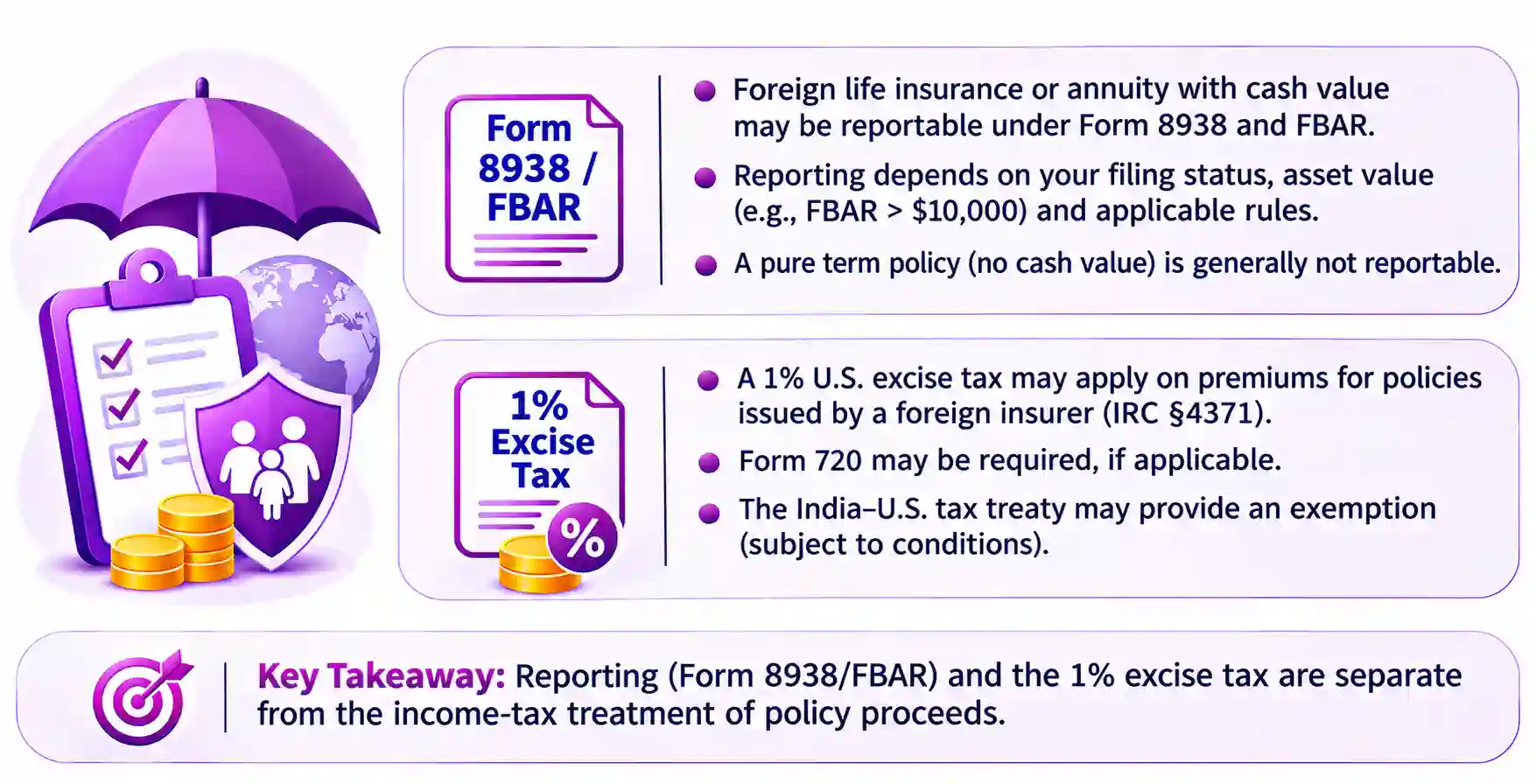
Taxation and financial-asset reporting are separate matters.
The IRS identifies foreign-issued life insurance or annuity contracts with cash value as potentially reportable under both Form 8938 and FBAR. Form 8938 reporting depends on the taxpayer's filing status, residence and total specified foreign financial assets. FBAR generally applies when the aggregate value of reportable foreign financial accounts exceeds $10,000 at any time during the calendar year. Each form has separate definitions, filing requirements and exceptions.
A pure term policy without cash value should not automatically be treated in the same way as a foreign cash-value policy.
For detailed filing requirements, read our guides:
These guides explain reporting obligations. They do not replace the separate analysis required to determine how a foreign policy is taxed.
Certain premiums paid on life insurance policies issued by foreign insurers may be subject to a 1% U.S. federal excise tax under Section 4371, subject to applicable statutory exceptions and treaty provisions. Depending on the circumstances, Form 720 filing and payment obligations may arise.
The India–U.S. income tax treaty may provide an exemption from this excise tax where the applicable conditions are satisfied. Therefore, premiums paid on an Indian life insurance policy should not automatically be treated as subject to the 1% tax without reviewing the insurer, policy and treaty eligibility.
This tax is separate from the income-tax treatment of policy proceeds and foreign financial account reporting.
Get expert guidance on your India–U.S. tax obligations.
Owning an Indian life insurance policy while living in the United States can involve more than checking whether the policy is tax-exempt in India. U.S. tax treatment depends on the contract's legal structure, qualification under federal tax rules, cash-value growth and the nature of any surrender, maturity or death-benefit proceeds.
NRIs, U.S. citizens, Green Card holders and other U.S. tax residents should review their foreign policies before surrendering them, receiving maturity benefits or filing their U.S. tax returns. A policy-specific review can help identify potential income-tax consequences and separate financial reporting obligations.
SaveTaxs helps individuals with India–U.S. financial connections understand cross-border tax considerations, review foreign financial assets and identify relevant U.S. and Indian compliance requirements.
This article is for general informational purposes only and does not constitute tax, legal, financial, or investment advice. Laws, regulations, rates, and procedures may change over time and may vary based on individual circumstances.
While SaveTaxs makes reasonable efforts to keep the information accurate and up to date, readers should verify applicable rules with official authorities or consult a qualified professional before making decisions based on this information.

Want to read more? Explore Blogs