NRIs in the evolving global investment landscape, while handling regulatory challenges, are seeking innovative ways to grow their wealth. One such opportunity that has gained significant attention is the rise of GIFT City AIF funds for NRIs. It especially gained traction after the introduction of the SEBI Alternative Investment Funds Regulations, 2012, followed by the development of a dedicated IFSC regulatory framework that enabled offshore-style fund structures within India. This also led to the expansion of AIFs within the International Financial Services Centre (IFSC).
With GIFT City bringing AIF funds into the spotlight, they are now playing an essential role in diversifying NRI investment portfolios, supporting entrepreneurial projects, and attracting global capital. Further, supported by GIFT City's strategic initiatives and regulatory framework, these funds have positioned themselves at the forefront of India's evolving investment landscape.
With this blog, explore the scope of GIFT City AIF Funds for NRIs, their benefits, how they operate, and their tax treatment.
Key Takeaways
- GIFT City AIF funds play a vital role in fostering entrepreneurial projects, diversifying investment portfolios, and attracting global capital.
- GIFT City AIF funds are primarily regulated by IFSCA (International Financial Services Centres Authority) under a unified IFSC framework, significantly reducing—though not entirely eliminating—the need for multiple domestic regulatory touchpoints such as RBI and SEBI.
- Provide access to diversified portfolios, including Indian infrastructure, private equity, startups, and real estate.
- The minimum ticket size for AIF fund investors in GIFT City is generally USD 150,000.
- Offers several structure-dependent tax efficiencies, such as potential withholding relief, selective capital gains exemptions, specified IFSC tax incentives, and DTAA benefits.
What are GIFT City AIF Funds for NRIs?
Alternative Investment Funds (AIFs) are privately pooled investments that invest in non-traditional assets like venture capital, private equity, and hedge funds. Although it looks like a mutual fund, the key difference is that these funds focus more on non-traditional assets. Additionally, they explore more complex and diverse investment strategies.
Considering this, GIFT City (Gujarat International Finance Tec-City) AIF funds are established in the GIFT IFSC (International Financial Services Centre) and regulated by the International Financial Services Centres Authority (IFSCA) under the IFSC fund management framework.
These funds pool capital from institutional and individual investors, including NRIs and foreign investors. AIFs at GIFT City generally cater to High Net Worth Individuals (HNIs), ultra HNIs, family offices, corporates, and institutional investors, with relatively high minimum commitment thresholds that vary depending on the scheme structure and investor category, typically starting around USD 150,000.
This was all about GIFT City Alternative Investment Funds (AIFs). Moving ahead, let's know the different types of AIFs and how they operate in GIFT IFSC.
Tax Assistance for NRIs in India
With Savetaxs, fulfill your tax obligations on time without any issue and maximize your refunds.
Types of AIFs Funds
In GIFT City, with variations based on their structure and remittance route, AIFs are structured to invest in securities denominated in USD ($). Considering this, structured-wise, they can be classified into three categories. Further, these funds are also segmented according to the remittance mode.
Structure-Wise
Structure-wise, there are three different types of AIFs. These are:
- Category I: The first category AIFs invest in sectors that are economically or socially desirable. For instance, SMEs, social ventures, startups, green energy, or infrastructure. Here, investors enjoy several tax and regulatory benefits.
- Category II: This AIF investment category includes debt funds, equity funds, real estate, Fund of Funds (FoF), and other schemes. Many of these funds do not take complex trading or undertake leverage strategies.
- Category III: It focuses on deploying and leveraging complex strategies. It includes investments such as high-frequency trading, hedge funds, and long-short funds. Additionally, the category III aims for short-term investment returns and can also invest in listed or unlisted derivatives.
Remittance Route
Under the remittance route, AIFs in GIFT City involve outbound and inbound investments. From an NRI investor perspective, these funds can also be understood based on where the capital is ultimately deployed—India-focused IFSC AIFs that invest in India-linked opportunities, and global/offshore IFSC AIFs that allocate capital to overseas securities and international markets.
- Inbound AIFs: These are AIFs where NRIs or foreign investors via the GIFT City route channel capital into India. In simple terms, the main investment source is in USD. Considering this, many inbound AIFs enable investments in Indian mutual funds, listed shares, and similar assets. Further, benefiting from a liberalized tax and regulatory framework, the invested capital is deployed into Indian assets or markets.
- Outbound AIFs: Outbound AIFs through the Liberalized Remittance Scheme (LRS) allow resident Indians to invest outside India. Here, GIFT City works as a way for the Indian capital to be invested in the international market through a regulated fund structure. With these funds, you can invest in foreign securities, offshore shares, US ETFs, global emerging markets, US markets, and more.
These are the different types of GIFT City AIF Funds for NRIs in India. Moving further, let's know the benefits of these funds for NRIs.
Benefits of GIFT City AIF Funds for NRIs?
Here are some of the key benefits of AIFs in GIFT City for NRIs:
- Lower Operational Cost: GIFT City provides a cost-effective environment to NRI AIF investors. It reduced the compliance burden and does not charge any GST on the IFSC fund's management fees. Additionally, it provides access to shared infrastructure, which further helps lower fund setup and administration fees.
- Seamless Global Access: GIFT City serves as a global gateway for both resident Indian and NRI investors. NRIs can invest in venture capital, private equity, and infrastructure, which are often not accessible through direct stock and listed equity mutual funds.
- Tax Efficiency: The most popular benefit of GIFT City AIF funds is the tax efficiency available to investors. Subject to the fund qualifying as a specified IFSC fund and meeting applicable statutory conditions, certain income attributable to non-resident investors may enjoy exemption or a significant reduction in Indian tax incidence, including potential concessional withholding, treaty efficiency, and specified exemptions depending on the structure. Considering this, income earned by Category III AIFs from trading in securities is often tax-efficient for NRIs. It may include:
- Potentially lower withholding exposure in certain structures
- Favourable capital gains treatment subject to asset class and fund qualification
- Specified IFSC-linked tax incentives available to eligible fund structures
- Double Taxation Avoidance Agreement (DTAA) benefits
- Enhanced Investor Protection: GIFT City AIF funds are regulated under the IFSCA framework. It provides transparency in global practices and ensures investor-friendly norms and disclosure.
- Better Liquidity and Repatriation Flow: GIFT IFSC supports cross-border settlement and foreign-currency accounts. It further simplifies the inflow and repatriation of capital for NRI investors.
- Deeper Diversification: AIFs complement NRIs' existing portfolios by providing exposure to unlisted securities, private markets, and niche strategies not available in mainstream mutual funds.
Moreover, for NRIs exploring beyond Indian equity funds or NRE FD, GIFT City AIF funds offer a structured investment way while staying compliant within a SEBI-supervised, regulated ecosystem.
Now moving forward, let's know how these funds work for NRI investors.
How GIFT City AIF Funds Work for NRI Investors?
The GIFT City AIF Funds for NRIs, from subscription to exit, follow a multiple-step process:
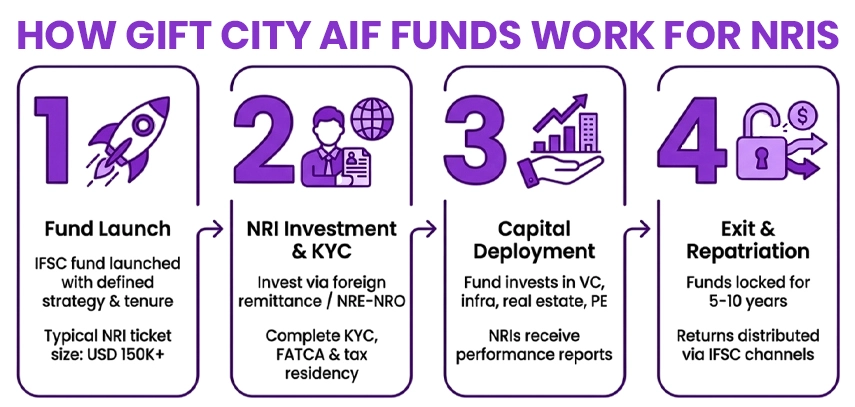
- Fund Structure and Launch
- An IFSC-domiciled AIF is launched by an IFSCA-registered/authorized fund management entity (often a private equity firm or an asset management firm) at GIFT City. It specifies the investment strategy, for instance, venture capital, infrastructure, or distressed assets.
- Additionally, the fund with a defined tenure (5-10 years) is closed-ended and has a minimum ticket size, typically between USD 150,000 - USD 250,000 or equivalent for NRIs.
- NRI Subscription and KYC
- Through foreign currency remittances or NRE/ NRO accounts, NRIs can subscribe to AIF units.
- Apart from this, before investment, NRIs need to provide complete KYC, FATCA/CRS declaration, and tax residency information to the fund manager or investment intermediary.
- Portfolio Construction and Deployment
- With the stated strategy, the AIF sponsor deploys capital in line. For instance, infrastructure projects, funding start-ups, or stressed real-estate assets.
- Apart from this, generally, NRIs receive updates and periodic reports on portfolio performance, realized/unrealized returns, and sector exposure.
- Holding Period and Exit
- NRIs for the defined AIF tenure, lock-in funds. Considering this, early Exit or fund redemptions are limited or subject to penalties.
- On exits, returns are distributed in the specified currency (depending on the fund structure, often USD or INR). Additionally, funds are repatriated via IFSC-linked channels.
Further, for NRIs, it means:
- Invested capital is committed for several years.
- Investment returns are generally a combination of capital appreciation and sometimes distribution-linked income depending on the underlying asset class.
- Suitability depends on liquidity needs, investment horizon, and risk tolerance.
So this is how GIFT City AIF Funds work for NRI investors in India. Moving ahead, let's know the tax treatment of these funds for NRIs.
Tax Treatment of GIFT City AIF Funds for NRIs
The tax treatment of AIF funds for NRIs varies by category and also depends on whether the fund qualifies as a specified IFSC fund under applicable regulations. Considering this:
- Taxability depends on the character of income, fund structure, underlying investments, and availability of specific IFSC exemptions under the Income Tax Act.
- Business income from Category I, II, and III AIFs is taxed at the fund level or in accordance with the specific tax pass-through provisions applicable to that category.
- Capital gains, interest, and dividends, at the investor level (i.e., pass-through), may apply subject to the relevant statutory framework and fund classification.
To give you an idea, the table below outlines the tax treatment of AIF funds in GIFT City for NRIs.
| Category |
Tax Benefits for NRIs |
| Category I & II AIFs |
- NRIs can avail of pass-through taxation (except business income)
- Capital loss can be claimed if units are held for 12 months or more (as per set-off rules)
- Tax-efficient income distribution depending on source of income
- Conditional relief on withholding tax, PAN, or return filing in specified cases
- Tax treaty (DTAA) benefits available
|
| Category III AIFs |
- NRIs can avail of tax benefits depending on income type and IFSC provisions
- Certain income may qualify for exemption or reduced tax rates (subject to conditions)
- Capital gains on eligible AIF units may be exempt (if conditions are met)
- Conditional relaxation in PAN and income tax return filing requirements
|
Furthermore, subject to specified IFSC fund conditions, NRIs may be exempt from paying tax on certain income generated from AIF funds or on the transfer of eligible units. However, the exact tax result always depends on the fund's legal structure, the source of income, the residency of the investor, and the applicable DTAA position.
Simply Invest in GIFT City AIF Funds
At Savetaxs, our financial experts provide you with complete consultation on GIFT City AIF funds-related matters.
Final Thoughts
Lastly, over the years, AIFs have turned out to be a good investment opportunity for investors. Ranging from venture capital to private equity funds to offshore investments overseas, it covers several assets. Additionally, GIFT City funds for NRIs offer several tax benefits and help them diversify their investment portfolios beyond fixed deposits and traditional equities into growth-oriented segments of the Indian market.
Furthermore, if you need assistance in registering or evaluating investment participation in an AIF in GIFT City, connect with Savetaxs. The experts in our team will guide you at every step of the process and help you in choosing the fund as per your financial goals and risk appetite.





_1781845771869.webp&w=828&q=75)
_1778936280179.webp&w=828&q=75)
_1778936089630.webp&w=828&q=75)