



Investment & Financial Planning
FCNR Deposit Interest Rates in 2026FCNR Deposit Interest Rates in 2026
Written by Vipul Jain

_1778676620943.webp&w=3840&q=75)
For both NRIs and residents, gold always remains a safer investment option for money, specifically when the financial market is not stable. However, in 2026, the choice between gold and stock investments depends on whether you want to protect or grow your wealth. While stocks are a good investment option for growing long-term wealth in the expanding economy of India.
Are you also confused between gold and stock investment options for NRIs in India? To help you out, this blog provides you with complete information about these investment options. So read on and clear all your doubts.
Gold investments include the purchase of physical gold (jewelry, bars, coins) or digital gold investments (mutual funds, ETFs, and independent bonds). During economic uncertainties, often holding value, this investment option is considered a protective asset. Additionally, it holds a deep cultural and financial significance for Indian families across generations. Even for NRIs living thousands of miles away from India, gold is one of the most reliable investments during economic uncertainty.
Gold often attracts investors when they are worried about currency weakness, inflation, or global uncertainty. It also performs well when the real interest rates fall or when the market looks for safety. In short, when everything looks uncertain, this investment option often acts as a financial anchor.
However, for long-term wealth, gold is not a good investment option. It is because it does not provide you with any income, and for years, the price of it can stay flat. Considering this, compared to other investments, relying solely on gold yields low returns.
This was all about gold investment for NRIs. Moving ahead, let's look at stock investment for NRIs.
While the gold keeps your money safe, stocks are designed to multiply it. Having stocks by your side, you own a piece of the most successful business in India. Stock market investment includes buying shares of companies, which provide potential dividends and capital. Generally, they are costlier but offer higher returns on investments.
Considering this, the stock market of India has provided strong long-term returns with the Nifty 50 and Sensex growing significantly over the past two decades, showcasing the expanding economy of the country. Additionally, equities have the strong ability to outpace inflation over time.
However, these investment options come with significantly higher short-term volatility. Apart from this, global recessions, market downturns, and sector-specific disruptions can provide significant temporary losses to investors.
Further, there are two ways NRIs can invest in Indian stocks. These are as follows:
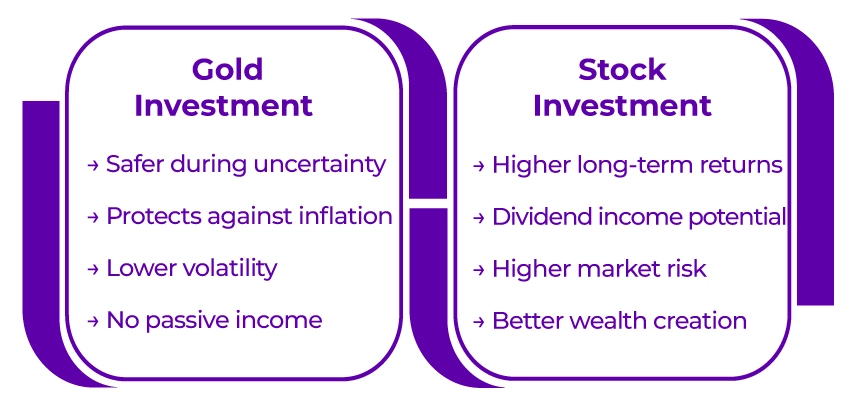
So this was all about stock investment for NRIs in India. Moving further, let's take a quick overview of both the investment options through a comparison table.
The table below showcases the key differences between gold and stock investments for NRIs in India:
|
Factor |
Gold |
Stocks |
|---|---|---|
|
Primary Purpose |
Wealth protection |
Wealth growth |
|
Return Potential |
Moderate |
High (long-term) |
|
Risk Level |
Lower |
Higher |
|
Regular Income |
None |
Possible (dividends) |
|
Inflation Protection |
Strong |
Good over the long term |
|
Volatility |
Comparatively low |
High |
|
Liquidity |
High (ETFs/ stocks) |
High |
|
Ideal Time Horizon |
Medium to long |
Long-term (5+ years) |
|
Ideal Market Condition |
Uncertainty/ crisis |
Economic growth |
|
Passive Income |
No |
Yes (dividends) |
This is how stock market investment differs from gold investment for investors. Moving forward, let's look at how these NRI investment options in India are taxed.
Taxation is one of the most frequently overlooked and consequential factors for NRIs when investing in India. It is because NRIs are obligated to pay taxes in both India and their country of residence. Additionally, it also impacts the post-return on investments.
This was about how NRI's gold and stock investments are taxed in India. Moving ahead, let's know the risk factors associated with these investments.
Here is the list of risk factors associated with gold and stock investments:
These are the key risk factors associated with gold and stock investments in India. Moving further, among the two, let's know which is the best investment option for NRIs in India.
Gold or stocks, both of these investments provide good results, given that you understand the market nature and features of these options. In terms of liquidity and return rates, Stocks generally offer stronger long-term growth potential, while both stocks and gold ETFs provide relatively high liquidity and better returns. However, gold investment for NRIs is an ideal option given market volatility and risk factors.
Here are some points that you can consider while investing in these:
Further, instead of choosing one option, many NRIs go for a balanced approach, i.e., investing in both gold and stocks, where gold provides them safety and stocks provide them higher returns in the long run.
Connect with Savetaxs and get CA-approved investment strategies as per your financial goals.
Lastly, both gold and stocks are the best investment options for NRIs. Gold offers stability, safety against uncertainty, and protection for purchasing power. In contrast, stocks provide compounding returns over time and the potential for passive income through dividends.
Further, choosing between the two investments depends entirely on your financial goals, time horizon, and risk appetite. Additionally, if you need any assistance in making the right investment decision, connect with Savetaxs. Our financial experts will help you pick the right investment based on your preferences and financial goals.
This article is for general informational purposes only and does not constitute tax, legal, financial, or investment advice. Laws, regulations, rates, and procedures may change over time and may vary based on individual circumstances.
While SaveTaxs makes reasonable efforts to keep the information accurate and up to date, readers should verify applicable rules with official authorities or consult a qualified professional before making decisions based on this information.
Vipul Jain is the Co-Founder of SaveTaxs and a tax expert with experience in Indian and NRI taxation. He advises individuals, NRIs, and businesses on tax filing, tax planning, capital gains, DTAA, and compliance matters. He focuses on making complex tax concepts simple and helping taxpayers make informed, compliant decisions. See Full Bio
Want to read more? Explore Blogs
_1781845771869.webp&w=828&q=75)
_1778936280179.webp&w=828&q=75)
_1778936089630.webp&w=828&q=75)