




Investment & Financial Planning
NRI Property Sale: How to Calculate Capital Gains TaxNRI Property Sale: How to Calculate Capital Gains Tax
Written by Shubham Jain
Being an NRI, returning to India after living for years in the US is exciting. However, you need to plan your US ETF portfolio carefully before boarding the flight. It is because of the change in your residential status, i.e., from NRI to an Indian resident, that your US ETF holdings face three distinct tax systems. It includes the US capital gains tax, the Indian capital gains tax, and the US estate tax. Missing any of them can cost you lakhs in unnecessary taxes.
"Do I exit US ETFs before moving to India is a good option in this case to avoid taxes?" This is the most common question for every NRI holding US ETFs. The answer to this question is quite tricky. You can exit US ETFs when you are a non-US resident alien in the US and an RNOR in India. However, apart from your residential status, when to quit your US investment also depends on another factor.
Want to know? This blog provides you with complete information on every dimension of that decision and whether you should hold this decision or not. So read on and get your answers.
NRIs living in the US prefer investing in US-listed ETFs (Exchange-traded funds) like the S&P 500 or the Nasdaq-100 as they are high-performing, simple, and low-cost vehicles to own top American companies. Additionally, these investments are structurally compelling.
Apart from this, with many broad-market funds charging as little as 0.03% annually, these investments also provide amazing expense efficiency. Compared to mutual funds that are actively managed, through exchange trading, US ETFs offer intraday liquidity that is significantly tax-efficient and provide access to the global equity market.
Furthermore, over a decade or more, returning NRIs held significant positions in these funds, often with substantial unrealised capital appreciation.
These are some of the key reasons NRIs investing in US ETFs while living there. Moving ahead, let's know the tax implications for them while leaving the US.
Under the expert guidance of Savetaxs, fulfill your tax obligations on time.
Before you move forward with Indian tax consequences, it is vital for you to first understand your tax position in the US. It is because the decisions made by you in the US framework shape your options after moving to India. Considering this, let's know about them in detail.
Like India, the capital gain taxation in the US also depends on the holding period, i.e., for how long you hold your ETFs in the US.
| Holding Period | Classification | Tax Rate | Possiblity |
|---|---|---|---|
| Less than 12 months | Short-term capital gain | Ordinary income rate, i.e., 10%-37% | 3.8% possibly |
| 12 months or more | Long-term capital gain | 0%, 15%, or 20%, depending on your income | 3.8% possibly |
Generally, most NRIs hold US ETFs for several years and later pay long-term capital gain tax rates on them. Additionally, for high-income taxpayers, including the Net Investment Income Tax (NIIT), the tax rate can reach 23.8%.
Before leaving the US, if you liquidate your ETF portfolio, you pay a known tax cost. However, exit it after relocation, you may still need to pay taxes as US-source assets can attract US taxation.
Furthermore, if you are giving away your US green card, under the IRS section 877A, IRS-covered expatriate rules may apply. Apart from this, it can trigger a deemed sale of global assets and create a big one-time tax liability. In this scenario, professional tax planning plays a vital role.
While you are a tax resident in the US, you qualify for paying dividend tax at concessional long-term capital gains rates. However, once your residential status in the US changes to a non-resident alien, you attract 30% withholding taxes on your dividends paid from US securities.
This tax rate, under the India-US DTAA generally reduced to 25% but is higher than the tax rates available to US residents.
Here is a checklist you can follow before moving to India with US investments.
| Pre-Departure Checklist for US ETF Holders | ||
|---|---|---|
| Item | Why It Matters | Action |
| Cost basis records | Need to determine capital gains | Download complete records from the broker |
| Unrealised capital gains/ losses | Assist in tax planning | Carefully reviews tax lots |
| End of tax residency date | Impacts final US filing | Confirm with the US CPA |
| Dividend reinvestment settings | Creates new purchase lots | Disable DRIP |
| Brokerage NRA update | Certifies correct withholding | Tell the broker about your residential status change |
This was all the US tax implications NRIs face before leaving the US. Moving further, let's know the Indian tax rules on US ETFs for NRIs and returning Indians.
The Indian tax law depends on the Residential Status of a person, i.e., the number of days you stayed in the country during a financial year. Considering this, according to section 6(1) of the Income Tax Act, during a financial year, if you stayed in the country for 182 or more days for that specific year, you become a tax resident in India if not you are considered an NRI.
Your residential status in India significantly impacts your tax obligations. It determines whether you will pay tax on your global income or only Indian-sourced income. Further, between NRI and resident and ordinarily resident (ROR), there lies a powerful residential status, i.e., Resident but Not Ordinarily Resident (RNOR). It applies:
Furthermore, for NRIs who lived overseas a decade or more, RNOR status generally lasts 2 to 3 financial years after moving to India. During this period, you are not liable to pay tax on your foreign income. It includes capital gains from selling US ETFs. For returning NRIs, this is the most valuable tax planning strategy.
Under section 6 of the Income Tax Act, 1961, as an NRI:
Considering this, as long as you hold NRI status in India, you are not liable to pay tax on the capital gains generated from your US ETF portfolio.
Once your RNOR status changes to ROR, upon your return, any US ETF held by you is taxed under a specific Indian tax framework. Considering this, Under Indian tax laws, US ETFs are generally classified as foreign unlisted securities rather than equity-oriented funds. This classification even applies to equity-heavy ETFs such as QQQ and VOO, which do not satisfy the 65% domestic Indian equity requirement.
In simple terms, once you become ROR, you are liable to pay tax on your global income, including dividends and capital gains from the US ETFs.
| Indian Tax on US ETF Gains- ROR Status | |||
|---|---|---|---|
| Holding Period | Gain Type | Indian tax Rate | Indexation |
| Less than 24 months | STCG | Slab rates | No |
| 24 months or more | LTCG | 12.50% | No |
Furthermore, it is advisable to plan your return wisely, considering your residential status in both India and the US. Instead of returning to India in August and trying to sell the US ETFs in November, when you hold RNOR status, which is good, however, for that time of the calendar year, you will still be considered a tax resident in the US. It is because you have stayed in the country for more than 183 days. Instead, wait till January for moving to India with US investments, where for that new calendar year, you are no longer a US tax resident.
This was all about Indian taxes on US ETFs after you become a full resident. Now moving forward, let's know what happens if you keep US ETFs after returning to India.
If you do not exit US ETFs before moving to India, and once your residential status from RNOR changes to ROR, you need to disclose your foreign assets to India. Considering this, report all your foreign bank accounts, ETF holdings, brokerage accounts, and other investments with no minimum value threshold in Schedule FA (Foreign Asset) when filing tax returns in India. Schedule FA follows a calendar year (January to December). To include these schedules, according to your source of income, you need to file ITR-2 or ITR-3.
Under the Black Money Act, 2015, it is mandatory for all Indian residents to mention their foreign assets in Schedule FA, non-discloure considred a criminal offence. Penalties include INR 10,00,000 per assessment year, in addition to a potential imprisonment of 6 months to 7 years. Additionally, if you are a US individual with a green card, you need to fulfill your FBAR filing obligations till you surrender the card to USCIS.
Apart from this, if you hold US ETFs after returning to India and transfer them to your heirs, you face up to 40% US estate tax. This tax is imposed on amounts more than $60,000. While US citizens get a $15 million tax exemption, non-resident aliens get only a $60,000 tax exemption.
After returning to India, if you plan to hold any long-term US investment, shift from US-domiciled ETFs to Ireland-domiciled UCITS ETFs. In this, you get market exposure without the risk of estate tax.
Upon returning to India, NRIs are not allowed to hold their NRE account. According to FEMA regulations, within 30 days of your return to India, you need to convert your NRE account to either a resident savings account or an RFC (Resident Foreign Currency) account. With RFC accounts during your RNOR status, you can preserve your foreign currency exposure and enjoy tax-free interest.
Additionally, you can hold the NRE fixed deposit account till its maturity and redesignate your NRO account to a resident account. Non-compliance with FEMA rules attracts penalties of up to 300% of the involved amount. Furthermore, under section 6(4) of FEMA, you can legally continue your US brokerage account.
So this is how India taxes U.S. ETFs after you become a full resident. Moving ahead, let's know whether you should sell, hold, or transfer your US ETFs.
Well, this question does not have a proper answer. Whether you want to sell, hold, or transfer your US ETFs depends on the right approach, i.e.,
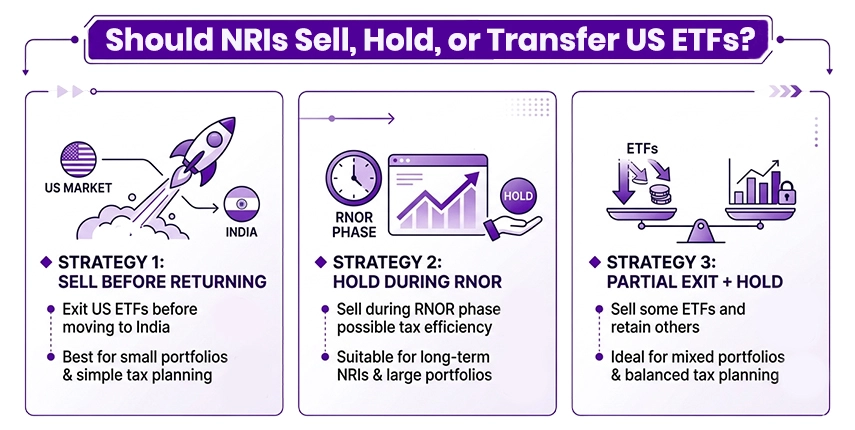
Considering this, here are some strategies you can consider.
So, whether you want to sell, hold, or transfer your US ETFs, it completely depends on your investment portfolio and tax bracket. Moving further, let's know about the DTAA relief and foreign tax credit for NRIs.
With the Double Taxation Avoidance Agreement (DTAA) between India and the US, you can prevent yourself from paying all taxes twice. Under section 90, the foreign tax credit mechanism allows you to offset your US withholding taxes with your tax obligations in India.
To claim the tax credit, you need to fill out Form 67 before or along with your tax return in India. Non-compliance with it leads to not getting the foreign tax credit benefits.
Confused, how does DTAA help in reducing your tax obligations? Let's understand this with an example.
| Item | Amount |
|---|---|
| LTCG on US ETF | INR 20,00,000 |
| US tax paid | INR 3,00,000 |
| Indian tax obligation | INR 2,50,000 |
| FTC Allowed | INR 2,50,000 |
| Excess US tax | INR 50,000 |
This was all about DTAA relief and FTC for NRIs in India.
With Savetaxs, from tax planning to filing and deductions, experts handle everything for you.
Lastly, the answer to the question, "Should you exit US ETFs before moving to India?" for long-term NRIs is often not to liquidate immediately before returning. Instead, it is advisable to strategically use their RNOR status to reduce or even eliminate India tax exposure on US ETF gains. However, NRIs with smaller portfolios and limited RNOR benefits can prefer to exit US ETFs before moving to India. This decision completely depends on your residential status, investment portfolio, and tax bracket.
Furthermore, if you are looking for a qualified cross-border tax professional to help you out with investment and tax planning in India, connect with Savetaxs. Our financial experts will help you optimise the transitions and prevent you from paying unnecessary taxes.
This article is for general informational purposes only and does not constitute tax, legal, financial, or investment advice. Laws, regulations, rates, and procedures may change over time and may vary based on individual circumstances.
While SaveTaxs makes reasonable efforts to keep the information accurate and up to date, readers should verify applicable rules with official authorities or consult a qualified professional before making decisions based on this information.
Vipul Jain is the Co-Founder of SaveTaxs and a tax expert with experience in Indian and NRI taxation. He advises individuals, NRIs, and businesses on tax filing, tax planning, capital gains, DTAA, and compliance matters. He focuses on making complex tax concepts simple and helping taxpayers make informed, compliant decisions. See Full Bio
Want to read more? Explore Blogs
_1781845771869.webp&w=828&q=75)
_1778936280179.webp&w=828&q=75)