
NRI Income Tax Compliance
How to Claim Excess TDS Refund After Selling Property in India as an NRIHow to Claim Excess TDS Refund After Selling Property in India as an NRI
Written by Shubham Jain

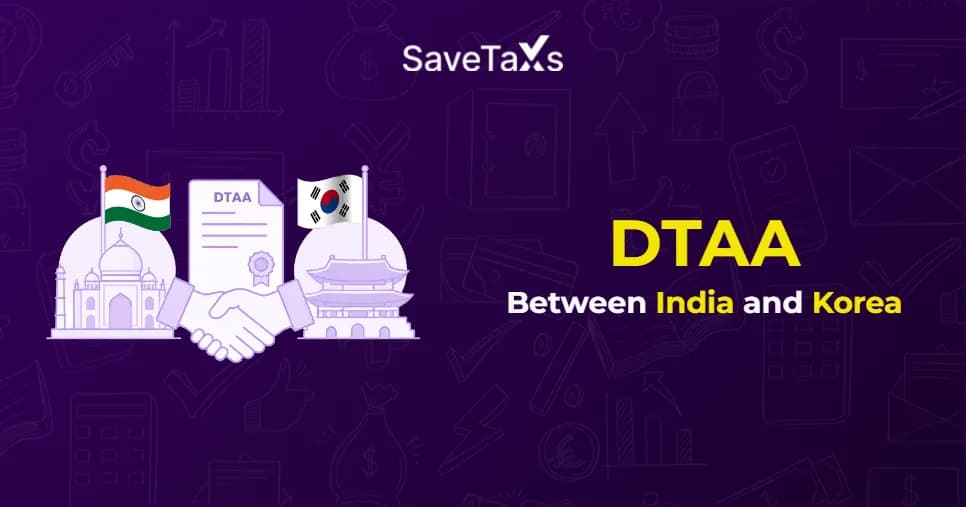
Like other DTAA agreements, the India-Korea DTAA also provides relief from double taxation on the same income to taxpayers. The agreement applies to Indian residents, Korean residents, and NRIs. Through this agreement, you can claim tax credits for the taxes paid in one country in another country, certifying that the tax is paid effectively in one country.
Apart from this, the agreement also eliminates tax ambiguities and provides a clear framework for the taxation of cross-border technology, investment, and personnel transfers between India and Korea.
Want to know more about the double taxation avoidance agreement between India and Korea, and what things are revised in it? Read the blog and get your answers.
On May 18th, 2015, during the visit of the Prime Minister Shri Narendra Modi to Seoul, a new revised DTAA between India and Korea to avoid double taxation and prevent fiscal evasion with respect to taxes was signed. The revised agreement came into force on September 12th, 2016, after both countries completed the procedural requirements. Before that, the agreement was signed between the two countries on July 19th, 1985, and was notified on September 26th, 1986. Further, let's know the salient features of the revised India-Korea DTAA:
Further, the revised DTAA between India and Korea aims to avoid the tax burden of double taxation between the two nations. Additionally, promote and stimulate the flow of technology, investment, and services between the two countries. Apart from this, the agreement provides tax certainty to taxpayers of India and Korea.
These are the silent features of the revised DTAA between India and Korea. Moving ahead, let's know the significance of this agreement between the two countries.
The significance of India-Korea DTAA for both countries is as follows:
So, these are the key reasons why the India-Korea DTAA is important for both countries. Moving further, let's know the taxes covered under this agreement.
The tax on the gross amount of interest from 15% reduced to 10%. Note that the penalty imposed for late payment is not considered interest for this discussion. Under the new DTAA, if an individual from one country stays a total of 183 days or more in another country in a year, the income earned from work there may also be taxed by that nation. Here, know that only the income directly associated with their work in that country is taxable.
Previously, the tax treaty allowed for the profit taxation from operating ships in the other country to be taxed up to 50% of its domestic tax. Under the new DTAA, these profits are now taxable in the country where the ship owner lives.
Apart from this, the updated DTAA states that if an individual from Korea receives dividends from India, the taxation on them should not be more than 15%. This is a modification from the previous dividend rate, i.e., 20%, and the conditions for qualifying for the 15% rate have also been removed.
Additionally, if a Korean resident receives fees for their technical services from India, these are taxed up to 10%. Any applicable cess and surcharge will also be determined.
These are the taxes covered under the DTAA between India and Korea. Moving forward, let's know how capital gains are taxable under this DTAA.
If an individual sells Indian shares that represent up to 5% paid-up capital of the company, Korea will tax any gains. However, if the capital gain is more than 5%, India will tax that capital gain. Additionally, if an individual sells shares in a company that holds real estate, the profit generated from that sale may be taxable in the country where the property is situated. Further, as per the revised agreement, these shares are stated as those gains of more than 50% of their value, either directly or indirectly, from real estate.
With Savetaxs, get insight into your tax situation from financial experts and fulfill it on time.
Apart from this, capital gain generated from the sale of immovable property is taxable in the country where it is located. For instance, you are an NRI who holds property in India and has sold it; the capital gain generated from that, as per DTAA on NRI property income, is taxable in India.
This was all about the DTAA benefits on capital gains that taxpayers received under the revised agreement. Now, moving ahead, let's look at employment taxation under this agreement.
If an individual is a resident of Korea and their employment income is generated outside India, then that income is not taxable in India. The revised DTAA provision applies in India to the income earned in any financial year beginning from the first day of April after the calendar year in which the new DTAA comes into effect.
Additionally, foreign workers who start their job in Korea by December 31, 2026, have the option to choose a flat tax rate of 19% including local tax on their salary income. It is applicable for up to 20 consecutive years from their employment date in Korea.
So this is how, under the revised India-Korea DTAA, employment income is taxed.
Connect with Savetaxs and easily claim your treaty benefits with the top tax experts of India and maximize your tax refunds.
Lastly, the revised India-Korea DTAA aims to avoid the double taxation burden on taxpayers of the two countries and balance the flow of investment, services, and technology between Korea and India. The new provision offers tax certainty to the residents of Korea and India.
Furthermore, if you need more information on DTAA between India and Korea or need assistance in claiming the treaty benefits, connect with Savetaxs. We have a team of financial experts who provide you with personalized guidance as per your tax situation. So contact us and maximize your tax refunds.
This article is for general informational purposes only and does not constitute tax, legal, financial, or investment advice. Laws, regulations, rates, and procedures may change over time and may vary based on individual circumstances.
While SaveTaxs makes reasonable efforts to keep the information accurate and up to date, readers should verify applicable rules with official authorities or consult a qualified professional before making decisions based on this information.
Vipul Jain is the Co-Founder of SaveTaxs and a tax expert with experience in Indian and NRI taxation. He advises individuals, NRIs, and businesses on tax filing, tax planning, capital gains, DTAA, and compliance matters. He focuses on making complex tax concepts simple and helping taxpayers make informed, compliant decisions. See Full Bio
Want to read more? Explore Blogs