

_1782996918646.png&w=828&q=75)
As an NRI, when you live in one country but have your income from another, then there are instances where both countries want to tax you on the same income. This is known as being taxed on the same income twice, aka double taxation. For NRIs, this is one of the biggest problems they face; however, there are certain analyses you can use to reduce this tension or avoid it entirely if you plan smartly.
In this guide, we will explain how double taxation works, how NRIs can avoid it, and more.
- NRIs can minimize or eliminate being taxed twice on the same income source through India's network of double taxation avoidance agreements (DTAAs), legal relief methods such as unilateral relief, exemptions, or tax credits, and by complying with certain filing requirements, such as TRC and Form 10F.
- Under the Foreign Tax Credit (FTC) mechanism, if you pay tax in India on income such as capital gains or house property income, you may claim credit for those taxes against your tax liability in your country of residence.
- If everything is planned smartly and with due diligence, then DTAA can be a game-changer tool for NRIs.
What Is Double Taxation?
As the name implies, double taxation means the same income is taxed twice, once in the country where it was earned, also known as the source country, and again in the country of residence.
Let us understand with an example: Assume that you live in the USA but have a house on rent in India. Now, India may tax your rental income, but if your country of residence is the USA, it might say, "You earn globally, so we are going to tax you for that." Now that's double taxation.
To help NRIs avoid such situations, many countries, including India, have signed a Double Taxation Avoidance Agreement (DTAA). Specifically, India has signed DTAAs with more than 100 countries. Under the tax treaty, you can get tax relief, such as claiming a credit for taxes paid elsewhere. Under Indian taxation law, Sections 90 and 91 address this relief.
Savetaxs helps NRIs file their ITR in India stress-free and with 100% accuracy.
How Can NRIs Avoid Double Taxation? Key Methods
The following are some ways NRIs can reduce or avoid double taxation.
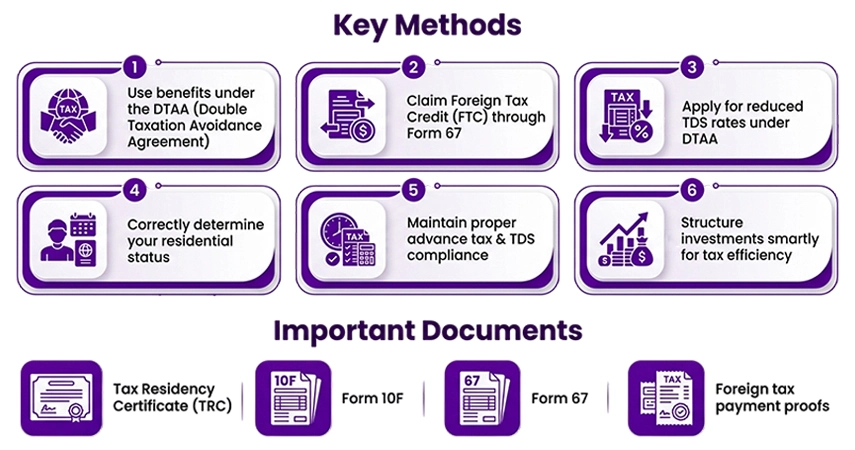
1: Use DTAA (Double Taxation Avoidance Agreement)
India has DTAA treaties with many major countries, including the USA, the UK, the UAE, Canada, and Singapore. Each tax treaty specifies which country can tax which types of income (such as interest, capital gains, dividends, salary, etc.).
Useful Tips
- As an NRI, you must obtain a Tax Residency Certificate (TRC) from your country of residence so that India knows where you are getting taxed elsewhere.
- You are also required to file Form 10F in India (the form includes details not included in the TRC).
- NRIs shall use Form 67 to claim a credit for taxes already paid abroad when filing their Indian tax return.
- NRIs must check the specific treatment in India and their country of residence beforehand, as it is necessary that all income is covered by the rates that vary.
2: Claim Foreign Tax Credit (FTC)
Claiming foreign tax credit means that if you, as an NRI, have paid taxes on income in a foreign country, India permits you to reduce your Indian tax by that amount (or a part of it). This way, you are more protected from paying full taxes again. This is often called the unilateral relief (if no DTAA), and under DTAA, it is known as bilateral relief.
Useful Tips
- In order to claim the foreign tax credit, you must keep proof of the taxes paid in the foreign country, such as your tax returns or receipts.
- The foreign tax credit is limited, meaning you cannot reduce the Indian tax below zero; furthermore, you may not recover the full foreign tax if the rates differ.
- You can claim the foreign tax credit on Form 67, filed together with the Indian income tax return (ITR).
- Be careful with timing; you must match the correct foreign tax year to the Indian year.
3: Exemptions Or Reduced Rates Under DTAA
Some double taxation avoidance agreements provide exemptions (income that India will not tax), or the lower withholding (tax deducted at source) rates on certain income, such as dividends, royalties, and interest. For example, instead of 30% interest tax, DTAA may allow only 10%.
Useful Tips
- For income such as interest or royalties, you, as an NRI, can request a lower TDS (tax deduction at source) certificate, which is required under the DTAA.
- NRIs should apply the reduced DTAA rates while making eligible investments or deposits
- At times, NRIs must apply in advance before the deduction to avail the lower rate.
4: Determining Your Residential Status Correctly
Your residential status matters. Whether India sees you as a Resident Indian or a Non-Resident Indian for tax purposes matters, as this determines how much of your income is taxable. If you happen to misclassify your Residential Status correctly, you might lose your DTAA benefits or get taxed more.
Useful Tips
- Under Indian law, the stay rules mean the number of days you have spent in India determines your residential status here.
- As an NRI, if you cross a certain specified number of days in India, then you might be classified as "Resident but Not Ordinarily Resident (RNOR) or resident and ordinarily resident (ROR).
- However, you must also check your country of residence rules, as you might be a tax resident there.
- Keep your travel records, passports, and any other exit documents with you.
Let us understand how DTAA helps NRIs help them avoid being taxed twice through an example:
Priya is an NRI living in the US. She received Rs 5 lakh in dividends from one of her Indian stocks. The standard TDS to be detected on this is 30%. However, under the India-USA DTAA, she submits her TRC and Form 10F to her broker, thereby reducing her TDS to 15%.
Priya then claimed a foreign tax credit on IRS Form 1116, which offsets that 15% against her US federal tax on the same source of income.
Meera, a returning NRI transitioning to ROR: Meera has returned to India after 12 years of staying in Singapore. During her RNOR period, her Singapore investment income remained exempt in India. But as she transitions to ROR, that income becomes taxable, and to avoid being taxed twice on the same income source, she files Form 67 to claim the credit for taxes paid in Singapore or any income now falling within India's taxable net.
Her CA ensured that her Form 67 was filed before the ITR due date. This is the only window for her to claim FTC in India.
5: Advance Tax & Withholding Compliance
As an NRI, if your total tax liability exceeds the prescribed threshold, you might then need to pay your Advance Tax in the quarters of the financial year. Furthermore, you must also pay keen attention to the withholding/tax deduction at source (TDS) rules in India. If these rules are missed, you might get penalized.
Useful tips
- As an NRI, if your net tax liability after considering TDS exceeds INR 10,000, you may be required to pay advance tax.
- NRIs shall ensure that the correct TDS is deducted by the payers on their income.
- You must file your ITR even if TDS exceeds your tax liability to claim refunds.
- Keep in mind that delay or non-payment of advance tax may lead to interest or penalties.
6: Structure Your Investments & Income Smartly
The time and how you invest influence your tax burden as an NRI.
Useful Tips
- As an NRI, you should understand that some investment returns may be exempt or taxed at a lower rate under the DTAA, and investing in or building your portfolio around those investment vehicles might be helpful for you.
- If possible, NRIs must hold the investments through the jurisdictions or entities that provide the tax benefits; however, they must abide by ethical and legal boundaries.
- NRIs should avoid any aggressive arrangements that might attract the general anti-avoidance rules (GAAR).
- Consult before shifting money or assets abroad or then back to India.
Key Documentation For NRIs To Avoid Double Taxation
To reap the benefits of a double-taxation avoidance agreement (tax treaty), an NRI must have a specific set of documents, including:
Tax Residence Certificate (TRC)
- The TRC for an NRI is issued by the tax authority of their residence country, which is the IRS in the USA, HMRC in the UK, and likewise in your resident country.
- The TRC confirms that you are a tax resident of the respective country for the financial year.
- NRIs must submit this document to every Indian income payer, such as the AMC, the bank, the tenant, or the company at the start of the financial year.
Form 10F
- Form 10F is a statutory self-declaration form filed by NRIs earning income in India under Rule 21AB. This form is used to claim tax relief and avoid any double taxation under the DTAA between India and the country of residence.
- Form 10F must be filed on the income tax e-filing portal.
- The form confirms your name, address, country of residence, and the tax identification number.
Section 197 Certificate (For large transactions)
- The Section 197 Certificate permits the taxpayer to receive income with a lower or nil rate of tax deducted at source, essentially for a larger or higher-value transaction to improve overall cash flow.
- Apply to the income tax department for a nil or lower deduction certificate.
- These certificates for NRIs are particularly important in the case of property sales, where the TDS can be 20% to 30% on the full sale value.
- This certificate allows the buyer to deduct the TDS at the reduced rate from the start.
- As an NRI, please ensure that you submit your TRC and Form 10F to the income payer well before the financial year begins and not after TDS has already been deducted at the full rate.
Savetaxes provides professional guidance for a seamless business setup.
Checklist For NRIs To Avoid Double Taxation
The following is the checklist to avoid double taxation for NRIs.
- The very first thing on the checklist for NRIs to avoid double taxation is to hire a CA who is well-versed in cross-border taxation and DTAA aspects. These qualified professionals will make your entire taxation journey seamless.
- NRIs must check their residential status under the Indian laws and the treaty tie-breaker rules.
- Get the tax residency certificate in your country of residence.
- File Form 10F and Form 67 if claiming any credits.
- NRIs must compute the foreign tax credit or the exemption under DTAA.
- NRIs must ensure that TDS is deducted at the treaty rate.
- Pay advance taxes in quarters throughout the fiscal year if required.
- Structure your investments very smartly.
- Keep each and every document and the proof associated with foreign taxes paid.
The Bottom Line
Yes, for NRIs, double taxation is a real cost, but it is not an unavoidable one. India’s DTAA network and the foreign tax credit framework, when used together, provide NRIs with a legitimate tool to ensure that the same income is not taxed twice. However, the key to unlocking DTAA benefits is smart planning, identifying the correct residential status, accurate documentation, and unmatched professional guidance.
And when we talk about financial and taxation professional guidance for NRIs in India, Savetaxs is the name to trust. Our experts help NRIs with advice and tax planning by analyzing their correct residential statuses under FEMA and the Income Tax Act to compute their tax liability. Furthermore, the experts help NRIs with DTAA benefit optimization between India and their home country, TRC acquisition, Form 15CA/15CB, Form 10F preparation and filing, assistance in claiming the foreign tax credit, managing bank compliance, and more.
Connect with us as we serve our clients 24/7 across all time zones.
- Advance Tax : Advance Tax is a Tax Paid in Advance, in Installments, During the Same Financial Year.
- House Property Income Tax: House Property Income Tax, Imposed on Housing Properties, on Income Earned From Renting Them.
- Tax Planning: Tax Planning, Minimizes the Tax Liabilities, Maximizes the Claimed Benefits.
- Unilateral Relief: Unilateral Relief Provides Protection Against Double Taxation a Lesser Tax Applies.
- General Anti-Avoidance Rule: General Anti-Avoidance Rule, a Regulatory Measure to Prevent Aggressive Tax Planning, Prevents Taxpayers From Taking Advantage of Taxes.
- Cash Flow: Cash flow is the movement of cash in and out of a business, showing how much cash is generated, used, and available to meet expenses and growth needs.
- How NRIs can Claim Benefits Under DTAA?
- DTAA between India and the USA
- Double Tax Avoidance Agreement (DTAA) Between India and UK
- Double Tax Avoidance Agreement (DTAA) Between India and Australia
- Double Tax Avoidance Agreement (DTAA) Between India and Netherlands
- How NRIs Can File Form 10F Without a PAN Card (Claiming DTAA Benefits)
- DTAA Claim Mistakes NRIs Make And How To Avoid Them
- DTAA Benefits On Capital Gains For NRIs
Note: This guide is for information purposes only. The views expressed in this guide are personal and do not constitute the views of Savetaxs. Savetaxs or the author will not be responsible for any direct or indirect loss incurred by the reader for taking any decision based on the information or the contents. It is advisable to consult either a CA, CS, CPA or a professional tax expert from the Savetaxs team, as they are familiar with the current regulations and help you make accurate decisions and maintain accuracy throughout the whole process.
Hatim Dudhiyawala is a Certified Public Accountant (CPA) with SaveTaxs and specializes in Indian and NRI taxation. He advises individuals, NRIs, and businesses on income tax filing, capital gains taxation, DTAA benefits, fund repatriation, and tax compliance. With experience in cross-border tax matters, Hatim helps taxpayers understand complex regulations and make informed decisions. Through his articles, he shares practical insights to help readers stay compliant and manage their tax obligations with confidence. See Full Bio
Want to read more? Explore Blogs
_1782996918646.png&w=828&q=75)
_1782911003992.webp&w=828&q=75)
_1782823781148.webp&w=828&q=75)