
US Tax Filing and Compliance
U.S. Taxation of Foreign Life Insurance Policies
Written by SaveTaxs Editorial Team

If you are an NRI living in the United States, a U.S. citizen working in India, a Green Card holder, or another U.S. tax resident with retirement savings outside the United States, you may have U.S. reporting obligations related to your foreign pension account.
Foreign pension arrangements can include employer-sponsored retirement plans, provident funds, national pension schemes and other overseas retirement benefits. However, owning a foreign pension does not automatically mean that you must report it on every U.S. foreign asset disclosure form.
The applicable reporting requirements depend on your U.S. tax status, the legal structure of the pension arrangement, your ownership or beneficial interest, and the relevant IRS and FinCEN rules.
This guide explains when foreign pension accounts may need to be reported to the IRS, which forms may apply, and what NRIs and other U.S. taxpayers should review before filing.
You may need to report a foreign pension account if you are a U.S. taxpayer with a reportable interest in an overseas retirement arrangement.
The U.S. tax treatment of a foreign pension depends on several factors, including:
Suppose an Indian professional moves to the United States, becomes a U.S. tax resident and continues to hold an Indian Employees' Provident Fund (EPF) account from previous employment.
The individual should not assume that the EPF account is outside U.S. reporting requirements simply because it was opened in India. The account's legal structure, the individual's interest and the relevant reporting rules must be reviewed.
Importantly, the requirement to disclose a pension interest is not necessarily the same as the requirement to pay U.S. tax on its contributions or accumulated earnings.
Understand how your Indian or overseas retirement arrangements may affect your U.S. tax reporting obligations.
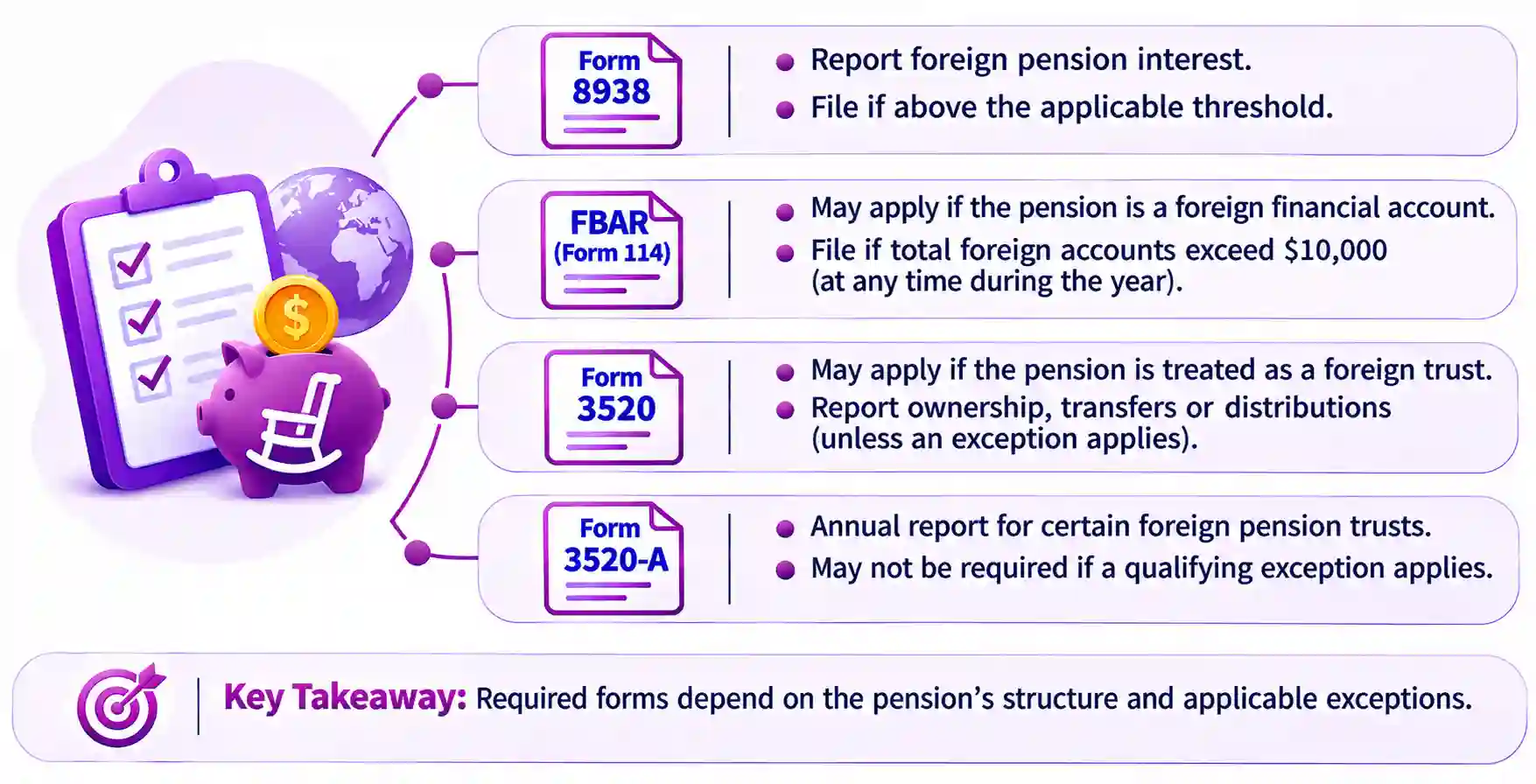
Different U.S. reporting rules may apply to foreign pension arrangements. The main forms to examine include Form 8938, FBAR (FinCEN Form 114), Form 3520 and Form 3520-A.
Not every taxpayer must file all these forms. Each has its own requirements.
Form 8938, Statement of Specified Foreign Financial Assets, is used by certain U.S. taxpayers to report specified foreign financial assets when the applicable reporting threshold is exceeded.
The IRS specifically addresses interests in foreign pension and deferred compensation plans in its Form 8938 instructions.
If you have an interest in a foreign pension plan, you may need to report that interest in Part VI of Form 8938 when you meet the applicable filing requirements. The assets held inside the pension plan are not separately reported as individual assets under this pension reporting rule.
The general valuation approach is based on the fair market value of your beneficial interest in the plan on the last day of the tax year. Special valuation rules may apply if the relevant fair market value is not known or reasonably available.
Example: An NRI who becomes a U.S. tax resident and retains an Indian employer-sponsored pension arrangement should assess whether the pension interest is a specified foreign financial asset and whether the applicable Form 8938 threshold is met.
Form 8938 is not required merely because a foreign pension exists. Your filing status, the value of your specified foreign financial assets and the applicable threshold must all be considered.
For detailed thresholds, valuation rules and filing guidance, read Form 8938 reporting requirements guide.
FBAR stands for Foreign Bank Account Report and is filed electronically with the Financial Crimes Enforcement Network (FinCEN), not as an attachment to your federal income tax return.
A U.S. person generally must file an FBAR when they have a financial interest in or signature authority over foreign financial accounts whose aggregate value exceeds $10,000 at any time during the calendar year, subject to applicable rules and exceptions.
However, the existence of a foreign pension does not automatically establish an FBAR filing requirement.
You must first determine whether the particular pension arrangement qualifies as a foreign financial account for FBAR purposes and whether you have the required financial interest or signature authority.
A foreign retirement arrangement may have a trust-based structure rather than operate like an ordinary bank account. Its treatment should therefore be examined based on its actual legal and financial structure.
Also remember:
For detailed account eligibility, thresholds and filing requirements, refer to the FBAR filing guide.
Some foreign pension and retirement arrangements may be treated as foreign trusts under U.S. tax rules.
If a foreign pension arrangement is classified as a foreign trust, a U.S. taxpayer may need to examine whether Form 3520 reporting applies to ownership, transfers or distributions. A U.S. owner of a foreign trust may also have Form 3520-A obligations.
However, foreign pension arrangements are not automatically subject to both forms.
The IRS provides exceptions for certain arrangements, including specified funded nonqualified deferred compensation arrangements and certain pension or profit-sharing trusts. Other relief may be available for qualifying tax-favored foreign trusts when the relevant conditions are satisfied.
For example, IRS guidance provides relief for certain eligible individuals with qualifying tax-favored foreign trusts established primarily to provide pension or retirement benefits. The conditions must be reviewed rather than assuming that every overseas pension qualifies.
Important: Whether Forms 3520 or 3520-A apply requires a review of the pension's governing documents, funding arrangements, ownership rules and applicable exceptions. Do not assume that an Indian EPF, PPF or NPS arrangement automatically qualifies for an exception or must be reported as a foreign trust.
If you have an overseas pension arrangement with a trust-based structure, obtain a specific U.S. tax classification review before deciding which forms to file.
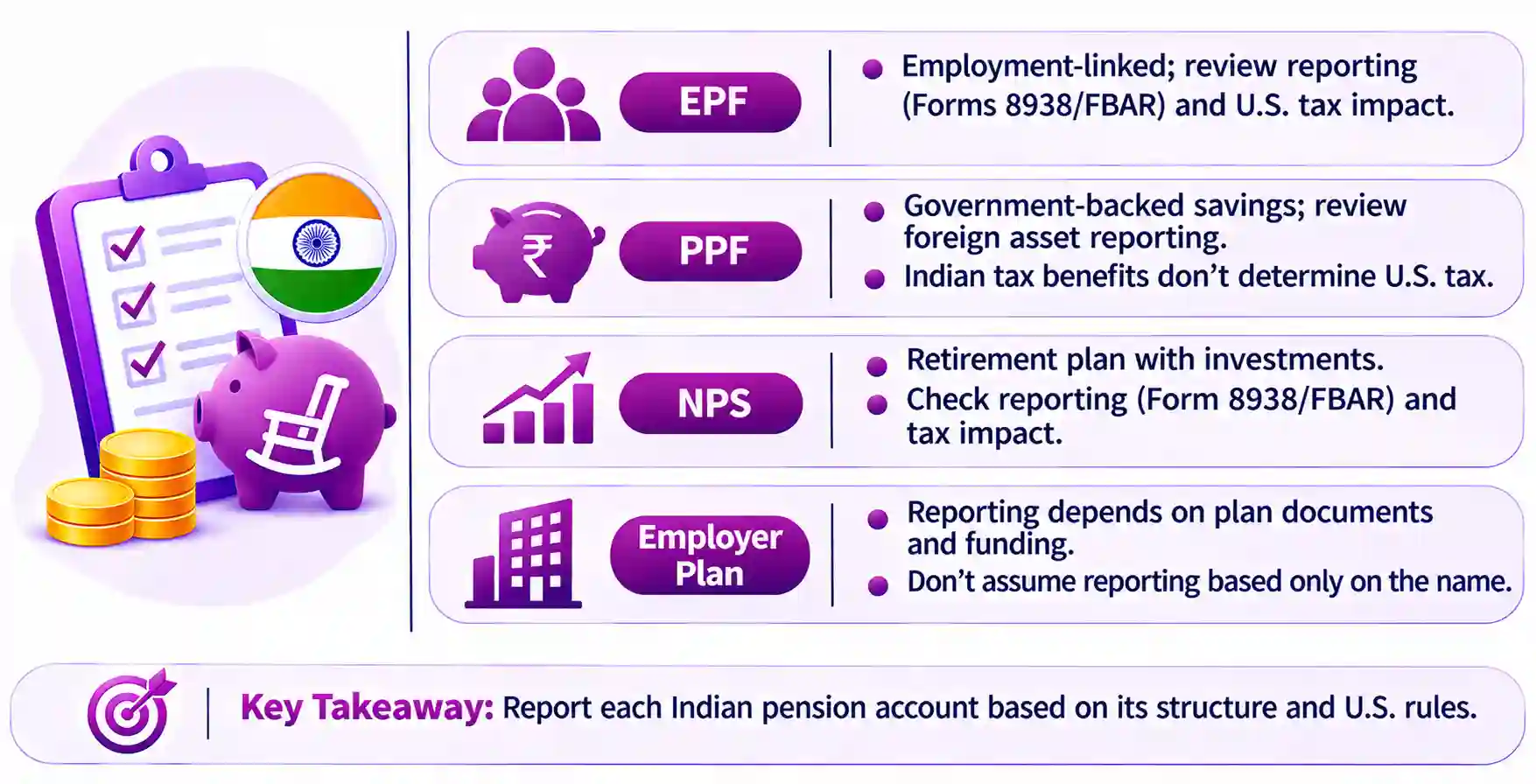
NRIs and U.S. taxpayers with Indian retirement savings should examine each arrangement separately. EPF, PPF, NPS and employer-sponsored pension plans do not necessarily have the same legal structure or U.S. tax treatment.
The correct reporting conclusion depends on the governing rules and the taxpayer's interest in each arrangement.
An EPF account is generally associated with employment in India and may include employee and employer contributions.
If you move to the United States while retaining your EPF account, consider:
Do not automatically conclude that every EPF account must be reported on FBAR or Forms 3520 and 3520-A. Its classification must be assessed under the relevant U.S. rules.
PPF is a government-backed savings arrangement in India. Its U.S. reporting treatment should not be assumed to be identical to EPF or an ordinary overseas bank account.
A U.S. taxpayer holding a PPF account should review the nature of the legal interest, the applicable foreign asset reporting rules and any potential tax treatment of accumulated income.
The fact that PPF receives favorable tax treatment in India does not by itself establish its U.S. tax treatment.
NPS is a retirement savings arrangement with its own account and investment structure.
U.S. taxpayers holding NPS interests should consider:
Do not assume that all NPS accounts receive the same U.S. reporting treatment.
Some Indian employers provide retirement benefits through pension or other employee retirement arrangements.
The reporting treatment may depend on the arrangement's governing documents, funding vehicle, ownership rights and applicable U.S. tax provisions.
A U.S. taxpayer should not rely only on the product name or the fact that the plan is employer-sponsored to determine whether reporting is required.
For NRIs: If you also have a U.S. 401(k), IRA or another U.S. retirement account, its management and tax treatment are separate questions. For India-related retirement planning, see the Savetaxs guide to managing a 401(k) after returning to India.
Failing to report a foreign pension interest when a reporting obligation applies can create compliance problems.
Depending on the applicable form and circumstances, the consequences may include:
The consequences depend on the specific reporting obligation, the reason for noncompliance, whether the omission was intentional and the applicable penalty provisions.
Failure to file Form 3520 when required can result in significant penalties. The IRS generally provides an initial penalty framework based on the type of reportable event, subject to applicable rules and exceptions.
If you discover that a foreign pension account was not disclosed in earlier years, do not automatically file every foreign asset form for every previous year. First determine:
If you have missed previous international tax disclosures, review whether the IRS Streamlined Filing Compliance Procedures may be relevant. Eligibility and the correct correction process must be assessed individually.
Get professional assistance reviewing foreign pension interests, international reporting forms and India–U.S. tax compliance considerations..
Foreign pension reporting can be complicated for NRIs, U.S. citizens, Green Card holders and other U.S. tax residents with retirement savings outside the United States.
The correct approach is not to assume that every foreign pension must be reported on Form 8938, FBAR, Forms 3520 and 3520-A. Instead, identify the legal structure of the arrangement, determine your interest in it, review applicable reporting thresholds and check whether any exceptions apply.
Savetaxs helps individuals with India–U.S. tax connections understand their cross-border tax reporting responsibilities, review foreign asset disclosures and identify the appropriate compliance steps.
Get your foreign pension reporting reviewed before filing your U.S. tax return.
This article is for general informational purposes only and does not constitute tax, legal, financial, or investment advice. Laws, regulations, rates, and procedures may change over time and may vary based on individual circumstances.
While SaveTaxs makes reasonable efforts to keep the information accurate and up to date, readers should verify applicable rules with official authorities or consult a qualified professional before making decisions based on this information.
Hatim Dudhiyawala is a Certified Public Accountant (CPA) with SaveTaxs and specializes in Indian and NRI taxation. He advises individuals, NRIs, and businesses on income tax filing, capital gains taxation, DTAA benefits, fund repatriation, and tax compliance. With experience in cross-border tax matters, Hatim helps taxpayers understand complex regulations and make informed decisions. Through his articles, he shares practical insights to help readers stay compliant and manage their tax obligations with confidence. See Full Bio

Want to read more? Explore Blogs