-for-401(k)_1790057066765.webp&w=828&q=75)
US Tax Filing and Compliance
Net Unrealized Appreciation (NUA) for 401(k): A Guide for NRIs Moving to IndiaNet Unrealized Appreciation (NUA) for 401(k): A Guide for NRIs Moving to India
Written by Vipul Jain

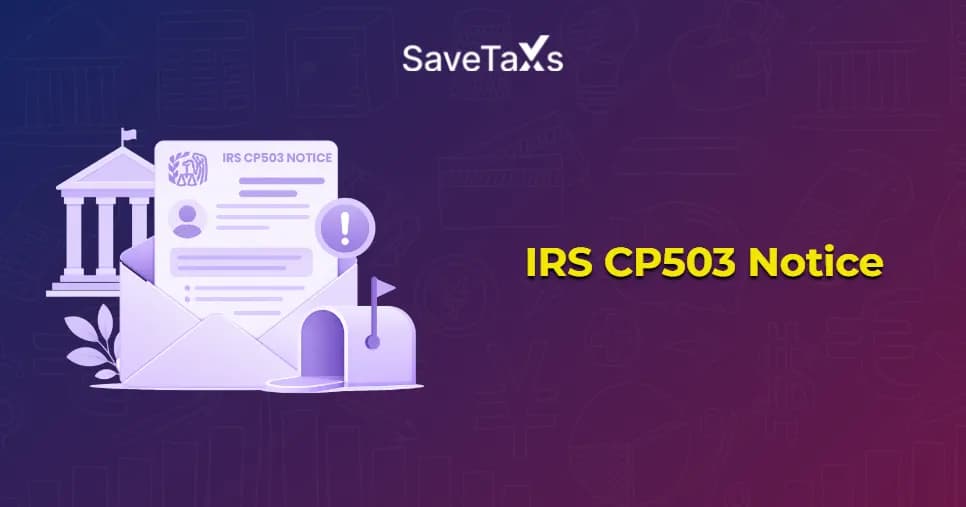
IRS Notice CP503 is the second reminder notice sent by the IRS that says that you have an unpaid tax balance. It informs you that a balance remains unpaid, that you have not responded to prior correspondence, and that you must take action to avoid further collection.0
A Non-Resident Indian (NRI) might receive this notice weeks after the original bill. This can happen because the notice is being sent through international mail, which can make the earlier notice arrive late or not be received at all. It's important for every individual not to ignore this notice and respond within the specified deadline to stop collection escalation. Therefore, in this blog, we will cover what the IRS CP503 notice means, why NRIs receive it, and steps to take before the situation becomes more serious.
IRS Notice CP503 is a second reminder from the IRS informing you about an unpaid balance. You will typically receive it about eight weeks after CP501 if the account balance still remains unresolved.
Since it's a second reminder notice, it means you will receive other notices. So, it typically works in a sequence:
Once you receive CP503, you must understand that the IRS is warning you that the routine reminders will now become more serious toward collection if you still don't take any action.
Although it's not a levy notice, it's a strict warning sent to you before you get one. Moreover, there can be various reasons behind an NRI receiving an IRS notice CP503. Let's discuss the common reasons why NRIs might receive a CP503.
If you are an NRI and received a CP503, it can mainly be due to any of these reasons:
Now, we know the reasons behind why you might have received the CP503 notice. Next comes the main part: reviewing it before responding. But what do you need to check on the notice? Let's see that.
Fulfill your US tax obligations on time with 100% accuracy with the help of Savetaxs.
Before you respond or take any further steps, there are a few details on your notice that you must review first. Here are the details that you need to check:
Now, if you find a tax year that you don't recognize or a balance that is not related to the return you actually filed or any other mismatches, wait before taking the next step. In such cases, instead of assuming that the notice is automatically correct, you must call the IRS before you make any payments.
However, if you think everything is correct, you can proceed with responding to the notice. That being said, next we will learn how NRIs can respond to CP503.
After reviewing the notice, if you find no errors or mismatches, you can respond to the notice by following the steps below:
If you are sure that the amount is accurate, you should pay the entire remaining balance in full. You can do this by paying the amount online or by mail using the payment stub included with your notice. Once you do this, you stop any further accumulation of interest and penalties.
The first option was to pay the balance in full. However, if you are not able to pay the entire amount at once, you still have other options:
Once you set up a payment plan after receiving the CP503, you basically ask the IRS to stop taking any further aggressive collection steps. However, interest will keep accruing on the unpaid balance until you fully pay it off.
The SFR filed by the IRS not matching the notice is one thing, while your own records not matching the notice is another. If you think of paying off the mentioned balance just to get rid of it, you must stop.
You should call the number provided on the letter and be ready to review and compare:
After reviewing everything, if you think that the numbers don't match, request that they check your account transcript. This often helps in determining how the mismatch happened, whether it's a misapplied payment or there's an entirely different reason.
Further, there might be NRIs who might not pay attention and ignore the CP503 notice. However, if you ignore the warning from the IRS received through CP503, you will face consequences. Next, we will learn what happens if you ignore CP503.
If you ignore the notice thinking it's just a second reminder and you will get more time, you will face issues. Ignoring this notice will move you further into more serious situations, like:
Although CP503 doesn't state that your assets will be seized tomorrow, it's more like the IRS is moderately informing you before you reach that point and put yourself in a more serious situation. You might have ignored the previous notice intentionally or by mistake. However, once you receive CP503, you must take further action instead of waiting for CP504. This will help you have more options and typically makes the resolution faster and less frustrating. Also, the SFR filed by the IRS may contain overstated figures compared to what you actually owe.
Since we have mentioned SFR, let's take a look at what it is and why understanding it matters for NRIs.
The Substitute for Return is filed by the IRS on your behalf if you never file a required U.S. tax return. To file it, they only use the income data reported by employers and payers and don't apply any deductions, credits, or your correct filing status.
After this, the resulting balance can trigger the same sequence as any other unpaid tax: CP14, CP501, CP503, and so on. For Non-Resident Indians (NRIs), this is very important. It is because the SFR filed by the IRS may contain overstated figures as compared to what you actually owe. Apart from that, there are other reasons as well:
If you receive a CP503 notice based on SFR instead of a return you have filed, don't pay the inflated SFR-based balance; instead, make a smart and effective move by filing your own correct return accurately.
Since the IRS doesn't consider deductions and treaties, filing yourself can help you reduce your liability significantly. Lastly, to understand everything easily, let's consider an example.
Rohit is an NRI who worked in the U.S. for two years on an H-1B visa before he moved back to India. Now, since his U.S. employment was over, he assumed that he had no tax obligations anymore.
As a result, he didn't file a return for his first partial year of U.S. wages. However, what he did not realize was that he still had a filing requirement even though he'd moved to India. A year and a half later, he received a notice at his Indian address in Pune. This notice was IRS CP503. It showed a balance based on a return the IRS had filed on his behalf.
He immediately contacted a tax preparer who helped him understand that the IRS had used an SFR, which was filed entirely based on his employer's W-2 data. He also noticed that no deductions were included and the default single filing status was applied.
As a result, his balance was significantly higher than what he would have been liable to pay under a correctly prepared Form 1040-NR. After that, Rohit filed his own accurate return for that year by taking the help of his preparer. He made sure to reflect his actual income correctly, claim the allowable deductions, and chose the correct nonresident filing status.
The IRS processed his real return, and as he expected, his balance dropped considerably from what the SFR-based figure reflected.
Considering Rohit's situation, we can understand that what the CP503 notice reflects is not necessarily the final word on what you actually owe. You can solve everything by filing a correct return on your own.
Connect with Savetaxs and get answers to all your doubts from the experts.
CP503 is a reminder from the IRS asking you to take quick action, as the next step can bring you closer to formal levy action. If your CP503 balance is based on an SFR and you believe it does not reflect your actual tax liability, review the assessment promptly and file the appropriate return or contact the IRS to correct the account. Do not simply ignore the balance, because interest and applicable penalties can continue to accrue.
Further, if your CP503 IRS notice doesn't match your records or you think it's related to a return you never filed, Savetaxs can help.
At Savetaxs, our experts can help you determine whether your balance is based on an SFR and prepare the correct Form 1040-NR filing. We can help make the resolution smoother and respond before the deadline passes to avoid any further strict consequences.
This article is for general informational purposes only and does not constitute tax, legal, financial, or investment advice. Laws, regulations, rates, and procedures may change over time and may vary based on individual circumstances.
While SaveTaxs makes reasonable efforts to keep the information accurate and up to date, readers should verify applicable rules with official authorities or consult a qualified professional before making decisions based on this information.
Vipul Jain is the Co-Founder of SaveTaxs and a tax expert with experience in Indian and NRI taxation. He advises individuals, NRIs, and businesses on tax filing, tax planning, capital gains, DTAA, and compliance matters. He focuses on making complex tax concepts simple and helping taxpayers make informed, compliant decisions. See Full Bio

Want to read more? Explore Blogs