-for-401(k)_1790057066765.webp&w=828&q=75)
US Tax Filing and Compliance
Net Unrealized Appreciation (NUA) for 401(k): A Guide for NRIs Moving to IndiaNet Unrealized Appreciation (NUA) for 401(k): A Guide for NRIs Moving to India
Written by Vipul Jain
Imagine you file your US tax return on time and are waiting for your tax refund, but instead you get an IRS Notice CP10. The notice tells you that in your filed return, the IRS found an error and adjusted your carryforward money for the next year. Through this notice, the IRS proposed an adjustment to your tax return based on third-party information (employers, banks, etc.) that states you owe more taxes.
In simple terms, IRS Notice CP10 is not a bill or a tax audit; it is only a calculation based on third-party data. Like other tax notices, the CP10 notice also comes with a response deadline, generally 60 days.
Confused? Want to know about IRS Notice CP10 in detail? Read the blog and get your answers.
IRS Notice CP10 is an official letter sent by the IRS stating they found a mathematical error in your tax return and they made one or more changes to it. Further, the changes made to your filed tax return result in reducing your refund or overpayment amount that you apply towards the estimated tax payments of next year.
Here is a key thing to understand about this notice. It is not a tax bill or audit; this is specifically about your estimated tax credit that you opt to carry forward next year. In simple terms, this notice means the amount that you estimated to carry forward for the next year, after IRS tax return adjustments, is smaller or larger than you requested.
Further, the IRS CP10 Notice explains the following things:
This was all about IRS Notice CP10. Moving ahead, let's know why NRIs receive this notice.
NRIs receive the IRS Notice CP10 for the following reasons:
These are the common reasons why NRIs receive IRS Notice CP10. Moving further, let's know what changes this notice makes to your tax return.
With Savetaxs, get personal guidance on your tax situation in the US and maximize your refunds.
Here are some key changes to your Form 1040 that the CP10 Notice makes:
Further, the notice clearly states the changes made, along with a comparison of your filed tax return and what the IRS calculated. Now, moving forward, let's know how NRIs should respond to the IRS Notice CP10.
Here is how NRIs should respond to IRS Notice CP10:
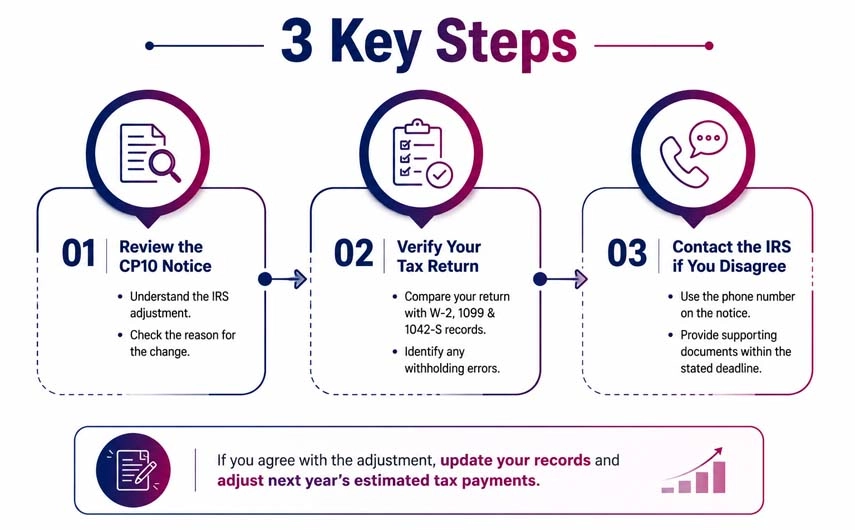
Do not panic. Carefully read the received tax notice. While reading the notice, you will know why the IRS does not accept your requested amount to be applied to your estimated tax payments in the next year. Additionally, you will also get additional information on what you should do in this situation.
Cross-check your filed tax return with the information mentioned in your Form W-2s, Form 1099s, and Form 1042-S. This helps you identify any mistakes you may have made unknowingly and correct them.
If you disagree with the IRS Notice CP10 and identify that the mistake was made on their end, contact the IRS by calling the number mentioned in your letter. This should be done within the notice deadline, i.e., 60 days. Explain your tax situation properly and, if possible, submit the relevant documents as proof of your actual withholding amount.
However, if you agree with the changes stated by the IRS, just update your filed tax return in your records. Do not resend this to the IRS; instead, adjust your estimated tax payments for next year to show the correct amount.
This is how NRIs should respond to IRS Notice CP10. Moving ahead, let's know how this notice impacts your estimated tax or refunds.
As mentioned earlier, the CP10 notice adjusts your estimated tax amount for next year. Here is how it impacts your finances:
*Tip for NRIs: If you receive the CP10 notice for the first time, it is advisable to cross-check it with your Form 1040-ES for the current year rather than using your old, incorrect numbers.
This is how CP10 affects your estimated tax or refunds. Now, moving further, let's know the common mistakes that NRIs should avoid after receiving the notice.
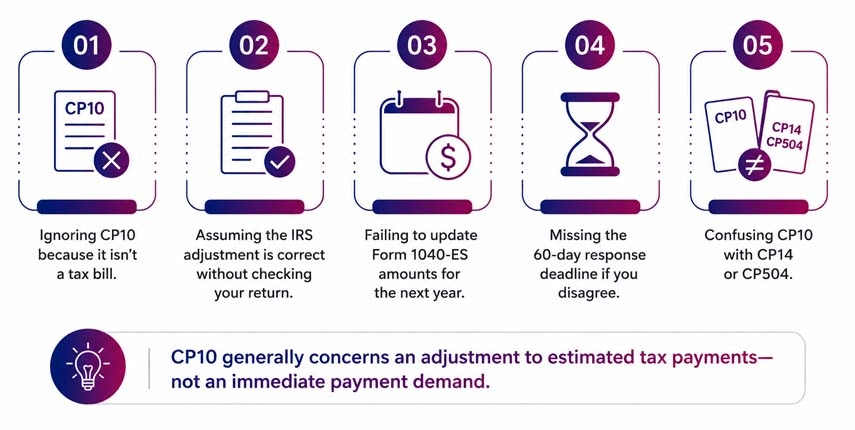
Common mistakes that NRIs should avoid after receiving the CP10 notice include:
Further, let's understand IRS Notice CP10 with an example.
Priya is a non-resident alien living in the U.S. Every year, on time, she filed her US tax return for dividend income using Form 1040-NR. Rather than taking a refund, she opted to carry forward her entire overpayment amount of $2,500 for the estimated tax payments for the next year. A few months later, after filing the tax return, she received an IRS CP10 notice stating that her carryforward amount has been reduced to $1,800.
When she cross-checked her records, she found a mathematical error in her own calculation — she had incorrectly added her total tax payments and claimed $2,500 as overpayment, but the correct calculation showed only $1,800. The IRS caught this mathematical error and adjusted her carryforward accordingly.
Since the IRS's calculation matched her own corrected figures, she confirmed the IRS's suggested adjustments. After that, she updated her own records and stated the correct amount ($1,800) towards her estimated tax payments for the next year. She also adjusted her quarterly payments to cover the difference.
Priya's case is a reminder that you may receive an IRS Notice CP10 because of mathematical or calculation errors on your return, not necessarily because of third-party reporting issues. So, when responding to the IRS notice, carefully review your own calculations before assuming the IRS is incorrect.
Connect with Savetaxs and get IRS audit, refund, and notice assistance from tax professionals.
Lastly, IRS Notice CP10 is one of the most manageable tax notices. It is a simple letter that correctly calculates your carryforward amount for estimated tax payments for the next year with third-party information such as Form 1042-S. Like other IRS notices, you also need to respond to this notice within the given timeline, i.e., 60 days from the date you received the notice.
Further, if you disagree with the tax notice you received or the information in the notice does not match your own documents, rather than dealing with this situation alone, connect with a cross-border tax expert like Savetaxs. We have experienced tax professionals on our team who can help you confirm and respond to the IRS notice correctly. Additionally, they make sure everything is done within the given timeframe without error.
This article is for general informational purposes only and does not constitute tax, legal, financial, or investment advice. Laws, regulations, rates, and procedures may change over time and may vary based on individual circumstances.
While SaveTaxs makes reasonable efforts to keep the information accurate and up to date, readers should verify applicable rules with official authorities or consult a qualified professional before making decisions based on this information.
Shubham Jain is the Founder of SaveTaxs and has extensive experience in Indian and NRI taxation. He advises individuals, NRIs, and businesses on tax filing, tax planning, capital gains, DTAA benefits, fund repatriation, and compliance matters. He regularly writes about taxation and related financial topics. His focus is on making complex tax concepts easy to understand. Through his articles, he helps taxpayers stay informed, avoid common mistakes, and stay compliant with Indian tax laws. See Full Bio

Want to read more? Explore Blogs