US Tax Filing and Compliance

How To Handle An IRS Notice Or Frozen Refund As An NRI

Shubham Jain
Written by Shubham Jain
Updated on: July 14, 202612 mins Editorial Standards
IRS Notice

An IRS letter stands in your mailbox, and your refunds are now frozen. And sitting in Bangalore, you are thinking, what to do next. This happens with many NRIs. The cross-border return carries treaty claims, foreign income, and withholding that the IRS system flags more often than an easy domestic return.

However, the good news is that many IRS notice problems and frozen refunds follow a clear path to fix them. This blog guide covers everything related to IRS notices: how to address the notice, find out why your refund is held, check the claim against your own return, respond on time, and get the money released on time. The guide will also cover the India-side questions that arise when the refund needs to be credited back to your account back home.

Key Takeaways
  • An IRS notice is not an audit. Find the CP or the LTR code first. This is because it tells you exactly what the IRS wants.
  • A frozen refund is generally considered paused and not lost. A review can take 18 to 45 days, while the most common refund arrives in less than 21 days.
  • For NRIs, the general triggers are picking up the wrong treaty position, unmatched 1042-S withholding, or unreported Indian income.
  • Ensure you always respond to the notice by the due date provided. Missing this will allow the IRS to finalize its own version of your return.
  • A US refund is issued to a US bank account or as a paper check, and never directly to your Indian bank account.

Why Do NRIs Receive IRS Notices Or Frozen Refunds

NRIs face a unique set of IRS triggers compared to standard US residents. The most common reasons an NRI receives an income tax notice and has their refund frozen include:
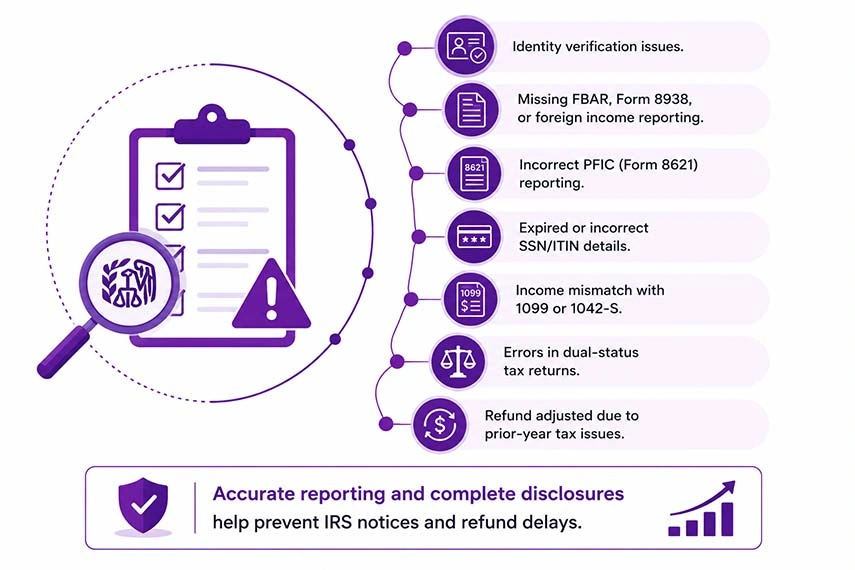
  • Identity Verification Issues: NRIs who are filing a US return after living abroad for an extended period may trigger stronger identity verification flags, especially if their filing address, phone number, or banking details have changed slightly. The IRS uses these details to confirm that you are who you claim to be before releasing the refund.
  • Missing or Incorrect Foreign Income Disclosures: Failing to report foreign bank accounts (FBAR), foreign financial assets through Form 8938, and income from foreign sources that must appear on your US return frequently results in IRS notices, sometimes years after the original filings.
  • PFIC-related Discrepancies: NRIs holding Indian mutual funds who haven't filed Form 8621 or have incorrectly reported PFIC gains as regular capital gains often receive CP notices or audit correspondence once the IRS identifies the mismatch.
  • TIN mismatch or missing taxpayer identification: The NRIs filing Form 1040-NR without a Social Security Number sometimes use an ITIN. Now, if the ITIN is expired, inconsistent, or missing from prior filings, refunds are frequently frozen pending verification.
  • Unreported Income Flagged By Information Returns: If a US payer, employer, financial institution, or brokerage issues a 1042-S or 1099 that does not match what you reported on your return, the IRS will generate an automated notice.
  • Dual Status Return Complexity: NRIs who have moved to or from the US during the year often file a dual-status return, one of the more complex return types. Errors or ambiguities in the dual-status filing frequently trigger IRS review.
  • Refunds held for prior-year obligations: If you have an outstanding balance, a debt owed to another government agency, or an unfiled prior-year return, the IRS can freeze your current-year refund until those issues are resolved.
File Your IRS Taxes From India With Savetaxs

Savetaxs helps NRIs and U.S. taxpayers file IRS tax returns accurately, claim eligible tax benefits, and stay fully compliant with U.S. tax laws.

Understanding Your IRS Notice

When you receive the IRS notice, the first thing to do is identify what it is about. Do not panic by the fact that you have been served with an IRS notice; read the entire notice carefully before doing anything else.

How To Identify The Notice Number

Every IRS notice has a notice number printed in the upper-right corner; it generally starts with "CP" (Computer Paragraph) or "LT" (Letter). The number tells you exactly what the IRS is communicating.

Look for the notice number, then find the specific meaning of the number at the IRS. gov. The IRS provided the explanations for every notice type in simple language. Knowing what the notice is actually about is the most important part.

Common IRS Notices Sent to NRIs

The following table outlines common IRS notices, including the notice number, what it means, and the required actions.

The Notice Number What Does It Mean Action Required
CP2000 The IRS found unreported income on your return, meaning the income shown on a 1099 or 1042-S does not match what you reported on your return. Review and respond to the notice within 60 days; agree or dispute.
CP05 Your refund is being reviewed, and the identification or the income verification is in progress. Wait for the IRS to complete the review, typically 60 days.
CP05A IRS needs specific documents to verify the income or withholding before releasing the refund. Submit requested documents by the deadline.
CP12 The IRS has made a math correction that has refunded a specific amount. Review the change; no response is needed from your side unless you disagree.
CP14 You owe the taxes; the IRS says you have a balance due. Pay or respond to the notice within the next 21 days to avoid any penalties.
CP501 Reminder: you have a certain balance due. Pay out the balance or contact the IRS to arrange the payment.
LT11/Letter 1058 The final notice before levy; the IRS intends to seize the assets. Respond to the notice immediately; this is urgent.
Letter 4883C IRS needs you to verify your identity before processing your return. Call the number on the notice within 30 days.
Letter 5071C Online identity verification required before processing return or refund. Complete verification online at idverify.irs.gov.
CP775 Refund frozen; end-of-line review of an earned income credit or other credit has been claimed. Provide the supporting documents requested.

For NRIs, CP2000, CP05, CP05A, Letter 4883C, and Letter 5071C are the most commonly encountered notices.

What To Do If Your IRS Refund Is Frozen

A frozen refund means that the IRS has processed your return but is holding the refund pending review or verification. It does not mean that yur refund is lost; it just means that the IRS needs something to release it.

Step 1: Check your refund status

Use the IRS "Where's My Refund?" tool on IRS.gov or the IRS2Go app. Enter your Social Security Number or ITIN, filing status, and exact refund amount. The tool will show whether your refund is being processed, held, or has already been sent.

Step 2: Read any notice you have received.

If the IRS has frozen your refund, a notice explaining the reason for the freeze should have been mailed to your address on record. If you haven't received the refund, the refund status tool will typically indicate the reason for the hold.

Step 3: Respond to identity verification requests promptly.

If you have received a Letter 5071C or Letter 4883C, identify the verification request and complete it as soon as possible. Letter 5071C allows online verification at idverify.irs. gov. Letter 4883C requires you to call the IRS. Both have the same response deadline, generally 30 days from the notice date.

Step 4: Provide The Requested Documents

If you have received a CP05A requesting wage statements, 1099s, or any other documentation, gather all the documents and submit them by the method and deadline specified in the notice. Keep the original copies of everything you have sent.

Step 5: Allow a processing time.

After you respond to the IRS notice, the authorities take at least 60 days to process your response, and then, if everything is in order, they release the refund. If more than 60 days have passed without a resolution, you can contact the IRS directly or request assistance from the Taxpayer Advocate Service (TAS) if you are experiencing any issues.

For the NRIs living outside the USA: The IRS generally accepts responses by mail from an international address. If the notice requires you to make a phone call and you are calling from India or any other country, dial the international access code +1, then the IRS number listed on the notice. Now, please know that waiting times can be long; therefore, calling early in the US business day (Eastern Time) can reduce them somewhat.

How To Respond To An IRS Notice?

The following is a step-by-step cheat sheet to respond to the IRS notice.

Documents You May Need

For identity verification

  • Passport or any other government-issued photo ID.
  • Tax year for the previous years for the purpose of verification questions.
  • Your Social Security Number (SSN) or ITIN for the assignment letter.

For Income Mismatch Notices (CP2000)

  • Form 1042-S showing the US-source income and withholding.
  • Foreign bank account statements.
  • Brokerage statements showing any capital gains or dividends.
  • Documentation of any income that you think is incorrectly reported.

For Refunds Hold Related To Foreign Reporting

  • FBAR filing confirmation (FinCEN 114 acknowledgment)
  • Form 8938 if it is filed separately.
  • Form 8621 for any PFIC holdings.
  • Form 3520, if applicable, for foreign gifts or trusts.

For Dual-status return questions

  • Passport entry and exit records establishing days in the US.
  • Documentation of the date you became or ceased to be a US tax resident.

What Are The Response Timeline & Next Steps

  • Know Your Deadline: Every IRS Notice States A Response Deadline, which is generally 30 to 60 days from the notice date. This is the date on the notice, not the date you received it. For NRIs receiving mail abroad, this can create a tight window. If you have already missed the deadline, you can respond anyway; late responses are still considered and are better than providing no responses at all.
  • Respond in Writing: For most notices, your responses must be in writing. Write a clear letter addressed to the IRS that references the notice number, the tax year, and your TIN (taxpayer identification number), explains your objections, and attaches all supporting documents.
  • Use certified mail with a return receipt: if you are mailing from the United States, send via USPS certified mail with the return receipt. If mailing from India, use a courier service that provides tracking and delivery confirmation. Keep the receipt.
  • Keep the copy for everything: You must copy each and every document you are sending out. Note the date you sent your response. If you spoke to an IRS representative by phone, note that representative's name, the date, and the time of the call.
  • Follow up with the authorities if you don't hear back: If the IRS hasn't responded within 60 days of your reply, you can call them for a status update or, if you are experiencing any issues, contact the TAS (Taxpayer Advocate Service). This is an independent organization within the IRS that has helped taxpayers experiencing delays or unresolved issues.
An NRI Example
Abhinav is an Indian origin pharmacist living in New Jersey on a green card. In March 2025, he received an IRS Form 5071C, an identity verification notice, requesting that he verify his identity before the IRS would process his 2024 tax return and release his $3,200 refund. Abhinav had recently changed his address from a New Jersey apartment to a new home in a different country, his first time filing from the new address. This has further triggered an identity verification flag.

He visited idverify.irs.gov within the 30-day deadline, completed the online verification using his SSN (Social Security Number, date of birth, filing status, and a photo of his passport or driver's license. The system confirmed his identity within a few minutes. Then the IRS released the refund within 9 weeks of verification and deposited it back into his bank account. However, Abhinav did seek professional help for this.

His CPA also noticed that he had received a separate CP2000 notice two months later; the IRS had flagged a 1042-S issued by his investment account showing $1,800 in dividend income that was not separately broken out on his Form 1040. His CPA also reviewed the return, confirmed that the income had actually been included in his tax return but was not itemized as the 1042-S suggested, and sent a written explanation to the IRS with a copy of the required brokerage statements. The CP2000 was then resolved with no additional tax owed.

There were two notices, two different processes, and two different outcomes, but of these, one was resolved by taking the right action within the deadline.

Common Mistakes NRIs Must Avoid

The following are common avoidable mistakes NRIs must avoid regarding IRS notices.
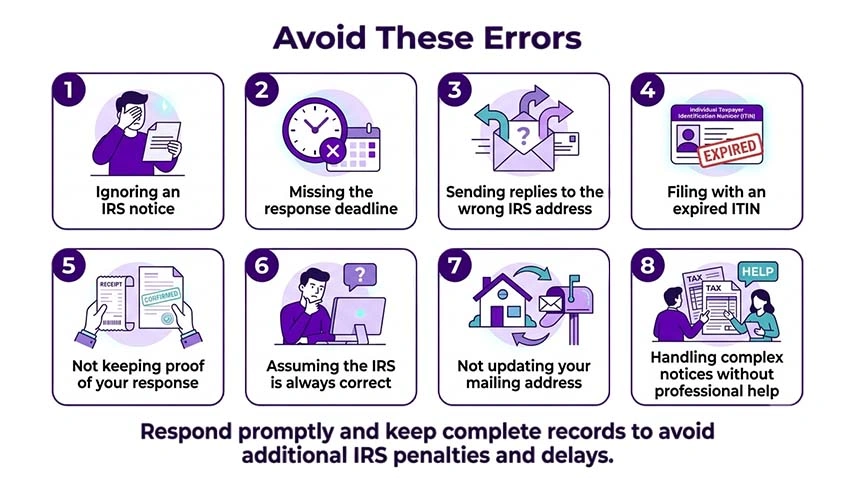
Ignoring the notice, hoping it goes away. This never works. And ignoring IRS notices will not make them vanish over time; instead, they'll escalate from the information requested to back the due notice to every warning. Every week of inaction adds interest and penalty exposure and reduces your response options.

  • Missing the Response Deadline: Every IRS notice comes with its own firm deadlines. If you received a notice several weeks ago and haven't responded yet, act now, not tomorrow. A later response to the notice is still better than no response at all; in fact, some notices even allow an extension request if you contact the IRS before the deadline.
  • Responding To The Wrong Address: Many NRI taxpayers often end up responding to their local IRS office or a generic IRS address. Every IRS notice includes a specific address to respond to; use that address, not a general one.
  • Expired ITIN: Using an expired ITIN is a big mistake. The ITINs generally expire if they are unused, and filing a return with an expired one can stall the refund.
  • Not Keeping Proof of Response: If you respond and the IRS claims it never received your response, you will need mailing proof. Hence, always send by certified mail or a trackable courier and keep the receipts and the copies permanently.
  • Assuming the IRS Is Always Right: CP2000 and certain similar notices are automated; they simply compare the data file against the return you filed and flag discrepancies. They are not always correct. If you believe the IRS assessment is wrong, dispute it clearly with supporting documentation; many NRIs pay additional tax on CP2000 notices without realizing that the IRS calculation was based on incomplete information.
  • Not updating your address with the IRS: As an NRI who moves frequently between the US and India, you should file Form 8822 (Change of Address) with the IRS whenever your mailing address changes. Notices sent to an old address can result in missed deadlines and unnecessary delays.
  • Handling Complex Notices Without Any Professional Help: Identify that verification notices are generally manageable on your own. But CP2000 notices, including the PFIC income, 1042-S discrepancies, or foreign income issues, and anything that involves an audit or levy, often benefit from professional assistance. A US CPA or EA with international tax experience can often resolve these notices more quickly and deliver better outcomes.
Respond To Your IRS Notice With Expert Guidance

Savetaxs provides expert CPA assistance to help you respond to your IRS notice.

Take Assistance Today!

The Bottom Line

An IRS notice does not always have to be a crisis. For most NRIs, the notices that arrive are the most common types, such as identity verification requests, income verification holds, and minor mismatch adjustments, which can be resolved easily by reading the notice carefully, responding within the deadline, and providing the right documentation.

The notices that become serious problems are almost always the ones that were ignored, responded to late, or handled without understanding what was actually being asked.

If you are an NRI receiving IRS mail, whether you are currently in the US, have returned to India, or are living abroad, the same rules apply: read the notice, understand what it asks, and respond by the deadline. When the issue involves foreign income, PFIC holdings, dual-status returns, or anything requiring a strategic verification approach, a US CPA or an EA familiar with international tax issues must be consulted before the start.

At Savetaxs, we have a team of experienced CPAs who help US-based NRIs navigate the IRS process, verify the accuracy of your filings, draft a clear response, and ensure the documents submitted are accurate.

Connect with us as we help our clients 24/7 across all time zones.

Note: This guide is for information purposes only. The views expressed in this guide are personal and do not constitute the views of Savetaxs. Savetaxs or the author will not be responsible for any direct or indirect loss incurred by the reader for taking any decision based on the information or the contents. It is advisable to consult either a CA, CS, CPA or a professional tax expert from the Savetaxs team, as they are familiar with the current regulations and help you make accurate decisions and maintain accuracy throughout the whole process.

About Author
Shubham Jain
Shubham Jain Founder & NRI Tax Advisor

Shubham Jain is the Founder of SaveTaxs and has extensive experience in Indian and NRI taxation. He advises individuals, NRIs, and businesses on tax filing, tax planning, capital gains, DTAA benefits, fund repatriation, and compliance matters. He regularly writes about taxation and related financial topics. His focus is on making complex tax concepts easy to understand. Through his articles, he helps taxpayers stay informed, avoid common mistakes, and stay compliant with Indian tax laws. See Full Bio

Recent Post

Want to read more? Explore Blogs

Frequently Asked Questions

It generally depends on why the refund is on hold. A standard review of the case, withholding, or credit can take 45 to 180 days, depending on how many items the IRS is reviewing. Refunds without a hold generally arrive in less than 21 days. If yours is far past 21 days, you can check "Where's My Refund?" in your IRS online account to see why.

A US refund cannot be directly credited to an Indian account. It goes to a US bank account or comes as a paper check. An Indian income tax refund is different from this and can be credited to a pre-validated NRO account that is linked to your bank. The account must be validated on the official income tax portal first; otherwise, the refund will fail.

The IRS generally communicates via official mail delivered by USPS, and notices will include a CP or LTR number in the top-right corner, along with the agency's logo.

Ignoring the IRS notice can escalate financial and legal trouble. The IRS will issue subsequent letters with penalties and interest, place a lien on your property, seize your bank account, and more. At worst, you may also forfeit your right to dispute the tax assessment.

The very first thing you should do with an IRS notice is read it carefully to understand what the IRS is trying to say. Do not ignore it or start panicking. Get in touch with a professional CPA experienced with the IRS and cross-border taxation to prevent penalties or resolve the issue.