-for-401(k)_1790057066765.webp&w=828&q=75)
US Tax Filing and Compliance
Net Unrealized Appreciation (NUA) for 401(k): A Guide for NRIs Moving to IndiaNet Unrealized Appreciation (NUA) for 401(k): A Guide for NRIs Moving to India
Written by Vipul Jain

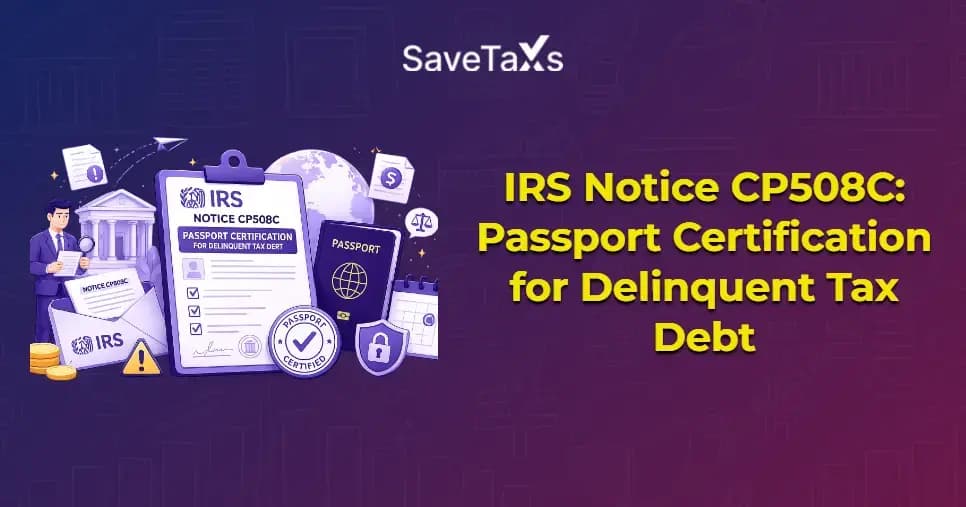
Imagine you are enjoying your vacation in India when you check your mailbox and find an IRS Notice CP508C. At first glance, it may seem like another tax notice. However, it carries much more serious consequences than a payment reminder. Besides the financial implications of unpaid taxes, your ability to obtain, renew, or even keep your U.S. passport may now be at risk.
You might be wondering how unpaid taxes can affect your passport. Under Internal Revenue Code (IRC) §7345, the IRS can certify taxpayers with seriously delinquent federal tax debt to the U.S. Department of State. Once this certification is made, the State Department may deny your passport application or renewal and, in certain circumstances, limit or revoke your existing passport.
For Non-Resident Indians (NRIs) and U.S. citizens living abroad, receiving Notice CP508C can be especially stressful. Whether you frequently travel between India and the United States, work overseas, or have an urgent international trip planned, understanding what this notice means and how to respond quickly is essential.
In this guide, you'll learn what IRS Notice CP508C is, why the IRS issues it, how it affects your passport, the fastest ways to resolve the issue, and what steps you can take to restore your passport eligibility.
Key Takeaways
IRS Notice CP508C confirms that the IRS has already certified your seriously delinquent federal tax debt to the U.S. Department of State.
Passport certification generally applies when your federal tax debt exceeds the IRS certification threshold (currently $66,000, adjusted annually for inflation) and required IRS collection actions have already occurred.
Receiving CP508C does not automatically mean your passport is revoked. However, your passport application or renewal may be denied, and in certain situations, your existing passport may be limited or revoked.
If you have a pending passport application, the U.S. Department of State generally holds it for approximately 90 days, giving you time to resolve the tax issue.
Paying the debt in full, entering into an approved installment agreement, or qualifying for another accepted IRS resolution can lead to passport decertification.
Taxpayers living abroad or facing imminent international travel may qualify for expedited passport decertification.
IRS Notice CP508C is an official notice confirming that the IRS has certified your seriously delinquent federal tax debt to the U.S. Department of State under Internal Revenue Code (IRC) §7345. Once certified, the State Department may deny your passport application or renewal and, in certain circumstances, limit or revoke your existing U.S. passport.
Unlike many IRS notices, CP508C is not a warning that passport certification might happen in the future. Instead, it confirms that the certification has already been completed and sent to the State Department.
The IRS mails this notice to your last known address using regular mail. If your address on file is outdated, you may not receive the notice promptly—even though the certification has already occurred.
For NRIs and Americans living abroad, this can create unexpected complications. Imagine your U.S. tax returns are being handled by a tax professional, but your mailing address with the IRS has not been updated after moving to India. You may remain unaware of the certification until your passport renewal is delayed or denied by the State Department.
Because passport certification can affect your ability to travel internationally, it is important to review every IRS notice promptly and keep your contact information updated with the IRS.
The IRS issues Notice CP508C when it determines that your unpaid federal tax debt qualifies as a seriously delinquent tax debt under IRC §7345. Before certification occurs, the IRS must satisfy several legal requirements.
Generally, the IRS certifies your tax debt when all of the following conditions apply:
Your unpaid federal tax debt, including penalties and interest, exceeds the IRS certification threshold (currently $66,000, adjusted annually for inflation). The applicable threshold is the amount in effect when the IRS certifies your debt.
The IRS has sent multiple notices requesting payment, but the debt remains unpaid.
The IRS has filed a Notice of Federal Tax Lien, and your appeal rights have been exhausted, or the IRS has issued a levy.
The IRS has completed the legally required collection actions before certification.
Your tax debt does not qualify for any statutory exclusions from passport certification.
Simply put, Notice CP508C is issued only after the IRS has completed the collection actions required under federal law and certified your seriously delinquent tax debt to the U.S. Department of State. Passport certification is one of the enforcement tools authorized under IRC §7345, not the first step in the IRS collection process.
Before certification occurs, many taxpayers also receive Letter 6152, informing them that their tax debt may be certified if the issue is not resolved. If no qualifying resolution is reached, the IRS proceeds with certification and then mails Notice CP508C to confirm that the certification has already taken place.
Receiving IRS bills or owing federal taxes does not automatically result in passport certification. The IRS excludes certain taxpayers from certification, even if they owe a significant amount.
Generally, the IRS does not certify tax debt when any of the following situations apply:
You have an approved and active IRS Installment Agreement.
Your Offer in Compromise (OIC) has been accepted by the IRS.
Your account has been placed in Currently Not Collectible (CNC) status because paying the debt would create financial hardship.
You have a pending Collection Due Process (CDP) hearing.
Your request for Innocent Spouse Relief is under IRS review.
The tax debt involves an identity theft issue.
IRS collection activity has been suspended because of bankruptcy proceedings or other legal reasons recognized under federal law.
If one of these situations applies to you but you still receive Notice CP508C, do not assume the certification is correct. Review your IRS account transcript, gather supporting documents, and contact the IRS immediately. If the certification was issued in error, correcting it promptly can help prevent unnecessary passport delays or restrictions.
Understanding the sequence of events makes it easier to know where you stand in the process.
| Step | What Happens |
|---|---|
| 1 | The IRS assesses your unpaid federal tax liability. |
| 2 | The IRS sends multiple balance-due notices requesting payment. |
| 3 | The IRS files a Notice of Federal Tax Lien or issues a levy. |
| 4 | The IRS may issue Letter 6152, informing you that your tax debt may be certified for passport action. |
| 5 | The IRS certifies your seriously delinquent tax debt under IRC §7345. |
| 6 | The IRS mails Notice CP508C, confirming the certification has already been sent to the U.S. Department of State. |
| 7 | The U.S. Department of State reviews the certification and determines whether passport restrictions apply. |
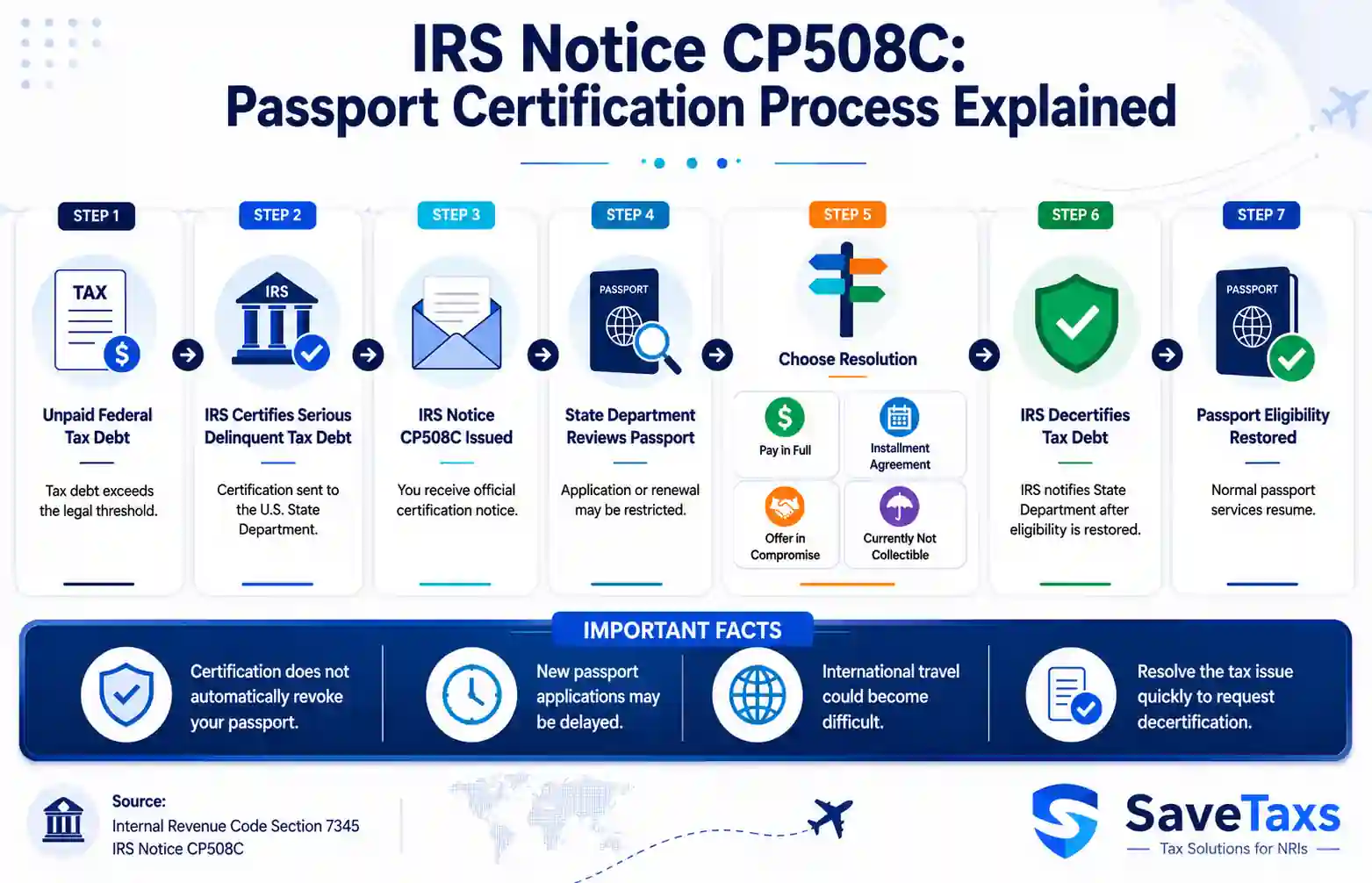
Receiving IRS Notice CP508C does not automatically cancel your passport. Instead, it confirms that the IRS has already certified your seriously delinquent tax debt to the U.S. Department of State. The State Department then determines what passport action, if any, is appropriate under federal law.
Depending on your situation, one or more of the following outcomes may occur:
If you apply for a new U.S. passport or submit a passport renewal application after your tax debt has been certified, the U.S. Department of State may deny your application until the IRS reverses the certification.
If you already have a valid U.S. passport, it is not automatically canceled upon certification. However, the State Department has the authority to limit or revoke an existing passport in certain circumstances permitted by law.
If your passport renewal is delayed, denied, limited, or revoked, your ability to travel internationally may be significantly affected. This can impact business travel, family emergencies, immigration requirements, and overseas employment.
If you have a pending passport application, the U.S. Department of State generally allows approximately 90 days for you to resolve your tax debt or correct an erroneous certification before taking final passport action. Although this timeframe is commonly followed, individual cases may vary.
For NRIs and Americans living abroad, acting quickly is essential. Delaying action can increase the risk of passport-related complications, especially if international travel is already planned.
Receiving Notice CP508C does not necessarily mean you have run out of options. In many cases, resolving the underlying tax issue promptly allows the IRS to reverse the certification before it causes significant passport problems.
Here are the steps you should take immediately.
Before making any payment, verify that the certified tax debt is accurate.
You should:
Review your IRS account transcript.
Compare the certified balance with your own tax records.
Check whether penalties and interest have been calculated correctly.
Confirm whether previous payments have been properly applied.
Determine whether the certification should have been excluded because of an approved payment arrangement or another qualifying exception.
Although uncommon, IRS certifications can sometimes involve outdated balances, administrative errors, identity theft issues, or tax debts that have already been resolved. Identifying these issues early may significantly change your response strategy.
If the certified tax debt is correct, resolve it using one of the IRS-approved methods.
Paying the entire outstanding balance is usually the fastest way to qualify for passport decertification.
If you cannot pay the full amount immediately, you may qualify for an IRS installment agreement. Once the agreement is approved and remains in good standing, it generally qualifies for passport decertification.
If paying the full balance would create significant financial hardship, you may qualify for an Offer in Compromise, allowing you to settle the tax debt for less than the total amount owed if the IRS accepts your offer.
Taxpayers experiencing severe financial hardship may qualify for Currently Not Collectible (CNC) status. When approved, the IRS temporarily suspends active collection efforts, and the account generally qualifies for passport decertification.
Important: Simply requesting additional time to pay or receiving a short-term payment extension does not automatically qualify for passport decertification. The IRS generally requires a formal qualifying resolution before reversing the certification.
Once you resolve your tax debt through a qualifying method—such as paying the balance in full, entering into an approved installment agreement, or having an Offer in Compromise accepted—the IRS reverses the passport certification and notifies the U.S. Department of State.
Typical processing times are shown below.
| Situation | Typical IRS Processing Time |
|---|---|
| Standard passport decertification | Generally within 30 days after the qualifying resolution, although processing times may vary. |
| Expedited passport decertification | Often within 9–16 business days, depending on supporting documentation and case urgency. |
The IRS may expedite passport decertification if:
You are already living outside the United States.
You have international travel scheduled within approximately 45 days.
Your passport application is pending with the U.S. Department of State.
You can provide supporting documentation demonstrating the urgency of your travel.
Supporting documents may include:
Airline tickets
Employer travel letters
Medical documentation
Passport application records
Other documents requested by the IRS
To request expedited processing, call the telephone number listed on your Notice CP508C and explain your situation. The IRS representative will advise you regarding the required documentation.
Practical Tip: Passport decertification involves two separate federal agencies. First, the IRS reverses the certification and sends a decertification notice to the U.S. Department of State. The State Department must then update its own records before your passport application or renewal can proceed. Because each agency has its own processing timeline, keep copies of your payment confirmation, IRS approval letters, and Notice CP508R, and follow up with both agencies if you have urgent travel plans.
Once the IRS completes the reversal, it sends Notice CP508R, confirming that your passport certification has been reversed and that the State Department has been notified.
If you are an NRI who has received IRS Notice CP508C, acting quickly can significantly reduce delays and help restore your passport eligibility sooner.
Here are the recommended steps.
Call the telephone number listed on your Notice CP508C as soon as possible. Do not wait until you have gathered every supporting document before making initial contact.
Request or download your IRS account transcript to:
Verify the certified balance.
Review penalties and interest.
Confirm whether payments have been correctly applied.
Identify any errors that may have resulted in an incorrect certification.
Based on your financial situation, choose the most suitable IRS-approved resolution option:
Pay the balance in full.
Enter into an installment agreement.
Submit an Offer in Compromise.
Request Currently Not Collectible status if eligible.
Choosing the right option early often shortens the overall resolution process.
If you have an upcoming international trip, a pending passport renewal, or already live outside the United States, ask the IRS whether you qualify for expedited passport decertification.
Providing complete supporting documentation at the beginning of the request can help avoid unnecessary delays.
Do not assume the process is complete simply because the IRS has approved your payment arrangement.
Instead:
Confirm that the IRS has issued Notice CP508R.
Verify that the State Department has updated your passport records.
Continue following up until your passport application or renewal proceeds successfully.
If your case involves significant financial hardship, an IRS administrative error, or an urgent travel emergency, you may qualify for assistance from the Taxpayer Advocate Service (TAS).
TAS can often help resolve situations involving delayed passport decertification or incorrect certifications.
Mr. A, an NRI living in Bengaluru, planned to travel to the United States for an important business meeting. While renewing his U.S. passport, he discovered that his application had been delayed because the IRS had certified a seriously delinquent tax debt of approximately $72,000.
Mr. A believed he had already resolved the issue years earlier through an installment agreement. However, after reviewing his IRS account transcript, he discovered that the agreement had defaulted after several automatic payments failed when his U.S. bank account was closed. Over time, additional penalties and interest increased the outstanding balance above the IRS certification threshold.
Because his business trip was only five weeks away, Mr. A immediately contacted the IRS using the telephone number listed on Notice CP508C. He established a new qualifying payment arrangement and requested expedited passport decertification by providing proof of his scheduled international travel.
The IRS processed the decertification request within a short period, issued Notice CP508R, and notified the U.S. Department of State. Shortly afterward, his passport renewal was approved, allowing him to complete his planned travel without further delays.
This example illustrates a common situation faced by taxpayers: a previously resolved tax issue can become seriously delinquent again if an installment agreement defaults. Regularly reviewing your IRS account and ensuring payment arrangements remain active can help prevent unexpected passport complications.
Resolving an IRS Notice CP508C is only the first step. The more important goal is ensuring your tax debt never reaches the point where it qualifies as a seriously delinquent tax debt again. Staying proactive with your U.S. tax obligations can help you avoid passport-related issues, penalties, and additional IRS collection actions.
Here are some practical steps you can take.
Even if you live outside the United States, you may still have U.S. tax filing and payment obligations. Review your income, deductions, tax credits, and estimated tax payments annually to avoid unexpected tax liabilities.
If your income changes significantly due to self-employment, investments, rental income, or foreign earnings, revisit your estimated tax payments before the next filing season.
Many taxpayers receive large tax bills because insufficient tax was withheld during the year or because estimated tax payments were too low.
To reduce the likelihood of future tax debt:
Update your payroll withholding if you're employed.
Make timely estimated tax payments if you're self-employed or have investment income.
Review your tax liability whenever your financial situation changes.
Paying taxes gradually throughout the year is often easier than managing a large balance due after filing your return.
Even if you cannot pay your tax bill immediately, filing your tax return by the due date is generally better than not filing at all.
Timely filing can:
Reduce failure-to-file penalties.
Preserve eligibility for certain IRS payment options.
Help you address tax issues before they become serious.
Prevent unnecessary interest and collection actions.
If you need additional time to file, request an extension before the filing deadline. Remember that an extension to file does not extend the deadline to pay any taxes owed.
If you resolve your tax debt through an installment agreement or an Offer in Compromise, continue meeting all payment requirements.
Missing payments can:
Cause the agreement to default.
Restart IRS collection activity.
Make your tax debt eligible for passport certification again.
Set up automatic payments whenever possible and regularly monitor your IRS account to ensure your agreement remains in good standing.
Ignoring IRS notices often allows relatively small tax problems to grow into much larger ones.
If you receive correspondence from the IRS:
Read it carefully.
Respond before the stated deadline.
Keep copies of all correspondence.
Contact the IRS or your tax professional if you disagree with the notice.
Early communication often provides more resolution options than waiting until collection actions begin.
Many taxpayers living outside the United States overlook this simple but important step.
Always ensure the IRS has your:
Current mailing address.
Updated contact information.
Authorized representative information (if applicable).
Receiving IRS notices promptly gives you more time to resolve issues before they escalate.
For NRIs, U.S. citizens abroad, dual residents, and taxpayers with international income, cross-border tax rules can become complicated.
Working with an experienced tax professional can help you:
Stay compliant with U.S. tax laws.
Reduce the risk of unexpected tax liabilities.
Identify available relief provisions.
Maintain active payment arrangements when necessary.
Avoid passport certification issues in the future.
Preventive tax planning is almost always less expensive and less stressful than resolving a serious IRS collection matter after it has already occurred.
Understanding the different IRS notices can help you determine where you are in the passport certification process.
| IRS Notice | What It Means | What You Should Do |
|---|---|---|
| Letter 6152 | The IRS intends to certify your seriously delinquent tax debt for passport action. | Contact the IRS immediately and resolve the tax debt before certification occurs. |
| Notice CP508C | The IRS has already certified your tax debt to the U.S. Department of State. | Resolve the tax debt through a qualifying method and request passport decertification if eligible. |
| Notice CP508R | The IRS has reversed your passport certification and notified the U.S. Department of State. | Follow up with the State Department if your passport application or renewal is still pending. |
Receiving Notice CP508C can be stressful, but many taxpayers make mistakes that unnecessarily delay resolution. Avoiding these common errors can help protect your passport eligibility and reduce processing delays.
Waiting for the problem to resolve itself rarely works. The sooner you respond, the more options you generally have.
An installment agreement that defaults because of missed payments or bank account changes no longer protects you from passport certification. Always verify that your agreement remains active.
Many taxpayers only take action after discovering that their passport application has been delayed or denied. By then, travel plans may already be affected.
Receiving Notice CP508R is an important milestone, but the U.S. Department of State must still update its records before your passport matter is fully resolved.
Maintain copies of:
IRS notices
Payment confirmations
Installment agreement approvals
Offer in Compromise acceptance letters
Notice CP508R
Passport correspondence
These records may be helpful if questions arise during the decertification process.
For the most current guidance regarding passport certification and seriously delinquent tax debt, consult the following official resources:
Internal Revenue Code (IRC) §7345 – Revocation or denial of passports for certain tax delinquencies.
IRS: Passport Certification for Seriously Delinquent Tax Debt.
IRS Publication 594: The IRS Collection Process.
U.S. Department of State: Passport Information and Application Guidance.
Taxpayer Advocate Service (TAS): Assistance for taxpayers experiencing significant hardship.
Because tax laws and administrative procedures may change, always rely on the latest official guidance when making important tax or travel decisions.
Receiving IRS Notice CP508C can be alarming, especially if you depend on your U.S. passport for work, family commitments, or international travel. However, the notice does not necessarily mean you have lost your passport permanently. Instead, it confirms that the IRS has certified your seriously delinquent federal tax debt to the U.S. Department of State under IRC §7345.
The key is to act promptly. Verify whether the certification is accurate, choose the most appropriate IRS-approved resolution option, and request passport decertification if you qualify. The sooner you resolve the underlying tax issue, the sooner the IRS can notify the State Department and restore your passport eligibility.
For NRIs and U.S. citizens living abroad, timely action is particularly important because passport delays can affect employment, immigration status, family travel, and international business commitments.
If your situation involves a complex tax dispute, defaulted payment agreement, or urgent travel requirement, professional guidance can make the resolution process significantly smoother.
At Savetaxs, our experienced U.S. tax professionals assist taxpayers with IRS notices, installment agreements, Offer in Compromise applications, passport certification issues, and other complex cross-border tax matters. We work closely with clients to identify the most appropriate resolution strategy and help them regain compliance with confidence.
This article is for general informational purposes only and does not constitute tax, legal, financial, or investment advice. Laws, regulations, rates, and procedures may change over time and may vary based on individual circumstances.
While SaveTaxs makes reasonable efforts to keep the information accurate and up to date, readers should verify applicable rules with official authorities or consult a qualified professional before making decisions based on this information.
Vipul Jain is the Co-Founder of SaveTaxs and a tax expert with experience in Indian and NRI taxation. He advises individuals, NRIs, and businesses on tax filing, tax planning, capital gains, DTAA, and compliance matters. He focuses on making complex tax concepts simple and helping taxpayers make informed, compliant decisions. See Full Bio

Want to read more? Explore Blogs