US Tax Filing and Compliance

How to Reclaim Overpaid U.S. Dividend Withholding Tax as an International Investor?

Hatim Dudhiyawala
Updated on: July 31, 20264 mins Editorial Standards
Reclaim Overpaid U.S. Dividend Withholding Tax

Investing in US stocks provides you with attractive dividend income, but do you know that the IRS withheld more tax than necessary? Like you, many international investors were unaware of this. Considering this, in many scenarios, they end up paying the default 30% US dividend withholding tax because they forget to submit or update tax documentation.

Here, the good news is you can claim your overpaid U.S. dividend tax. However, it is vital to understand the India-US treaty, maintain a valid Form W-8BEN, and file the appropriate US tax return. Confused about how to reclaim overpaid US dividend withholding tax as an NRI? This blog provides you with complete information about it and explains how over-withholding tax happens in the US. So read on and clear all your doubts.

Key Takeaways
  • The dividend withholding tax (DWT) imposed on US dividends paid to non-resident aliens is 30%. Eligible investors, under the India-US DTAA, may generally qualify for a 25% reduced tax treaty.
  • To reduce the withholding rate, it is vital to have a valid Form W-8BEN by your side. Without it, you are liable to pay the default 30% withholding tax.
  • NRIs who have overpaid U.S. dividend withholding tax may generally reclaim the excess amount by filing Form 1040-NR, claiming the applicable treaty benefits, and filing the refund claim within the IRS time limits.
  • To substantiate your claim for a refund, you need to provide supporting documents like Form 1042-S, Form W-8BEN, an ITIN, and brokerage statements.
  • To avoid overpaying taxes annually, review your withholding and keep your tax documents updated. Additionally, ensure on your US dividend income correct tax treaty rate is applied to your U.S. dividend income.

What is U.S. Dividend Withholding Tax (DWT)?

When U.S. companies pay dividends to non-resident investors, the Internal Revenue Service (IRS) withholds up to 30% of the dividend payment automatically. Considering this, the tax deduction applies to:

  • Overseas employee shareholders
  • Individual international investors
  • Global mutual fund or ETF investors

For most non-resident individual investors, it is a final withholding tax, meaning the tax is collected upfront rather than through a tax return filed later. However, the 30% dividend withholding tax is by default. Considering this, the double tax avoidance agreement (DTAA) between the US and the other 65+ countries, including India, reduced this tax rate for eligible investors.However, to claim the reduced tax rate, the investors need to submit the correct documents before the dividend payment.

This was all about U.S. dividend withholding tax. Moving ahead, let's know why NRIs overpay these taxes.

Why NRIs May Overpay U.S. Dividend Withholding Tax (DWT)?

Under the US-India tax treaty, instead of the standard 30% tax on dividends, individual portfolio investors qualify for a reduced 25% withholding rate. Additionally, a lower 15% tax rate is also available only for corporate shareholders holding a minimum of 10% of the voting stock of the company.
NRIs May Overpay U.S. DWT

However, unlike the standard tax rate, the lower rate does not apply automatically. Considering this, you need to submit a valid Form W-8BEN to your broker, certifying your Indian tax residency and treaty eligibility.

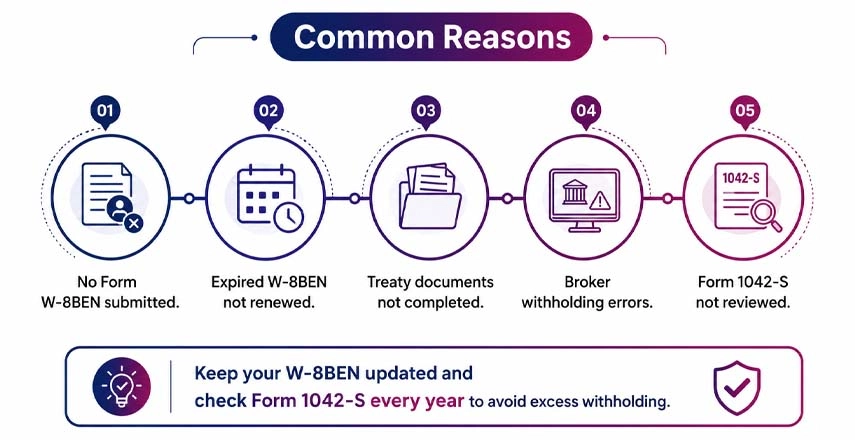
For the following reasons, NRIs generally end up overpaying the US dividend withholding taxes:

  • Fail to submit Form W-8BEN to the broker and face a 30% withholding tax rate.
  • Form W-8BEN is valid for three years. Considering this, once it expires and you do not update it, your broker will revert to the default tax rate.
  • Opening the account before completion of treaty documents also triggers the 30% standard dividend tax rate.
  • Even when everything from your side is accurate, withholding mistakes do happen because of errors in the system of broker.

To avoid these issued it is advisable to check your Form 1042-S annually. It is an annual statement sent by the US brokers to foreign account holders. If you are eligible for the tax treaty and the withholding rate shows 30% instead of 25%, you need to claim your tax refund.

So here is why NRIs may overpay U.S. dividend withholding tax. Moving further, let's know who can reclaim these overpaid taxes.

Facing Issues in Claiming Refund on U.S.Dividend Withholding Tax?

Connect with Savetax and get personalized assistance for claiming a refund as per your tax situation.

Who Can Reclaim Overpaid U.S. Dividend Withholding Tax?

You can generally claim a refund for overpaid U.S. dividend withholding tax if:

  • For US tax purposes, you are a non-resident alien. Most NRIs living in India come into this category.
  • Received a US-source dividend income during the tax year.
  • Tax was withheld at a higher rate than what you were entitled to under the US-India tax treaty.
  • For refund claims, you were within the IRS tax filing window

Further, claim refunds within three years from the original return due date or two years from when you actually paid tax- whichever is later. In case you have overpaid the taxes across multiple years, you need to check each year separately since older years may now fall outside the window.

This was all about who can reclaim overpaid U.S. dividend withholding tax. Moving ahead, let's know how to reclaim these taxes.

How to Reclaim Overpaid U.S. Dividend Withholding Tax?

Here is how you can reclaim overpaid dividend withholding tax for non-resident aliens:

  • Confirm your tax overpayment. For this, compare the withholding tax rate on your Form 1042-S against the 25% tax treaty you are eligible for.
  • Get or update your Form W-8BEN. Fill out this form and submit it to your broker so that your future dividends are withheld correctly at source. Although it does not fix your past overpayment but helps in avoiding in the future.
  • File Form 1040-NR for the relevant tax year and report your dividend income on Schedule NEC (income not connected effectively with a US business) at the correct tax treaty rate.
  • If needed, also attach Form 8833 to disclose our treaty-based position, as some dividend rate claims qualify for a reporting exception. Additionally, including this form provides clarity and reduces the chance of follow-up from the IRS.
  • Claim the Refund. It is the difference between the amount withheld and what you actually owe under the tax treaty.
  • If you do not have an ITIN, obtain one first. This is because you cannot file Form 1040-NR without a valid US taxpayer identification number.
Confused? Let's better understand this with an example.

For instance, Vikram is an NRI who lives in Bengaluru and, through an American brokerage, he invests in US tech stocks. A few years ago, he opened the account but did not submit Form W-8BEN to the broker. As a result of this, his broker withheld tax at the 30% standard rate. Considering this, his Form 1042-S states $3,000 withheld on $10,000 in dividends, but under the India-US tax treaty, he was liable to pay only 25% or $2,500. Vikram filed Form 1040-NR, reported the dividend income on Schedule NEC at the tax treaty rate, and claimed the $500 difference. He also updated his Form W-8BEN with his broker so future dividends would be correctly withheld from the start.

This is how you can U.S. dividend tax refund. Moving further, let's know the documents required to claim a refund on U.S. withholding tax on dividends.

Documents Required to Claim a Refund

The documents required to claim a tax refund are as follows:

  • Form 1042-S: Shows the gross dividend amount and tax withheld, annually issued by your broker.
  • Form W-8BEN: Proof of your tax treaty claim, submitted to your broker.
  • ITIN: Required to file Form 1040-NR; apply via Form W-7 if you do not have one.
  • Brokerage Account Statements: Supporting records of received dividend payments.
  • Prior Year Tax Filings: If you are claiming overpaid taxes for an earlier year, confirm what you already reported.

These are the documents required to claim a refund of U.S. withholding tax. Moving forward, let's know the common mistakes to avoid when claiming US withholding tax.

Common Mistakes to Avoid

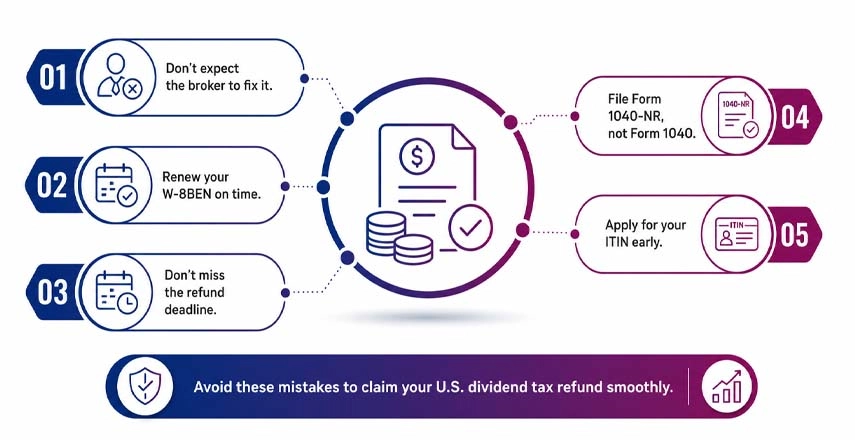
Common mistakes to avoid when claiming overpaid U.S. dividend withholding tax are as follows:
Common Mistakes to Avoid

  • Assuming the broker will fix the issue automatically. Once tax is withheld and reported to the IRS, you can recover the excess amount only through a filed tax return. Considering this, brokers generally won't issue a retroactive refund themselves.
  • Letting Form W-8BEN expire. It is the single biggest reason for ongoing tax overpayment.
  • Missing the tax refund claim deadline. Waiting too long to claim the refund results in losing access to refunds for older tax years.
  • Filing Form 1040 instead of Form 1040-NR. Using the wrong tax form can delay or complicate the refund processing.
  • Not applying for an ITIN early enough. ITIN processing takes several weeks, and you cannot file a tax refund without it.

These are some common mistakes to avoid when claiming overpaid IRS dividend withholding tax.

Paying More US Taxes Than You Owe?

At Savetaxs, get a tax review and see how our tax experts help you file, plan, and stay compliant with your US taxes.

Talk to an Expert!

Final Thoughts

Lastly, paying more US withholding tax on dividend income than required is a common issue for NRIs. Considering this, understanding your treaty entitlement, maintaining a valid Form W-8BEN, and filing Form 1040-NR helps you claim a U.S. dividend tax refund. Additionally, it also ensures future dividend income is taxed at the tax treaty rate.

Further, if you need any help in claiming a refund on overpaid U.S. dividend withholding tax, connect with Savetaxs. We have a team of professional tax experts who help NRIs claim tax refunds on overpaid taxes. Additionally, they can also help you with your U.S. tax and investment planning.

Note: This guide is for information purposes only. The views expressed in this guide are personal and do not constitute the views of Savetaxs. Savetaxs or the author will not be responsible for any direct or indirect loss incurred by the reader for taking any decision based on the information or the contents. It is advisable to consult either a CA, CS, CPA or a professional tax expert from the Savetaxs team, as they are familiar with the current regulations and help you make accurate decisions and maintain accuracy throughout the whole process.

About Author
Hatim Dudhiyawala
Hatim Dudhiyawala Certified Public Accountant (CPA)

Hatim Dudhiyawala is a Certified Public Accountant (CPA) with SaveTaxs and specializes in Indian and NRI taxation. He advises individuals, NRIs, and businesses on income tax filing, capital gains taxation, DTAA benefits, fund repatriation, and tax compliance. With experience in cross-border tax matters, Hatim helps taxpayers understand complex regulations and make informed decisions. Through his articles, he shares practical insights to help readers stay compliant and manage their tax obligations with confidence. See Full Bio

Recent Post

Want to read more? Explore Blogs

Frequently Asked Questions

To reclaim overpaid U.S. dividend withholding tax, file Form 1040-NR with the IRS if you are eligible to claim a refund under U.S. tax laws or an applicable tax treaty. Keep supporting documents, such as Form 1042-S, brokerage statements, and Form W-8BEN, to support your refund claim.

Excess withholding generally occurs when you do not submit a valid Form W-8BEN to your broker, treaty benefits are not applied, or your tax residency details are incorrect. In such cases, the default withholding tax rate of 30% is generally applied instead of the reduced rate available under an applicable tax treaty.

Yes, NRIs may be eligible to claim a refund of overpaid U.S. dividend withholding tax under the India–U.S. Double Taxation Avoidance Agreement (DTAA) or other applicable U.S. tax rules. Eligibility depends on your tax residency, documentation, and compliance with IRS filing requirements.

The most effective way to reduce U.S. dividend withholding tax is to submit a valid Form W-8BEN to your broker before receiving dividend payments. This allows the broker to apply the applicable withholding tax rate available under the India–U.S. DTAA, if you qualify.

To claim treaty benefits on U.S. dividends, complete Form W-8BEN accurately and certify your status as an Indian tax resident. Your broker or financial institution uses this information to apply the applicable treaty withholding rate instead of the default U.S. withholding rate.