-for-401(k)_1790057066765.webp&w=828&q=75)
US Tax Filing and Compliance
Net Unrealized Appreciation (NUA) for 401(k): A Guide for NRIs Moving to IndiaNet Unrealized Appreciation (NUA) for 401(k): A Guide for NRIs Moving to India
Written by Vipul Jain

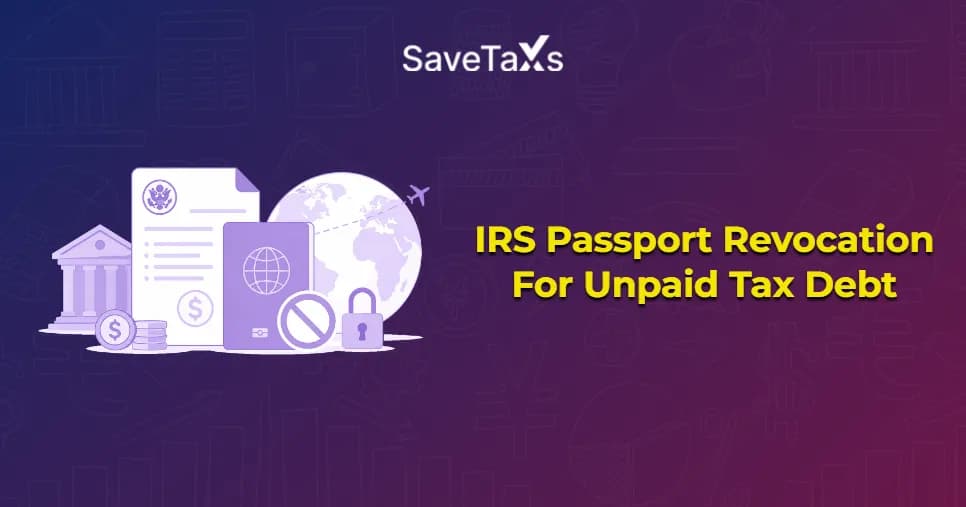
Okay, imagine you are packing for a trip back to India to see your family and loved ones, and you find that your passport application is stuck, not because of late immigration but because you didn't pay your US tax bill in full.
This situation happens more often than one expects, and NRIs are particularly exposed to such things. Between cross-border income management, visa restrictions, and the assumption of "I'll deal with this kind of tax later," a tax debt can simply cross a threshold that will put your US passport at risk immediately.
In this blog, we will talk about how this rule works and what to do if it's applicable to you.
The quick answer is that, under Internal Revenue Code Section 7345, the IRS can certify the seriously delinquent tax debt to the United States Department, which can then deny, revoke, or limit your passport until the debt is resolved.
This isn't a new IRS investigation; it has been on the alert since late 2015, and the IRS has been certifying debts to the State Department since 2018. It is applicable whether you are currently in the US or already living abroad.
The program does not specifically target every taxpayer with a due balance. It is designed for debts that meet a specific legal definition, and understanding that definition is the key to knowing where you are actually at risk.
For your tax debt to be categorized as "Seriously delinquent" under Section 7345, several conditions need to be true at the same time.
The debt has been formally assessed by the IRS.
It remains unpaid, and the collection statute has not expired.
The total, including both the interest and the penalties, exceeds the current inflation-adjusted threshold, which stands at more than $66,000 for the year 2026.
The IRS has either filed a notice of the Federal Tax Lien with the exhaustion of appeal rights or issued a levy under Section 6331.
A hefty balance alone does not trigger the certification. The lien or levy must be in place as well. If you are trying to evaluate your own exposure, this detail is worth checking closely, because this means some large but very recent debt may not yet qualify.
There are specific situations that are excluded even above the threshold; this includes debt in currently not collectible status due to financial stress, debt associated with identity theft, debt under an active installment agreement or accepted Offer in Compromise, and cases involving a pending collection due to the process hearing.
Savetaxs helps you file your taxes in the USA with 100% accuracy and compliance.
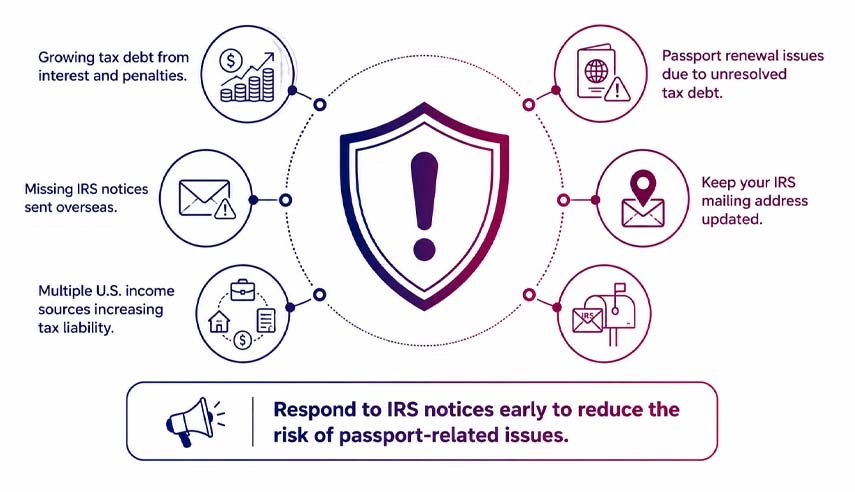
NRIs often face a few specific risk factors that make them pay close attention to this rule.
The IRS mails Notice CP508C to your last known address. Depending on your authorization and IRS records, you should not assume your representative will automatically receive a copy. If you have a US tax representative but you haven't updated your mailing address yet, you could miss out on this notice entirely until you try to renew your passport.
If you have received a notice CP508C or suspect that your account balance may be approaching the threshold, here is a general path forward.
Once your accounts show a fulfilling resolution, the IRS generally notifies the State Department to reverse the certification, but this hasn't been instantaneous. Therefore, building in a buffer before any planned travel is a smart move, since the processing of the reversal can take time.
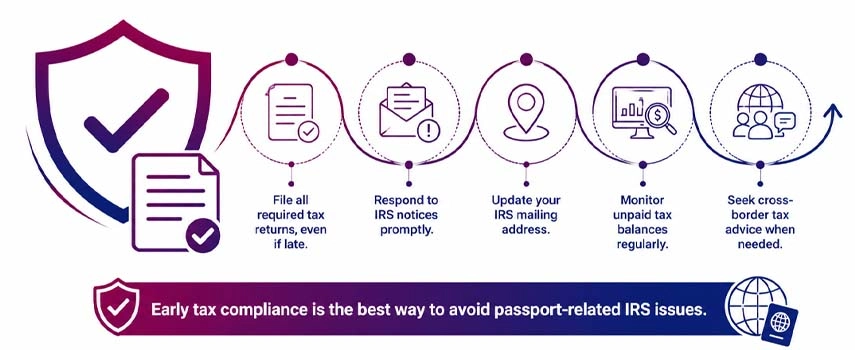
Yes, you can prevent it, and prevention is far less stressful than reversal. A few practical habits go a very long way.
File every required year, even the late ones. Filing also often turns into the larger balance once the penalties for non-filing stack up for non-payment.
Respond to IRS Notices as soon as they arrive. The early communication almost always opens up more resolution options than waiting until the certification happens.
Keep your mailing address updated with the IRS, especially if you have relocated internationally, so the notices do not get misplaced during transit.
Monitor your balance if you are carrying any unresolved debt: A free thousand dollars away from the threshold today can cross it faster than expected once the interest compounds.
Work with a cross-border tax professional early, especially if your situation involves multiple years of back filing or income from the US and Indian sources.
An NRI Facing Passport Denial/Restriction Ahead Of The Family Trip
Sanjay is an NRI who has been working in the USA on the H-1B visa for several years before returning to India. He has an old IRS balance from a year when he underreported freelance income. He assumed it would be around $40,000 and was amazed; he kept meaning to deal with it.
Between compounding interest, failure-to-pay penalties, and a federal tax lien filed years earlier, his balance ended up crossing the threshold of $66,000. He only found out this when he applied to renew his passport for an upcoming family wedding in India and the application came back flagged.
By the time he got his IRS Notice CP508C, the certificate had already reached the State Department. Sanjay then hired a tax professional who understands both Indian and US taxation, and with him, Sanjay set up an installment agreement covering the entire balance. After the IRS confirmed the agreement was in place, it notified the State Department to lift the certificates; however, the process took a few weeks, and Sanjay had to postpone his travel dates.
Sanjay's case illustrates the core risk for NRIs: it is just one rare, dramatic tax bill that can cause this. It is a manageable debt left unresolved long enough to cross the threshold nobody was actively watching.
As an NRI with cross-border compliances, Savetaxs will help you manage your finances and taxes accurately.
Passport revocation over unpaid taxes is not reserved for extreme cases; it is merely a threshold-based rule that can catch NRIs off guard, especially when a manageable debt quietly grows with interest and penalties over several years.
If you have any unresolved US tax balance and your travel plans are near, it is always advisable to check your account status now rather than discovering a problem at the time of passport renewal. A qualified tax professional like Savetaxs, who is experienced in cross-border cases, will help you confirm your status and put a resolution in place before it affects your ability to travel.
Connect with us as we serve our clients 24/7 across all time zones.
This article is for general informational purposes only and does not constitute tax, legal, financial, or investment advice. Laws, regulations, rates, and procedures may change over time and may vary based on individual circumstances.
While SaveTaxs makes reasonable efforts to keep the information accurate and up to date, readers should verify applicable rules with official authorities or consult a qualified professional before making decisions based on this information.
Shubham Jain is the Founder of SaveTaxs and has extensive experience in Indian and NRI taxation. He advises individuals, NRIs, and businesses on tax filing, tax planning, capital gains, DTAA benefits, fund repatriation, and compliance matters. He regularly writes about taxation and related financial topics. His focus is on making complex tax concepts easy to understand. Through his articles, he helps taxpayers stay informed, avoid common mistakes, and stay compliant with Indian tax laws. See Full Bio

Want to read more? Explore Blogs