NRI Banking Services
What Should NRIs Know Before Choosing an NRI Account?What Should NRIs Know Before Choosing an NRI Account?
Written by Shubham Jain


If you are a Non-Resident Indian (NRI) earning income from India, investing in an Indian business, or managing a company from overseas, choosing the right bank account is an important part of handling your money and meeting applicable compliance requirements.
However, there is no single bank account suitable for every NRI business transaction. The right choice depends on who owns the money, the type of business, the source of funds, and the purpose of the transaction.
An NRO account, NRE account, business current account, and Special Non-Resident Rupee (SNRR) account serve different purposes. Understanding these differences can help you identify which account to discuss with your bank before receiving payments, funding a business, or transferring money across borders.
Start by identifying the type of transaction you want to carry out.
These are starting points, not automatic approvals. The correct account depends on the underlying transaction and the legal status of the person or entity making it.
Understand the tax and compliance considerations before selecting an account for your business transactions in India.
| Account type | Main purpose | When it may be relevant |
|---|---|---|
| NRO account | Managing eligible rupee funds and transactions in India | Eligible Indian income and permitted local transactions |
| NRE account | Holding eligible overseas funds in India | Transferring eligible foreign earnings to India |
| Business current account | Day-to-day banking for a business entity | Customer receipts, supplier payments, payroll, and operating expenses |
| SNRR account | Specified permissible rupee transactions by eligible non-residents with a business interest in India | Qualifying business-related transactions covered by RBI rules |
An NRO or NRE account is a non-resident banking arrangement. A business current account is generally opened for the legal entity that operates the business. An SNRR account has specific eligibility, transaction, and operating conditions; it is not a universal replacement for the other account types.
The Reserve Bank of India's guidance on accounts in India by non-residents explains the differences between NRO and SNRR accounts, including their permitted transactions and repatriation treatment.
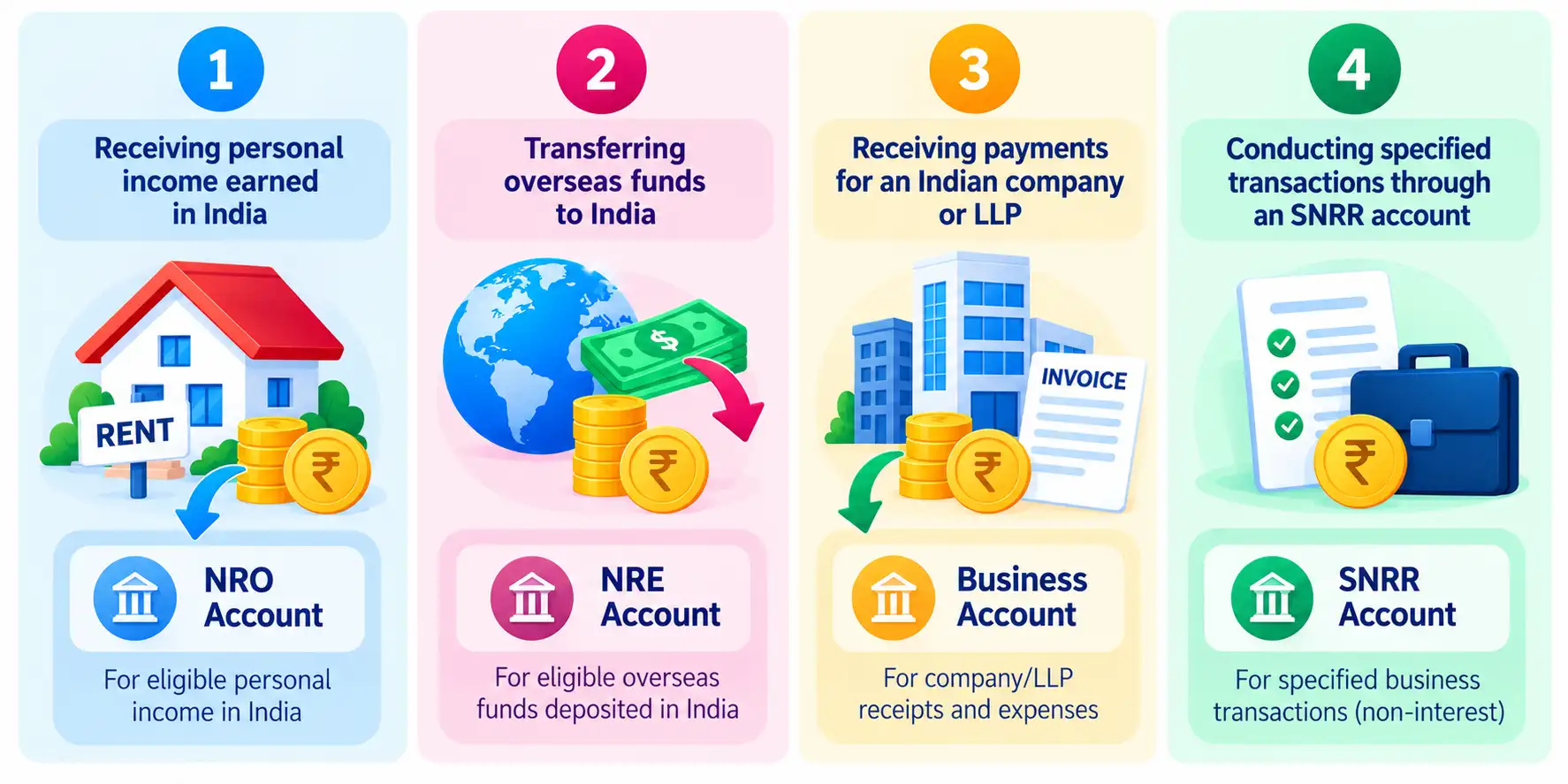
An NRO account may be appropriate for eligible personal income received in India, such as rental income or other legitimate dues, subject to the account's permitted-credit conditions.
However, first establish who earned the income. Money earned by you personally is different from revenue earned by a company in which you own shares.
An NRI living in the United States receives rent from a personally owned property in India. An NRO account may be suitable for receiving that income. If an Indian company collects payment from its customers, those receipts belong to the company and should generally be handled through the company's own banking arrangement.
Do not assume that every payment connected with a business can be deposited into your personal NRO account.
An NRE account is intended for eligible overseas funds deposited in India. It can be useful when you transfer eligible foreign earnings to manage your personal finances in India.
Funding a business is a separate question. If you intend to invest in an Indian company, contribute capital, or provide a loan, the transaction may need to comply with separate foreign investment, lending, and FEMA requirements.
Before sending the money, confirm the permitted route, documentation, reporting requirements, and correct account with your bank.
An Indian company or LLP is a separate legal entity. Its customer receipts and business expenses should be handled through banking arrangements appropriate to that entity.
A business account may be used for eligible customer payments, supplier invoices, payroll, operating costs, and other business transactions. The bank will determine the appropriate account based on the entity's structure, authorised signatories, and activity.
Your personal NRO or NRE account should not be treated as the company's general collection account simply because you own or manage the business.
An SNRR account may be available to a person resident outside India who has a business interest in India and needs to conduct specified permissible rupee transactions.
The account must be used for transactions consistent with its stated business purpose and the applicable RBI conditions. It is generally non-interest-bearing, and its permitted operation and duration are subject to the relevant rules.
An SNRR account is not required for every NRI business and should not be selected solely because you are a non-resident founder. Ask your authorised dealer bank whether the proposed transaction qualifies under the current rules.
For details, refer to the RBI's SNRR account FAQs.
Yes. You should identify the legal structure through which the business operates before choosing an account.
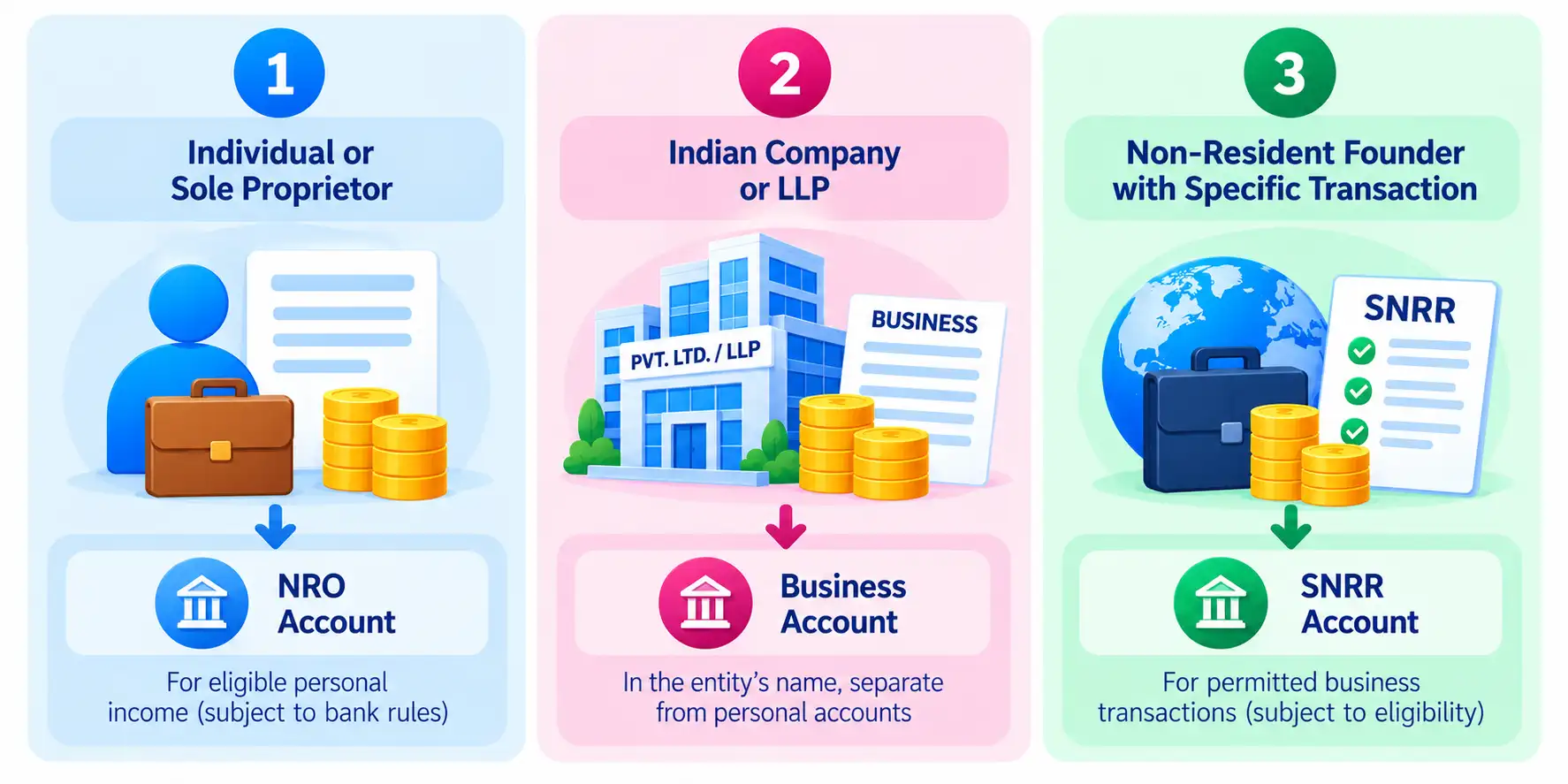
The suitable banking arrangement depends on your residential status, the nature of the activity, the source of receipts, and the bank's rules. An NRO account may be relevant for eligible personal income, but it should not automatically be assumed to be the correct account for every business receipt or payment.
Explain your business activity to the bank and confirm which account is permitted for the proposed transactions.
A company or LLP has its own legal identity. Its banking arrangements should be in the entity's name and kept distinct from the personal accounts of its NRI owners, directors, or members.
Money contributed by an NRI to the entity may also be subject to rules governing capital contributions, foreign investment, loans, or other funding arrangements. The appropriate account alone does not establish that the underlying transaction is permitted.
An SNRR account may be worth discussing with your bank where the proposed activity falls within the permitted categories. Eligibility depends on the transaction and applicable rules, not simply on your status as a founder.
For account-opening procedures and founder documentation, see Open a Bank Account in India as a Non-Resident Founder.
Not in every situation. A personal NRO or NRE account should not be treated as a universal business account.
Before using a personal account for a business-related payment, check:
If you own shares in an Indian private limited company, the company's sales revenue belongs to the company—not to you personally. Your personal account should not be used as the company's general collection account.
Keeping personal and business funds separate also supports clearer accounting and documentation if the transaction is later reviewed by a bank, auditor, or tax professional.
Before opening or using an account, review these points:
For broader regulatory information, read FEMA Regulations for NRIs. This article focuses on account selection rather than explaining FEMA compliance in full.
Get guidance on NRI taxation and cross-border compliance considerations for your business.
Lastly, the right bank account for NRI business transactions depends on who owns the funds, the source of income, the nature of the transaction, and the legal structure of the business. An NRO account may suit eligible personal income, an NRE account may be appropriate for eligible overseas funds, a business current account supports an entity's operations, and an SNRR account may apply to specific permitted transactions. The best option is the one that fits your actual activity and the applicable regulatory requirements.
Further, if you need help understanding Indian tax and compliance considerations for your business, connect with SaveTaxs. Our team can help you understand relevant NRI taxation and cross-border compliance considerations so you can discuss the appropriate banking and transaction structure with your bank and qualified advisers.
This article is for general informational purposes only and does not constitute tax, legal, financial, or investment advice. Laws, regulations, rates, and procedures may change over time and may vary based on individual circumstances.
While SaveTaxs makes reasonable efforts to keep the information accurate and up to date, readers should verify applicable rules with official authorities or consult a qualified professional before making decisions based on this information.
Vipul Jain is the Co-Founder of SaveTaxs and a tax expert with experience in Indian and NRI taxation. He advises individuals, NRIs, and businesses on tax filing, tax planning, capital gains, DTAA, and compliance matters. He focuses on making complex tax concepts simple and helping taxpayers make informed, compliant decisions. See Full Bio
Want to read more? Explore Blogs