
Investment & Financial Planning
NRI Property Sale: How to Calculate Capital Gains TaxNRI Property Sale: How to Calculate Capital Gains Tax
Written by Shubham Jain


Investing in Indian real estate can help Non-Resident Indians (NRIs) build an asset in India, earn rental income, or plan for a future return. However, purchasing property from overseas requires more than selecting a location and agreeing on a price. You also need to understand property eligibility, ownership records, payment rules, tax obligations, and the process for transferring money across borders.
A property that looks attractive in a sales presentation may have title issues, delayed approvals, unclear possession terms, or costs that affect its long-term value. NRIs should therefore approach property investment with the same care they would apply to any significant financial decision.
This guide covers the key do’s and don’ts of NRI real estate investment in India, including FEMA restrictions, property verification, tax considerations, and repatriation.
NRIs can generally purchase residential and commercial property in India, subject to the Foreign Exchange Management Act (FEMA), the applicable rules, and other legal requirements.
The rules differ depending on the investor's status and the type of property. An NRI, an Overseas Citizen of India (OCI), and a foreign national who is neither an NRI nor an OCI should not assume they have identical rights.
Under the ordinary purchase route, NRIs and OCIs are generally not permitted to purchase agricultural land, plantation property, or farmhouses. Inheritance and certain permitted transfers are separate situations and must be assessed under the relevant rules.
Before making an offer, confirm that you are eligible to acquire the specific property and that the transaction can be completed through a permitted route.
Official reference: RBI — FAQs on Purchase of Immovable Property in India by Non-Resident Individuals.
Do: Ask an independent property lawyer to examine the title chain, ownership records, and documents relevant to the property. Depending on the transaction, checks may include previous conveyance deeds, encumbrance records, land or municipal records, approved plans, and evidence of any existing mortgage or dispute.
Don’t: Rely solely on a developer's brochure, seller's assurances, photocopies, or a broker's verbal confirmation.
For resale property, confirm that the seller has the legal authority to transfer ownership. For a property being sold by multiple owners or inherited through a family, check that all necessary parties and documents are in order.
Do: For a project covered by the Real Estate (Regulation and Development) Act, 2016, check its registration and relevant disclosures on the applicable state or union territory RERA portal. Review the promoter's details, project status, declared completion timeline, and other available records.
Don’t: Assume that a project is safe simply because it has a marketing office, model apartment, or advertised possession date.
RERA registration is an important check where required, but it is not a substitute for independent legal due diligence. Also verify the applicable exemptions and requirements rather than assuming every property transaction must have a project registration number.
Understand the property-purchase rules, documentation, and financial considerations to review before investing.
Do: Evaluate the location, access to transport and essential services, rental demand, resale prospects, maintenance arrangements, and comparable property prices.
Calculate the full acquisition cost, including stamp duty, registration charges, brokerage, legal fees, maintenance deposits, furnishing, and any applicable taxes.
Don’t: Make an investment decision based only on a promised appreciation rate or an advertised rental yield.
Real estate returns are not guaranteed. Prices can stagnate or fall, vacancies can reduce rental income, and selling a property may take time.
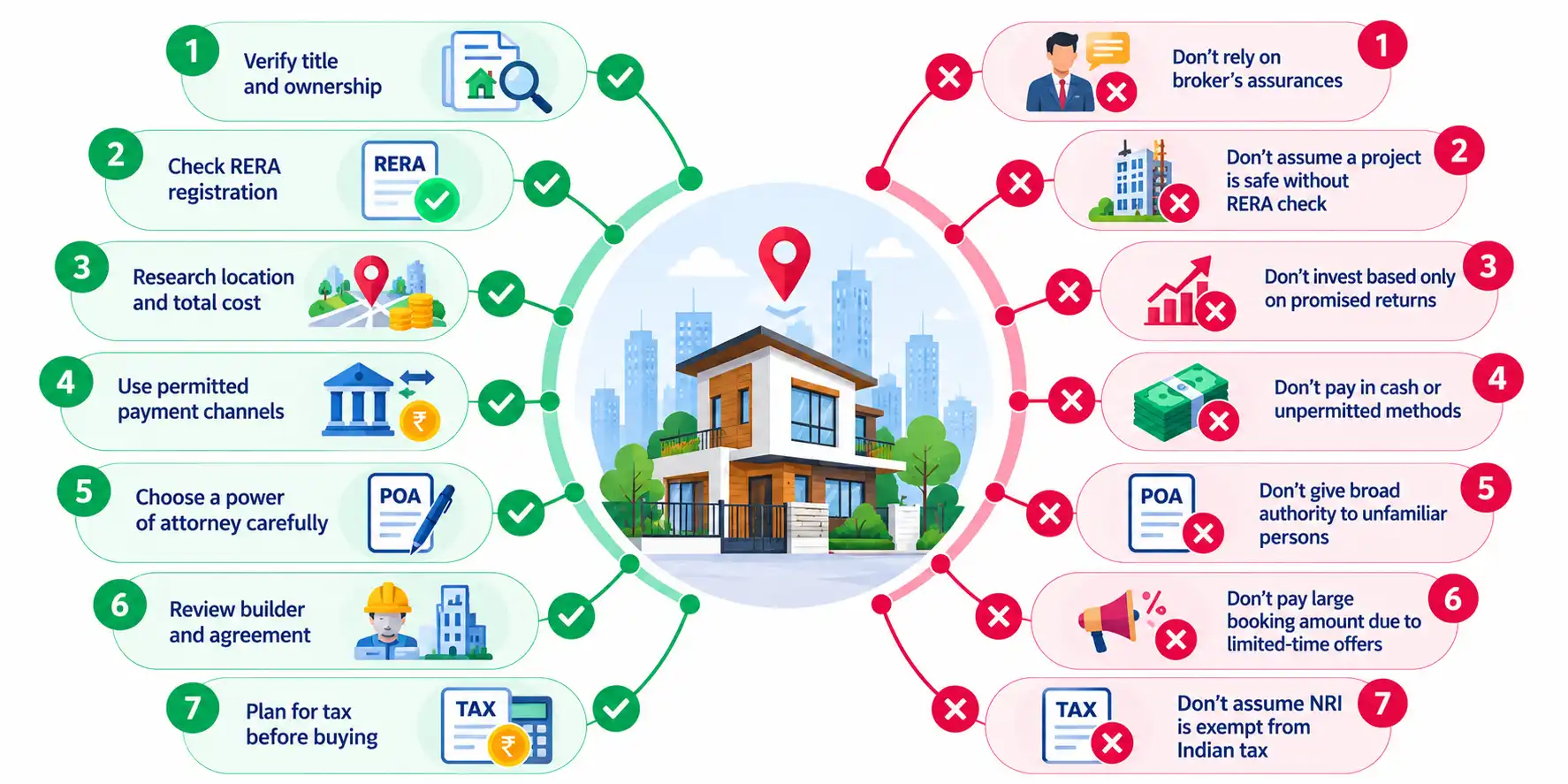
Do: Confirm the accepted funding route with your bank and the seller or developer before transferring money. Under the applicable FEMA framework, payment for eligible NRI/OCI property purchases is generally made through normal banking channels using permitted inward remittances or eligible non-resident accounts, such as NRE, NRO, or FCNR(B), as applicable.
Don’t: Pay the purchase consideration in cash, foreign currency notes, traveller's cheques, or another method that is not permitted under the applicable rules.
Maintain bank statements, remittance records, payment receipts, agreements, and proof of the source of funds. These records can be important for compliance and any future repatriation request.
Do: If you cannot attend the transaction in India, consider whether a properly drafted Power of Attorney (PoA) is appropriate. Clearly define the representative's authority and follow the applicable execution, attestation, stamping, and registration requirements.
Don’t: Give broad authority to an unfamiliar person or assume that signing a PoA automatically completes every legal formality.
A PoA does not remove the need for due diligence, valid sale or purchase documents, payment compliance, and property registration where required. Obtain advice on the document's acceptance in the relevant Indian state.
Do: Examine the developer's track record, delivery history, litigation disclosures where available, approvals, construction status, payment schedule, possession conditions, and remedies for delay.
Read the agreement carefully and seek clarification about carpet area, specifications, cancellation, maintenance, handover, and other obligations.
Don’t: Pay a large booking amount simply because a promotion is described as a limited-time offer.
For under-construction property, check the project documents and contractual terms before making payments. The payment schedule should be understood in relation to the agreement and applicable legal requirements.
Do: Consider how the property will be used, how rental income will be reported, and how a future sale could be taxed. Keep records of the purchase price, stamp duty, registration costs, eligible improvement expenses, rental receipts, and relevant tax deductions.
Don’t: Assume that being an NRI exempts you from Indian tax on property income or gains.
Rental income from property located in India is generally taxable in India, subject to the applicable rules. A future sale may result in capital gains, and the buyer may have to deduct tax at source when purchasing property from a non-resident seller.
Tax rules can depend on the transaction date and the law applicable to the relevant tax year. For relevant tax matters from 1 April 2026, check the Income-tax Act, 2025 and the applicable rules. Obtain transaction-specific advice before signing the agreement or selling the property.
| Property type | General position for NRIs/eligible OCIs |
|---|---|
| Residential apartment or house | Generally permitted, subject to applicable rules |
| Commercial property | Generally permitted, subject to applicable rules |
| Non-agricultural plot | May be permitted; verify land classification, title, and local rules |
| Agricultural land | Generally not permitted for purchase under the ordinary route |
| Plantation property | Generally not permitted for purchase under the ordinary route |
The classification of land matters. A plot marketed as a residential or investment plot should not be treated as eligible without verifying its legal classification and permitted use.
Inheritance and other specifically permitted acquisitions may be governed by different conditions. If the property is agricultural, plantation, or a farmhouse, obtain advice before entering into any transaction.
NRI property investors should plan for tax at both the income and sale stages.
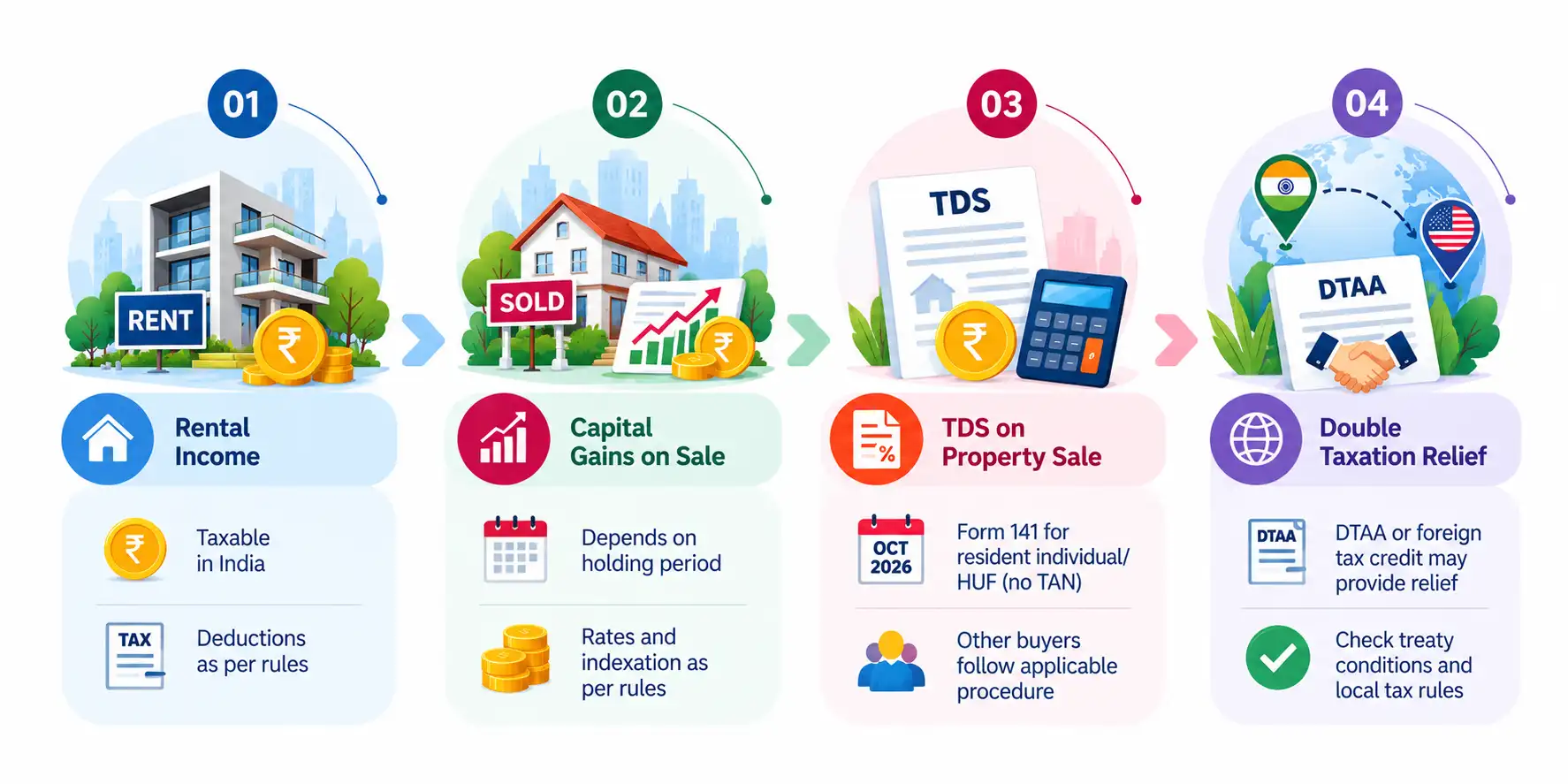
Rent earned from property located in India is generally taxable in India. The computation may allow deductions under the applicable provisions, and tax may be required to be deducted by the tenant depending on the facts and relevant law.
Keep a record of rent received, expenses, and tax deducted. Check the applicable tax year and filing requirements before preparing your return.
When an NRI sells Indian property, the profit may be taxable as capital gains. The treatment depends on the acquisition and transfer dates, holding period, cost basis, eligible expenses, and the law applicable to the transaction.
Do not rely on an old fixed-rate statement without checking the current rules. The tax rates, indexation treatment, and transitional provisions can depend on the date of transfer and the applicable legislation.
When a non-resident sells immovable property in India, the buyer generally has TDS obligations under the applicable non-resident payment provisions. The withholding treatment is not necessarily the same as the TDS rules for a resident seller.
For specified transactions from 1 October 2026, a resident Individual or Hindu Undivided Family (HUF) buyer can report TDS on a purchase from a non-resident through Form 141, Schedule E, under section 393(2) of the Income-tax Act, 2025, without obtaining a Tax Deduction and Collection Account Number (TAN) solely for this purpose. Other buyer categories must follow the applicable reporting procedure.
The amount deducted may differ from the seller's final tax liability. In suitable circumstances, the seller may need to evaluate an application for lower or nil withholding, file a return, or claim a refund, subject to the relevant requirements.
Official reference: Income Tax Department — Form 141, Schedule E, and TDS when a non-resident sells immovable property.
If you are tax-resident in another country, the same property income or capital gain may also need to be considered under that country's tax rules. A Double Taxation Avoidance Agreement (DTAA) or foreign tax credit may provide relief where the conditions are met.
Relief is not automatic in every case. Check the applicable treaty, residency conditions, documentation, and local tax rules.
NRIs may be able to repatriate eligible proceeds from the sale of Indian property, but the process depends on the source of funds, property type, applicable FEMA rules, and banking documentation.
The often-mentioned USD 1 million limit is not a blanket permission to transfer any property-sale amount overseas. It applies within a specific regulatory framework and subject to conditions. Separate rules apply to qualifying property acquired using eligible foreign-exchange remittances or funds from specified non-resident accounts. Under the applicable property-sale repatriation rules, the amount repatriated is subject to the relevant funding conditions and, for residential property, a limit of two such properties.
Before selling or transferring money abroad:
Official reference: RBI — FAQs on Purchase and Transfer of Immovable Property by Non-Resident Individuals.
Get help understanding NRI property taxation, capital gains, TDS, and cross-border compliance considerations.
There is no universally better option. The right choice depends on the investor's financial objectives, risk tolerance, investment horizon, and ability to manage the property from abroad.
Residential property may be worth evaluating if you want a future home for yourself or family, are considering rental income, or prefer a property with a use beyond investment.
Commercial property may be worth evaluating if you understand the local business-rental market, can assess tenant quality and lease terms, and can manage potentially different vacancy, maintenance, and liquidity risks.
Compare net returns rather than headline rental yields. Include vacancy, maintenance, property management, taxes, transaction costs, and the time it may take to sell. Neither property type guarantees capital appreciation or rental income.
Real estate can be one way for NRIs to maintain an asset in India, generate rental income, or plan for future use. But residential and commercial properties involve different risks, and neither should be selected solely on the basis of projected returns or marketing claims.
Before investing, verify eligibility, ownership and approvals, funding routes, total costs, tax obligations, and the conditions for any future repatriation. A properly documented transaction and independent legal and tax review can help you make a more informed decision.
Planning to invest in Indian property as an NRI? SaveTaxs can help you understand the relevant NRI taxation and financial-compliance considerations before you proceed.
This article is for general informational purposes only and does not constitute tax, legal, financial, or investment advice. Laws, regulations, rates, and procedures may change over time and may vary based on individual circumstances.
While SaveTaxs makes reasonable efforts to keep the information accurate and up to date, readers should verify applicable rules with official authorities or consult a qualified professional before making decisions based on this information.
Vipul Jain is the Co-Founder of SaveTaxs and a tax expert with experience in Indian and NRI taxation. He advises individuals, NRIs, and businesses on tax filing, tax planning, capital gains, DTAA, and compliance matters. He focuses on making complex tax concepts simple and helping taxpayers make informed, compliant decisions. See Full Bio
Want to read more? Explore Blogs