
- What Is the Foreign Tax Credit for NRIs?
- When Can an NRI Claim the U.S. Foreign Tax Credit?
- Which Foreign Taxes Qualify for the Foreign Tax Credit?
- How Is the Foreign Tax Credit Calculated?
- Foreign Tax Credit Limitation and Unused Credit
- Foreign Tax Credit vs Foreign Tax Deduction
- Do NRIs Need Form 1116 to Claim the Foreign Tax Credit?
- Conclusion
If you are an NRI with U.S. tax obligations, earning income in India can sometimes create tax exposure in both countries. For example, you may pay Indian income tax on income earned in India while the same income also enters your U.S. tax calculation.
The U.S. Foreign Tax Credit (FTC) is designed to reduce this type of double taxation by allowing eligible taxpayers to claim a credit for certain foreign income taxes paid or accrued.
However, being an NRI does not automatically make you eligible for the U.S. Foreign Tax Credit. “NRI” is an Indian residential-status concept. For U.S. tax purposes, whether you are a U.S. citizen, resident alien, or nonresident alien can significantly change how the FTC rules apply.
This guide explains when the Foreign Tax Credit for NRIs may apply, which foreign taxes can qualify, how the credit limitation works, and what happens when you cannot use the full credit in the current year.
- The Foreign Tax Credit for NRIs can help reduce double taxation when qualifying foreign-source income is taxed abroad and also enters the U.S. tax calculation.
- Being an NRI under Indian tax rules does not automatically qualify you for the U.S. FTC.
- The credit is particularly relevant to NRIs who are U.S. citizens or U.S. resident aliens and therefore generally face U.S. tax on worldwide income.
- Not every tax paid in India qualifies. The IRS applies specific requirements to determine whether a foreign tax is creditable.
- The allowable FTC can be lower than the actual foreign tax paid because of the Foreign Tax Credit limitation.
- Eligible unused foreign taxes can generally be carried back 1 year and forward up to 10 years, subject to applicable rules.
- Individuals generally use Form 1116 to calculate the FTC, although a limited exception applies in certain cases.
What Is the Foreign Tax Credit for NRIs?
The Foreign Tax Credit is a U.S. tax mechanism intended to reduce the double-tax burden that can arise when foreign-source income is taxed by both the United States and a foreign country.
This is particularly relevant for some NRIs because Indian and U.S. tax residency rules operate independently.
For example, an Indian citizen may qualify as an NRI under Indian income-tax rules while simultaneously being treated as a U.S. resident alien for U.S. federal income-tax purposes.
U.S. citizens and resident aliens are generally subject to U.S. federal income tax on worldwide income. Therefore, an NRI who is a U.S. resident alien may have to include certain income from India in their U.S. tax return even though India has already taxed it.
If the Indian tax satisfies U.S. requirements for a creditable foreign tax, an FTC may help offset some or all of the U.S. tax attributable to the relevant foreign-source income.
The IRS generally requires a foreign tax to be imposed on you, paid or accrued by you, represent your legal and actual foreign tax liability, and qualify as an income tax or tax in lieu of an income tax.
When Can an NRI Claim the U.S. Foreign Tax Credit?
The first question should not be simply, “Am I an NRI?”
Instead, determine your U.S. tax status and whether the foreign income is subject to U.S. taxation.
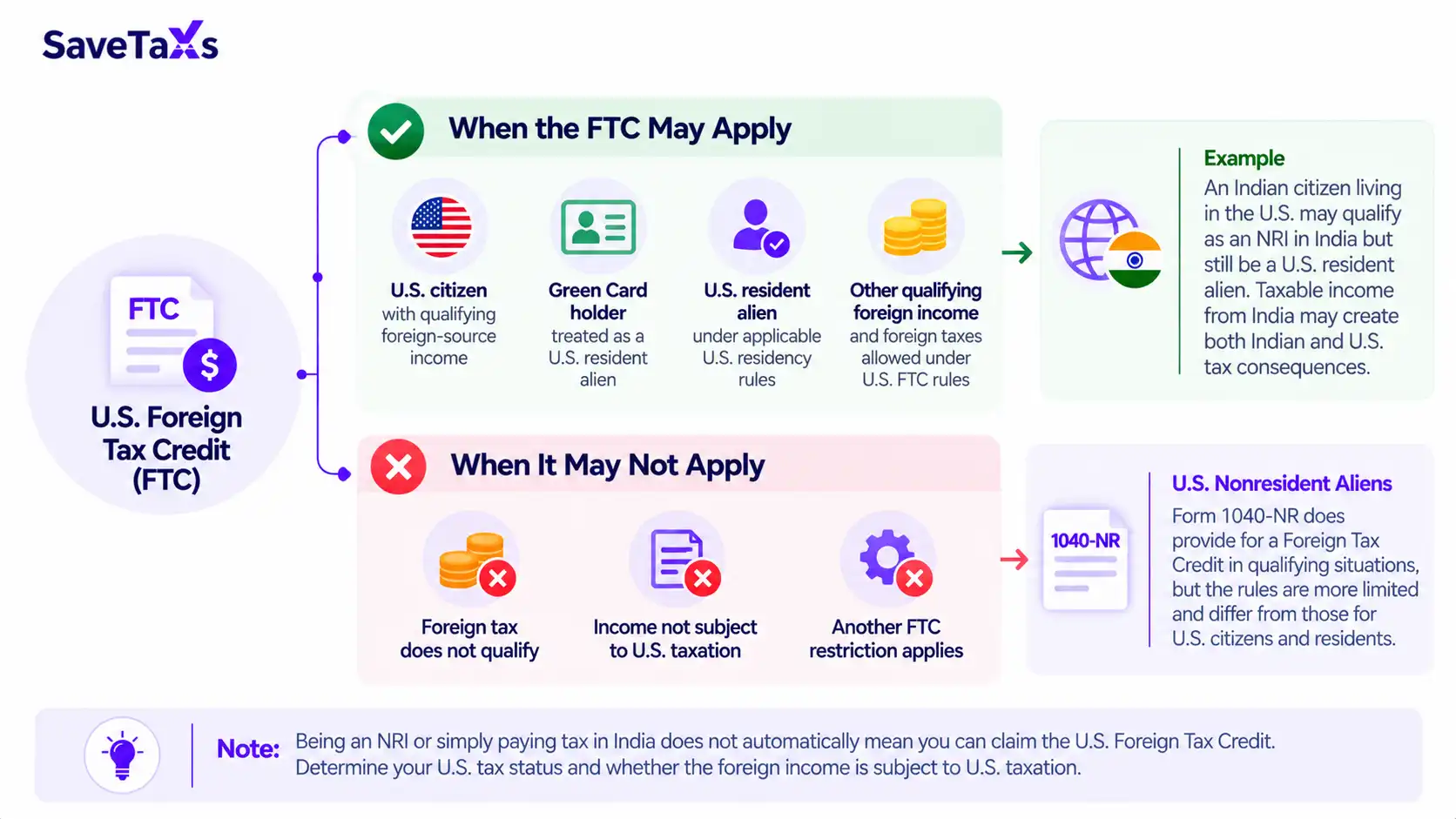
When the FTC May Apply
The Foreign Tax Credit may be relevant when an NRI:
- is a U.S. citizen with qualifying foreign-source income;
- is a Green Card holder treated as a U.S. resident alien;
- qualifies as a U.S. resident alien under applicable U.S. residency rules; or
- otherwise has foreign-source income and foreign taxes for which the U.S. FTC rules permit a credit.
A common example is an Indian citizen living in the United States who qualifies as an NRI in India but remains a U.S. resident alien. If that person continues earning taxable income from India, the same income may create both Indian and U.S. tax consequences.
When It May Not Apply
The normal FTC rules do not automatically apply merely because an NRI paid tax in India.
The credit may be unavailable or restricted when the foreign tax does not qualify, the underlying income is not subject to relevant U.S. taxation, or another FTC restriction applies.
U.S. nonresident aliens also have different and more limited rules. Form 1040-NR does provide for a Foreign Tax Credit in qualifying situations, so it would be incorrect to say that nonresident aliens can never claim one. However, their U.S. tax system and FTC eligibility differ substantially from those of U.S. citizens and resident aliens.
NRI point of view: Do not use your Indian NRI status alone to decide whether you qualify for a U.S. FTC. Establish your U.S. tax status first.
Which Foreign Taxes Qualify for the Foreign Tax Credit?
Paying a tax or government charge in India does not automatically create a U.S. Foreign Tax Credit.
For a foreign tax to generally qualify, the IRS requires four basic conditions:
- The tax must be imposed on you.
- You must have paid or accrued the tax.
- It must be your legal and actual foreign tax liability.
- It must be an income tax or a tax imposed in lieu of an income tax.
Certain taxes can still be non-creditable even if the basic requirements appear to be satisfied.
This distinction matters for NRIs because payments such as Indian GST, stamp duty, or ordinary property-related levies should not be assumed to qualify merely because they are taxes paid in India.
There is another important issue: tax withheld is not necessarily the same as creditable foreign tax.
Suppose too much tax was withheld in India and you are entitled to a refund or lower treaty rate. The IRS generally looks at your legal and actual foreign tax liability rather than simply accepting the gross amount withheld as the creditable amount.
What About Income Excluded From U.S. Tax?
You generally cannot claim a Foreign Tax Credit for the portion of foreign taxes attributable to income excluded under the Foreign Earned Income Exclusion or foreign housing exclusion.
This prevents the same income from receiving both an exclusion from U.S. tax and an FTC for the related foreign tax.
For an NRI using multiple cross-border tax provisions, this interaction needs to be checked before assuming that all foreign taxes are available for FTC.
How Is the Foreign Tax Credit Calculated?
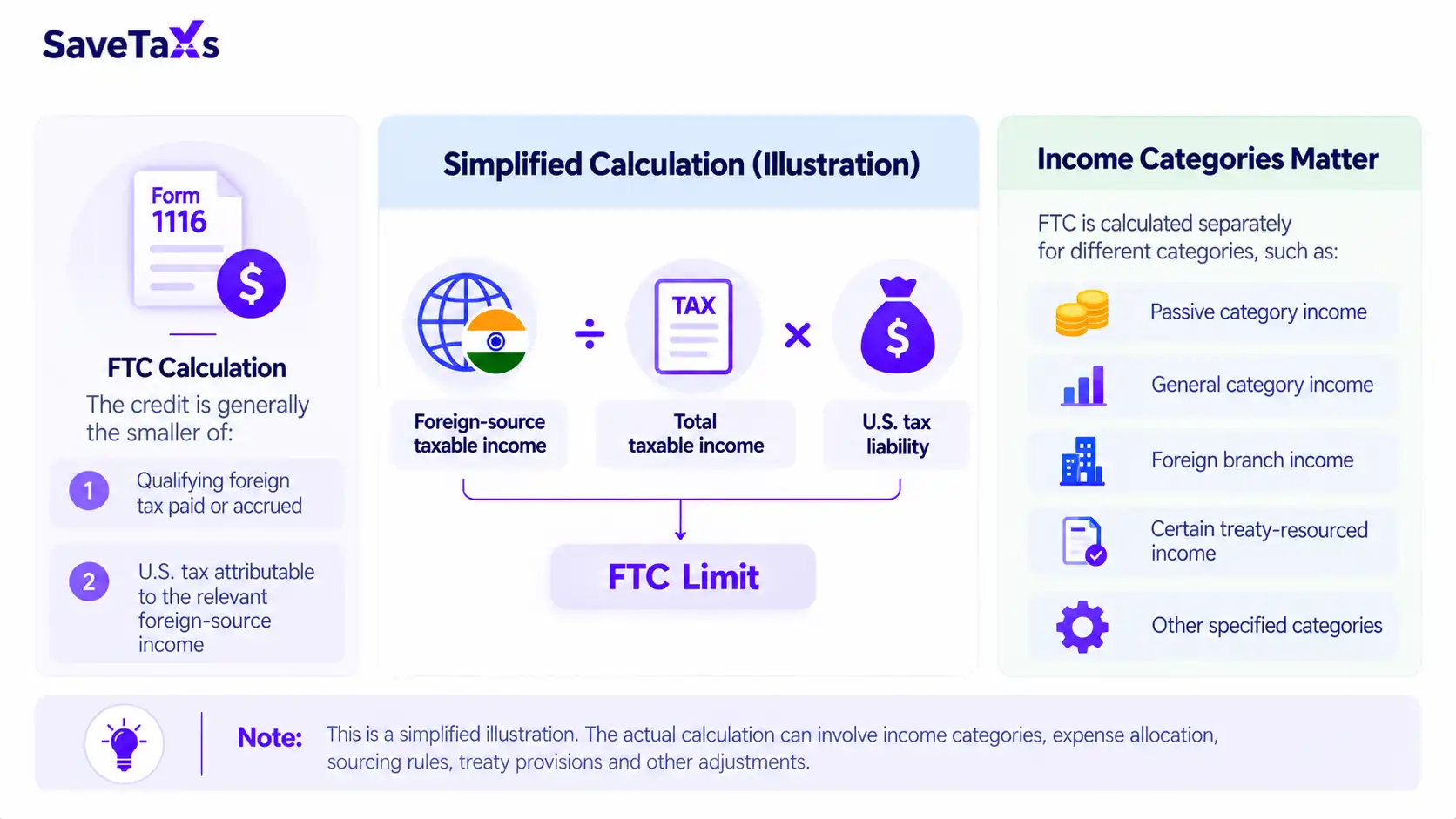
The amount of Indian tax you pay is not necessarily the amount you can claim against your U.S. tax liability.
When Form 1116 applies, the FTC is generally limited to the smaller of the qualifying foreign tax paid or accrued and the U.S. tax attributable to the relevant foreign-source income.
A simplified way of understanding the limitation is:
Foreign-source taxable income ÷ Total taxable income × U.S. tax liability
This is only a simplified illustration. The actual calculation can involve income categories, expense allocation, sourcing rules, treaty provisions, and other adjustments.
Why Income Categories Matter
The FTC limitation is calculated separately for different categories of foreign income.
These can include passive category income, general category income, foreign branch income, certain treaty-resourced income, and other specified categories.
Therefore, an NRI should not simply combine every type of Indian income and every rupee of Indian tax into one FTC calculation.
Foreign Tax Credit Limitation and Unused Credit
Consider an NRI who paid $6,000 of qualifying foreign income tax but whose current-year FTC limitation for the relevant category is only $4,500.
The taxpayer generally cannot use the full $6,000 simply because that amount was paid abroad.
The current-year credit may be limited to $4,500, leaving $1,500 of excess foreign tax.
Subject to the applicable rules, unused qualifying foreign tax can generally be:
Carried back: 1 year
Carried forward: up to 10 years.
There are exceptions. For example, the IRS states that no carryback or carryover is allowed for foreign tax on section 951A category income.
For NRIs with Indian income that varies significantly from year to year, tracking unused foreign taxes can therefore be important.
Foreign Tax Credit vs Foreign Tax Deduction
Eligible taxpayers may generally choose between taking qualifying foreign income taxes as a credit or claiming them as an itemized deduction.
These two methods have different effects.
| Foreign Tax Credit | Foreign Tax Deduction |
|---|---|
| Directly reduces applicable U.S. income tax | Reduces taxable income |
| Subject to FTC rules and limitations | Claimed as an itemized deduction |
| Can provide a dollar-for-dollar tax reduction up to the allowable credit | Tax benefit depends on the effect of the deduction |
| Often more beneficial when fully usable | May be appropriate in particular circumstances |
For example, an allowable $1,000 FTC can reduce the applicable U.S. tax by $1,000. A $1,000 deduction instead reduces taxable income by $1,000.
The IRS allows taxpayers to choose between a credit and deduction for qualified foreign taxes, subject to the applicable rules, and generally requires the choice to be applied consistently to qualified foreign taxes for that year.
For many eligible NRIs, the credit may produce a greater benefit, but the result depends on the taxpayer's facts.
Do NRIs Need Form 1116 to Claim the Foreign Tax Credit?
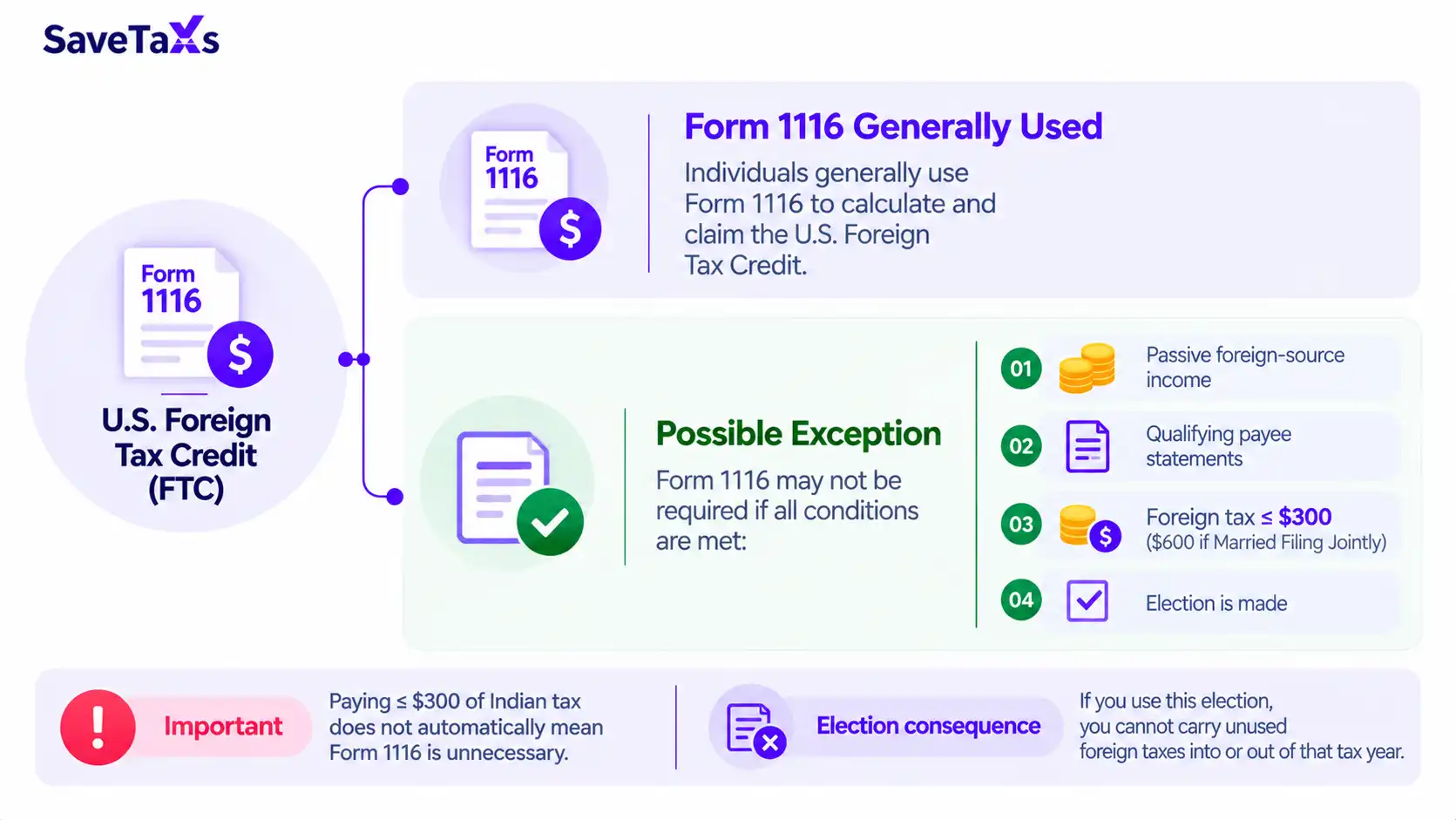
Individuals generally use Form 1116, Foreign Tax Credit (Individual, Estate, or Trust) to calculate and claim the Foreign Tax Credit.
However, Form 1116 is not required in every case.
An individual may qualify to claim the FTC without Form 1116 when all applicable conditions for the exception are satisfied. Among the core requirements:
- the foreign-source gross income must meet the applicable passive-income requirement;
- the income and foreign taxes must be reported on qualifying payee statements;
- total creditable foreign taxes cannot exceed $300, or $600 for Married Filing Jointly; and
- the taxpayer must elect the procedure.
Additional requirements apply.
An NRI therefore should not assume that paying less than $300 of Indian tax automatically means Form 1116 is unnecessary.
Another important consequence is that if you use this election, you cannot carry unused foreign taxes into or out of that tax year.
Suppose Rahul is an Indian citizen who lives and works in the United States.
For Indian tax purposes, he qualifies as an NRI. For U.S. federal income-tax purposes, however, Rahul is a resident alien.
He continues to hold investments in India and earns income that, under the applicable sourcing and tax rules, is taxable in India and also enters his U.S. tax calculation.
Assume for illustration that:
- Rahul has $100,000 of total taxable income;
- $20,000 is applicable foreign-source taxable income;
- his U.S. income tax before FTC is $18,000; and
- he paid $5,000 of qualifying Indian income tax attributable to that income.
Using a simplified FTC limitation:
$20,000 ÷ $100,000 × $18,000 = $3,600
Although Rahul paid $5,000 of qualifying Indian income tax, the simplified current-year FTC limitation in this example is $3,600.
The remaining $1,400 is not automatically refunded by the IRS. Depending on the applicable category and other rules, the unused foreign tax may potentially be available under the carryback or carryforward provisions.
The example highlights three important points for NRIs:
Rahul's Indian NRI status does not create the FTC. His U.S. tax position is critical.
The amount of Indian tax paid does not automatically equal the U.S. credit.
And the FTC must be analyzed using U.S. sourcing, income-category, limitation, and creditability rules.
Conclusion
The Foreign Tax Credit for NRIs can be valuable when income is exposed to taxation in both the United States and another country such as India.
But the first question is not simply whether you are an NRI.
You need to determine your U.S. tax status, whether the relevant foreign income enters your U.S. tax calculation, whether the tax paid abroad qualifies as a creditable foreign tax, and how the FTC limitation applies.
For NRIs who are U.S. citizens or resident aliens, this can be particularly important because their U.S. tax obligations can extend to worldwide income. For U.S. nonresident aliens, different and more restrictive rules can apply.
Once you determine that a Foreign Tax Credit may be available, the next step is deciding how the credit should be calculated and reported. Where required, that is handled through Form 1116.

Hatim Dudhiyawala is a Certified Public Accountant (CPA) with SaveTaxs and specializes in Indian and NRI taxation. He advises individuals, NRIs, and businesses on income tax filing, capital gains taxation, DTAA benefits, fund repatriation, and tax compliance. With experience in cross-border tax matters, Hatim helps taxpayers understand complex regulations and make informed decisions. Through his articles, he shares practical insights to help readers stay compliant and manage their tax obligations with confidence. See Full Bio
Expert CA-led ITR filing

- What Is the Foreign Tax Credit for NRIs?
- When Can an NRI Claim the U.S. Foreign Tax Credit?
- Which Foreign Taxes Qualify for the Foreign Tax Credit?
- How Is the Foreign Tax Credit Calculated?
- Foreign Tax Credit Limitation and Unused Credit
- Foreign Tax Credit vs Foreign Tax Deduction
- Do NRIs Need Form 1116 to Claim the Foreign Tax Credit?
- Conclusion
Frequently Asked Questions
U.S. citizens, resident aliens, and, in some situations, dual-status taxpayers who have paid or accrued foreign income taxes on foreign-sourced income.
If you don't claim the FTC, you may end up paying taxes twice, once in the foreign country and again in the United States.
You can claim the Foreign Tax Credit by filing Form 1116 along with your U.S. tax return (Form 1040). After that, you need to report the foreign income, taxes paid, and attach proof to lower your U.S. tax liability.
No, the foreign tax credit is non-refundable. It only lowers your U.S. tax due. Any unused credit can be carried back 1 year or carried forward up to 10 years.
Form 1116 is required if you paid over $300 ($600 for married filing jointly) in foreign taxes or have multiple sources of foreign income. For smaller amounts, you can claim without using Form 1116.