


Investment & Financial Planning
NRI Property Sale: How to Calculate Capital Gains TaxNRI Property Sale: How to Calculate Capital Gains Tax
Written by Shubham Jain


Fractional real estate investment is an innovative approach in which a group of investors pool in their funds to purchase a high-value property together. This offers passive income, low entry costs, and a dash of diversification to one's portfolio. And with SEBI reforms supporting it, this investment option has now become the talk of the town.
This has also attracted the attention of non-resident Indian who want to own a share in the high-value properties of India. And with respect to NRIs, let us understand the fractional ownership of real estate for NRIs, including its benefits to fractional ownership, tax implications, process, and
Fractional ownership is a type of investment in which different investors co-own a high-value property and receive returns with respect to their share invested. This is different from traditional real estate investments, as fractional ownership allows people with limited funds to invest in high-value properties in India.
Let us understand this with an example:
Imagine there is a very high-end premium office space worth Rs 100 cr in Noida. Now, if an individual had purchased it, he/she would have to invest Rs 100 cr to buy the property. But not everyone is this rich; only high-net-worth individuals can afford such a premium property.
Now, this is where the concept of fractional investment comes in: several investors come together, pool their money, and purchase that A-grade commercial property in Noida.
Here, each investor has partial ownership of the office, and the profit is divided proportionally to the amount of funds invested. This is how fractional ownership lets individuals with limited funds step into the A-grade premium segment of the real estate market.
As the economy or inflation in India rises, the market value of the property will also increase, providing investors with good returns.
Experts at Savetaxs help NRIs file smart NRI returns in India, ensuring their liabilities are minimised and exemptions are maximized.
In India, Grade A commercial or residential properties are usually listed on online platforms. However, the commercial properties usually have tenants. Now, as an NRI investor, you can contribute anywhere from Rs 10 lakh to 25 lakh or more, depending on the property's worth and the proportion of return you wish to enjoy.
The fractional ownership for every commercial property is executed through a specific purpose vehicle (SPV). Here, funds from all investors are routed through a trusteeship company or a limited liability partnership under which the SPVs operate.
SPV purchases the property, and each fractional owner of the property who has invested will own a share of the SPV holding the property proportionate to his/her fund contribution made in the property.

The entire Specific Purpose Vehicle is created solely to hold the property on behalf of the customer. The investment platform is liable for the Specific Purpose Vehicle (SPV) and the associated underlying property on behalf of the customers.
The property's fractional ownership is transferred to the investor through an SPV.
Additionally, NRI investors must sign the SPV agreements to be registered with the "Registrar of Companies (ROC)" under the Ministry of Corporate Affairs. Post signing, all related documents for the property, such as the property sale deed, rental, or lease agreements, along with a copy of the SPV agreement, are shared with the investors.
For NRIs looking to invest in the luxury segment of the Indian real estate market, fractional ownership of real estate offers a range of benefits. Here are the best ones:
The tax implications of fractional property investments for NRIs are as follows:
An NRI can easily invest in fractional ownership of a commercial or residential property in India. However, please ensure that FEMA does not allow agricultural land, farmhouses, or plantation property. Here are the steps:
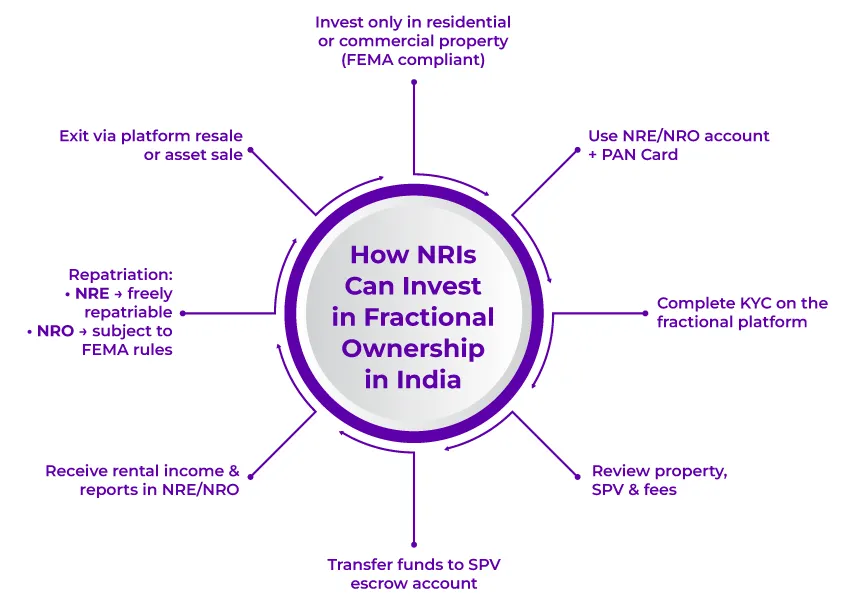
As per FEMA regulations, NRIs are allowed to invest only in residential or commercial properties.
Keep NRE/NRO Accounts and PAN Ready
NRIs, please ensure that your investments are made only through the NRE or NRO bank account. Having a PAN card is mandatory when dealing in the Indian real estate market.
You must complete KYC verification by providing the required documents, including your PAN card, Passport, overseas address proof, and NRE/NRO bank details.
As an NRI, before you make any fractional ownership in Indian real estate investment, review.
Reviewing this beforehand ensures that the organization and the structure comply with FEMA.
NRIs must transfer funds from their NRE/NRO bank accounts to the SPV's escrow account. Then the platform issues fractional units and shares once all funds have been received.
After the investment is made, NRIs will receive monthly/quarterly
The repartition of rental income or exit proceeds depends on the source account from which the investments were made.
If you have invested the fund through an NRE account, the rental and exit proceeds are easily repatriable without any restrictions.
Whereas if you have used an NRO account to invest, Repatriation is allowed but subject to certain FEMA restrictions.
The lock-in period and exit option for fractional investments vary from portal to portal. Some portals have a six-month lock-in period, while others do not impose any such restrictions. Now, when it comes to the exit, there are usually three ways to make it.
Release your share through the investors' dashboard, in a private sale, or in a complete asset sale when the entire property is being sold.
In a nutshell, exit after the capital gains or when the assest appreciation cycle ends.
NRI financial planning experts at Savetaxs help you with an entire financial plan for handling your cross-border finances effectively.
The following are the risks that an NRI must consider before making a fractional investment.
| The Feature | Traditional Investments | Fractional Ownership |
|---|---|---|
| Capital Requirement | High/Medium | Low |
| The Property Ownership | Full Property | Fractional Property Share |
| Liquifity | Low | Moderate |
| Divesification | Difficult | Easy |
In a nutshell, for NRIs, fractional real estate ownership for NRIs offer diversification across properties, reduce risk, and provide exposure to high-value assets.
Fractional ownership of real estate for NRIs allows them to explore the premium and high-end segment of the Indian real estate market. This entire concept of fractional property ownership is innovative, cost-effective, and a viable option for NRIs.
It provides shared ownership, professional property management, and access to world-class amenities. This investment model is changing the pathway for NRIs to be a part of India's high-end market and generate good returns.
If you are an NRI contemplating fractional ownership and need expert guidance along the way until you make a purchase, Savetaxs will get the job done right.
We have been helping NRIs from 20+ countries make real estate investments in India, whether traditional or fractional, and our satisfied clientele speaks volumes about the services we provide.
Connect with us and explore the high-end segment of the Indian real estate market with Savetaxs. We serve our clients 24/7 across all time zones.
This article is for general informational purposes only and does not constitute tax, legal, financial, or investment advice. Laws, regulations, rates, and procedures may change over time and may vary based on individual circumstances.
While SaveTaxs makes reasonable efforts to keep the information accurate and up to date, readers should verify applicable rules with official authorities or consult a qualified professional before making decisions based on this information.
Shubham Jain is the Founder of SaveTaxs and has extensive experience in Indian and NRI taxation. He advises individuals, NRIs, and businesses on tax filing, tax planning, capital gains, DTAA benefits, fund repatriation, and compliance matters. He regularly writes about taxation and related financial topics. His focus is on making complex tax concepts easy to understand. Through his articles, he helps taxpayers stay informed, avoid common mistakes, and stay compliant with Indian tax laws. See Full Bio

Want to read more? Explore Blogs
_1781845771869.webp&w=828&q=75)
_1778936280179.webp&w=828&q=75)