
UAE NRI Taxation
How UAE NRIs Can Build a Retirement Corpus for IndiaHow UAE NRIs Can Build a Retirement Corpus for India
Written by Shubham Jain
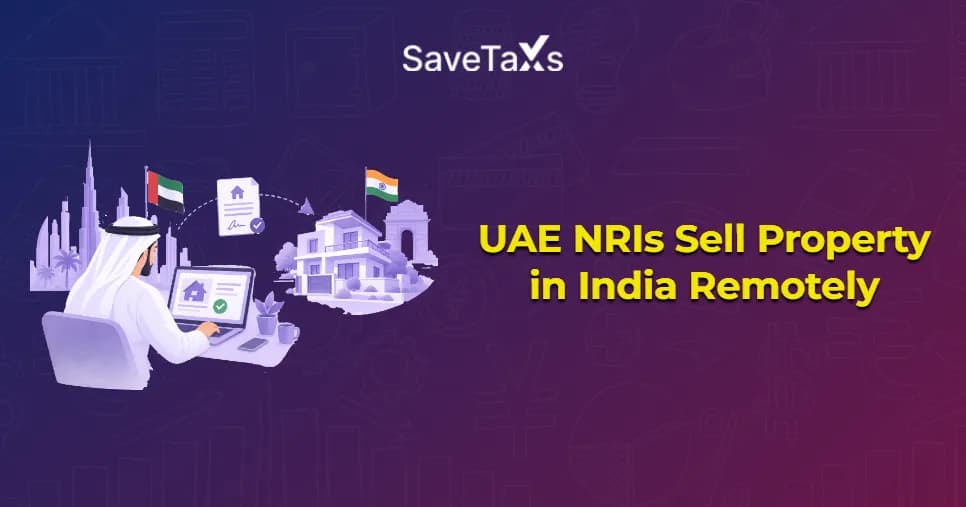
Want to sell your Indian property but unable to visit the country? What if I told you you can do it without going to India? For NRIs living in the UAE, owning property in India is a way to stay connected to their Indian roots. However, when it comes to selling that property without visiting, a common question arises: how can they do so? UAE-based NRIs can sell eligible property in India remotely through a Power of Attorney (PoA), subject to applicable legal and registration requirements.
Apart from appointing a PoA, there are several other things that NRIs need to consider when selling Indian property from the UAE. This includes legal complexities, Indian taxes, and more.
Want to know how UAE-based NRIs sell property in India remotely in detail? Read the blog and get your answers.
Yes, NRIs can sell eligible Indian property from the UAE without being physically present in India. Considering this, Indian law allows:
Further, UAE-based NRIs can sell residential and commercial properties without visiting India. Under FEMA, an NRI can transfer immovable property in India to a person resident in India. An NRI can also transfer eligible immovable property, other than agricultural land, plantation property, or a farmhouse, to another NRI or OCI, subject to applicable FEMA requirements. A remote sale does not change the Indian laws and tax rules applicable to NRIs during property sales. Remote sale only changes how NRIs manage the transaction process.
Now, let's look at the role of a Power of Attorney (PoA) in a property sale.
A Power of Attorney (PoA) is one way of selling Indian property without visiting India. Through a PoA, a UAE-based NRI authorizes a reliable or professional person to:
So, this is the role of a Power of Attorney (PoA) for UAE-based NRIs selling property in India remotely. Moving further, let's know how UAE-based NRIs can sell property in India remotely.
With Savetaxs, plan your sale in advance and stay compliant with Indian property and tax rules.
Here is how UAE-based NRIs can sell property in India remotely:
Before you begin the sale, confirm you legally own the property and that it is free of disputes. Important documents to verify include:
Carefully choose a Power of Attorney (PoA) that can efficiently represent you before the relevant authorities in India. A PoA can be your family member, friend, or professional. The PoA holds the following powers, if specifically authorized:
A PoA executed outside India must meet the applicable authentication and registration requirements in India before it can be used for registration purposes. Under Section 33 of the Registration Act, 1908, a PoA executed by a principal residing outside India can be recognized when executed and authenticated in the prescribed manner.
A general remote-sale team includes the following people:
| Professional | Responsibility |
|---|---|
| Property Lawyer | Review the title, agreement, and sale deed |
| Chartered Accountant | Helps with TDS and capital gains planning |
| Broker | Marketing and buyer coordination |
| Local Representative | Helps with inspection, access, and documents |
Under the applicable tax law, when an NRI sells immovable property in India, the buyer is required to deduct TDS on the taxable amount under the provisions applicable to payments to non-residents. For transactions governed by the Income-tax Act, 2025 from 1 April 2026, TDS provisions are contained in Section 393. For transactions governed by the Income-tax Act, 1961, Section 195 applies.
In addition, depending on the period, you are also liable to pay tax on your capital gain. The applicable rates include:
For transfers on or after 23 July 2024, long-term capital gains on immovable property are generally taxed at 12.5% without indexation for non-residents, subject to applicable surcharge and cess.
Before finalizing the sale deed, check:
Once you finalize the property buyer, draft a sale agreement, outlining:
As per Section 17 of the Registration Act, 1908, instruments covered by the section are compulsorily registrable. The sale deed should be duly executed and presented for registration before the appropriate Sub-Registrar's Office in accordance with the applicable registration requirements.
If the property you sold has an active loan, you should declare it to the buyer before selling. This is because you may need to obtain a No Objection Certificate (NOC) or other release documentation from the bank confirming the status of the loan and charge on the property.
Under FEMA guidelines, you can transfer a limited amount from your NRO account to the UAE. Considering this, the repatriation is subject to:
The RBI permits eligible NRIs/OCIs to repatriate sale proceeds subject to the applicable FEMA conditions. Where the property was acquired out of foreign exchange or NRE/FCNR(B) funds, repatriation may be permitted to the extent specified under FEMA, subject to applicable conditions and, for residential property, the limit of not more than two such properties. Other eligible sale proceeds may generally be remitted under the USD 1 million facility.
This is how to use a Power of Attorney for selling Indian property from the UAE. Now, moving forward, let's look at the taxation rules for NRIs selling property in India.
Under Indian tax rules, the buyer is required to deduct TDS from the amount chargeable to tax when purchasing property from an NRI and deposit it with the Income Tax Department. The TDS rate for NRIs depends on the applicable capital gains category and the tax law applicable to the transaction.
Accordingly, long-term capital gains on transfers on or after 23 July 2024 are generally taxed at 12.5%, plus applicable surcharge and health and education cess. For short-term capital gains, the final tax liability is generally determined at the applicable rates based on the seller's tax status and income. For TDS purposes, the Income Tax Department specifies a 30% rate for short-term capital gains in the case of a non-resident individual or firm, plus applicable surcharge and cess.
This means the property buyer may withhold a large portion of the sale consideration upfront, which can be more than your final tax liability. However, you can reduce it by applying for a lower TDS certificate. For transactions governed by the Income-tax Act, 1961, the application is made under Section 197 in Form 13. For Tax Year 2026-27 under the Income-tax Act, 2025, the corresponding provision is Section 395(1), and the application is made in Form 128. The application should be made before the relevant payment or credit on which tax is required to be deducted.
In simple terms, the capital gains of the seller depend on the following things:
This covers the taxation rules for UAE-based NRIs selling property in India remotely. For a detailed overview, read our guide on "TDS rates, capital gains calculations and exemptions on property sales."
Now, moving ahead, let's look at the documents required for the property sale.
Here is the list of documents required for the property sale:
You'll need these documents during the property sale. Now, let's learn how to complete the sale deed registration.
Your final sale deed should match your property records and commercial terms. Considering this, before the sale deed registration, check the following things:
In addition, before the sale registration, verify the state-specific requirements for identity verification, witnesses, PoA acceptance, and original documents. Also, once you register the sale deed or official document, check that it matches the document you approved.
Next, let's discuss repatriating the sale proceeds to your UAE account.
Once your POA sold your Indian property, you first received the amount in your NRO account. For repatriating the sale proceeds to your UAE account, you need to fulfill the following requirements:
In addition, avoid the following things:
To learn more about the repatriation process, read our blog, "How NRIs Can Repatriate Property Sale Proceeds from India to UAE." Now, let's look at the tips for a smooth Indian property sale from the UAE.
At Savetaxs, we help UAE-based NRIs to manage their Indian tax and cross-border obligations with complete accuracy
Consider the following points when selling Indian property remotely from the UAE
These are key steps that help you complete a smooth Indian property sale remotely from the UAE.
Lastly, by appointing a Power of Attorney, UAE-based NRIs can sell eligible property in India remotely. The process also requires proper planning, an understanding of the legal and tax work, and proper documentation.
If you are facing issues selling Indian property from the UAE and need assistance, connect with Savetaxs. Our team of cross-border tax experts helps you stay compliant with Indian tax rules and meet them on time. Contact us to sell your property in India without any issues.
This article is for general informational purposes only and does not constitute tax, legal, financial, or investment advice. Laws, regulations, rates, and procedures may change over time and may vary based on individual circumstances.
While SaveTaxs makes reasonable efforts to keep the information accurate and up to date, readers should verify applicable rules with official authorities or consult a qualified professional before making decisions based on this information.
Vipul Jain is the Co-Founder of SaveTaxs and a tax expert with experience in Indian and NRI taxation. He advises individuals, NRIs, and businesses on tax filing, tax planning, capital gains, DTAA, and compliance matters. He focuses on making complex tax concepts simple and helping taxpayers make informed, compliant decisions. See Full Bio
Want to read more? Explore Blogs