
NRI Income Tax Compliance
How Much Gold Is Allowed From Dubai to India? Guide To 2026 LimitsHow Much Gold Is Allowed From Dubai to India? Guide To 2026 Limits
Written by Shubham Jain

If you are an NRI who has inherited or owns agricultural land in India and is planning to sell it, you have probably run into Section 54B while researching how to save tax on capital gains. This is a genuine exemption, and yes, NRIs can use it as well. However, there is a catch- a catch that many articles toss over, and it is specific to your residential situation as a non-resident. We will get to that here as well, along with all the aspects related to Section 54B.
Section 54B provides you with the capital gains exemption for the sale of urban agricultural land. Because rural agricultural land is not considered a capital asset, it is outside the scope of Section 54B. Individuals and HUFs who have used their land for agricultural activities can claim this exemption.
The idea behind this is simple: if you are reinvesting the sale proceeds in the farmland rather than taking the money for something else, the government does not tax those gains.
In a nutshell, Section 54B exempts capital gains from the sale of agricultural land if you reinvest the proceeds into new agricultural land within two years. The exemption applies only to individuals and HUFs, and only to urban agricultural land (rural agricultural land isn't taxed in the first place).
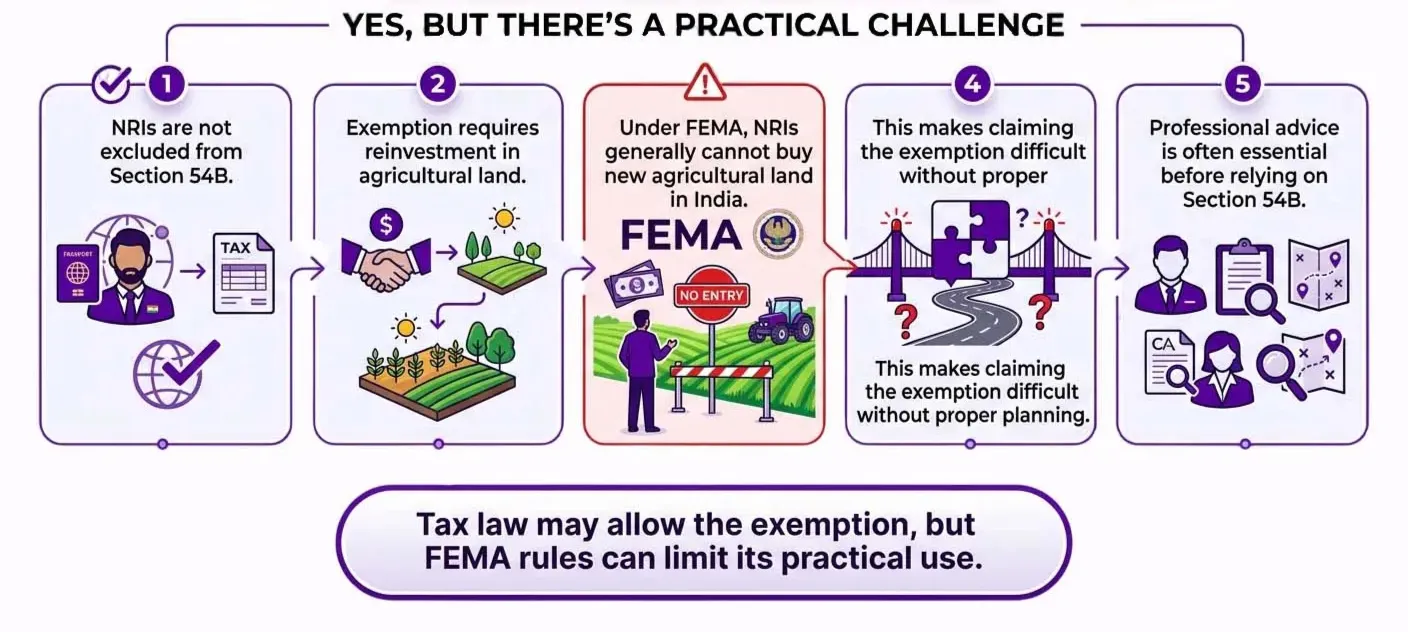
Yes, Indian tax law does not exclude a non-resident Indian from this exemption. As an NRI, if you are selling the agricultural land situated in India and you reinvest in another agricultural land in India, you can claim it just like any other resident taxpayer.
But here is the part that catches most of the NRIs off guard: under the FEMA rules, NRIs generally cannot purchase fresh agricultural land in India. However, you can inherit it and can continue to hold the land while being an NRI, but you aren't permitted to go out and buy new farmland to reinvest the sale proceeds in it.
This poses a practical problem for NRIs, as Section 54B requires reinvestment in agricultural land to claim the exemption. If FEMA won't let you buy the land, the exemption under Section 54B becomes quite hard to use unless you have a family member, typically a resident Indian who can be a co-purchaser, or you plan the transaction carefully with professional advice. This is the single most important thing an NRI needs to understand before assuming that any section 54B will save them from paying any tax.
Facing issues in filing ITR in India? At Savetaxs, from DTAA benefits to FEMA compliance, we handle every aspect of your Indian tax obligations.
To claim the exemption, all of these need to hold true:
You are an individual or a HUF; companies, LLPs, and firms do not qualify for this.
The land sold must be urban agricultural land (rural agricultural land is not treated as a capital asset in most cases and therefore does not require exemption under Section 54B).
You, your parents, or your HUF must have used the land for agricultural purposes for a minimum of 2 years immediately before the sale.
You must reinvest in another agricultural land, urban or rural, within the specified time.
Urban vs rural land and why does it matter: whether your land counts as "urban" depends on its distance from the nearest municipality and that area's population, based on the specific distance and population slabs set out in the law. If your land falls outside the prescribed limits, it is generally treated as rural agricultural land, and you do not need Section 54B because such gains are generally not taxable.
The following are certain reinvestment rules under Section 54B:
Time Limit For Purchasing New Agricultural Land
You must purchase the new agricultural land within two years from the date of transfer of the original agricultural land. The new land can be in any state in India; there is no requirement that it has to be near the land you have sold or even in the same state (urban or rural).
One thing to keep in mind is that the new land has to be purchased in your own name. You can't buy it under your spouse's name and still claim the exemptions.
If you cannot finalize the new land purchase before you file your own income tax return, do not panic; you will not lose the exemptions automatically. You can deposit the unutilized capital gains into the Capital Gains Accounts Scheme (CGAS) before the due date for filing your return under Section 139 of the Income-tax Act.
You then have until the two-year mark to actually use that deposited amount to buy the land. If you do not, the unused deposit will be treated as a long-term capital gain in the year the 2-year window closes, and it will become taxable.
Here is a practical note for NRIs: Opening and operating a CGAS account will involve standard KYC and NRI banking documentation. It is advisable to loop in your bank as early as possible because this isn't something to leave until the last week before your filing deadline.
How To Calculate The Exemptions Under Section 54B
The exemption amount is the lower of:
Example: Suppose you sell an agricultural land for Rs 60 lakhs and the capital gain works out to Rs 25 lakhs. You then bought a new agricultural land for Rs 15 lakhs.
Your exemption is capped at Rs 15 lakh (the lower of the two figures). The remaining Rs 10 lakh of the gains will be taxable.
Meera is an NRI based in Dubai. She inherited urban agricultural land from her father, who has used it for farming purposes over a decade. In the financial year 2025-26, she sold that land for Rs 80 lakh, resulting in a long-term capital gain of Rs 30 lakh (no indexation benefits will apply to her, since NRIs have lost that option for gains arising after 23rd July 2024).
Because Meera cannot buy fresh agricultural land for herself under the FEMA law, she works with her brother, a resident Indian, who purchases new agricultural land jointly in both their names, with Meera's share of investment being of Rs 20 lakhs. Her exemption under Section 54B is limited to Rs 20 lakh (the lower of her Rs 30 lakh gain and Rs 20 lakh investment), leaving Rs 10 lakh still taxable.
This example illustrates why NRIs generally need a resident family member involved or a specialist in FEMA and tax matters before assuming they can claim the full exemption on their own.
If you sell the new land within three years of buying it, the exemption you claimed will be reversed
| Scenario | What Happens |
|---|---|
| The new land is sold within the three years; the sale price is lower than the original capital gains. | In this case, the exemptions are withdrawn, and the cost of acquisition is treated as NIL. |
| New land sold within the three years, sale price higher than the original gains. | Exemption will be withdrawn; you cannot deduct the purchase price minus the exemption claimed) while computing the new gains. |
| New land sold after three years | The exemption stays intact. |
This is where NRI sellers face a materially different rule from resident sellers, and it catches many people off guard.
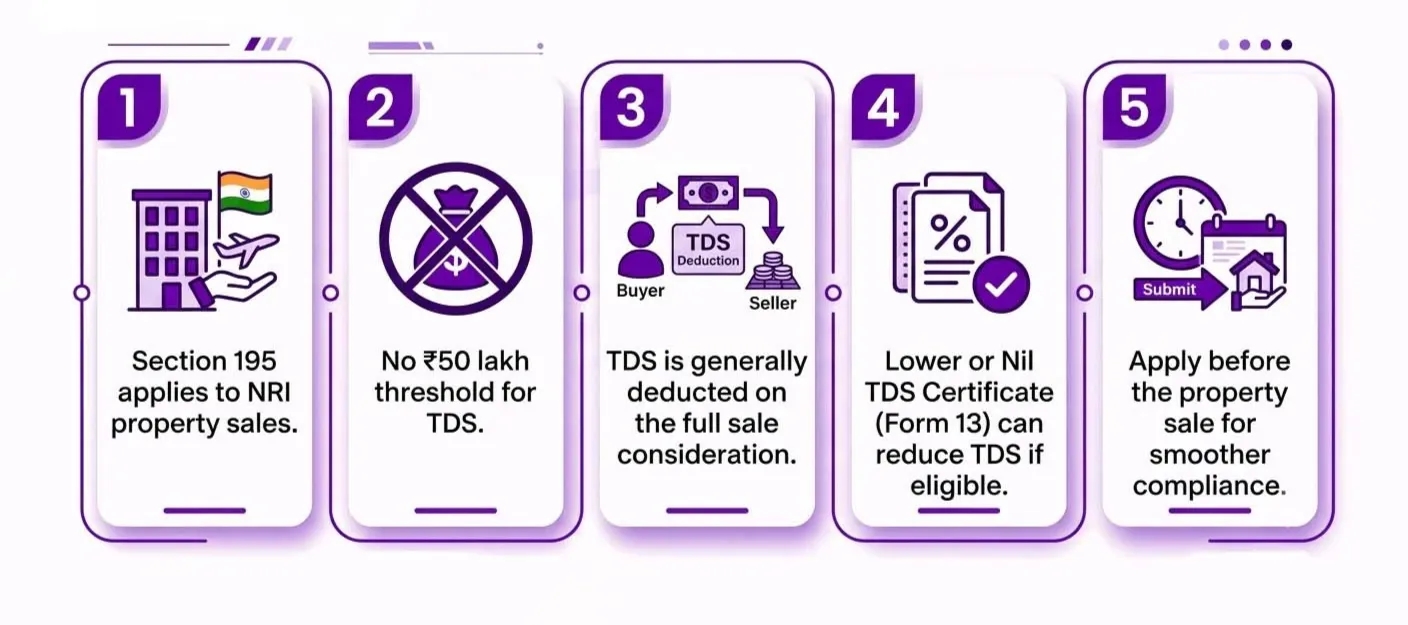
For resident-to-resident property sales, TDS under Section 194-IA is applicable only on amounts above the Rs 50 lakh threshold, at a flat 1%. None of this is applicable to you as an NRI seller; instead, your buyer shall deduct the TDS under Section 195.
There is no Rs 50 lakh threshold; the TDS is applicable regardless of the sale value.
TDS is typically calculated on the entire sale consideration, not just the capital gain, unless a lower deduction certificate is obtained.
For long-term capital gains, tax is Deducted Under Section 195 at the rates in force, together with the applicable surcharge and health and education cess, subject to any lower deduction certificate or DTAA relief.
For short-term gains, TDS is deducted at your applicable slab rate, which can reach around 30% plus surcharge and cess.
Well, here's good news: if the property genuinely qualifies for a full or partial section 54B exemption, you don't have to accept a large TDS deduction and wait for a refund. You can apply for a lower or nil deduction certificate by filing Form 13 electronically through the Income Tax e-Filing Portal before the sale is completed. Once approved by your Assessing Officer, the buyer can deduct TDS at the rate specified in the certificate. This lets the buyer deduct TDS closer to their actual tax liability rather than on the full consideration. Given the processing times, it is worth applying at least a month in advance of the transaction.;
To claim the exemption under Section 54B in the ITR:
Save capital gains tax with expert Section 54B guidance.
The following are the common mistakes that NRIs should avoid at all costs:
Section 54B is available to NRIs, but claiming that this is a straightforward case, as it is for resident farmers, may mainly be due to FEMA's restriction on NRIs buying new agricultural land. Before you count on this exemption to reduce your entire tax bill, you must clarify whether you can realistically reinvest in the agricultural land; often, this means involving a resident family member or exploring an alternative exemption such as Section 54F or 54EC.
Given the interplay of Section 54B, FEMA rules, the TDS under Section 195, and the possibility of a DTAA with your residential country, it is worth consulting a chartered accountant who has experience in NRI taxation before you finalize the sale, and not after.
Savetaxs has a team of CA and CPA experts helping NRIs and foreign investors sort out their taxes worldwide. Connect with us for expert assistance 24/7 across all time zones.
This article is for general informational purposes only and does not constitute tax, legal, financial, or investment advice. Laws, regulations, rates, and procedures may change over time and may vary based on individual circumstances.
While SaveTaxs makes reasonable efforts to keep the information accurate and up to date, readers should verify applicable rules with official authorities or consult a qualified professional before making decisions based on this information.
Vipul Jain is the Co-Founder of SaveTaxs and a tax expert with experience in Indian and NRI taxation. He advises individuals, NRIs, and businesses on tax filing, tax planning, capital gains, DTAA, and compliance matters. He focuses on making complex tax concepts simple and helping taxpayers make informed, compliant decisions. See Full Bio
Want to read more? Explore Blogs