NRI Income Tax Compliance
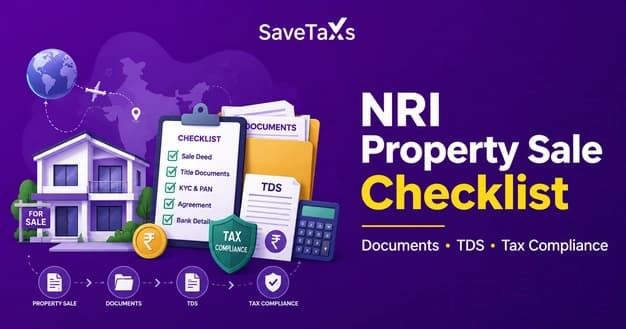
NRI Property Sale Checklist: Documents, TDS & Tax ComplianceNRI Property Sale Checklist: Documents, TDS & Tax Compliance
Written by Shubham Jain

_1779453565706.webp&w=3840&q=75)
The new tax regime is now made even more effective under the Union Budget 2025. It means ₹12 lakh is now effectively tax-free, the rebate was increased to ₹60,000, and new slabs were introduced. However, the old regime is still beneficial for taxpayers as it offers significant deductions. In this blog, we will cover every income tax deduction and exemption available under both regimes for FY 2025-26.
Regardless of which regime you choose, the table below lists the deductions and exclusions permitted under both regimes:
| Deductions/ Exemptions | Limit | Key Details |
|---|---|---|
| Standard deduction on salary |
|
For all salaried individuals and pensioners, a flat deduction is permitted without the need for any documents. It is applied automatically by the employer while calculating TDS. |
| Professional Tax - Section 16(iii) | Actual amount paid (max ₹2,500/ year) | Professional tax charged by the states is deductible from gross salary. It is available in both regimes, but is often missed by taxpayers. |
| Entertainment Allowance - Section 16(ii) | Only available for government employees: lower of ₹5,000, 20% of basic, or actual | Available only for central and state government employees. Employees working in the private sector cannot claim. |
| Section 80CCD(2)- Employer NPS contribution | Up to 14% of salary (central government) and 10% for others | Employer's contribution to the employee's NPS account. It is available in both regimes. It is very powerful ans is raised upto 14% for employees from FY 2024-25. |
| Section 24(b)- Home loan interest on let-out property | Unlimited deduction on let-out property |
|
| Agricultural Income Exemption | Fully exempt | Agricultural income is exempt from taxation in both regimes. If agricultural income exists, partial integration for rate purposes on non-agricultural income is permitted. |
| Section 10(10) - Gratuity exemption | Up to ₹20 lakh (government employees are fully exempt) |
|
| Section 10 (10A) - Commuted pension |
|
It is available in both regimes. However, an uncommuted (regular) pension is fully taxable in both. |
| Section 10(10C) - VRS compensation | Up to ₹5 lakh | Voluntary retirement scheme compensation is exempt for up to 5 lakh under both regimes |
| Section 10(10D) - Life insurance maturity | Varies by policy date and premium rules |
|
| Section 10(38) equivalent -LTCG on equity (₹1.25L exempt) | ₹1.25 lakh per year |
First ₹1.25 lakh of LTCG from listed equity and equity mutual funds is exempt in both regimes (Section 112A). It gets the same treatment regardless of the regime you choose. |
| Section 54/54F/ 54EC - Capital gains reinvestment | Varies based on the section | Exemption on capital gains acquired from the property sale through reinvestment is available in both regimes. The choice of regime will not affect the capital gains exemption eligibility. |
These are the deductions permitted under both old and new regimes. Let's now see the deductions that you can get only under the old regime.
The old regime is ideal for you if your combined total of the deductions saves you more money than the lower tax rates in the new regime. Here is a list of the deductions available only under the old regime and eliminated from the new regime:
It offers a deduction of up to ₹1,50,000 per year. It covers LIC premiums, ELSS, PPF, NSC, 5-year FDI, tuition fees, home loan principal, SCSS, and Sukanya Samriddhi. It is the most popular deduction and the foundation of middle-class tax planning.
It offers a deduction of up to ₹25,000 - ₹1,00,000. It covers health insurance premiums for self (₹25K), parents (₹25K additional and ₹50K if senior citizens). It also includes a preventive health check-up sub-limit of ₹5,000. A total deduction of up to ₹1 lakh for self and senior parent is covered.
The voluntary NPS contributions over the ₹1.5 lakh 80C limit can attract an additional deduction of ₹50,000. This additional deduction of ₹50,000 is a separate and exclusive NPS deduction in the old regime.
House rent allowance exemption is offered on the lowest of:
(a) actual HRA recieved
(b) 50%/40% of basic + DA (metro/non-metro)
(c) rent paid minus 10% of basic + DA
It is one of the largest deductions for salaried employees in rental accommodation.
In the old regime, you can deduct up to ₹2 lakh against taxable income. In the new regime, this deduction is not available for self-occupied property.
Deductions for donations made to eligible trusts, political parties, PM relief fund etc is available only in the old regime. The deduction may vary based on the institution, but it is usually 50% or 100%. Cash donations exceeding ₹2,000 are not allowed.
Under section 80TTA, a deduction of ₹10,000 is available on savings account interest (for non-seniors). Under section 80TTB, a deduction of ₹50,000 is available on all interest income for senior citizens aged above 60.
100% of the interest paid on the education loan for self, spouse, children, or a student for whom you are the legal guardian can be deducted for 8 years.
An additional deduction of up to ₹1.5 lakh on a home loan interest can be claimed by first-time homebuyers. It is available for loans sanctioned between 1st of April, 2019, and 31st of March, 2022, provided the property stamp value is ≤ ₹45 lakh with no existing property.
Under Section 80U, a deduction is provided for a taxpayer with a disability. While under section 80DD, a deduction is provided for maintaining a disabled dependent. A fixed deduction of ₹75,000 is available for disability instead of an actual expense-based deduction. For severe disability, a deduction of ₹1.25 lakh is available.
Leave travel allowance allows for tax-exempt reimbursements for domestic vacation travel. It covers actual transit costs (air, rail, or public road transport) for up to two journeys within a designated 4-year block.
Children's education allowance is permitted at ₹100/month per child for schooling and ₹300/month per child for hostel costs, limited to two children.
These are the deductions that you can claim only if you opt for the old regime. Moving further, let's see the Section 87A rebate.
File NRI ITR with no errors, no hassles, and no stress at Savetaxs
Under Section 87A, a tax rebate is available that brings the final tax liability to zero for taxpayers below a specified income threshold. It directly reduces the calculated tax and not the taxable income. Moreover, this does not apply to NRIs. Consider the table below to know the zero-tax benefit under the Section 87A rebate:
| Feature | Old Regime (FY 2025-26) | New Regime (FY 2025-26) |
|---|---|---|
| Section 87A rebate amount | ₹12,500 | ₹60,000 |
| Income limit to claim the rebate | Total income ≤ ₹5,00,000 | Total income ≤ ₹12,00,000 |
| Effective zero-tax income (salaried) | ₹50,00,000 + standard deduction consideration | ₹12,75,000 (₹12L + ₹75K standard deduction) |
| Available to NRIs | No | No |
| Available at a special rate for income | No, capital gains at special rates are excluded from the rebate calculation | No, the same restriction applies |
*Note: Remember that Section 87A doesn't apply to capital gains taxed at special rates. If your total income is ₹11 lakh but includes ₹5 lakh of STCG on equity (taxed at 20% separately). Then, the rebate is applicable only to your non-capital gain income. You must pay 20% on the STCG and cannot claim the 87A rebate to avoid that portion. Let's now look at the exemptions available in both regimes.
Regardless of which regime you choose, some types of income may remain exempt from tax. These are those income categories that are never considered during the tax calculation:
| Type of Income | Old Regime | New Regime | Basis |
|---|---|---|---|
| Agricultural Income | Exempt | Exempt | Section 10(1) constitutional right of states |
| PPF maturity and interest | Exempt | Exempt | Section 10(11): EEE instrument |
| PF (Employees Provident Fund), within limits | Exempt | Exempt | Section 10(12): employer contribution above ₹7.5L is taxable |
| Gratuity (within statutory limits) | Exempt up to ₹25L | Exempt up to ₹25L | Section 10(10) |
| LTCG on equity - up to ₹1.25L annually | Exempt | Exempt | Section 112A provision |
| NRE and FCNR FD interest (for NRIs) | Exempt | Exempt | Schedule IV, IT Act 2025 (formerly section 10(4)) |
| Life insurance maturity proceeds (within conditions) | Exempt | Exempt | Section 10(10D) |
| Scholarship for education | Exempt | Exempt | Section 10(16) |
| Dividend from Indian companies - NREs (NRI-specific) | No longer exempt (DDT abolished) | No longer exempt | Taxable since FY 2020-21 in both |
These are some exemptions available under both old and new regimes.
Our experts offer personalized strategies to ensure you unlock maximum return potential.
The better choice between the old and new regimes for FY 2025-26 comes down to your income structure. The new regime is ideal for those with fewer deductions. It offers a generous zero-tax threshold of ₹12.75 lakh. The old regime remains beneficial for taxpayers who can maximize 80C, HRA, home loan interest, and health insurance deductions. To make the smartest choice, you must calculate your liability under both regimes before the start of the financial year. Also, you can switch it whenever it makes sense.
Moreover, as an NRI, if you need assistance with ITR filing, Savetaxs is the smartest choice. We have been helping NRIs from more than 90 countries in filing their ITR. Savetaxs team will ensure you stay compliant with Indian tax laws. We will also ensure you file the ITR accurately and on time, claim eligible tax exemptions, and do everything with compliance. Connect with us right away as we serve our clients 24/7 across all time zones.
This article is for general informational purposes only and does not constitute tax, legal, financial, or investment advice. Laws, regulations, rates, and procedures may change over time and may vary based on individual circumstances.
While SaveTaxs makes reasonable efforts to keep the information accurate and up to date, readers should verify applicable rules with official authorities or consult a qualified professional before making decisions based on this information.
Vipul Jain is the Co-Founder of SaveTaxs and a tax expert with experience in Indian and NRI taxation. He advises individuals, NRIs, and businesses on tax filing, tax planning, capital gains, DTAA, and compliance matters. He focuses on making complex tax concepts simple and helping taxpayers make informed, compliant decisions. See Full Bio
Want to read more? Explore Blogs