US Tax Filing and Compliance
Is an S Corporation Worth It? Costs, Tax Benefits and Decision ChecklistIs an S Corporation Worth It? Costs, Tax Benefits and Decision Checklist
Written by Shubham Jain

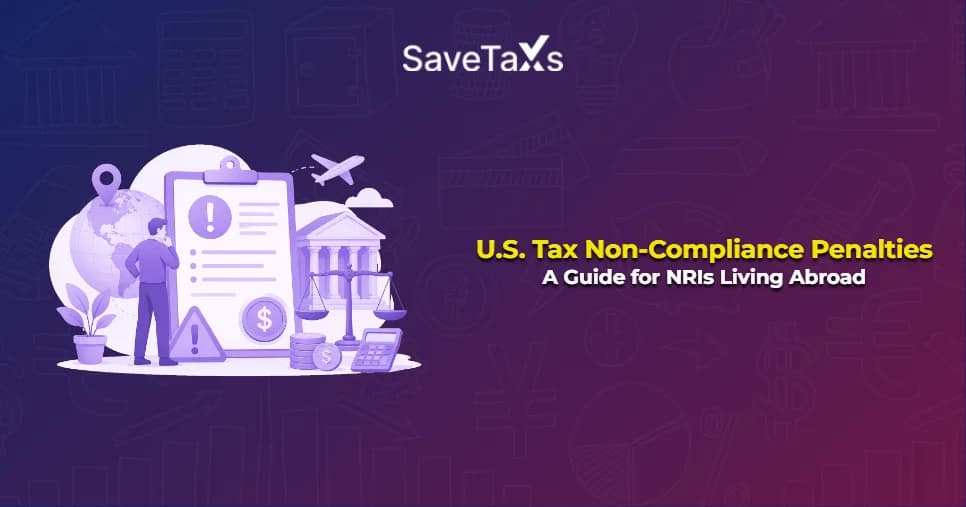
When you move out of the US, your tax obligations still remain back there. Many US citizens, green card holders, and NRIs living outside the USA or in India have discovered that they still have US tax obligations to fulfill, such as filing one or more US tax returns, foreign asset reporting, and FBAR filing requirements, and so on and due to this, a lot of US taxpayers miss out on filing these, making a noncompliant move.
However, the good news is that Missing a U.S. tax or foreign-account filing can result in penalties and interest. However, eligible taxpayers may have compliance options that can provide relief from certain penalties, depending on the facts and the procedure used. Based on your situation, the IRS will provide you with compliance options to help you rectify any mistakes you have made. One of the most important of all the available options is the Streamlined Foreign Offshore Procedures, which is for the US taxpayer living outside the US.
In this blog, we will understand what US tax noncompliance and US tax return penalties can cost, how interest accrues on penalties for not filing US taxes, and more.
US tax non-compliance, in layman's terms, means that you, as a U.S. taxpayer, have some obligations to fulfill for a given year and you did not meet them. Now, this noncompliance could be anything, such as a missed FBAR filing, a missed Form 1040-NR filing, or a missed Form 8938. Noncompliance is more than just hiding money from the authorities; sometimes it is a missed deadline or a misunderstanding about whether the filing was required after moving to another country.
Non-compliance does not always mean there will be only a single penalty; Depending on the facts, multiple types of penalties and interest can potentially arise from the same period of noncompliance. The applicable penalties depend on the specific missed filing, tax liability, reporting requirement and taxpayer circumstances..
| Cost | How it generally works |
|---|---|
| Failure to file penalty | Generally 5% of unpaid tax per month or part of a month, up to 25%, subject to special rules and minimum penalties |
| Failure to pay penalty | Generally 0.5% of unpaid tax per month or part of a month, generally up to 25% |
| Interest | Accrues on unpaid tax and certain penalties; the rate is adjusted quarterly and interest compounds daily |
| FBAR Penalty (non-intentional) | Separate civil penalties may apply depending on the nature of the violation and whether it was willful |
| Other information return penalties. | May apply separately to forms such as Forms 8938, 3520, 5471, etc., depending on the form and circumstances |
The IRS has confirmed the failure-to-pay penalty rate at 0.5% and the maximum at 25%.
Quite a few penalties increase over time, the longer the tax balance remains unpaid. Further, the interest continues to accumulate on the tax that is not being paid, along with the failure-to-file and the failure-to-pay penalties.
If you ignore or miss out on the US tax filing, certain FBAR and other information-related penalties are also applicable. Hence, delaying compliance will increase your costs and ultimately limit your options to address the issue.
The streamline foreign offshore procedure is for people whose non-filing or non-compliance was genuinely non-willful, an honest misunderstanding, and not a deliberate attempt to hide the income. For such filers, the IRS streamlines foreign offshore procedures in simple terms; it lets you catch up by filing.
In case you are eligible and comply with the IRS's streamline foreign offshore procedures, the IRS however provides certain relief from failure-to-file, failure-to-pay, accuracy-related, certain information-return, and FBAR penalties covered by the procedures.
You are still required to pay the full tax and any applicable interest due.
Savetaxs helps NRIs file their IRS tax return in the USA
The eligibility for the streamlined foreign offshore procedures depends on several requirements.
For U.S. citizens and green card holders, one of the most important eligibility requirements is that.
In at least one of the most recent three years for which the United States return deadline has passed, you did not have a US abode and were physically outside the United States for a minimum of 330 full days.
Further, you also need to certify that your acts of noncompliance, such as failure to file, report, or pay taxes, did not happen willfully.
If Streamline procedures are unavailable in your situation, it must be because the noncompliance is willful; hence, other compliance options need to be sought. The IRS Criminal Investigation Voluntary Disclosure Practice is designed for taxpayers seeking to disclose willfully noncompliant conduct. While other taxpayers need to consider delinquent returns, amended returns, delinquent international information returns, reasonable cause relief, or other applicable procedures, these matters are most important.
The Streamlined Foreign Offshore Procedures (SFO) and Streamlined Domestic Offshore Procedures (SDO) are both designed for eligible taxpayers whose foreign reporting noncompliance was non-willful. However, the main difference is where the taxpayer resides and whether they meet the foreign-residency requirement.
If you live outside the United States and satisfy the applicable residency requirements, the Streamlined Foreign Offshore Procedures may be available. If you live in the United States or do not satisfy the foreign-residency requirement, you may instead need to consider the Streamlined Domestic Offshore Procedures, provided you meet their separate eligibility requirements.
| Feature | Streamlined Foreign Offshore Procedures | Streamlined Domestic Offshore Procedures |
|---|---|---|
| Generally intended for | Eligible U.S. taxpayers residing outside the United States | Eligible U.S. taxpayers residing in the United States |
| Foreign-residency requirement | Must satisfy the applicable foreign-residency requirement | Does not satisfy the foreign-residency requirement |
| Non-willful conduct | Required | Required |
| Tax returns | Generally, the most recent 3 applicable years | Generally, the most recent 3 applicable years |
| FBARs | Generally, the most recent 6 applicable years | Generally, the most recent 6 applicable years |
| Miscellaneous offshore penalty | Generally, no miscellaneous offshore penalty | Generally, a 5% miscellaneous offshore penalty applies |
An important point is that failing to qualify for the Streamlined Foreign Offshore Procedures does not automatically mean that your conduct was willful. For example, you may be non-willful but fail the foreign-residency requirement. In that situation, you may need to determine whether you qualify for the Streamlined Domestic Offshore Procedures or another IRS compliance option.
The correct procedure depends on your residency, filing history, foreign assets, and the circumstances that caused the noncompliance. Therefore, you should determine your eligibility before submitting delinquent returns or foreign information reports.
Let us understand the concept with an example: Anil is a green card holder who moved back to India eight years ago. While leaving the United States, Anil believed that, because he had left the country, his US tax obligations had also ended, as had his US filing obligations, so he stopped filing returns and FBARs.
Now, before taking an action, Anil thought to review his eligibility for the Streamlined Foreign Offshore Procedures. Now, because Anil has been living outside the US and has no US abode, he satisfies the applicable 330-day non-residency requirement and can truthfully certify that his failure was non-willful, he is eligible for the IRS streamlined procedures.
If Anil is eligible, he has to submit the most current three-year income tax returns and the six most recent delinquent FBARs along with Form 14653 and the required tax and other interest. Further, the case states how important it is to understand US tax compliance for NRIs.
The following is a quick checklist to abide by to remain in compliance:
Savetaxs helps NRIs understand the available treaty benefits smartly
As an individual with a US tax obligation, if you miss filing US tax returns or FBARs, it can lead to penalties and interest that grow over time. However, there may be certain relief options if your noncompliance was unintentional. The Streamline Foreign Offshore Procedures can help eligible taxpayers catch up on missed US tax returns filings and then reduce the risk of harsh penalties.
In case you have missed a US tax filing or certain foreign account reporting, it is advisable to seek professional assistance to make things right as soon as you can. Such a tax professional is Savetaxs, as they can help you understand your options and choose the right path towards compliance.
Contact Savetaxs today, as we serve our clients 24/7 across all time zones and take a first step towards becoming US tax compliant.
This article is for general informational purposes only and does not constitute tax, legal, financial, or investment advice. Laws, regulations, rates, and procedures may change over time and may vary based on individual circumstances.
While SaveTaxs makes reasonable efforts to keep the information accurate and up to date, readers should verify applicable rules with official authorities or consult a qualified professional before making decisions based on this information.
Vipul Jain is the Co-Founder of SaveTaxs and a tax expert with experience in Indian and NRI taxation. He advises individuals, NRIs, and businesses on tax filing, tax planning, capital gains, DTAA, and compliance matters. He focuses on making complex tax concepts simple and helping taxpayers make informed, compliant decisions. See Full Bio

Want to read more? Explore Blogs