
US Tax Filing and Compliance
FBAR Filing Deadline 2026: October 15 Extension & RulesFBAR Filing Deadline 2026: October 15 Extension & Rules
Written by Shubham Jain


When you move between India and the U.S. during the year, your U.S. tax filing can become more complicated than a standard return. If your U.S. tax residency changes during the year, you may be treated as a nonresident alien for one part of the year and a resident alien for another, resulting in a dual-status tax year.
Under the dual-status alien rule, you are treated as a nonresident alien for one part of the year and a resident alien for the rest of the year. It basically means your income may become subject to different tax rules in the U.S.
However, having dual status is not the only challenge; another is determining the residency start and end dates. NRIs often believe that their residency date is either when they physically moved or their flight date, which is completely wrong.
Moreover, the result can be affected by the substantial presence test, the green card test, residency start date rules, and a few other factors. In this guide, we will cover how dual-status alien taxation works for NRIs, how to determine your residency period, how Indian income is treated, the return you need to file, and much more.
A dual-status alien is someone who holds both resident alien and nonresident alien status at different times during the same tax year. It's not an immigration status but a tax residency classification in the U.S. This situation usually occurs when you are:
Confused? Let's understand this with an example.
Daksh moves to the U.S. from India during the year and later becomes a tax resident in the U.S. under the applicable residency rules. So, if he was a nonresident alien for the first part of the year and a resident alien for the remainder of the year, he may have a dual-status tax year. It is basically a day-counting rule that helps identify whether you are a U.S. tax resident.
Therefore, as discussed, he is treated as a nonresident alien for part of the year and as a resident alien for the remainder of the year, based on the applicable residency-start-date rules. This makes him dual-status for that year.
For NRIs, this dual-status alien taxation treatment usually occurs during transition events. So, next, we will discuss what these events are and when an NRI receives dual-status alien treatment.
As an NRI, you may come across dual-status treatment usually when you go through these transition events:
It's very simple: if you went through any of these changes during the tax year, you must determine whether dual-status treatment applies to your specific filing. It basically means that the main key here is to identify when the situation might apply to you.
Further, your tax residency in the U.S. is determined based on two tests: the green card test and the substantial presence test. Let's understand what both tests mean and how the U.S. determines your tax residency.
Simplify your U.S.taxes with expert assistance from Savetaxs.
For U.S. federal tax purposes, an individual who is not a U.S. citizen generally determines resident or nonresident alien status under the green card test or substantial presence test. Certain elections, exceptions and income-tax treaty provisions can also affect the final U.S. tax residency position.
Under the green card test, you generally become a U.S. resident for federal tax purposes when you are a lawful permanent resident. If you receive a green card while abroad, the residency starting date is generally the first day you are physically present in the United States after becoming a lawful permanent resident. If both the green card test and substantial presence test apply, the residency-starting-date rules must be reviewed based on the specific facts.
Although the green card test itself is simple, things get complicated during transition years when other life events occur simultaneously. There's much more to know about the green card test, so if you want to get a complete overview of how shifting to a green card affects your tax obligations over time, read our specialized guide: H1B to green card transition: How Does Tax Residency Change?
If you don't have a green card, that doesn't mean you're exempt from U.S. tax residency. If you spend sufficient time by being physically present in the U.S., you may be treated as a resident alien for tax purposes, even without a green card.
Under the Substantial Presence Test, the calculation is done considering a weighted three-year period. It basically counts:
So, it generally requires you to spend at least 31 days in the current year plus a combined total of 183 days across the three-year window. We have now understood the calculation in brief, but if you want to see the complete step-by-step calculation, read our dedicated article on the substantial presence test.
Further, while determining your residency, certain situations may affect the process, such as specific visa categories and close connection rules. That being said, let's next learn about these situations.
It's worth knowing that certain situations can affect how your residency is determined. It includes:
**Point to Note: These exceptions may vary depending on the situation. Hence, instead of assuming, you must carefully review each situation to avoid any unfair mistakes.
There is one common point that many NRIs get confused about: understanding the residency start and end dates. It's important to understand that the starting dates differ between the two tests. So, let's now learn how these dates are determined.
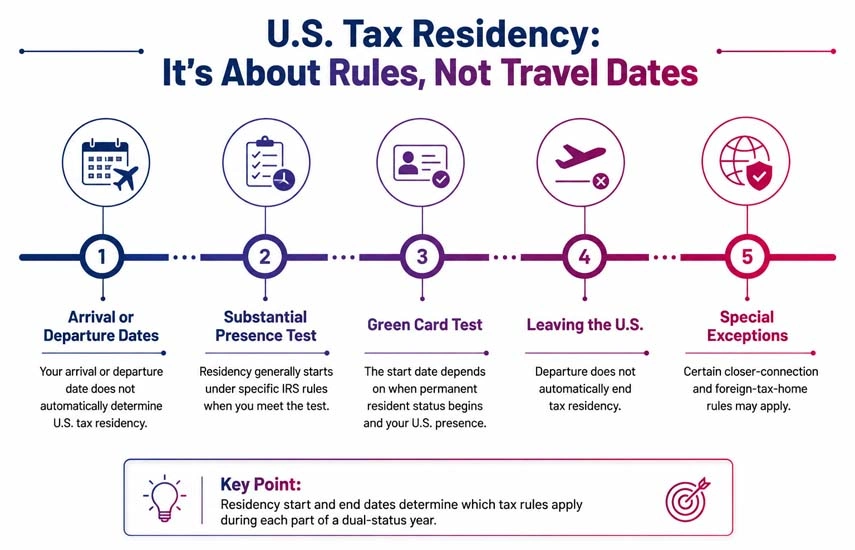
It's very common for NRIs to get stuck at this point. Always remember that the day you physically arrive in the U.S. will not automatically be your residency starting date. Similarly, the day you leave the country will not be your residency termination date.
Both tests consider your residency start and end dates, but apply different rules. Don't assume that the date you decide to move or your first day in the country will be your residency starting date. So,
Similarly, your residency termination date depends on whether you meet certain conditions. Don't think that booking a flight back home will set this date. Leaving the U.S. does not automatically terminate your federal tax residency. The residency-ending date must be determined under the applicable IRS rules. In certain circumstances, an individual may qualify for an exception based on a foreign tax home and closer connection, but that is a specific exception with its own eligibility requirements and should not be treated as the general residency-termination rule.
These dates might seem normal, but understanding them is very important. Your year is divided into a nonresident period and a resident period based on these dates. Also, this division helps determine which set of tax rules applies to which income.
To keep it short, assume you relocate from India to the U.S. during the year. In this case, your U.S. tax treatment will depend on the residency rules applicable to you. Don't consider that the date you booked the flight will determine all your tax consequences for the year. This is because a wrong assumption can directly affect your tax obligations.
Further, during a dual-status tax year, your income is taxed on two separate tax periods. Next, we will understand how your income is taxed during the dual-status alien tax return year.
A dual-status year contains two separate tax periods, one for the resident period and one for the nonresident period, each governed by a different set of rules. Here are the two tax periods in detail.
During the resident alien period, you are generally subject to pay U.S. federal income tax on your global income. It means income earned anywhere in the world, not just in the U.S. This can specifically be relevant for NRIs as this can include income from:
During the nonresident portion of a dual-status year, U.S. federal taxation generally focuses on U.S.-source income and income effectively connected with a U.S. trade or business. Foreign-source income is generally outside U.S. federal taxation during the nonresident period, but the source and character of the income must be determined under the applicable rules, and treaty provisions may also affect the result.
Income arising around your residency change date requires careful analysis. The tax treatment is not determined solely by the date you receive a payment; the source, character and applicable timing rules for the particular type of income must also be considered. It means that if you earn salary, business investment income, or rental income close to your residency start or end date, it may require careful sourcing analysis to identify which period it actually belongs to.
Understanding this is another important point of dual-status filing, and ensuring you get the timing right is crucial. It's because if you get the timing wrong even on one payment, it can affect how it's taxed.
Now comes another question: are the dual-status alien, full-year resident, and nonresident alien the same? The answer is no; these are three different tax classifications under U.S. tax laws. Having said that, let's discuss the difference between these three statuses.
The table below lists the differences between these three statuses:
| Status | General Tax Position | Typical Return Context | Foreign Income |
|---|---|---|---|
| Full-year U.S. resident | Resident throughout the year | Form 1040 | Worldwide income rules generally apply |
| Nonresident Alien | Nonresident throughout the year | Form 1040-NR where filing is required | Generally subject to nonresident taxation rules |
| Dual-status alien | Resident for part of the year and then nonresident for the remainder of the year | Special dual-status filing mechanics | Treatment depends on the relevant period |
Next, let's understand the tax return that a dual-status alien needs to file.
Based on whether you are a resident or a nonresident alien at the end of the year, your filing mechanism may vary. Your year-end status will help determine which form you need to use as your primary return.
If you are a resident alien on the last day of the tax year, you generally file Form 1040 marked “Dual-Status Return” and attach a statement showing the income attributable to your nonresident period. Form 1040-NR can generally be used as the statement and should be marked “Dual-Status Statement.”
If you are a nonresident alien on the last day of the tax year, you generally file Form 1040-NR marked “Dual-Status Return” and attach a statement showing the income attributable to your resident period. Form 1040 or 1040-SR can generally be used as the statement and should be marked “Dual-Status Statement.”
Conversely, if you are a nonresident alien on 31st of December, you file Form 1040-NR as your main return. Similar to Form 1040, you need to mark "Dual-status return" and attach a statement that proves your income and details for the resident period.
Now, we have covered the basics of the forms. If you want to learn more about these two forms, explore our dedicated guide: Form 1040 vs. Form 1040-NR. Now that we have understood which form to file, let's discuss how to file a dual-status tax return.
Follow the steps below to file a dual-status alien tax return:
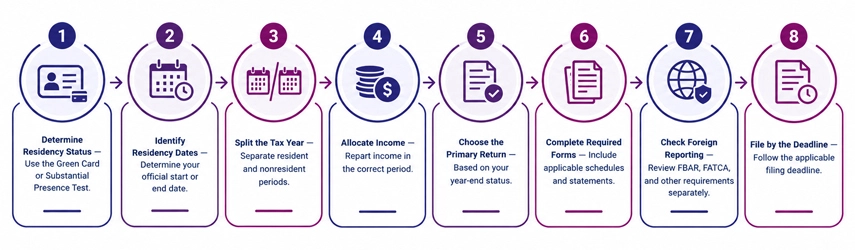
Apart from the complications, the dual status might have restrictions on certain tax benefits. Next, we will look at the restricted tax benefits for dual-status aliens.
A dual-status alien may not receive all the tax benefits available to a full-year U.S. resident. It means if you have dual status, you will not qualify to claim the standard deduction and may also face restrictions on certain filing statuses, deductions, and credits. Also, you may face exceptions depending on specific treaty provisions or individual circumstances.
Now comes a common confusion: whether an IRS dual-status alien files a joint return with a spouse. Let's discuss this.
A dual-status taxpayer generally cannot file a joint return for the dual-status year. However, in qualifying circumstances, a dual-status taxpayer who is married to a U.S. citizen or resident may elect to be treated as a U.S. resident for the entire year and file a joint return. Because this election changes the tax treatment of the entire year, the eligibility requirements and tax consequences should be reviewed before making the election.
Further, let's discuss tax treatment of your Indian income and assets during a dual-status year.
The tax treatment of Indian income depends entirely on whether it was earned during the U.S. resident or nonresident timeframe:
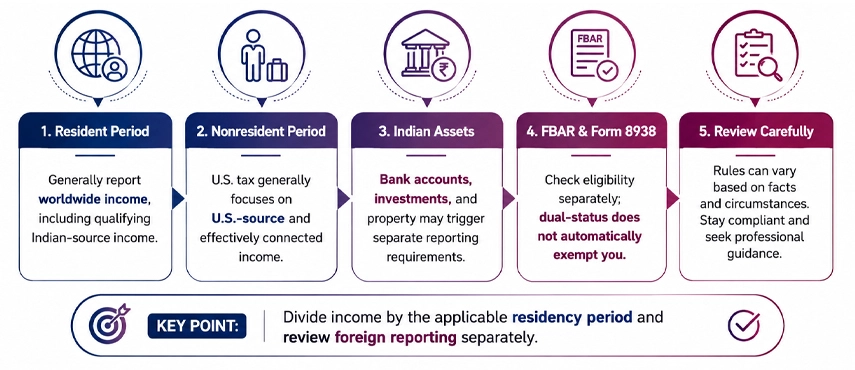
Moreover, holding assets or financial accounts in India can trigger additional reporting obligations in the U.S. FBAR and Form 8938 reporting requirements have their own eligibility criteria and filing guidelines. Hence, it means don't assume you are automatically exempt from these requirements simply because you are a dual-status taxpayer.
Moving further, let's discuss what happens if an NRI moves to the U.S. during the year.
You may have a nonresident period followed by a resident period if you move from India to the U.S. during the year and become a tax resident in the U.S. If you are in this situation, you generally need to:
If you have moved to America and are filing your first U.S. tax return, read our detailed guide to better understand the requirements. Now, this is what you need to do when you move to the U.S., but the requirements may vary in the reverse situation, which is when you leave the U.S. and return to India. Let's understand this in detail.
An NRI may also face a dual-status year in the reverse situation, when they leave theU.S.and move back to India. In this case, you may have a U.S. resident period followed by a nonresident period, depending on the applicable rules governing residency termination. The main issues arise with:
Since your residency under federal and state tax is determined by different rules, it's important to understand the differences. Having said that, let's understand the difference between the rules governing both.
The table below lists the rules used by Federal and state tax laws to determine your residency status:
| Factor | Federal Tax Residency | State Tax Residency |
|---|---|---|
| Governing rules | Federal tax law | Individual state law |
| Green card/ Substantial Presence Test | Generally relevant | Not necessarily determinative |
| Domicile | Usually not the primary test | Often important |
| Leaving the U.S. | Does not automatically end your residency | Does not automatically end your residency |
So, don't assume your tax residency or domicile in a particular U.S. state will end simply because your federal tax residency has ended. It is a wrong assumption and may have its own consequences.
You must be feeling confident now that you have knowledge of the requirements, process, and more, but even with good information, you may still make some very common mistakes. To address that and prevent errors from causing issues, we will next cover the mistakes you need to avoid.
Here are some common mistakes that you must not make during the dual-status tax filing year:
Avoid making these mistakes to pass the dual-status year smoothly. Lastly, let's look at an example with Amit to better understand and recall everything.
At the start of the year, Amit lives and works in India. He moves to the U.S. during the year and later satisfies the applicable U.S. residency requirements under the substantial presence test. His exact residency starting date must be determined under the IRS residency-starting-date rules. If he was a nonresident before that date and a resident afterward, he may have a dual-status tax year. But before he moved to the U.S., he earned an Indian salary, and after moving there, he earned a U.S. salary. Simultaneously, he also has investments and bank accounts in India.
In this case, he would need to take the following steps:
Keep in mind that we only covered the process in this example. The actual tax treatment may vary based on your specific facts. So, ensure you check and review everything first.
Let the experts handle your U.S. tax needs with accuracy and precision.
When you have a dual-status filing year, you need to determine your residency status, identify the correct transition date, split your income between the two tax periods, and use the relevant filing structure. If you are an NRI, it's important to keep in mind that your physical move or flight date will not decide the starting or ending date of your residency. However, it's crucial to get this date right as it will decide how you need to report the rest of your tax year.
Since there are various requirements that must be met accurately under dual-status filing, it's worth contacting an expert to simplify the process. When it comes to experts, there's no better option than Savetaxs.
Our expert team can help determine U.S. tax residency for NRIs, identify the exact transition date, split income between the two tax periods, and ensure compliance with all reporting requirements. Connect with U.S.right away to have your residency date and filing position reviewed before filing, to avoid costly corrections later.
This article is for general informational purposes only and does not constitute tax, legal, financial, or investment advice. Laws, regulations, rates, and procedures may change over time and may vary based on individual circumstances.
While SaveTaxs makes reasonable efforts to keep the information accurate and up to date, readers should verify applicable rules with official authorities or consult a qualified professional before making decisions based on this information.
Vipul Jain is the Co-Founder of SaveTaxs and a tax expert with experience in Indian and NRI taxation. He advises individuals, NRIs, and businesses on tax filing, tax planning, capital gains, DTAA, and compliance matters. He focuses on making complex tax concepts simple and helping taxpayers make informed, compliant decisions. See Full Bio

Want to read more? Explore Blogs

-for-401(k)_1790057066765.webp&w=828&q=75)