US Tax Filing and Compliance
S Corporation Health Insurance for 2% Shareholders: Tax Rules and DeductionsS Corporation Health Insurance for 2% Shareholders: Tax Rules and Deductions
Written by Shubham Jain

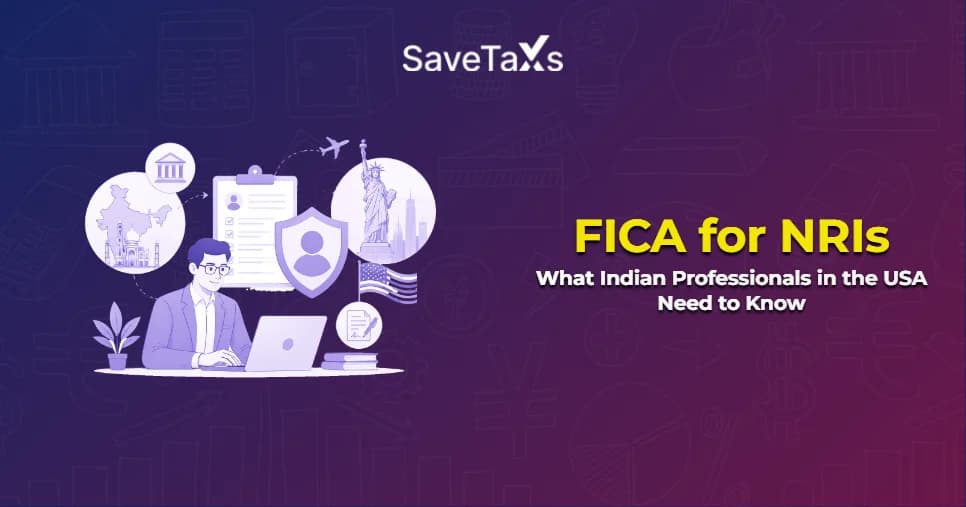
FICA is a payroll tax that helps finance the U.S. Social Security and Medicare programs. You don't become responsible for paying FICA solely because you are an Indian citizen. Instead, whether you need to pay it depends mainly on your employment status and immigration status.
Many individuals mistakenly assume that FICA is part of their regular U.S. income tax. Some even think they will be exempt from FICA because they have NRI status. However, neither is true in many situations, which is a common point of confusion. To clear up such doubts, this blog covers everything you need to know about FICA for NRIs.
FICA stands for Federal Insurance Contributions Act, which consists of two main payroll taxes: Social Security tax and medicare tax. For 2026, the Social Security rate for employees is 6.2%, while employers pay an additional 6.2% and the wage base is $184,500.
Conversely, for both the employer and the employee, the Medicare tax is 1.45% with no wage limit. Furthermore, for an employee's wages exceeding $200,000, an additional medicare tax of 0.9% can apply. It means the standard employee FICA rate for most employees is 7.65%, resulting from:
I am an NRI; do I need to pay FICA? Well, having an NRI status doesn't automatically mean you need to pay FICA. However, if you are working as an employee in the USA as an NRI, you must pay FICA. However, there may be some exceptions as well. Having said that, let's understand whether you, as an NRI, need to pay FICA.
Generally, if you are employed in the United States, you must pay FICA. Don't consider yourself exempt from U.S. FICA simply because you are an Indian citizen, have an Indian passport, or are an NRI under Indian tax law.
Nonresident aliens working in the U.S. are generally liable to pay Social Security and Medicare taxes on U.S. wages, according to the IRS. However, certain exceptions may apply in some situations.
For example, Sanjay is an Indian professional working for a U.S. company on an H-1B visa. He will generally have FICA withheld from his U.S. wages. This is because H-1B workers don't receive a special exemption for FICA. Next, we will understand more about FICA for H-1B visa holders.
Since H-1B workers are nonresident aliens, they are generally not exempt from FICA. According to the IRS, H-1B workers rendering services in the United States are subject to pay Social Security and medicare taxes. This requirement applies unless their employment falls within an exception.
It means an Indian professional on H-1B status will generally notice deductions for:
FICA and federal income tax are separate taxes. Next, let's discuss FICA implications for F-1 students.
A FICA exemption may be available to certain Indian students in the United States. You are generally exempt from Social Security and Medicare taxes if you are a nonresident alien student who is present in the United States for a temporary period on F-1, J-1, or M-1 status. It applies only if you have qualifying wages for services you have performed in the U.S., provided you satisfy the requirements for the exemption.
Keep in mind that you don't get the exemption only because you have an F-1 visa. Instead, you will be exempt if you remain a nonresident alien for tax purposes and your work is authorized and connected to your studies.
Further, an F-1 student's status automatically changes to H-1B status on the requested start date of the approved petition when they file a formal petition with USCIS. But does this transition change anything related to the FICA exemption? Let's discuss this next.
When an individual's F-1, J-1, M-1, or Q-1 nonresident alien status changes to H-1B status, the FICA exemption becomes unavailable to them. The employer will begin withholding FICA on the date of the status change to H-1B.
Additionally, if you are an NRI while being a U.S. citizen or resident alien living abroad, it's crucial to understand the difference between FICA and FEIE. These are two distinct terms that refer to different taxes. Next, we will learn more about how FICA and FEIE are different.
The Foreign Earned Income Exclusion (FEIE) and Federal Insurance Contributions Act (FICA) address different taxes.
Under FEIE, you can exclude qualifying foreign-earned income from U.S. federal income tax, provided you fulfill the applicable requirements. However, it doesn't exempt you from Social Security and Medicare taxes. It means you cannot stop paying FICA automatically because you claimed FEIE.
For U.S. citizens or resident aliens working abroad, identifying whether your foreign wages are subject to U.S. Social Security and medicare taxes depends on separate rules. Similarly, for self-employed people, the rules are different. Having said that, let's now understand how it is different for self-employed individuals.
According to the IRS, nonresident aliens are not liable to pay U.S. self-employment tax. However, as soon as an individual becomes a U.S. resident alien, self-employment tax applies in the same way as to U.S. citizens and resident aliens. The result can also be impacted by certain international social security agreements.
Hence, don't automatically assume that the employer FICA rules apply to you because you are an NRI running a business or working as an independent contractor.
Further, one of the biggest issues that Indian professionals working in the US face is understanding whether there is a totalization agreement between the US and India. Let's clear this confusion.
As of 2026, no totalization agreement is in force between the United States and India. The current list of U.S. Social Security Administration agreements does not include India. But what is a totalization agreement?
So, a totalization agreement basically helps workers to prevent paying Social Security taxes to both countries for the same work. When determining eligibility to claim benefits, it may also permit some workers to merge coverage periods from both countries.
Although both countries have discussed a possible agreement, no agreement is in force as of now. The information regarding ongoing discussions on a social security totalization agreement was confirmed by a 2024 US-India trade policy forum statement. But how does this lack of agreement matter? We will discuss this next.
Consider an Indian citizen employed in the US who contributes to US Social Security via FICA payroll taxes. In the absence of an India-US totalization agreement, their total contribution period cannot be merged with U.S. Social Security coverage. This can be a major drawback for temporary workers who spend only a fraction of their working years in the United States.
However, leaving the United States doesn't automatically mean that you will lose every FICA dollar. Depending on your individual earnings record and applicable U.S. rules, your eligibility for Social Security will be determined. Reach out to the Social Security Administration to verify your benefit situation.
Next, let's discuss whether you can claim a refund for FICA.
You can get a refund of FICA that was wrongfully withheld. For example, you qualified for a FICA exemption, but the employer deducted the tax incorrectly. On the other hand, if you leave the US or return to India and FICA was correctly withheld from your wages, you might not qualify for a refund.
What you need to do is ask the employer to correct the withholding. If the employer cannot or doesn't correct it, you may be allowed to seek a refund using Form 843 and submit the required supporting documents.
Moving forward, we will distinguish between FICA and income tax.
The table below lists the differences between FICA and Income Tax to help you avoid being confused about these taxes:
| Tax | Purpose | Basic: 2026 Employee Rate |
|---|---|---|
| Social Security | U.S. Social Security program | 6.2% |
| Medicare Tax | U.S. Medical program | 1.45% |
| Federal Income Tax | General federal taxation | Depends on income |
| Additional Medicare Tax | Higher-income medicare tax | 0.9% above the applicable threshold |
The key difference is that FICA is withheld directly from your paycheck, whereas federal income tax withholding is computed separately. Lastly, to help avoid any issues, let's look at the common FICA mistakes made by NRIs.
Here are some of the common mistakes that NRIs make that you must avoid:
Get dedicated one-on-one assistance and guidance for your tax situation.
FICA is a standard payroll tax for most Indian professionals employed in the United States, applying regardless of their NRI status. The employee rate for 2026 is generally 7.65%, with 6.2% for Social Security and 1.45% for medicare taxes, along with additional rules for higher medicare wages.
If you are an Indian professional working in the U.S., keep in mind that currently there is no totalization agreement between India and the U.S. As a result, if you are an NRI who would eventually return to India, planning long-term Social Security becomes important. Moreover, if you are still confused and need help understanding whether you qualify for FICA exemption, connect with an expert at Savetaxs. We have an entire team of experts familiar with cross-border tax rules, legal requirements, financial requirements, and much more. Reach out to us right away, as we are actively working 24/7 across all time zones.
This article is for general informational purposes only and does not constitute tax, legal, financial, or investment advice. Laws, regulations, rates, and procedures may change over time and may vary based on individual circumstances.
While SaveTaxs makes reasonable efforts to keep the information accurate and up to date, readers should verify applicable rules with official authorities or consult a qualified professional before making decisions based on this information.
Hatim Dudhiyawala is a Certified Public Accountant (CPA) with SaveTaxs and specializes in Indian and NRI taxation. He advises individuals, NRIs, and businesses on income tax filing, capital gains taxation, DTAA benefits, fund repatriation, and tax compliance. With experience in cross-border tax matters, Hatim helps taxpayers understand complex regulations and make informed decisions. Through his articles, he shares practical insights to help readers stay compliant and manage their tax obligations with confidence. See Full Bio

Want to read more? Explore Blogs