
Investment & Financial Planning
NRI Property Sale: How to Calculate Capital Gains TaxNRI Property Sale: How to Calculate Capital Gains Tax
Written by Shubham Jain


Mutual fund investments do not always happen through a single investment on a single date. You may invest through monthly SIPs, make additional investments when markets fall, redeem some units, and continue investing afterward.
When money moves in and out of an investment on different dates, simply comparing the amount invested with the current value may not accurately show your annualized return.
This is where XIRR in mutual funds becomes useful.
XIRR considers both the amount and the actual date of every cash flow to calculate an annualized rate of return. This makes it particularly useful for SIPs and other investments involving multiple transactions.
XIRR, or Extended Internal Rate of Return, is a method used to calculate the annualized return from an investment when cash flows occur on different dates.
Suppose you invest ₹10,000 every month through a SIP.
Your first ₹10,000 installment may remain invested for 12 months, while the most recent installment may have been invested for only one month. Therefore, treating the entire ₹1,20,000 as though it was invested on the same date would not correctly represent your investment performance.
XIRR handles this by considering:
It then calculates a single annualized percentage representing the return on those cash flows.
For example, if your mutual fund investment shows an XIRR of 12%, it indicates that the annualized return based on the timing and amount of the relevant cash flows is approximately 12%.
It does not mean that every SIP installment individually earned exactly 12%.
Understand your investment returns and plan your Indian mutual fund portfolio with expert guidance based on your goals and risk profile.
The main feature of XIRR is that it accounts for the timing of cash flows.
For calculation purposes, money you invest is generally treated as a negative cash flow, while money you receive is treated as a positive cash flow.
For example:
| Date | Transaction | Cash Flow |
|---|---|---|
| 5 January | SIP investment | -₹10,000 |
| 5 February | SIP investment | -₹10,000 |
| 5 March | SIP investment | -₹10,000 |
| 5 April | SIP investment | -₹10,000 |
| Valuation date | Current mutual fund value | + ₹43,000 |
XIRR considers each date separately.
This is important because the January installment has been invested for longer than the April installment. XIRR incorporates this difference while determining the annualized return.
The same principle can be applied when there are irregular investments, additional purchases, or redemptions.
You do not normally need to calculate XIRR manually. Spreadsheet programs and many investment platforms can perform the calculation once the correct cash flows and dates are entered.
Conceptually, XIRR finds the rate at which the present value of all cash flows becomes zero.
In simplified terms:
XIRR = annualized rate that balances all investment and withdrawal cash flows according to their actual dates.
Because the calculation involves different time intervals between transactions, manually solving it can be impractical.
Suppose an investor makes the following investments:
| Date | Amount |
|---|---|
| 1 January | ₹20,000 |
| 15 March | ₹15,000 |
| 10 June | ₹25,000 |
| 20 September | ₹10,000 |
Assume the investment is worth ₹78,000 on 31 December.
For an XIRR calculation, enter the investments as negative numbers and the final value as a positive number:
| Date | Cash Flow |
|---|---|
| 1 January | -₹20,000 |
| 15 March | -₹15,000 |
| 10 June | -₹25,000 |
| 20 September | -₹10,000 |
| 31 December | + ₹78,000 |
In a spreadsheet, the calculation can be performed using the XIRR function with the cash-flow amounts and their corresponding dates.
The resulting percentage represents the annualized return based on those particular cash flows.
The exact result depends on the actual transaction dates and amounts, which is why XIRR can be more informative than a simple percentage-return calculation.
XIRR and CAGR both express returns on an annualized basis, but they are designed for different cash-flow patterns.
| Basis | XIRR | CAGR |
|---|---|---|
| Full form | Extended Internal Rate of Return | Compound Annual Growth Rate |
| Multiple investments | Suitable | Generally not suitable |
| Irregular cash flows | Accounts for them | Does not |
| SIP investments | Commonly more appropriate | Limited usefulness |
| Single lump-sum investment | Can be used | Usually simpler |
| Uses transaction dates | Yes | Primarily start and end values/time |
Suppose you invest ₹1 lakh as a lump sum and leave it untouched for five years. CAGR can provide a straightforward measure of annualized growth.
But if you invest ₹10,000 every month for five years, every installment enters the investment at a different point in time. XIRR is generally the more appropriate measure because it accounts for those individual dates.
Therefore, XIRR vs CAGR is not simply about which metric is better. The appropriate metric depends on how money was invested and withdrawn.
A SIP creates a series of cash flows rather than one investment.
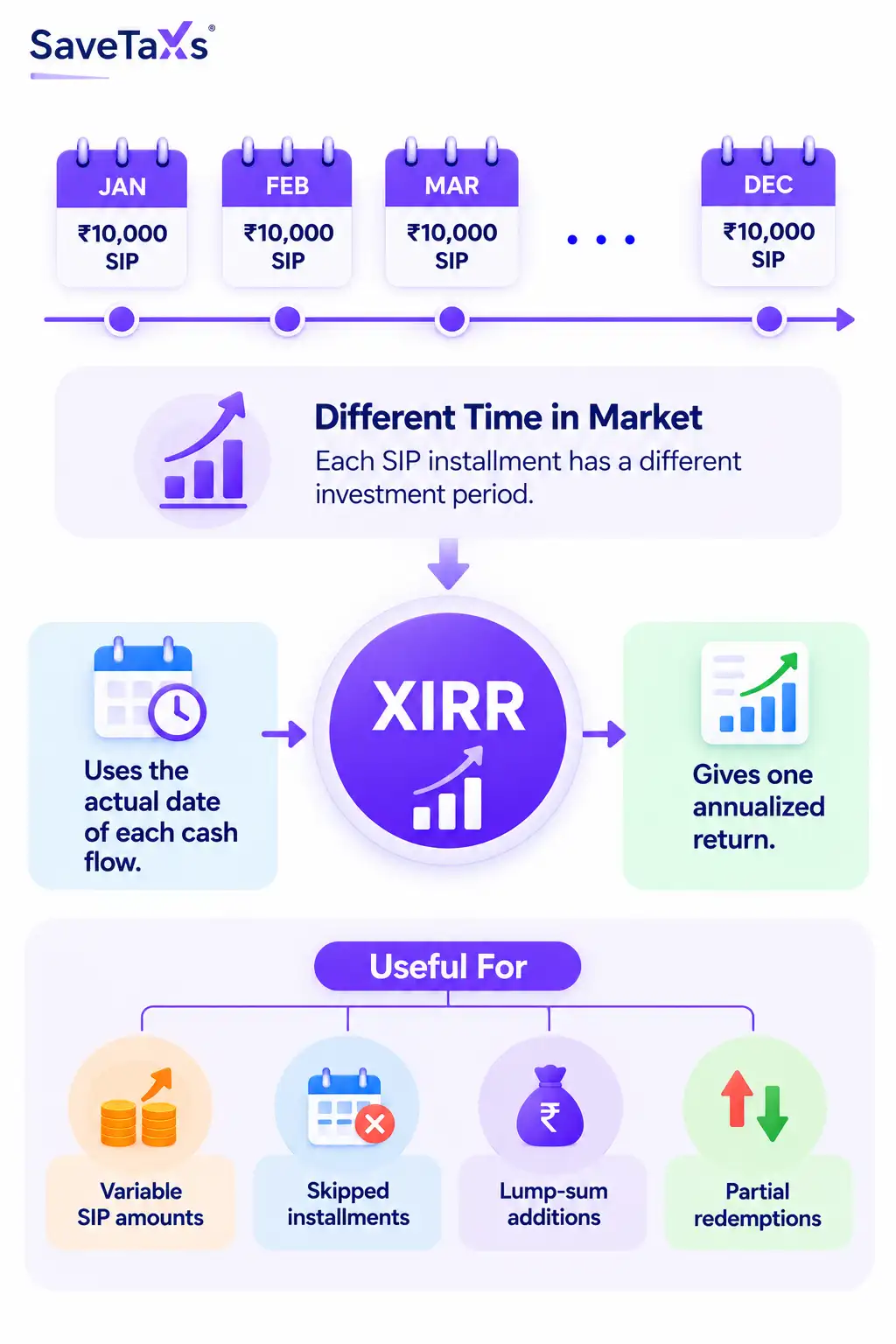
Consider an investor who starts a ₹10,000 monthly SIP in January. The January installment has more time to participate in market movements than the installment made in December.
A basic return calculation may ignore this timing difference.
XIRR in SIP calculations solve this issue by assigning each installment its actual investment date.
XIRR can also be useful when an investor:
This gives investors one annualized return figure reflecting their actual cash-flow history.
There is no universal percentage that qualifies as a good XIRR in mutual funds.
A 10%, 12%, or 15% XIRR should not be evaluated in isolation.
Whether an XIRR is satisfactory can depend on factors such as:
For example, comparing the XIRR of an equity mutual fund directly with that of a relatively low-risk debt-oriented investment may provide little useful information because their risk profiles and objectives differ.
XIRR tells you what annualized return your particular cash flows generated. It does not by itself tell you whether the investment is safe, tax-efficient, or suitable for your financial goals.
For NRIs investing in Indian mutual funds, the basic XIRR calculation works in the same way as it does for other investors.
Suppose an NRI sends money to India periodically and invests different amounts in an Indian mutual fund rather than maintaining a fixed monthly SIP.
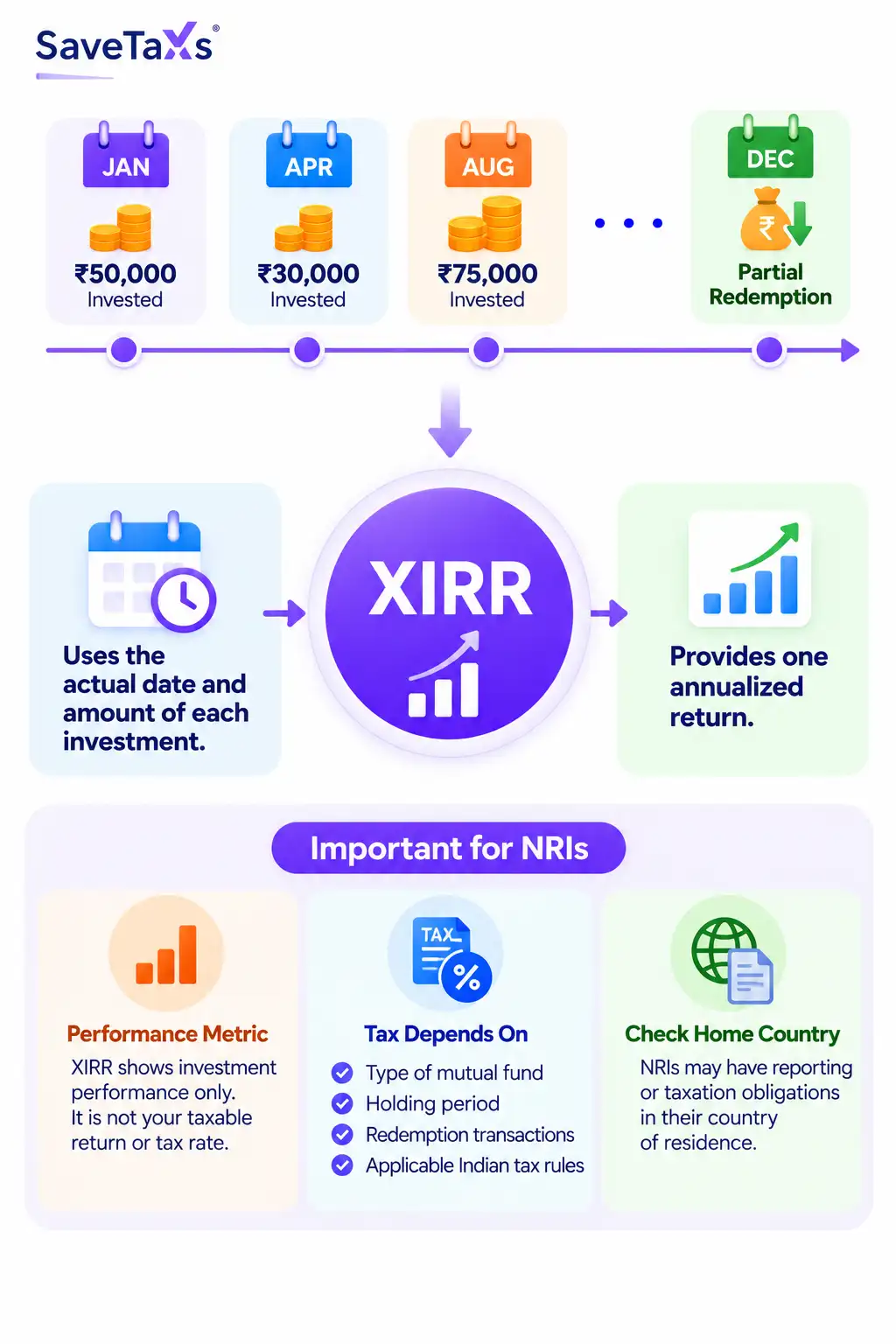
For example:
Because the amounts and dates differ, XIRR can provide a more meaningful annualized return measure than a simple beginning-versus-ending-value calculation.
However, NRIs should distinguish investment performance from taxation.
An XIRR displayed by an investment platform is a performance metric. It is not the investor's taxable return or tax rate.
Tax consequences can depend on factors such as the nature of the mutual fund, holding period, applicable Indian tax provisions, redemption transactions, and the investor's circumstances.
NRIs may also have reporting or taxation obligations in their country of residence. Therefore, an attractive XIRR does not by itself indicate the investor's post-tax return.
Get expert support to understand the Indian tax implications of your mutual fund investments, redemptions, and capital gains as an NRI.
There is another consideration for NRIs evaluating Indian investments: currency movement.
A mutual fund may show its performance in Indian rupees. However, an NRI living abroad may ultimately evaluate wealth in USD, GBP, AED, CAD, or another currency.
For example, an Indian mutual fund could generate a positive rupee-denominated XIRR while depreciation of the Indian rupee against the investor's home currency reduces the effective return after conversion.
Therefore, NRIs evaluating their overall investment performance should not automatically treat a rupee-denominated XIRR as their return in their country-of-residence currency.
This distinction becomes particularly relevant when funds will eventually be converted and repatriated abroad.
XIRR in mutual funds is an annualized return measure designed for investments involving cash flows on different dates.
It is particularly useful for SIPs, irregular investments, additional purchases, and redemptions because it considers both the amount and timing of each transaction.
For a straightforward lump-sum investment, CAGR may be sufficient. When multiple cash flows are involved, XIRR usually provides a more representative picture of the investor's actual annualized performance.
For NRIs, the calculation itself remains the same, but XIRR should not be confused with post-tax or foreign-currency returns. Taxation, reporting requirements, and currency movements may affect the investor's actual outcome separately.
This article is for general informational purposes only and does not constitute tax, legal, financial, or investment advice. Laws, regulations, rates, and procedures may change over time and may vary based on individual circumstances.
While SaveTaxs makes reasonable efforts to keep the information accurate and up to date, readers should verify applicable rules with official authorities or consult a qualified professional before making decisions based on this information.
Vipul Jain is the Co-Founder of SaveTaxs and a tax expert with experience in Indian and NRI taxation. He advises individuals, NRIs, and businesses on tax filing, tax planning, capital gains, DTAA, and compliance matters. He focuses on making complex tax concepts simple and helping taxpayers make informed, compliant decisions. See Full Bio

Want to read more? Explore Blogs