Investment & Financial Planning

How to Convert an NRI Demat Account to a Resident Demat Account?

autohr img By Manish Prajapat | Last Updated : 30 Dec, 2025

Convert an NRI Demat Account to a Resident Demat Account

If you plan to move back to India permanently or wish to stay for a longer duration, your residency status will change from NRI to a resident. As per the law, a resident cannot hold an NRI demat account, and an NRI cannot hold a resident demat account, meaning you will have to convert your NRI demat account to a resident demat account. 

It is mandatory to convert the account to ensure correct tax treatment, proper fund handling, and align the investment account with your new residential status. Additionally, since it is a legal requirement and not just a formality, non-compliance can lead to hefty penalties.

Applying to convert to a resident demat account follows a clear set of steps and hence is not complex. This blog will explain the process of converting an NRI demat to a resident demat account. 

Key Takeaways
  • An NRI must convert their NRI demat account to a resident demat account when they move back to India permanently and become a resident. 
  • Not converting the NRI demat account even after becoming a resident in India can lead to significant penalties. 
  • You must notify your bank or broker immediately when you plan to move back to India. 
  • You need to pay off any debt balance, withdraw credit balance, and close all open trading positions in your trading account before converting the account. 
  • Once your broker receives all the documents, the account conversion process will usually take 5-10 working days. 
  • During the account conversion process, you cannot trade using your old account since it is in the process of closure. 

When Do You Need to Convert an NRI Demat Account?

Converting an NRI demat to a resident demat is a legal requirement under the rules of FEMA and SEBI. You need to convert your NRI demat account to a resident demat account when: 

  • You move back to India permanently with the intention of residing for an indefinite period
  • You fulfill the resident requirements under the Indian income tax laws

The trigger here is the change in residential status and not citizenship or OCI status. 

Upon becoming a resident:

  • You are not allowed to operate NRI Demat + PIS accounts
  • Continuing to trade through them will be considered non-compliant 

What Happens to Your Existing Investments?

When converting an NRI demat account to a resident demat account, NRIs may face one of the biggest concerns, which is determining whether they need to sell their investment. Additionally, you neither lose nor distribute any of your investments.

All your existing holdings, including shares, mutual funds, ETFs, and bonds, stay intact. Also, the demat account itself remains the same, and only its residential status is updated from an NRI to a resident. There is:

  • No change in ISINs or transaction history
  • No change in the number of units or shares you hold
  • You are not required to repurchase securities or sell your investments

Your broker updates the account classification in their system and removes the NRI/PIS tagging. 

In short, this is not related to asset transfer; instead, it is a status conversion. Your investment will stay intact without any interruption. The only difference is that you start operating them as a resident investor. 
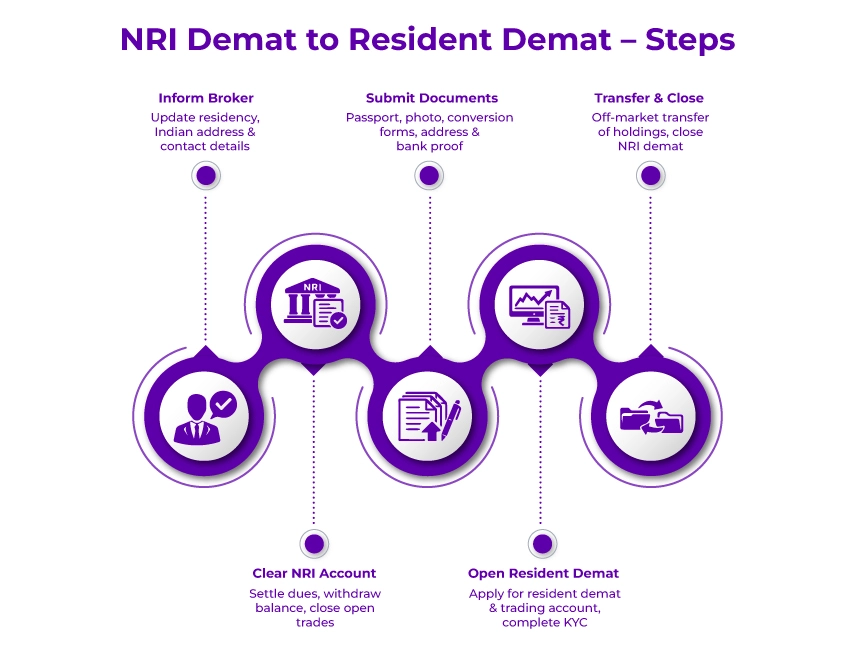
NRI Demat to Resident Demat – Steps

What are the Steps to Convert an NRI Demat Account to a Resident Demat Account?

The account conversion process may sound complicated, but it has a clear set of steps. Follow the steps below to convert an NRI demat account to a resident demat account:

Notify Your Bank and Broker 

  • Contact your bank or broker immediately and inform them about your permanent return to India. It could be your depository participant (DO) or any other brokerage. They will help you understand the process and provide you with the required forms. 
  • Submit updated details like your new Indian address, local mobile number, and email. 
  • In case there are joint holders, they are also required to sign the forms. 

Clear Your Existing Account 

Before applying for the conversion, you must:

  • Pay off any outstanding dues (also known as debit balances) in your trading account.
  • Withdraw any remaining amount (credit balance from your NRI trading account.
  • Close all open trading positions, especially if you hold F&O (Futures and Options) positions. The account can't be converted by the broker if open positions are there.
  • Ensure that your signature matches the signature on your earlier records. You might receive a signature proof from the broker to ensure there is no mismatch. 

Gather the Necessary Documents 

The document requirements may vary based on different brokers. However, the most commonly required documents are as follows:

  • Photograph: Passport-sized photograph required for identity proof
  • Copy of passport and visa: A copy of your passport and visa (even if expired) to reflect your previous NRI status and current status.
  • Account Conversion Form: Application form for converting the demat account.
  • Account Closure Form: For the existing NRI demat and trading account.
  • Account Modification Form: To make updates in the details, such as address, contact number, and bank account. 
  • Proof of Address: Driving license, passport, voter ID, or masked Aadhaar as proof of your Indian address. 
  • Bank Proof: First page of your bank passbook/statement that shows your bank account number, MICR, and IFSC code. If not, a copy of a cancelled personalised cheque (self-attested). 

Submit the Documents 

Numerous brokers follow a two-step submission:

  • Submit the scanned documents via email to your broker's forms department. Your forms will be reviewed, and you will be notified if anything is incorrect or missing. 
  • Send the physical documents via courier, along with a small fee. Also, send a cheque or bank draft payable to the brokerage. Additionally, you may have to send the papers to the broker's head office. 

An In-Person Verification (IPV) may be required by some brokers, which can be done online through your phone or laptop camera. 

Open a New Resident Demat and Trading Account 

The brokers close the NRI demat account and open a new resident demat and trading account in most situations. You cannot reuse your NRI account number; hence, you will receive a new client ID. Consider the following steps:

  • Fill out the application form to open a new resident demat and trading account. 
  • Submit your KYC documents and link your new resident savings bank account to this trading account.
  • Provide income proof if you wish to trade in derivatives (F&O). 

Shift Securities from the Old Account to the New Account 

When the new resident's demat account is opened:

  • All your shares and securities will be transferred by your broker from your old NRI demat account to your new resident demat account. This process is often known as an off-market transfer. 
  • Your broker will communicate with the designated bank for NRE investment held under PIS. This will ensure accurate remittance and compliance.
  • Your old NRI demat account will be closed once the transfer is complete. Closing the account will prevent any kind of confusion and help you adhere to the regulations. 
Financial Peace Of Mind Even Across Borders

Savetaxs helps NRIs file NRI Income Tax returns effortlessly with expert guidance.

How Much Time Does the Account Conversion Process Take? 

The process to convert an NRI demat account to a resident demat account usually takes 5-10 working days after your broker gets all the documents. You may not be able to trade through your old accounts during this process. This is because your account will be in the process of closure. 

Moreover, you can check your holdings using various online platforms. You can start trading again after your new account is active, using your new resident demat number. 

What are the TDS and Tax Implications? 

Your tax liability changes once your residential status changes from an NRI to a resident. After becoming a resident, you must keep the following things in mind

TDS on Capital Gains

TDS (tax deducted at source) applies only when you are an NRI. The broker or AMC deducts TDS before crediting the amount on stock or mutual fund sales in India. Once you become a resident, no TDS will be deducted, and you will be liable to pay the tax through self-assessment during ITR filing. 

Long-term gains

  • Equity shares and equity mutual funds: Investments held for more than 12 months are treated as long-term. LTCG is taxed at a rate of 12.5% on gains exceeding the limit of Rs. 1.25 lakh per financial year, plus cess. 
  • Debt mutual funds: Gains are taxed at the applicable income-tax slab rate without any indexation, regardless of the holding period. 

Short-term gains 

  • Equity shares and equity mutual funds: Investments held for 12 months or less are taxed at 15% plus cess.
  • Debt mutual funds: Short-term gains are taxed at the applicable income-tax slab rate, plus cess. 

Resident vs. NRI taxation

Once you become a resident, your global income may become subject to taxation in India. This will depend on whether you qualify as RNOR (Resident but Not Ordinarily Resident) or ROR (Resident and Ordinarily Resident). During the RNOR phase, foreign income is generally not taxed; however, it becomes taxable under the ROR status. 

Income Tax Return (ITR) Filing

Filing an ITR in India becomes necessary when your residency status changes. You must declare all your income and capital gains in the ITR. Any excess TDS deducted during your NRI phase can be claimed as a refund while filing the ITR.

Grow Your Money Across Borders

Invest safely in India with Savetaxs’ expert investment tax guidance.

Schedule A Call Today Schedule A Call Today

The Bottom Line 

Your residential status under FEMA and the Income Tax Act depends on your intention and the duration you wish to spend in India. Once you become a resident under FEMA, you must update your status immediately and convert your NRI demat account to a resident demat account. An NRI demat account can be held only by people living abroad. Converting NRI demat to resident demat involves informing your broker, clearing your old account, submitting the documents, opening a new account, transferring your holdings, and closing the old account. Though it might sound complex, it can be done easily if you follow the proper steps. 

Still, if you find any part confusing, don't think twice to seek assistance from an expert at Savetaxs. We have a team of professionals who can guide you every step of the way. They will ensure your investment remains legal and secure in India. Choosing the experts will not only ensure compliance with the rules but also offer you peace of mind. Contact us right away and make your transition back to India smooth and hassle-free. 

Note: This guide is for information purposes only. The views expressed in this guide are personal and do not constitute the views of Savetaxs. Savetaxs or the author will not be responsible for any direct or indirect loss incurred by the reader for taking any decision based on the information or the contents. It is advisable to consult either a CA, CS, CPA or a professional tax expert from the Savetaxs team, as they are familiar with the current regulations and help you make accurate decisions and maintain accuracy throughout the whole process.

profile
Manish Prajapat (Tax Expert)

Mr Manish is a financial professional with over 10 years of experience in strategic financial planning, performance analysis, and compliance across different sectors, including Agriculture, Pharma, Manufacturing, & Oil and Gas. Mr Prajapati has a knack for managing financial accounts, driving business growth by optimizing cost efficiency and regulatory compliance. Additionally, he has expertise in developing financial models, preparing detailed cash flow statements, and closing the balance sheets.

Recent Post

Want to read more? Explore Blogs

Frequently Asked Questions

No matter what your source of income is, we've got you covered. There’s a plan for everybody!

You must clear and withdraw credit balances, close open positions (including MTF/F&O), and ensure name/signature matches existing records (banker's letter if there is a change in signature).

No, you can't convert both NRE and NRO to a resident account at once. Instead, you should convert one at a time and process separately if holding both.

During a conversion, your holdings remain safe in the same demat account, but trading is temporarily frozen. You can still view them on CDSL/NSDL portals (Easi/Speed-e), but you cannot buy/sell until the conversion is fully approved.

The conversion process typically takes 7–15 working days. During processing, access to Kite/Console is suspended, but holdings are visible online.

The processing fee may vary from Rs. 300–Rs. 500 (broker-specific).
