


Investment & Financial Planning
FCNR Deposit Interest Rates in 2026FCNR Deposit Interest Rates in 2026
Written by Vipul Jain

_1767099354.png&w=3840&q=75)
A cryptocurrency is a digital or virtual currency. It has already taken the investment world, and for investors, whether Indian or NRI, it has become a trend. Additionally, as we know, cryptocurrencies have the potential to redesign the financial world. However, like any investment, cryptocurrency does have its own pros and cons for investors.
Confused, don't worry. To help you better understand this, in this blog, we have mentioned the advantages and disadvantages of cryptocurrency for NRIs. So read on and gather all the information.
From prospects of high returns to round-the-clock trading on transparent, ultra-secure infrastructure, cryptocurrency has a lot to offer if you know how to invest in it. Let's see a few advantages of cryptocurrency for NRIs.
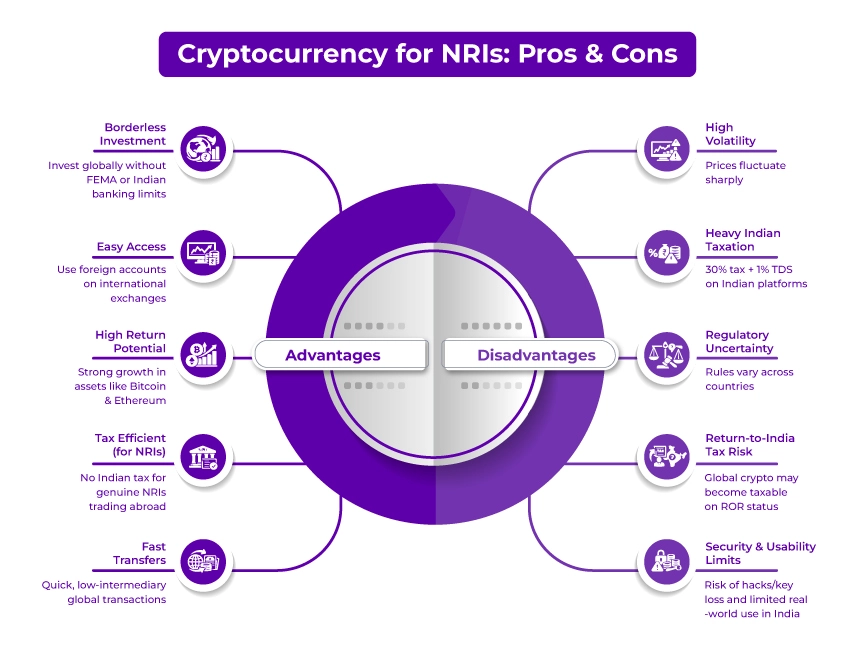
Cryptocurrency is not limited by country borders. Considering this, NRIs can purchase, hold, and sell crypto regardless of whether they live, without relying on FEMA-related approvals or Indian banking systems. This makes them convenient investment options for NRIs who frequently move to different countries or have assets across jurisdictions.
Using foreign bank accounts or cards, through popular international exchanges, NRIs can simply invest in cryptocurrency. Unlike other Indian investments, in this, NRIs do not require NRE/ NRO accounts, RBI compliance, and PIS permissions. Further, compared to other investments, access to cryptocurrency is more straightforward for NRIs.
It is well-known to everyone that cryptocurrency has high return potential compared to other Indian investments. During growth cycles, it has delivered excess returns. Additionally, assets like Ethereum and Bitcoin have also shown strong long-term appreciation. For NRIs seeking growth-oriented investments and who have a high risk appetite, cryptocurrencies are the best investment options.
For NRIs with no India-sourced income, trading in cryptocurrency on foreign exchange, there is no tax imposed. Additionally, NRIs also do not need to report this on their ITR filings in India. Further, compared to many Indian investments that imposed TDS and ITR reporting obligations, cryptocurrency offers tax benefits to NRIs.
Through blockchain technology, you can transfer cryptocurrencies in a few minutes or even seconds. Compared to the traditional banking system that depends on intermediaries and SWIFT, this allows for quick transactions. Although it is not a replacement for legal remittance channels. However, cryptocurrencies have the efficiency of decentralized financial technology.
These were some of the key advantages of cryptocurrency for NRIs. Moving ahead, let's know the disadvantages of it for NRIs.
Investing in cryptocurrency might look profitable and appealing; however, NRIs should also consider its downsides. Considering this, now let's see the disadvantages of cryptocurrency for NRIs:
The prices of crypto fluctuate sharply within hours. Sudden market rallies or crashes can lead to losses or emotional decision-making. For NRIs who look for predictable or stable returns, the crypto is not suitable.
For NRIs, income from crypto investment becomes taxable in India if trading is done on Indian exchanges or their residential status changes to Resident & Ordinarily Resident (ROR). In this scenario, they are liable to pay:
This makes the cryptocurrency in India one of the most heavily taxed asset classes.
From country to country, crypto regulations differ, and they are still evolving. Considering this, the government, with little notice, may also impose new rules, bans, or restrictions. Further, this uncertainty regulation increases legal risks and compliance for NRIs living in multiple jurisdictions.
When NRIs move to India, and again become Indian residents, they need to pay tax in India on their global crypto holdings. Additionally, they also need to follow the disclosure rules. Further, many NRIs face issues with Schedule VDA, tracking old transactions, or Schedule FA disclosures, leading to compliance challenges.
Cryptocurrency comes with the risk of self-custody. Hacking of wallets, loss of private keys, or exchange failures can outcome in permanent fund loss. Considering this, unlike banks in cryptocurrency, there is no authority to recover or reverse transactions.
In India, cryptocurrency is not a legal currency. Considering this, you cannot freely use these for making payments. These are only stated as digital assets. Compared to traditional money and financial instruments, this limits the usage of cryptocurrency to the real world.
So these were some of the disadvantages of cryptocurrency for NRIs. Moving further, let's know whether these are suitable investment options in India for NRIs or not.
With the expert guidance of Savetaxs, file your ITR on time with 100% accuracy.
For certain types of NRIs, cryptocurrency is a suitable investment option in India. However, it is not a one-size-fits-all investment. Considering this, cryptocurrency is a perfect choice for NRIs who:
For these NRIs, cryptocurrency is a growing asset and works as a diversification tool. However, investing in these assets is not a good option for NRIs who:
In simple words, investing in cryptocurrency is perfect for NRIs who can handle complexity and uncertainty. However, it is not an ideal investment option for those looking for clarity, stability, and ease of compliance.
Connect with Savetaxs, get expert guidance on crypto taxation, and maximize your refunds.
Lastly, the advantages and disadvantages of cryptocurrency for NRIs provide a complex image of a revolutionary financial system. While providing benefits like global and borderless investment, high return potential, it also consists of challenges, including extremely high volatility, security, and custody risks. Considering this, for anyone investing in this, a thoughtful consideration of the perks and drawbacks is vital.
Further, if you are facing issues in choosing the right investment option in India, connect with Savetaxs. We have a team of financial experts who can assist you in selecting the correct investment as per your financial goals, which further offers you maximum refunds.
This article is for general informational purposes only and does not constitute tax, legal, financial, or investment advice. Laws, regulations, rates, and procedures may change over time and may vary based on individual circumstances.
While SaveTaxs makes reasonable efforts to keep the information accurate and up to date, readers should verify applicable rules with official authorities or consult a qualified professional before making decisions based on this information.
Vipul Jain is the Co-Founder of SaveTaxs and a tax expert with experience in Indian and NRI taxation. He advises individuals, NRIs, and businesses on tax filing, tax planning, capital gains, DTAA, and compliance matters. He focuses on making complex tax concepts simple and helping taxpayers make informed, compliant decisions. See Full Bio
Want to read more? Explore Blogs
_1781845771869.webp&w=828&q=75)
_1778936280179.webp&w=828&q=75)
_1778936089630.webp&w=828&q=75)