US Tax Filing and Compliance
How to Report Multiple 1099 Forms on a U.S. Tax Return: A Guide for NRIsHow to Report Multiple 1099 Forms on a U.S. Tax Return: A Guide for NRIs
Written by Hatim Dudhiyawala

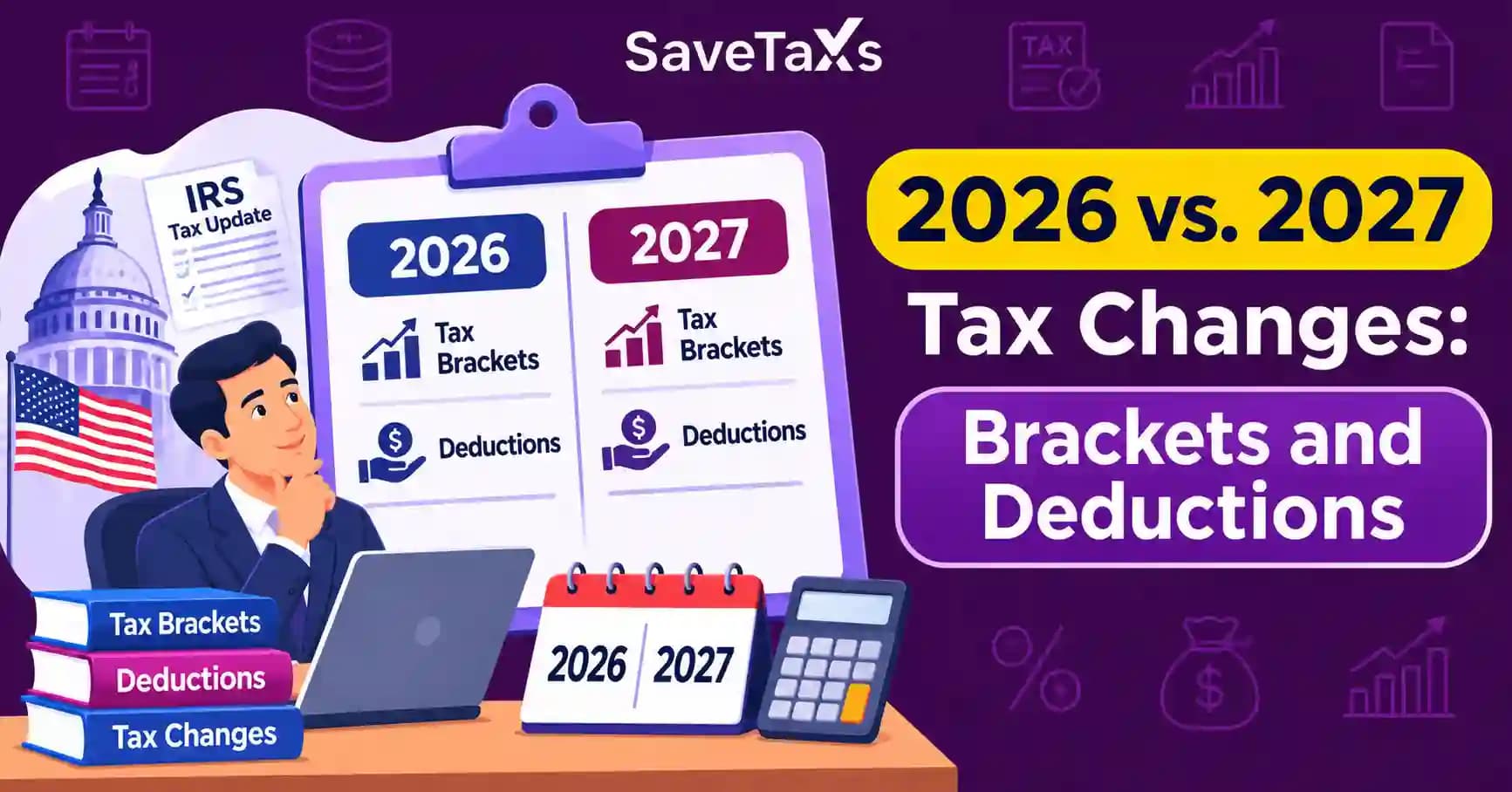
The IRS has announced new inflation-adjusted tax provisions for Tax Year 2027, bringing changes to federal income tax brackets, standard deductions, tax credits and other important thresholds. These adjustments follow the Working Families Tax Cuts (WFTC) provisions and affect how individuals and families plan their U.S. federal taxes.
For taxpayers, understanding the differences between Tax Year 2026 and Tax Year 2027 is important for estimating taxable income, reviewing deductions and preparing for upcoming tax obligations. The federal income tax rates remain unchanged, but several income thresholds and deduction limits increase for 2027.
For NRIs, U.S. citizens and Green Card holders living outside the United States, some changes may also affect overseas income and tax planning, particularly the Foreign Earned Income Exclusion (FEIE).
This guide compares the important U.S. federal tax changes for 2026 and 2027, explains what remains unchanged and highlights the provisions that taxpayers with India–U.S. financial connections should understand.
The IRS adjusts several federal tax provisions annually to account for inflation. The following table highlights some of the most important differences between the two tax years.
| Tax provision | 2026 | 2027 |
|---|---|---|
| Standard deduction – Single | $16,100 | $16,600 |
| Standard deduction – Married filing jointly | 32,200 | 33,200 |
| Standard deduction – Head of household | 24,150 | 24,925 |
| Top federal income tax rate | 37% | 37% |
| Top bracket threshold – Single | $640,600 | $661,375 |
| Top bracket threshold – Married filing jointly | $768,700 | $793,650 |
| Maximum Child Tax Credit | $2,200 | $2,300 |
| AMT exemption – Single | $90,100 | $93,000 |
| AMT exemption – Married filing jointly | $140,200 | $144,700 |
| Estate tax exclusion | $15 million | $15.48 million |
| Annual gift tax exclusion | $19,000 | $20,000 |
| Foreign Earned Income Exclusion | 132,900 | 137,300 |
| Maximum EITC – Three or more qualifying children | 8,231 | 8,496 |
| Health FSA contribution limit | $3,400 | $3,500 |
Note: These are federal tax amounts. Eligibility requirements, income limitations and other statutory conditions still apply. Tax Year 2026 amounts generally apply to returns filed in 2027, while Tax Year 2027 amounts generally apply to returns filed in 2028.
The IRS retains the seven federal individual income tax rates for 2027. However, the income thresholds associated with these rates increase.
This means that a portion of taxable income may fall into a lower marginal tax bracket than it would under the previous year's thresholds, depending on the taxpayer's income and filing status.
| Tax rate | 2026 taxable income | 2027 taxable income |
|---|---|---|
| 10% | Up to $12,400 | Up to $12,800 |
| 12% | 12,401–50,400 | 12,801–52,025 |
| 22% | 50,401–105,700 | 52,026–109,125 |
| 24% | 105,701–201,775 | 109,126–208,325 |
| 32% | 201,776–256,225 | 208,326–264,550 |
| 35% | 256,226–640,600 | 264,551–661,375 |
| 37% | Above $640,600 | Above $661,375 |
| Tax rate | 2026 taxable income | 2027 taxable income |
|---|---|---|
| 10% | Up to $24,800 | Up to $25,600 |
| 12% | 24,801–100,800 | 25,601–104,050 |
| 22% | 100,801–211,400 | 104,051–218,250 |
| 24% | 211,401–403,550 | 218,251–416,650 |
| 32% | 403,551–512,450 | 416,651–529,100 |
| 35% | 512,451–768,700 | 529,101–793,650 |
| 37% | Above $768,700 | Above $793,650 |
Head-of-household and married-filing-separately taxpayers have separate thresholds. For example, the highest 37% bracket begins above $640,600 for head-of-household filers in 2026 and $661,350 in 2027.
What does this change mean for taxpayers?
The increase in bracket thresholds does not mean that the federal income tax rates have decreased. Instead, the income ranges have shifted upward.
For example, a single taxpayer with $55,000 in taxable income would have part of their income taxed at 22% under the 2026 thresholds. Under the 2027 thresholds, the 12% bracket extends to $52,025 rather than $50,400.
The amount of tax ultimately owed still depends on the taxpayer's complete taxable income and applicable deductions and credits.
For a detailed explanation of the previous year's income limits, see our 2026 Federal Income Tax Brackets guide.
Review your U.S. tax position, deductions and cross-border tax obligations with expert guidance.
The standard deduction reduces the amount of income subject to federal income tax. Taxpayers who claim the standard deduction generally do not need to itemize individual deductible expenses.
For Tax Year 2027, the IRS has increased the standard deduction amounts across the main filing categories.
| Filing status | $2,026 | $2,027 | Increase |
|---|---|---|---|
| Single | $16,100 | $16,600 | $500 |
| Married filing jointly | $32,200 | $33,200 | $1,000 |
| Married filing separately | $16,100 | $16,600 | $500 |
| Head of household | $24,150 | $24,925 | $775 |
Consider a single taxpayer with $75,000 in adjusted gross income who qualifies for the standard deduction and has no other adjustments.
The standard deduction reduces the amount of income remaining before other applicable adjustments and deductions by an additional $500 in 2027.
This does not mean the taxpayer automatically saves $500 in tax. The actual tax difference depends on the applicable marginal rates, other deductions, credits and income.
Apart from income tax brackets and standard deductions, the IRS has adjusted several tax credits and contribution limits for 2027.
The maximum Child Tax Credit increases by $100 for 2027.
| Particulars | $2,026 | $2,027 |
|---|---|---|
| Maximum Child Tax Credit | $2,200 | $2,300 |
| Maximum refundable portion | $1,700 | $1,800 |
The increase may benefit eligible families with qualifying children. However, taxpayers must still satisfy the applicable eligibility, identification and income requirements.
The maximum Earned Income Tax Credit for taxpayers with three or more qualifying children increases from $8,231 in 2026 to $8,496 in 2027.
The credit also has different income thresholds and maximum amounts depending on the number of qualifying children and filing status.
Therefore, taxpayers should not assume that the maximum credit is available to everyone who earns income.
The contribution limit for health Flexible Spending Arrangements increases in 2027.
| Particulars | $2,026 | $2,027 |
|---|---|---|
| Maximum salary reduction contribution | $3,400 | $3,500 |
| Maximum permitted carryover | $680 | $700 |
Employees participating in eligible employer-sponsored cafeteria plans may benefit from the higher contribution limit, subject to their plan's terms.
The IRS also increases certain thresholds related to the Alternative Minimum Tax (AMT), estate tax and annual gift tax exclusion.
The AMT is a separate federal tax calculation designed to ensure that certain taxpayers with higher incomes and specified tax preferences pay a minimum amount of tax.
The exemption amounts increase for 2027.
| Filing status | 2026 exemption | 2027 exemption |
|---|---|---|
| Single / Unmarried | $90,100 | $93,000 |
| Married filing jointly | $140,200 | $144,700 |
| Married filing separately | $70,100 | $72,350 |
The income levels at which these exemptions begin to phase out also increase.
Taxpayers with substantial income or certain deductions should review their AMT exposure rather than assuming that an increase in the exemption eliminates their liability.
The federal estate tax exclusion increases from $15 million in 2026 to $15.48 million in 2027.
| Particulars | $2,026 | $2,027 |
|---|---|---|
| Federal estate tax exclusion | $15,000,000 | $15,480,000 |
The applicable exclusion is relevant to estates of individuals who die during the respective calendar year.
The annual gift tax exclusion increases from $19,000 to $20,000 per recipient.
| Particulars | $2,026 | $2,027 |
|---|---|---|
| Annual gift tax exclusion per recipient | $19,000 | $20,000 |
| Gifts to a non-U.S.-citizen spouse | $194,000 | $201,000 |
The exclusion for gifts to a non-U.S.-citizen spouse is a separate special limit.
For taxpayers with U.S. estate and gift tax exposure, these annual adjustments may be relevant when reviewing transfers to family members or beneficiaries.
Not every federal tax provision increases each year. Some important rules and limits remain unchanged.
| Tax provision | $2,026 | $2,027 |
|---|---|---|
| Federal individual income tax rates | 10%–37% | 10%–37% |
| Personal exemption | $0 | $0 |
| Lifetime Learning Credit phaseout – Single | 80,000–90,000 | 80,000–90,000 |
| Lifetime Learning Credit phaseout – Joint | 160,000–180,000 | 160,000–180,000 |
The seven federal individual income tax rates remain the same. The personal exemption also remains eliminated.
The overall limitation on itemized deductions remains eliminated under the applicable WFTC provisions, although a separate limitation affects the tax benefit of itemized deductions for taxpayers in the 37% bracket.
Taxpayers should distinguish between provisions that remain unchanged and provisions that are subject to annual inflation adjustments.
The 2027 U.S. tax adjustments may be relevant to NRIs who have continuing U.S. tax obligations. However, the effect depends on their U.S. tax classification, income sources and filing requirements.
Being classified as an NRI under Indian tax law does not automatically determine whether someone is a U.S. citizen, resident alien or nonresident alien.
U.S. citizens generally remain subject to U.S. federal income tax on worldwide income even when they live in India.
The higher 2027 tax bracket thresholds and standard deduction may affect their federal tax calculations, subject to applicable eligibility rules.
They may also need to evaluate the Foreign Tax Credit when qualifying income is taxed in both countries.
Green Card holders generally continue to be treated as U.S. tax residents unless their status changes under applicable rules.
For example, an Indian Green Card holder who relocates to India may still have U.S. federal tax filing and worldwide-income reporting obligations.
The 2027 changes should therefore be considered alongside their residency status and continuing U.S. tax responsibilities.
The Foreign Earned Income Exclusion increases from $132,900 in 2026 to $137,300 in 2027.
This provision may benefit qualifying U.S. citizens and resident aliens who live and work outside the United States.
However, taxpayers must meet the applicable foreign tax home requirement and either the bona fide residence test or the physical presence test.
An Indian citizen classified as a nonresident alien for U.S. tax purposes does not automatically qualify for FEIE.
For eligibility requirements and detailed rules, refer to our Foreign Earned Income Exclusion (FEIE) guide.
NRIs with income in both countries may need to review the interaction between U.S. federal taxes and Indian income taxes.
For example, an NRI who is a U.S. tax resident and earns qualifying income in India may need to evaluate whether the Foreign Tax Credit is available.
The credit depends on income sourcing, tax paid, eligibility and applicable limitations.
Read our guide to Foreign Tax Credit for NRIs to understand how qualifying foreign taxes may reduce double taxation.
High-income NRIs working in the United States may need to review the impact of changing federal tax brackets on their annual compensation.
Salary, bonuses, and restricted stock unit (RSU) vesting can affect total taxable income. A change in the bracket thresholds may influence the calculation of their annual federal tax liability.
However, withholding on salary or bonuses is not necessarily equal to the final tax owed.
NRIs with significant equity compensation should also review their withholding, estimated payments, and investment decisions.
For additional guidance, read our Tax Planning for High-Income NRIs in the US: RSUs and Bonuses.
Connect with Savetaxs experts for personalized tax and compliance guidance.
Taxpayers can use the annual IRS adjustments to review their financial and tax positions before the beginning of Tax Year 2027.
Consider the following steps:
For NRIs, an annual review should also consider Indian tax residency, foreign-source income, tax credits and applicable reporting requirements in both countries.
The 2027 U.S. federal tax adjustments bring higher income thresholds, standard deductions, tax credits and selected exemptions compared with 2026. Although the seven federal individual income tax rates remain unchanged, the adjustments can influence taxable income and tax planning decisions.
For NRIs, U.S. citizens and Green Card holders living abroad, understanding these changes is particularly important when managing worldwide income, foreign tax credits and U.S. filing responsibilities.
Savetaxs helps NRIs and individuals with India–U.S. financial connections understand applicable tax requirements, evaluate cross-border tax implications and plan their tax compliance based on their circumstances. Whether you need guidance on U.S. income tax, foreign income or tax-credit eligibility, consulting an experienced tax professional can help you make informed decisions.
This article is for general informational purposes only and does not constitute tax, legal, financial, or investment advice. Laws, regulations, rates, and procedures may change over time and may vary based on individual circumstances.
While SaveTaxs makes reasonable efforts to keep the information accurate and up to date, readers should verify applicable rules with official authorities or consult a qualified professional before making decisions based on this information.
Shubham Jain is the Founder of SaveTaxs and has extensive experience in Indian and NRI taxation. He advises individuals, NRIs, and businesses on tax filing, tax planning, capital gains, DTAA benefits, fund repatriation, and compliance matters. He regularly writes about taxation and related financial topics. His focus is on making complex tax concepts easy to understand. Through his articles, he helps taxpayers stay informed, avoid common mistakes, and stay compliant with Indian tax laws. See Full Bio

Want to read more? Explore Blogs