NRI Income Tax Compliance
Capital Gains Tax Planning for NRIs Living in the USCapital Gains Tax Planning for NRIs Living in the US
Written by Hatim Dudhiyawala


A high salary does not always mean your US tax payments are on track. For NRIs working in the United States, annual compensation may include a base salary, performance bonuses, restricted stock units (RSUs), employee stock purchase plans (ESPPs) and proceeds from selling employer shares. Indian tax residency and US tax residency are determined under different rules, so your US filing obligations should be assessed separately from your Indian residential status.
Consider an Indian professional working in the US who earns a salary, receives a substantial year-end bonus and has RSUs vesting throughout the year. Even if tax is withheld from regular paychecks, the combined income may leave a gap between the amount already paid and the final tax liability.
Tax planning for high-income NRIs in the US involves forecasting compensation, reviewing withholding, assessing upcoming equity events and checking whether additional tax payments may be necessary. It also means considering the financial implications of selling employer shares and identifying cross-border issues when income or residency connects the US and India.
This guide focuses on practical annual tax-planning decisions—not a repeat of the detailed salary, RSU or ESOP tax rules covered in other Savetaxs articles.
For high-income professionals, tax planning should not begin only when it is time to file a tax return. Compensation can change throughout the year, and a decision made months before filing may affect the amount of tax owed.
A professional might receive a salary increase, a performance bonus, additional equity compensation or investment income. If the annual tax estimate is not updated, the withholding deducted from regular paychecks may no longer be sufficient.
Three questions should guide your annual review:
For example, an NRI employed by a US technology company may have a predictable base salary but variable bonuses and quarterly RSU vesting. Reviewing each item independently may make it harder to identify the combined effect on annual tax liability.
The objective is to maintain a realistic estimate and update it when circumstances change.
For detailed information about salary taxation, payroll withholding, FICA and state-tax basics, see US Salary Income Taxation for NRIs.
Review your withholding, equity income, and India–US tax considerations before year-end.
An annual compensation forecast brings expected income events into one planning document. It helps identify changes early enough to review withholding or estimated payments.
Start by collecting your latest pay statements, bonus information, employer equity schedule and investment records.
| Income or compensation source | What to review | Planning purpose |
|---|---|---|
| Base salary | Annual salary, pay frequency and expected changes | Establish the regular wage estimate |
| Performance bonus | Expected amount, payment date and withholding | Identify additional income and possible withholding gaps |
| RSUs | Scheduled vesting dates and estimated values | Forecast compensation associated with vesting |
| ESPP or stock options | Expected purchase, exercise or sale events | Identify transactions requiring separate tax review |
| Employer-share sales | Expected proceeds, basis and holding period | Estimate potential gains or losses |
| Other income | Interest, dividends and other relevant income | Assess the broader annual tax position |
Distinguish confirmed income from estimates. For example, an approved bonus may be a more reliable planning input than an unconfirmed performance award. Equity values may also change before vesting.
A single estimate can become outdated quickly. Consider maintaining two scenarios:
Compare both scenarios with your expected federal and state tax payments. Also review relevant payroll and additional taxes, such as Additional Medicare Tax, and assess whether investment income could trigger the Net Investment Income Tax (NIIT). This does not require predicting the exact final tax bill months in advance. It helps you recognize when the current plan may need adjustment.
Your forecast should also reflect your filing status, relevant deductions, credits, other household income and state-tax circumstances. A compensation total alone is not a complete tax calculation.
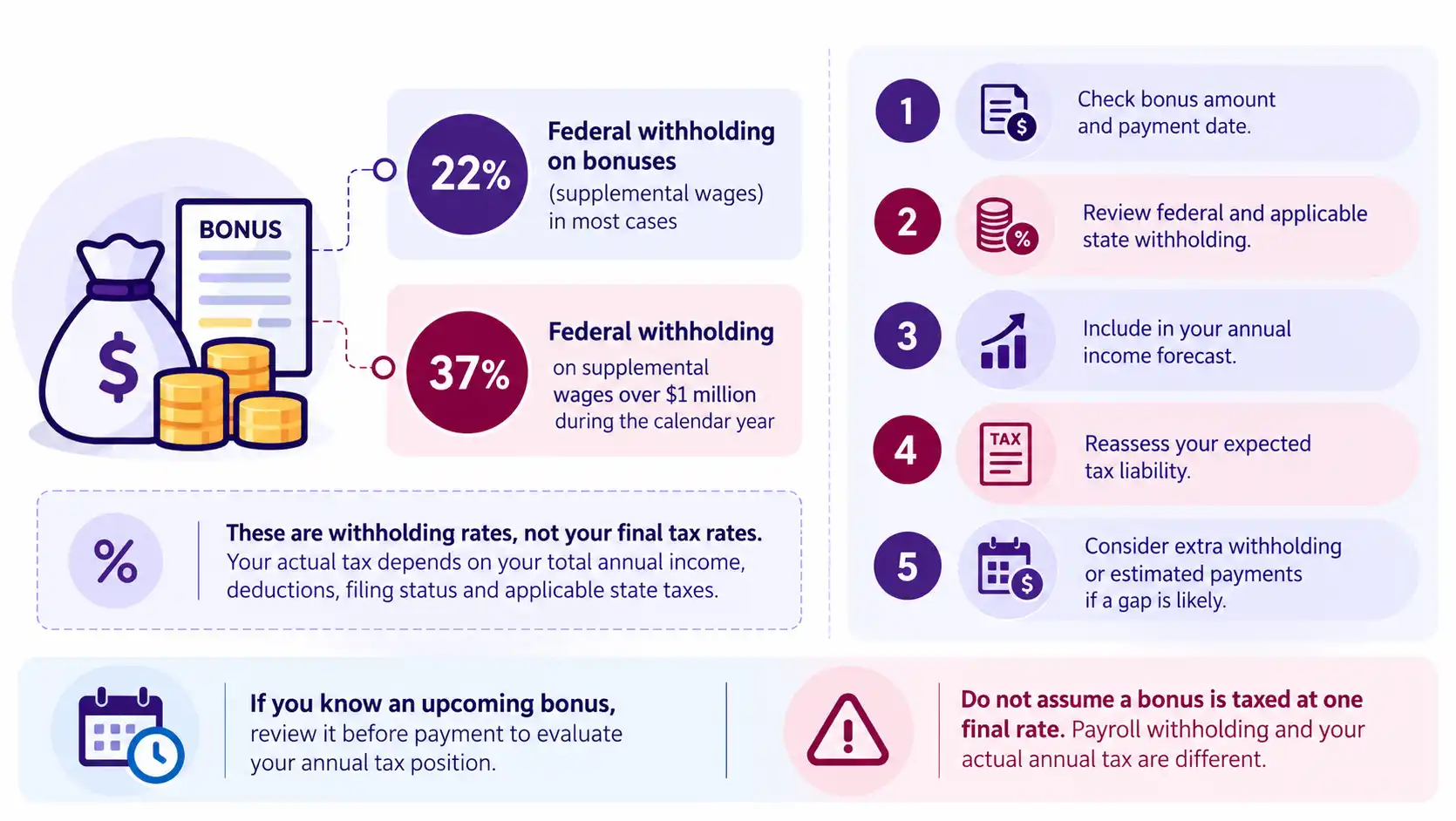
A performance bonus can increase your annual income, but the amount withheld from the payment may not match the final tax attributable to your total income.
Under US federal payroll rules, bonuses generally fall within supplemental wages. Under the 2026 IRS rules, separately identified supplemental wages may generally be subject to a flat 22% federal income-tax withholding method when the applicable conditions are met. The mandatory withholding rate is 37% on supplemental wages exceeding $1 million during the calendar year. These are withholding rules, not necessarily the final tax rates on your annual income. The IRS explains these rules in Publication 505: Tax Withholding and Estimated Tax.
The important distinction is between tax withheld from a bonus and your final annual tax liability.
Suppose an NRI receives a $30,000 performance bonus. The employer withholds federal income tax from the payment. However, the employee's overall tax position also depends on salary, equity compensation, investment income, filing status, deductions and applicable state taxes.
The withholding on the bonus alone does not establish whether the employee has paid enough tax for the year.
Where possible, review a known upcoming bonus before it is paid. That gives you time to evaluate your annual position rather than discovering a possible shortfall after year-end.
Do not assume that a bonus is subject to one special final tax rate. The payroll withholding method and the tax ultimately due on total annual taxable income are different matters.
RSUs can make compensation planning more complicated because vesting events may occur throughout the year. The number and value of shares can also change, so an estimate prepared at the beginning of the year may not remain accurate.
For planning purposes, maintain a calendar of expected vesting dates and estimated values. Update it when your employer issues a new equity statement or when the vesting schedule changes.
The aim is to include anticipated equity compensation in your annual forecast and review the associated withholding. It is not necessary to reproduce the full rules governing RSU taxation in this article.
| When | What to do |
|---|---|
| Start of the tax year | Collect the current vesting schedule and recent equity statements |
| Before a significant vesting event | Update the estimated value and review anticipated withholding |
| After vesting | Reconcile the event with employer and payroll records |
| Before year-end | Update total compensation and review any planned share sales |
A vesting event may affect your compensation forecast even if you intend to retain the shares. That is why a plan based only on cash received from selling shares can overlook relevant income.
For a typical RSU award, distinguish the compensation recognized when shares vest and settle from any later gain or loss when those shares are sold. The compensation value generally forms the starting tax basis for the shares, subject to the applicable rules. If you worked in more than one country during the award's service period, the sourcing and tax treatment may require additional review.
The actual tax treatment depends on the award and your circumstances. For Indian tax treatment of RSUs, see RSU Taxation in India. For the specific US tax treatment of Indian ESOPs and ESPPs, including relevant transaction and reporting rules, see US Tax on Indian ESOPs for NRIs.
These existing guides cover detailed tax mechanics. This article focuses on when to review equity events as part of annual tax planning.
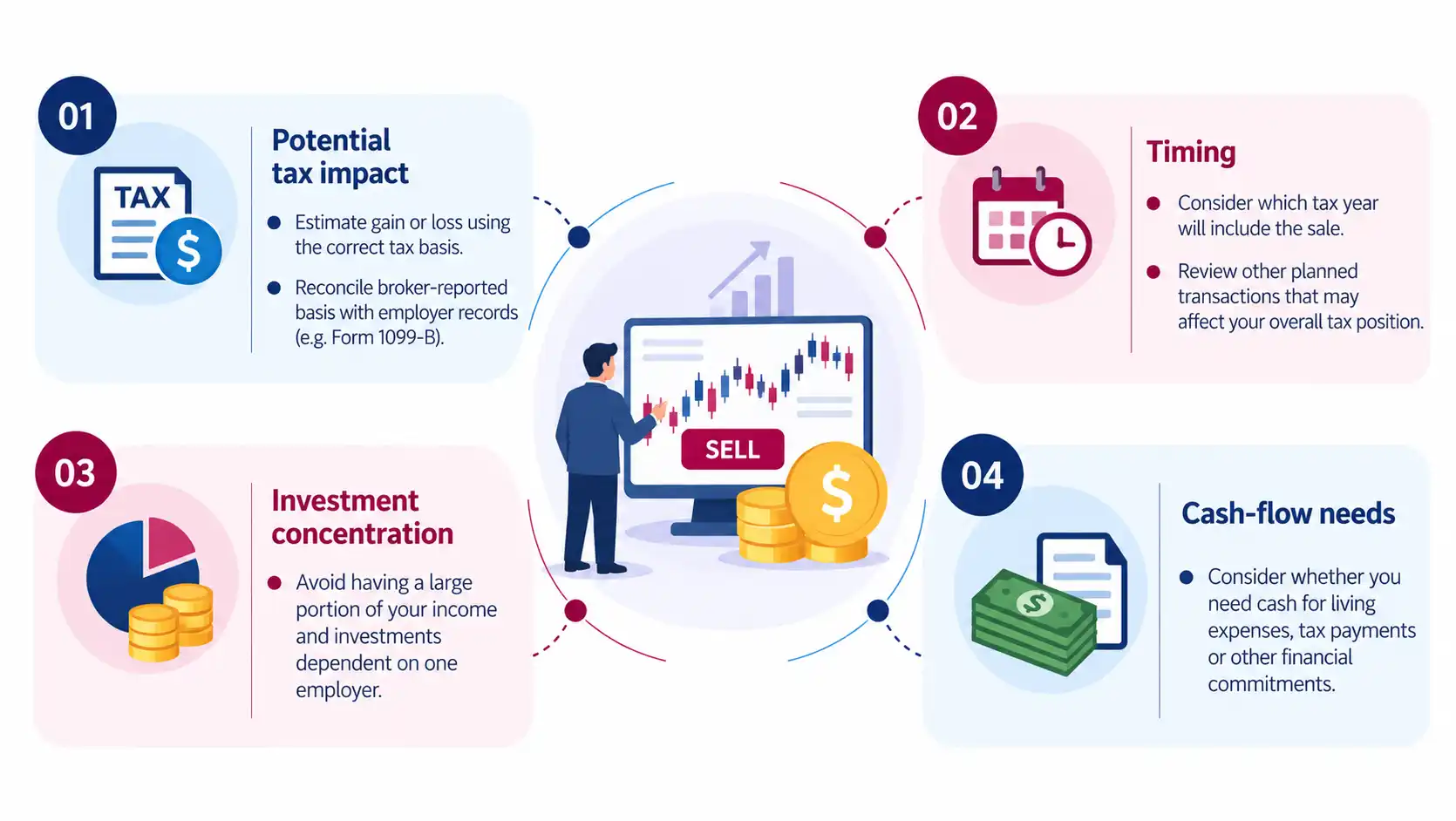
Selling vested employer shares can create a tax event separate from the compensation associated with receiving the shares. The amount and character of a gain or loss depend on the applicable rules, the relevant tax basis, the sale proceeds and the holding period.
Before making a sale, review four areas.
Estimate the potential gain or loss using the appropriate tax basis and expected sale proceeds. Before selling employer shares, reconcile the broker-reported tax basis with your employer's compensation records and the value previously included in income, where applicable. Form 1099-B may not always reflect every adjustment needed for an accurate gain or loss calculation.
Consider which tax year will include the sale and whether other planned transactions could affect your overall tax position. Do not assume that delaying or accelerating a sale will always reduce tax.
If a substantial portion of your income and investments depends on one employer, your financial position may be exposed to the same company's performance in multiple ways.
Consider whether you need cash for living expenses, tax payments or other financial commitments. A sale decision should account for your broader financial position rather than tax in isolation.
For example, an NRI whose salary, annual bonus and substantial investment holdings all depend on one technology company may want to assess employer-stock concentration alongside the potential tax consequences of selling shares.
There is no single sale date that is best for every taxpayer. The appropriate decision depends on your circumstances, financial objectives and applicable tax rules.
ESPPs and stock options can follow different rules from RSUs. Review the specific award type rather than assuming all employer equity is taxed identically.
A withholding shortfall may arise when the tax already paid during the year is insufficient to cover the final liability. High-income employees should review this risk when bonuses, equity compensation or investment income increase their expected income.
Use the following process:
This is a planning estimate, not a substitute for a completed tax return.
The IRS generally requires individuals to consider estimated payments when they expect to owe at least $1,000 after withholding and refundable credits and do not meet the applicable withholding and prior-year/current-year tax thresholds. For 2026, the general safe-harbor test uses 90% of current-year tax or 100% of prior-year tax, whichever is smaller. If prior-year adjusted gross income exceeded 150,000(75,000 for married filing separately), the prior-year percentage generally increases to 110%, subject to applicable rules and exceptions. Special rules apply to certain taxpayers, including nonresident aliens, who should review Form 1040-ES (NR) where applicable. Review the current IRS estimated-tax guidance and Publication 505 before deciding what applies to you.
Employees who receive wages may also be able to address a projected shortfall by asking their employer to withhold additional tax through an updated Form W-4, where applicable. Nonresident alien employees must follow the IRS's special Form W-4 instructions for nonresident aliens. The appropriate option depends on the size and timing of the gap.
If your income varies significantly throughout the year, do not assume that dividing your estimated annual liability into four equal payments will always reflect your situation. Payment timing and applicable estimated-tax rules may matter.
Federal income-tax withholding is only one part of the annual review. Depending on your circumstances, high-income NRIs may also need to assess investment-related taxes and state obligations.
The Net Investment Income Tax (NIIT) is generally 3.8% of the lesser of your net investment income or the amount by which your modified adjusted gross income exceeds the applicable threshold. The thresholds are generally $200,000 for single or head-of-household filers, $250,000 for married filing jointly or qualifying surviving spouses, and $125,000 for married filing separately.
If you expect interest, dividends or taxable investment gains, include them in your broader tax estimate. Do not evaluate your tax position solely from salary and bonus income.
State rules differ. The state where you live or work, the period of residence and the applicable sourcing rules can affect your filing obligations.
If you relocate during the year, review whether the move changes your state-tax position. Do not assume that state tax obligations end automatically on the date you leave.
For detailed salary and state-tax context, refer to US Salary Income Taxation for NRIs rather than repeating the full explanation here.
A spouse's income, investment activity, a change in filing status or another significant financial event can change the overall tax estimate. Include relevant information in the review where applicable.
The purpose of this section is to flag additional review areas, not to provide a complete guide to every tax that may affect high-income taxpayers.
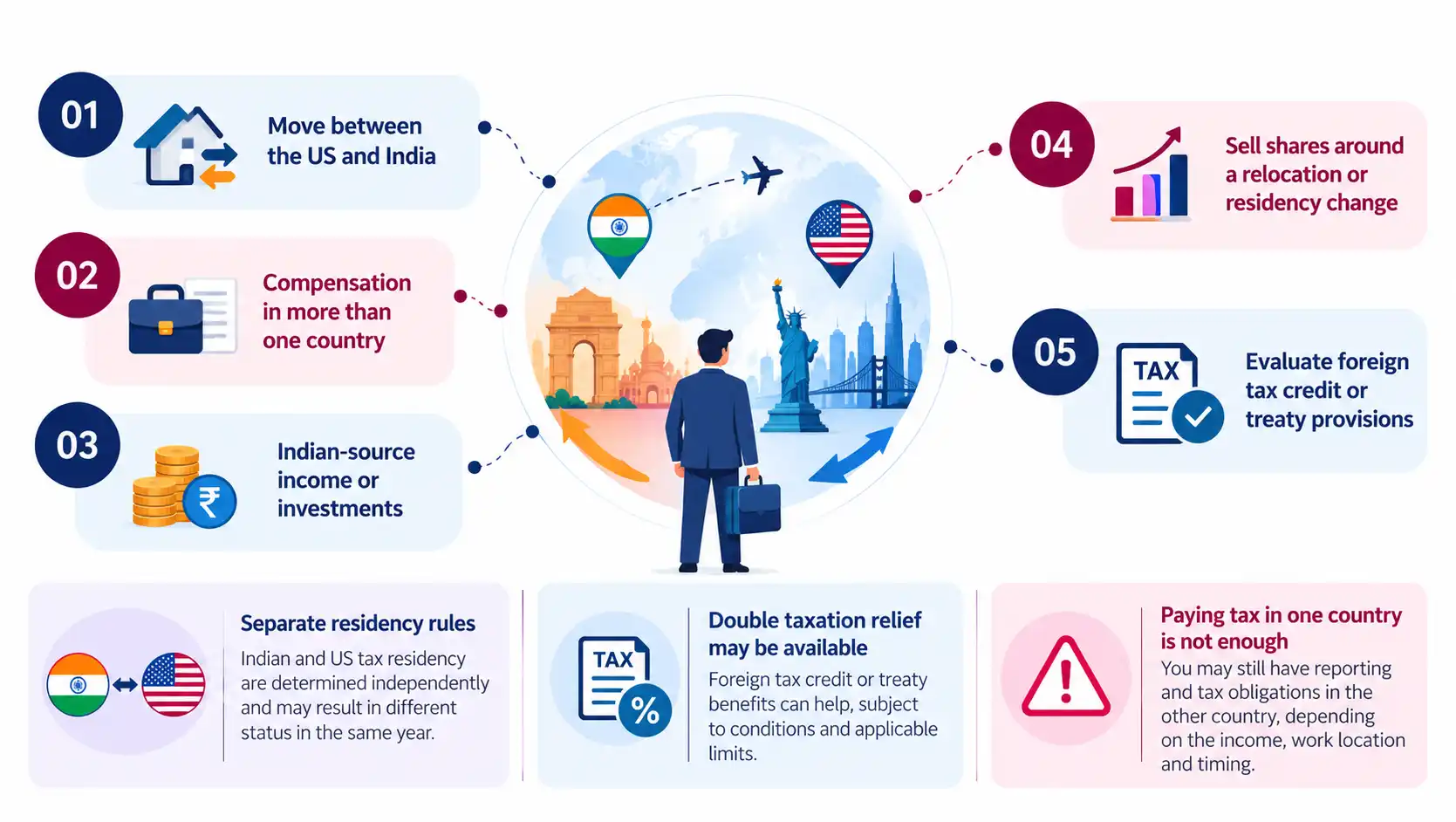
An NRI working in the US may also have Indian-source income, investments or a change in residence during the year. Such circumstances can require separate consideration of Indian tax rules and relevant cross-border provisions.
Indian tax residency and US tax residency are determined under different rules. A person may be a non-resident under Indian tax rules while being a US tax resident. The applicable status must be evaluated separately for each jurisdiction and tax year.
Cross-border review may be relevant if you:
Do not assume that paying tax in one country automatically resolves the tax treatment in the other. The result depends on the relevant income, work location, residency, timing and applicable rules.
If you have income or investments connected with both India and the United States, assess tax residency and income sourcing separately under each country's rules. A foreign tax credit or treaty benefit may help address double taxation where the relevant conditions are met, but relief is not automatic. Review the type and source of income, the tax paid or accrued, applicable limitations and supporting documentation. US taxpayers may need Form 1116, subject to the applicable rules and exceptions.
Keep the analysis specific to your circumstances. Detailed residency tests, treaty interpretation and foreign-tax-credit calculations should be handled through the relevant specialist guidance or professional review rather than repeated in this article.
For broader India–US tax-planning support, see Savetaxs' US tax-planning service.
Use this checklist to review your position throughout the tax year:
Update the checklist after a material compensation event rather than waiting until tax-return season.
Get help reviewing your compensation structure, estimated tax payments, and cross-border filing considerations.
For high-income NRIs working in the US, effective tax planning starts with a clear view of how salary, bonuses and equity compensation combine over the tax year. Regularly updating that forecast can help identify withholding gaps, anticipate vesting events and assess employer-share sales before year-end.
Review your tax position whenever compensation changes materially, and consider cross-border advice if your circumstances connect India and the US. Savetaxs can help individuals evaluate relevant tax-planning and compliance questions based on their circumstances.
This article is for general informational purposes only and does not constitute tax, legal, financial, or investment advice. Laws, regulations, rates, and procedures may change over time and may vary based on individual circumstances.
While SaveTaxs makes reasonable efforts to keep the information accurate and up to date, readers should verify applicable rules with official authorities or consult a qualified professional before making decisions based on this information.
Vipul Jain is the Co-Founder of SaveTaxs and a tax expert with experience in Indian and NRI taxation. He advises individuals, NRIs, and businesses on tax filing, tax planning, capital gains, DTAA, and compliance matters. He focuses on making complex tax concepts simple and helping taxpayers make informed, compliant decisions. See Full Bio

Want to read more? Explore Blogs