US Tax Filing and Compliance
How to Report Multiple 1099 Forms on a U.S. Tax Return: A Guide for NRIsHow to Report Multiple 1099 Forms on a U.S. Tax Return: A Guide for NRIs
Written by Hatim Dudhiyawala

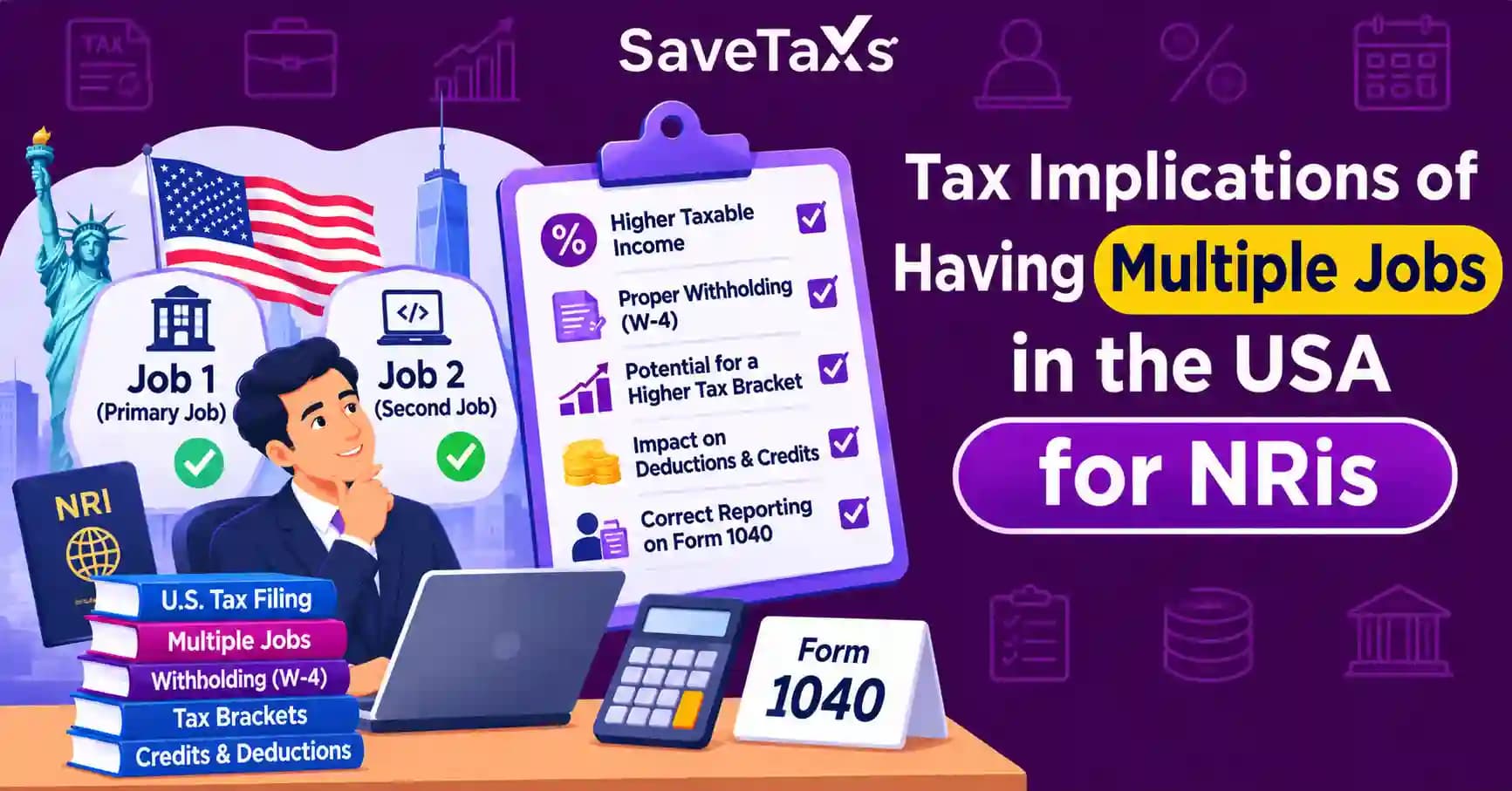
Working two or more jobs in the United States can increase your total annual income, but it can also create additional tax and withholding considerations. For NRIs, the impact depends not only on how many jobs you hold but also on your U.S. tax residency status.
A person who is an NRI under Indian tax law may be a U.S. resident alien or a nonresident alien for U.S. federal tax purposes. These classifications follow different rules and can affect how your employers withhold federal income tax, whether Social Security and Medicare taxes apply, and which tax return you need to file.
If you work for multiple U.S. employers during 2026, understanding these differences can help you avoid underwithholding, identify excess payroll tax deductions, and report your employment income correctly.
If you work for two or more U.S. employers during the same tax year, your employment income generally needs to be considered together when determining your federal income-tax liability.
However, the exact tax treatment depends on whether you are a U.S. resident alien or a nonresident alien.
Your Indian NRI status does not automatically make you a nonresident alien in the United States.
The IRS generally classifies an individual as a resident alien if they meet the Green Card Test or Substantial Presence Test, subject to applicable exceptions and treaty rules. If you do not meet the relevant tests or an applicable election, you may be treated as a nonresident alien.
Resident aliens are generally taxed under rules similar to those applicable to U.S. citizens. They generally report worldwide income on their U.S. federal income-tax return, subject to applicable exclusions, deductions, credits, and treaty provisions.
If you work for multiple U.S. employers, the wages from those jobs must be considered together when determining your annual tax liability.
Nonresident aliens are generally taxed on U.S.-source income and income effectively connected with a U.S. trade or business under the applicable rules.
Compensation for services physically performed in the United States is generally U.S.-source income. If you receive wages from multiple U.S. employers, the relevant income and withholding information must be considered when preparing your U.S. tax return.
If you perform services partly in the United States and partly outside the United States, your compensation generally needs to be allocated between U.S. and foreign sources based on the applicable sourcing rules. The return will generally be Form 1040-NR, subject to the applicable filing rules and exceptions.
It can. Your combined taxable income may cause part of your income to fall into a higher marginal tax bracket.
However, this does not mean that all your income is taxed at the higher rate. Only the portion falling within the relevant bracket is subject to that marginal rate.
Example:
Suppose an Indian professional working in the United States earns:
The individual's overall tax calculation must take the combined employment income into account, along with applicable deductions, credits, filing status, and other relevant income.
The employers may calculate paycheck withholding separately, but the employee's final federal income-tax liability is determined using the applicable annual tax rules.
For a broader explanation of how U.S. salary income is taxed for NRIs, read our guide to U.S. salary taxation for NRIs.
Get help reviewing your U.S. tax withholding, income reporting, and filing obligations as an NRI.
One of the most important tax considerations when working multiple jobs is federal income-tax withholding.
Each employer generally calculates withholding using the information available for that employment. If the other job is not properly accounted for, the combined withholding may be insufficient to cover your final annual tax liability.
The process is different for resident aliens and nonresident aliens.
Resident aliens generally use the regular Form W-4 instructions, like U.S. citizens.
For 2026, Form W-4 Step 2 addresses multiple jobs or situations where both spouses work and file jointly.
Depending on your circumstances, the available methods include:
The worksheet generally calculates the additional amount needed across the jobs and helps determine the extra withholding to enter in Step 4(c) on the relevant Form W-4.
For greater accuracy, the IRS generally recommends completing the relevant adjustments on the Form W-4 for the highest-paying job. Follow the current form instructions before submitting updated forms to your employers.
Nonresident aliens should not simply follow the regular Form W-4 instructions without checking the special IRS rules.
The IRS provides Notice 1392, which contains supplemental instructions for nonresident aliens completing Form W-4.
For multiple jobs, nonresident aliens may use the applicable Step 2(b) worksheet for one job or, if they have only two jobs, the Step 2(c) checkbox option on both Forms W-4. They must also follow the instructions for identifying nonresident-alien status on the applicable Form W-4. Nonresident aliens should not use Step 2(a) or the IRS Tax Withholding Estimator.
These instructions address matters such as filing-status restrictions, multiple jobs, and additional withholding. Nonresident aliens should use the applicable current-year instructions rather than automatically applying the standard resident-alien procedure.
If you work for multiple employers, review the withholding instructions with each employer's payroll department and make sure the correct nonresident-alien treatment is applied.
Consider an NRI who earns $70,000 from one employer and $45,000 from another.
If the withholding calculation at each employer does not adequately account for the other job, the total federal income tax withheld during the year may be lower than the employee's final liability.
This can result in an additional amount due when the tax return is filed.
Review your withholding during the year, especially when you start another job, receive a salary increase, or change your employment arrangements.
In addition to federal income-tax withholding, NRIs working for multiple U.S. employers may need to review Social Security and Medicare taxes, commonly called FICA taxes.
However, FICA treatment depends on your U.S. tax residency and the type of employment you perform.
For employees whose wages are subject to FICA, the 2026 rates are:
| Tax | Employee rate | 2026 wage limit |
|---|---|---|
| Social Security | 6.20% | $184,500 |
| Medicare | 1.45% | No general wage limit |
| Additional Medicare Tax | 0.9% when applicable | Based on applicable thresholds: $200,000 for Single, Head of Household and qualifying surviving spouse; $250,000 for Married Filing Jointly; and $125,000 for Married Filing Separately |
These are employee-side rates. Your employer generally pays a matching Social Security and Medicare amount, except for Additional Medicare Tax, which has no employer match.
The answer depends on your status.
Resident aliens generally have the same Social Security and Medicare tax liability as U.S. citizens.
Nonresident aliens are generally subject to Social Security and Medicare taxes on U.S. employment wages, but certain visa-related exemptions apply.
For example, qualifying nonresident alien students and exchange visitors in F-1, J-1, M-1, or Q-1 status may be exempt from FICA on authorized employment performed to carry out the purpose for which they were admitted to the United States.
The exemption does not apply automatically to every job or every person holding one of these visas. The employment must meet the relevant conditions.
If you have more than one job, check the FICA treatment of each job separately. For example, qualifying practical training employment may be exempt while separate employment that does not meet the exemption requirements may be subject to Social Security and Medicare taxes.
For 2026, the Social Security wage base is $184,500.
Each employer generally withholds Social Security tax from the wages it pays, without accounting for wages paid by another employer.
If your combined covered wages from multiple employers exceed the annual Social Security wage base, the total amount withheld may exceed the maximum employee Social Security tax for the year, which is $11,439 for 2026.
You may generally claim a credit for eligible excess Social Security tax withheld by multiple employers when filing your federal income-tax return, subject to the applicable rules. If a single employer withholds more than the annual maximum, you generally need to request a refund from that employer. If the employer does not refund the excess, you may be able to claim a refund using Form 843.
For a nonresident alien filing Form 1040-NR, the IRS also explains that excess Social Security tax withheld by multiple employers may be claimed as a credit against U.S. income-tax liability.
Do not confuse excess Social Security withholding with Medicare tax. Medicare generally has no annual wage base limit.
An additional 0.9% Medicare tax may apply when Medicare wages exceed the relevant threshold.
Employers generally begin withholding Additional Medicare Tax when the wages they pay an employee exceed $200,000 during the calendar year, regardless of the employee's filing status.
However, the final tax liability is determined using the applicable filing-status threshold and combined Medicare wages. Therefore, having multiple employers can create a difference between the amount withheld by employers and the employee's final Additional Medicare Tax liability.
Review the applicable IRS rules before preparing your return.
If you work for multiple U.S. employers, you should collect the income and withholding documents from each employer before preparing your annual tax return.
You generally do not file a separate federal income-tax return for every job.
Instead, the relevant employment income and withholding information is reported on the appropriate individual tax return.
Your U.S. tax residency generally determines which return applies.
The correct return depends on your circumstances, residency status, income and applicable filing requirements.
Before filing your return, organize the following documents:
Check that the income and withholding figures across your documents are consistent with the information used in your tax return.
For help organizing your U.S. and Indian tax documents, review the Savetaxs year-end tax planning checklist for NRIs.
Connect with Savetaxs experts for guidance on multiple-employer income and NRI tax compliance.
Working multiple jobs in the United States can affect an NRI's combined taxable income, federal income-tax withholding, Social Security tax, Medicare tax, and annual filing obligations.
The most important step is to identify your U.S. tax residency correctly. Resident aliens and nonresident aliens may follow different withholding and reporting rules, so applying the wrong instructions can lead to errors.
Before filing your 2026 U.S. tax return, review the income and withholding records from every employer, verify the correct Form W-4 treatment, and check whether excess Social Security tax was withheld.
Savetaxs can help NRIs review their U.S. tax filing circumstances, understand applicable withholding and reporting requirements, and prepare for tax compliance involving multiple employers.
This article is for general informational purposes only and does not constitute tax, legal, financial, or investment advice. Laws, regulations, rates, and procedures may change over time and may vary based on individual circumstances.
While SaveTaxs makes reasonable efforts to keep the information accurate and up to date, readers should verify applicable rules with official authorities or consult a qualified professional before making decisions based on this information.
Vipul Jain is the Co-Founder of SaveTaxs and a tax expert with experience in Indian and NRI taxation. He advises individuals, NRIs, and businesses on tax filing, tax planning, capital gains, DTAA, and compliance matters. He focuses on making complex tax concepts simple and helping taxpayers make informed, compliant decisions. See Full Bio

Want to read more? Explore Blogs