US Tax Filing and Compliance
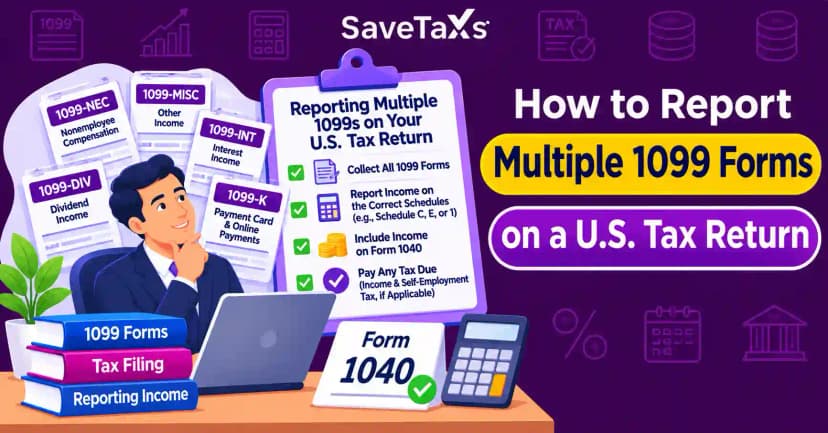
How to Report Multiple 1099 Forms on a U.S. Tax Return: A Guide for NRIsHow to Report Multiple 1099 Forms on a U.S. Tax Return: A Guide for NRIs
Written by Hatim Dudhiyawala

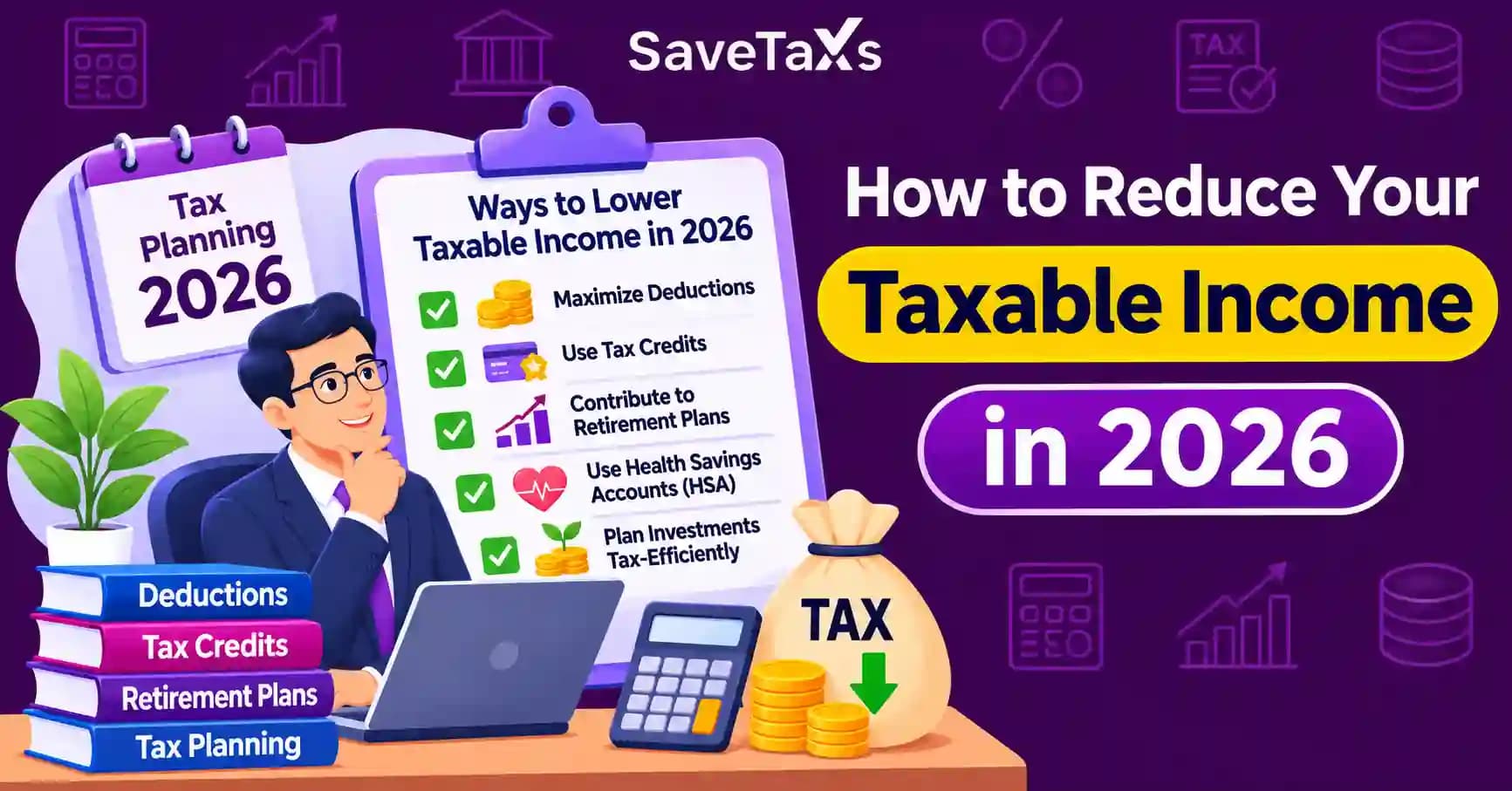
Reducing your taxable income can help lower your U.S. federal income tax liability. Whether you are a salaried employee, a self-employed professional, or a business owner, understanding the deductions available under federal tax law can help you make better financial decisions.
For Tax Year 2026, taxpayers can review options such as traditional retirement contributions, Health Savings Account (HSA) contributions, itemized deductions, eligible business expenses, and certain additional deductions introduced under recent tax legislation.
However, not every deduction applies to every taxpayer. Your eligibility may depend on your income, filing status, type of business, retirement plan, and other IRS requirements. For NRIs, eligibility also depends on whether you are a U.S. citizen, resident alien, or nonresident alien, as different rules may apply to each category. Indian NRI status is determined separately under Indian tax law and does not automatically determine your U.S. tax residency. U.S. citizens and resident aliens generally report worldwide income, while nonresident aliens are generally taxed on U.S.-source income and certain income effectively connected with a U.S. trade or business.
This guide explains eight legal ways U.S. taxpayers and business owners can reduce their 2026 taxable income.
Taxable income is the amount of income on which your federal income tax is calculated after applicable adjustments and deductions.
A simplified calculation is:
Gross income − eligible adjustments = Adjusted Gross Income (AGI)
AGI − standard or itemized deductions − other applicable deductions = Taxable Income
For example, assume a single U.S. citizen or resident alien has $90,000 in income and qualifies for a $5,000 adjustment to income.
This example assumes no other income, deductions, or special tax adjustments.
A deduction reduces the amount of income subject to tax. It does not generally reduce your tax bill dollar for dollar. The actual tax savings depend on your applicable tax rate and overall tax situation.
Get help reviewing your income, deductions and tax-planning opportunities for 2026.
Contributing to an eligible traditional retirement account is one way employees can reduce their current federal taxable income.
Traditional 401(k) contributions are generally made from pre-tax salary. These contributions reduce federal income-taxable wages, although they generally remain subject to Social Security and Medicare taxes.
For 2026, the employee contribution limit for most 401(k) plans is $24,500. Eligible employees aged 50 or older may qualify for additional catch-up contributions of $8,000, if permitted by their plan. Employees who turn 60, 61, 62, or 63 during 2026 may qualify for a higher catch-up contribution limit of $11,250.
For example, an employee earning $100,000 who contributes $10,000 to a traditional 401(k) may generally reduce the salary included in federal income-tax calculations by that contribution amount, subject to plan rules.
Eligible taxpayers may also deduct contributions to a traditional IRA.
The 2026 contribution limit is $7,500, or $8,600 for individuals aged 50 or older. However, the amount you can deduct may depend on your income, filing status, and whether you or your spouse participate in an employer-sponsored retirement plan.
A Roth IRA contribution does not provide the same current-year deduction.
Before contributing, review the applicable IRS limits and eligibility rules.
A Health Savings Account can provide tax advantages to individuals enrolled in an eligible high-deductible health plan.
Eligible taxpayers can generally deduct qualifying HSA contributions when calculating adjusted gross income. Employer contributions and payroll arrangements may receive different tax treatment.
For 2026, the HSA contribution limits are:
Additional catch-up contributions of $1,000 may be available to eligible individuals aged 55 or older.
To contribute, you must meet the IRS eligibility requirements. For example, having disqualifying health coverage or being claimed as another taxpayer's dependent can affect eligibility.
HSA funds can be used for qualified medical expenses under IRS rules. Keep contribution records and healthcare documentation to support your tax reporting.
U.S. taxpayers generally choose between the standard deduction and itemized deductions when calculating taxable income.
Nonresident aliens generally cannot claim the standard deduction. An exception may apply to qualifying students and business apprentices from India under Article 21(2) of the U.S.–India Income Tax Treaty, provided they do not itemize deductions. This exception does not apply to every Indian NRI. Nonresident aliens generally cannot file a joint U.S. income tax return unless they qualify for and make an election to be treated as U.S. residents with their U.S. citizen or resident spouse. Such an election generally requires both spouses to report their worldwide income. Nonresident aliens are also subject to special restrictions on itemized deductions, which are generally limited to deductions properly connected with income effectively connected with a U.S. trade or business, subject to certain exceptions.
Standard deduction for 2026
| Filing status | 2026 standard deduction |
|---|---|
| Single | $16,100 |
| Married filing jointly | $32,200 |
| Married filing separately | $16,100 |
| Head of household | $24,150 |
These amounts generally apply to eligible taxpayers who can claim the standard deduction; nonresident aliens are subject to the restrictions described above.
If your eligible itemized deductions are greater than your standard deduction, itemizing may reduce your taxable income further.
Common itemized deductions may include:
For example, a married couple filing jointly may compare their eligible itemized deductions with the $32,200 standard deduction for 2026.
If their allowable itemized deductions exceed that amount, itemizing may be more beneficial. Otherwise, the standard deduction may provide the larger deduction.
Do not assume that every expense is deductible. Each item has specific IRS requirements and limitations.
Donations to qualifying charitable organizations may reduce taxable income when they meet IRS requirements.
For taxpayers who itemize deductions, qualifying charitable contributions are generally reported on Schedule A. Beginning in 2026, an additional limitation applies: deductible charitable contributions are generally limited to amounts exceeding 0.5% of adjusted gross income, subject to the applicable rules.
For NRIs, donations to Indian charities or other foreign organizations are not automatically deductible on a U.S. federal income tax return. The organization must satisfy the applicable U.S. charitable deduction requirements, unless a specific exception applies.
There is also a deduction for certain cash contributions available to taxpayers who do not itemize:
To claim the non-itemizer deduction, contributions must be qualifying cash donations made to eligible charitable organizations. Donations to individuals are not deductible.
Maintain receipts, bank records, and written acknowledgments where required.
Taxpayers who repay qualifying student loans may be able to deduct eligible student loan interest.
The deduction can be up to $2,500, subject to income limits and other eligibility requirements.
Important conditions include:
The student loan interest deduction is an adjustment to income, meaning eligible taxpayers may be able to claim it even if they use the standard deduction.
Review your Form 1098-E and the IRS requirements before claiming the deduction.
Business owners can reduce their taxable business profit by deducting qualifying expenses incurred in operating their business.
Under federal tax rules, ordinary and necessary expenses paid or incurred in carrying on a trade or business may generally be deductible. For nonresident aliens, deductible business expenses are generally limited to expenses properly connected with income effectively connected with a U.S. trade or business, subject to applicable rules.
Examples can include:
For example, a self-employed consultant earns $120,000 in business revenue and has $25,000 in qualifying business expenses.
| Particulars | Amount |
|---|---|
| Business revenue | $120,000 |
| Eligible business expenses | $25,000 |
| Illustrative business profit | $95,000 |
The business profit, rather than the full revenue, is generally used in determining the owner's business income for federal tax purposes. Other adjustments and deductions may apply.
Business owners should also review the Qualified Business Income (QBI) deduction.
Eligible owners of certain pass-through businesses may qualify for a deduction of up to 20% of qualified business income, subject to income thresholds, business-type restrictions, wage and property limitations, and other rules. For nonresident aliens, qualifying income must generally be effectively connected with a U.S. trade or business.
The deduction is not generally available to C corporations. A C corporation calculates its own taxable income separately from its shareholders' personal taxable income.
Keep business and personal transactions separate. Personal expenses cannot be treated as business deductions simply because they were paid from a business account.
Tax Year 2026 includes additional deductions that may benefit eligible taxpayers. Some can be claimed whether you itemize or take the standard deduction.
Eligible workers may deduct up to $25,000 in qualified tips, subject to occupation, reporting, income and other requirements. The taxpayer must have a valid Social Security number, and married taxpayers generally must file jointly to claim the deduction. Certain foreign students and scholars filing Form 1040-NR may also qualify if they meet the applicable IRS requirements. An ITIN cannot replace the required SSN.
Eligible employees may deduct up to $12,500 of qualified overtime compensation, or $25,000 for eligible joint filers. Income limitations apply. The taxpayer must have a valid Social Security number, and married taxpayers generally must file jointly to claim the deduction. Certain foreign students and scholars filing Form 1040-NR may also qualify if they meet the applicable IRS requirements. An ITIN cannot replace the required SSN.
The deduction generally covers the qualifying overtime premium required under the Fair Labor Standards Act (FLSA). It does not mean all overtime wages are excluded from income or payroll taxes.
Eligible taxpayers may deduct up to $10,000 of interest paid on a qualifying passenger vehicle loan. The loan must generally have been originated after December 31, 2024, and secured by a first lien on a qualifying new vehicle purchased for personal use. The vehicle must meet requirements including final assembly in the United States. Used vehicles and lease payments do not qualify. Income limitations apply. Nonresident aliens are generally not eligible for this deduction.
Eligible individuals aged 65 or older may qualify for an additional deduction of up to $6,000 per person, subject to income phaseouts and other conditions. The deduction begins to phase out when modified adjusted gross income exceeds $75,000 for individual filers or $150,000 for joint filers. A valid Social Security number is required, and married taxpayers generally must file jointly to claim the deduction. Nonresident aliens generally do not qualify for this deduction.
These deductions have specific requirements. Review the IRS instructions for Schedule 1-A before claiming any of them.
Tax planning should not wait until you prepare your tax return.
Before December 31, 2026, review your financial records and identify deductions you may qualify for.
Consider the following:
Some contributions and deductions have specific deadlines, so do not assume that every tax-saving action can be completed after the tax year ends.
A tax professional can help assess which options apply to your income, filing status, and business structure.
When trying to reduce taxable income, taxpayers should avoid these common mistakes:
Connect with Savetaxs experts for guidance on individual and business tax matters.
Reducing your taxable income in 2026 requires more than simply claiming deductions. You need to understand which deductions apply to your income, filing status, retirement contributions and business structure.
For employees, traditional retirement contributions, HSA contributions and eligible deductions may help reduce taxable income. For business owners, maintaining accurate records of ordinary and necessary business expenses and reviewing the QBI deduction can be equally important.
SaveTaxs can help individuals and U.S.-based business owners review their tax position, identify potentially eligible deductions, understand business tax considerations, and prepare for federal tax compliance. Professional guidance can help you make informed decisions while staying within IRS requirements.
Plan your 2026 taxes carefully and claim only the deductions you are eligible for.
This article is for general informational purposes only and does not constitute tax, legal, financial, or investment advice. Laws, regulations, rates, and procedures may change over time and may vary based on individual circumstances.
While SaveTaxs makes reasonable efforts to keep the information accurate and up to date, readers should verify applicable rules with official authorities or consult a qualified professional before making decisions based on this information.
Hatim Dudhiyawala is a Certified Public Accountant (CPA) with SaveTaxs and specializes in Indian and NRI taxation. He advises individuals, NRIs, and businesses on income tax filing, capital gains taxation, DTAA benefits, fund repatriation, and tax compliance. With experience in cross-border tax matters, Hatim helps taxpayers understand complex regulations and make informed decisions. Through his articles, he shares practical insights to help readers stay compliant and manage their tax obligations with confidence. See Full Bio

Want to read more? Explore Blogs