



NRI Returning to India
Moving Back to India with a Foreign Spouse: Tax, OCI and Legal ChecklistMoving Back to India with a Foreign Spouse: Tax, OCI and Legal Checklist
Written by Vipul Jain

After moving to India permanently, your tax obligations change fundamentally. While you hold RNOR status, you are generally not liable to pay tax in India on your global income, subject to specific exceptions under Indian tax law. However, once your residential status changes to ROR, you must pay tax in India on your worldwide income.
Returning to India doesn't mean you need to sell your foreign assets; it depends on your situation and investment goals. However, it does impact your tax obligations in India. So, selling the asset before moving to India isn't always the best option. This also isn't ideal, as an early sale can trigger foreign-country tax, early-withdrawal penalties, exit tax, transition costs, or the loss of future investment growth.
Now the question is: when to sell foreign assets? Selling foreign assets before becoming an ROR, i.e., while you are an RNOR, may have different tax consequences depending on your residential status for the relevant financial year. Want to know why? Read the blog and find out.
When deciding whether to sell foreign assets before becoming an ROR or after, as a returning NRI, first determine your residential status under Indian income tax law. Returning to India does not automatically make you an ROR; it depends on how many days you spend in the current financial year and your past travel history.
Here is how, depending on your residential status, your tax obligations change when you sell the foreign assets after returning to India:
| Status at the Time of Sale | General Indian Tax Position |
|---|---|
| Non-Resident Indian (NRI) | Foreign capital gains are generally not taxable in India if they are not received or deemed to be received in India and do not otherwise accrue or arise in India |
| Resident but Not Ordinarily Resident (RNOR) | Foreign capital gains are generally not taxable in India if they are not received or deemed to be received in India and do not otherwise fall within Indian tax scope |
| Resident and Ordinarily Resident (ROR) | Liable to pay tax on global income, including foreign capital gains |
However, in the following circumstances, when holding the RNOR status, your foreign income can be taxable in India:
Considering this, if you sell your foreign assets while holding RNOR status but the foreign-source income is first received in your Indian bank account, it may be taxable in India under the applicable receipt rules. However, if the income was first received outside India and is later remitted to India, the subsequent remittance does not by itself create a new taxable receipt. So when selling a foreign asset, besides checking your residential status, also focus on the source of the gain, the place of receipt, and the connection with India.
However, tax rules for NRIs returning to India change completely once they become ROR. They are liable to pay tax on their global income in India even when:
To prevent double taxation on the same income, you can claim a foreign tax credit under the applicable DTAA and Indian foreign-tax-credit rules, subject to the applicable conditions and limits. However, it does not remove your reporting requirements in India.
Connect with Savetaxs and meet your Indian tax obligations on time and maximize your refunds.
Another important thing that you need to consider during a foreign share sale after returning to India is the cost basis. Only because your residential status changes to ROR, India does not reset the acquisition cost of the asset to its market value. Confused? Let's better understand this with an example.
For instance, an NRI purchased foreign shares for INR 20,00,000, and before changing to ROR status, the shares increased in value to INR 50,00,000. In this situation, subject to the rules applicable at the time of sale, India may calculate a taxable capital gain using the applicable cost of acquisition rules. Here, the fact that the person was living abroad before becoming an ROR does not exclude calculating the appreciation cost of shares in India. Further, before becoming an ROR, NRIs should review tax obligations on the large unrealized gains.
So, whether you want to sell foreign assets before becoming ROR or after, this depends on your financial goals and your preference. Moving ahead, let's review your tax obligations when you sell the asset before becoming an ROR.
Selling your foreign assets during your NRI or RNOR status in India can provide tax-efficient benefits. This is because generally these residential statuses provide tax relief on foreign capital gains. Additionally, the foreign-country tax consequences of selling the asset may also vary depending on the country and asset type. In the following situations, this approach is worth considering:
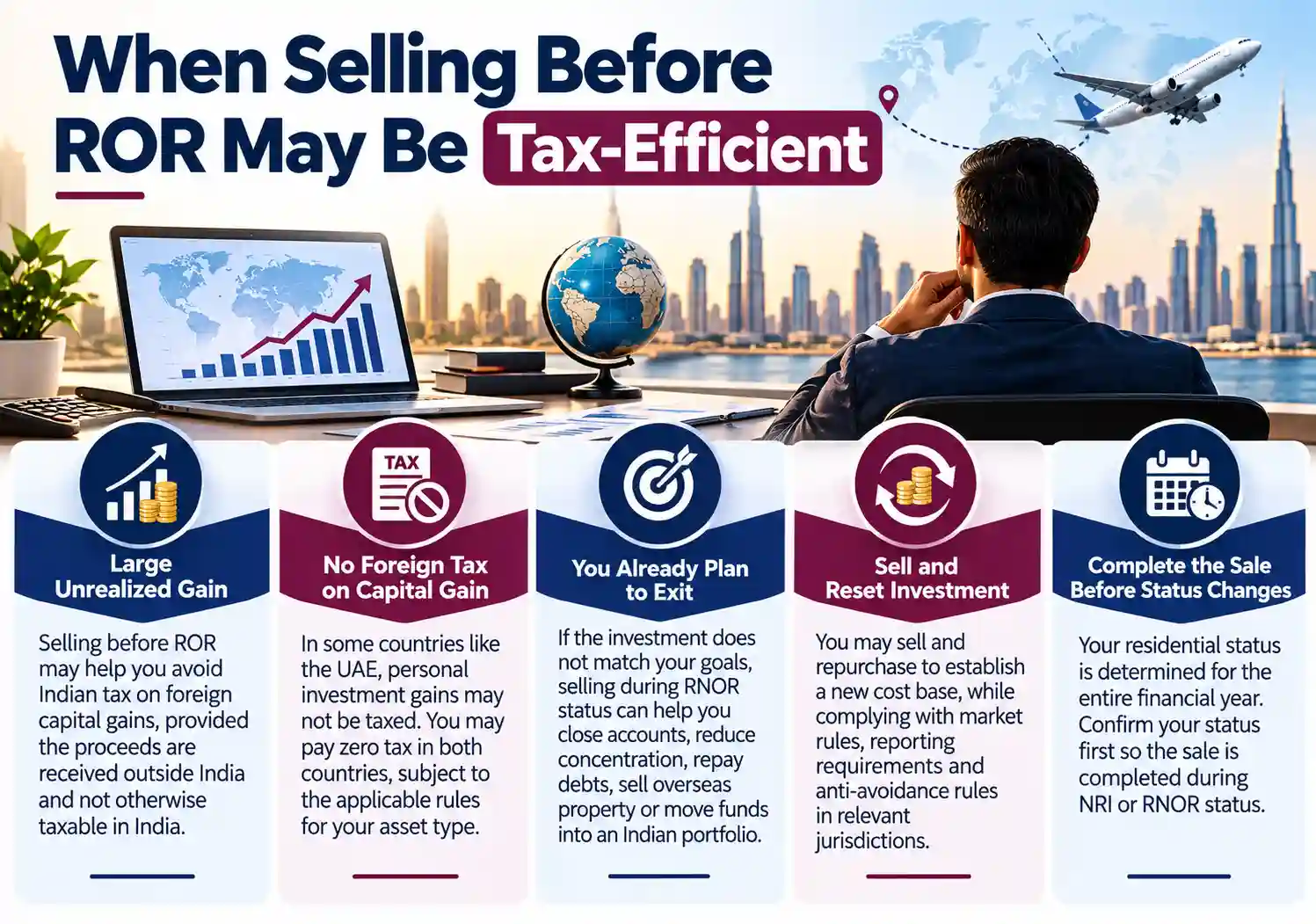
Suppose several years ago you purchased foreign shares and over the years their value has grown substantially. In this situation, if you sell the foreign shares after becoming an ROR, you must calculate your capital gains tax under Indian rules.
However, if you sell the foreign shares before becoming an ROR, it may prevent you from paying tax on your foreign capital gain in India, provided you receive it outside the country and it is not otherwise taxable in India.
Some countries, like the UAE, generally do not impose UAE Corporate Tax on personal investment income from owning shares or other securities. In such cases, if you sell the assets while you are an NRI or RNOR, you may pay zero tax in both countries, subject to the applicable rules.
However, before deciding, it is advisable to check the applicable rule for your asset type. This is because a country that does not tax share capital gains may tax your gains from property sales, gains earned by short-term residents, or business securities.
If the foreign investment does not match your financial goal, selling it while you are in RNOR status can provide investment and tax benefits. For instance, you may already want to:
In these circumstances, it may be worth considering selling foreign assets before becoming ROR after comparing the overall post-tax outcome. It may help you avoid exposure to Indian taxes on these foreign investments.
Some returning NRIs consider selling their foreign assets during RNOR status and, to establish a new cost base, repurchasing those assets. When you do, pay close attention. The transaction should be genuine and comply with the applicable market abuse, wash-sale, transaction reporting, and anti-avoidance rules in the relevant jurisdictions. Additionally, your investment returns can also be reduced by brokerage costs, foreign taxes, and market movements.
Also, do not implement a sale-and-repurchase strategy before reviewing the tax laws of both countries.
Your residential status is calculated for the entire financial year. As a result, depending on the asset sale date, you cannot choose between RNOR and ROR status.
To avoid this issue, before selling foreign assets, first determine your residential status in India for the entire financial year. This is because even if you sell a foreign asset early in the year, your physical presence in India may qualify you for ROR status.
This was all about what happens if you sell your foreign assets before becoming an ROR. Next, let's look at what happens if you hold foreign assets until you become an ROR.
Don't sell your foreign assets just because of your tax obligations in India. Sometimes, holding a foreign asset even after becoming an ROR may provide better returns. Consider the following things before selling a foreign asset:
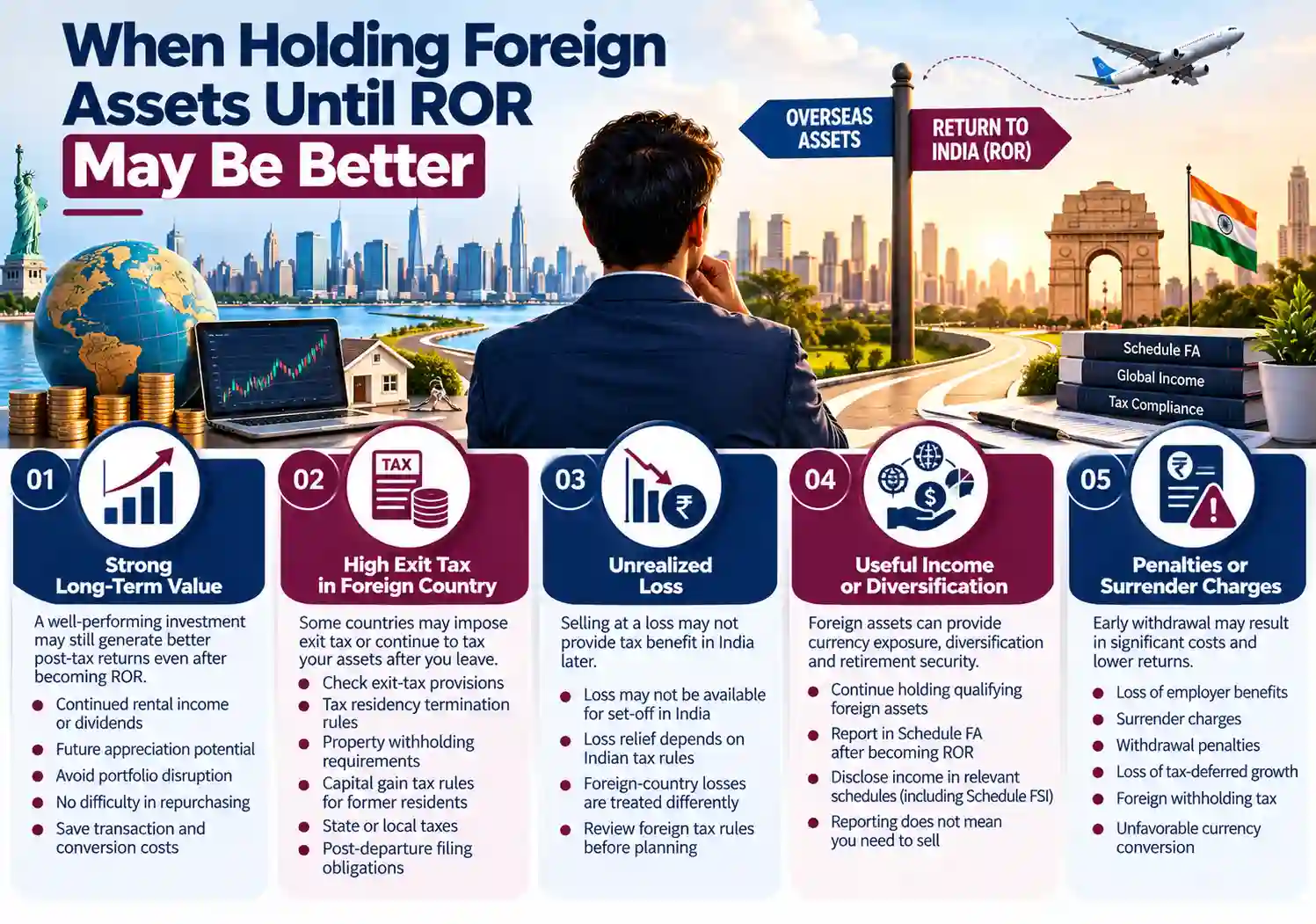
Selling a well-performing foreign investment only to avoid tax obligations in India can be counterproductive. An early investment sale may result in:
So, before making a decision to sell foreign assets before becoming an ROR, it is advisable to compare the post-tax returns after and before holding ROR status.
Some foreign countries may impose a deemed disposal or exit tax when an individual ends tax residency. Other countries may still tax them on their foreign assets after they leave. So, if the foreign country already imposes substantial tax, selling the foreign assets before ROR status does not provide any tax benefit. Considering this, the returning NRI should check:
Selling foreign assets before ROR at a loss may mean that the loss is not available for set-off in India when you later become liable to pay tax on your global income in India. However, loss relief in India depends on reporting, computation, and set-off rules. Additionally, foreign-country losses are treated differently.
Also, review the tax rules of the foreign country where you hold the foreign assets before carrying them forward to India.
A foreign investment may provide you with currency exposure, geographic diversification, or retirement security. Moving to India permanently does not mean you need to liquidate all your foreign investments. Considering this, subject to FEMA and foreign country rules, you can continue holding qualifying foreign assets acquired while you were resident outside India even after returning to India.
Once your residential status changes to ROR, you need to report your foreign assets in Schedule FA and disclose the income generated from them in the relevant schedules, including Schedule FSI where applicable, of your tax return. Here, reporting the foreign assets does not mean you need to sell them.
If you make an early withdrawal or surrender your foreign retirement accounts, annuities, insurance products, or structured investments, you may face penalties. For these foreign assets, an early sale may create:
Further, in these circumstances, the cost of exiting the investment can be more than your Indian tax obligation
Now, moving forward, let's see how your residential status creates different tax obligations on shares, property, and retirement accounts.
Different foreign assets create different tax and practical consequences. So, when planning your return to India, consider whether to sell foreign assets before becoming an ROR.
| Foreign Asset | Key Points to Consider |
|---|---|
| Shares and Investment Funds | Unrealized capital gain, foreign capital gains tax, portfolio concentration, cost basis, local funds or PFIC rules, and sale and repurchase restrictions |
| Overseas Property | Foreign country tax, rental income, mortgage, selling costs, withholding, property-specific relief, and currency movement |
| Retirement Accounts | Withdrawal penalty, tax treaty treatment, section 158 eligibility, loss of tax deferral, and foreign withholding |
Let's understand all of this in detail.
Compared to foreign property, you can easily sell your foreign shares. However, determining your tax obligation can be difficult. So before selling, check the following things:
Additionally, you need to take extra care with your employer shares. Stock options, RSUs, and employee shares can involve both employment-related and capital-gains tax considerations. So selling them before ROR may not remove Indian tax obligations if you perform employment services from India.
Also, compared with direct shares, the tax treatment for foreign investment funds can differ. So, before assuming a capital gains tax obligation in India, review the foreign fund's legal form and portfolio.
Generally, a foreign home and rental property may be taxable in the country where they are physically present. Regardless of the seller's residential status, the foreign country can impose withholding tax, capital gains tax, or local transfer tax.
Also, if you sell the overseas property after becoming an ROR, you are also liable to pay capital gains tax in India. Subject to the applicable tax treaty and credit rules, tax relief may be available for foreign tax. The decision should also take into account the following:
Compared to a share sale, a property sale is slower. With this in mind, a returning NRI should not assume that, during RNOR status, listing the overseas property asset is enough. The relevant sale or transfer date should be checked against the applicable tax rules in both countries.
A foreign retirement account is different from a brokerage account. Considering this, early withdrawal from a 401(k), superannuation, or pension account may result in penalties and foreign tax. It also affects the tax-deferred growth.
Under Section 158 of the Income-tax Act, 2025 (corresponding to Section 89A of the Income-tax Act, 1961), subject to applicable conditions and an election for an eligible foreign retirement account, India offers timing relief. This helps in aligning Indian taxation with foreign taxation. However, it applies only to specific foreign retirement accounts. So, before making a withdrawal from foreign pension or retirement accounts, confirm:
This was all about how the decision of selling foreign assets before ROR status changes your foreign shares, property, and retirement account. Moving ahead, let's talk about foreign tax, DTAA, and the foreign tax credit.
At Savetaxs, we provide expert guidance to returning NRIs and help them manage their foreign assets properly in India, aligned with their financial goals.
After becoming an ROR, when you sell foreign assets, the sale may also be taxable in India and, depending on the foreign country's rules and the applicable treaty, may be taxable in the country where the assets are located. This is because an ROR is liable to pay tax in India on their global income. This often creates double taxation on the same income in two countries. To relieve double taxation, the applicable DTAA may provide an exemption or foreign tax credit, subject to the treaty and Indian tax rules. Although the DTAA on capital gains does not make it tax-free, it may exempt it or provide you with a credit for taxes paid.
Depending on the asset and treaty, the DTAA may:
The foreign tax credit is subject to Indian rules and may be restricted to the lower of:
To claim eligible foreign tax credit on foreign income that is taxable in India, you need to file Form 67 under the Income-tax Act, 1961 or Form 44 under the Income-tax Act, 2025, as applicable, subject to the applicable conditions, and retain the following documents:
Timing mismatches also create reporting issues. This is because some foreign countries follow a calendar year (January to December), while India follows an April-to-March financial year. As a result, you may also pay foreign tax after you file your ITR in India. Therefore, as a returning NRI, compare your tax period and tax-filing deadlines before proceeding with the sale.
Here, the sale location is not the main test. Also, keeping the sale amount in your foreign bank account after gaining ROR status does not prevent you from paying tax on it in India. Similarly, remitting foreign sale proceeds to India after they were first received outside India does not by itself create new income.
Plan your taxation of foreign-source income in India to avoid any hassle and maintain clear records.
Lastly, whether to sell foreign assets before becoming ROR or after gaining this status depends on your investments, tax obligations, and preference. Selling your foreign assets during RNOR status may reduce your exposure to Indian taxation on certain foreign income; however, it can trigger exit tax, capital gains tax, or early withdrawal penalties. It may also conflict with your retirement or investment goals. One approach may be to consider selling assets during RNOR status that aren't working as expected or that you no longer want to carry forward. Also, consider retaining foreign assets that, over time, may provide better returns.
If you're unsure what to do with your foreign assets while returning to India permanently, connect with Savetaxs. Our team of cross-border taxation and financial experts provides the right guidance based on your investment and financial goals. They can also help you manage your foreign assets and meet your tax obligations.
This article is for general informational purposes only and does not constitute tax, legal, financial, or investment advice. Laws, regulations, rates, and procedures may change over time and may vary based on individual circumstances.
While SaveTaxs makes reasonable efforts to keep the information accurate and up to date, readers should verify applicable rules with official authorities or consult a qualified professional before making decisions based on this information.
Shubham Jain is the Founder of SaveTaxs and has extensive experience in Indian and NRI taxation. He advises individuals, NRIs, and businesses on tax filing, tax planning, capital gains, DTAA benefits, fund repatriation, and compliance matters. He regularly writes about taxation and related financial topics. His focus is on making complex tax concepts easy to understand. Through his articles, he helps taxpayers stay informed, avoid common mistakes, and stay compliant with Indian tax laws. See Full Bio
Want to read more? Explore Blogs
_1779454749573.webp&w=828&q=75)
_1778504462654.webp&w=828&q=75)