


NRI Returning to India
Should You Sell Foreign Assets Before or After Becoming an Indian Tax Resident?Should You Sell Foreign Assets Before or After Becoming an Indian Tax Resident?
Written by Shubham Jain

Planning to return to India with your foreign spouse? Have you made the necessary arrangements? Moving back to India with a foreign spouse is not as simple as it looks. Your duty doesn't end with booking flights, applying for an Indian visa, and finding a home in India; it begins there. You need to obtain a lawful immigration status for your file and determine your residential status in India. Also, according to the Foreign Exchange Management Act (FEMA), 1999, make your banking arrangements.
Your marriage alone does not grant your foreign spouse Indian citizenship, Overseas Citizen of India (OCI) status, or unrestricted permission to live or work in India. Obtaining it incorrectly may result in application rejection, incorrect tax reporting, or many other issues.
So, do you want to know how to handle this situation with minimal effort? Read the blog to learn how to plan your return to India with your foreign spouse.
Marriage connects two people; however, it does not mean it also combines their legal and tax identities. With that in mind, when moving back to India with a foreign spouse, determine your residential status, immigration permissions, and reporting requirements separately. Also, a returning couple in India should answer the three questions mentioned below:
| Status | What It Determines | What It Does Not Determine |
|---|---|---|
| Visa or OCI | On what conditions your foreign spouse may enter or remain in India | Indian tax residency |
| Income Tax Residency | Whether you are an NRI, RNOR, or Resident and Ordinarily Resident (ROR) | Immigration or work permission |
| FEMA Residency | Permitted bank accounts and foreign-exchange treatment | Income-tax residency by itself |
Like you, many returning NRIs also often get confused between immigration, tax residency, and FEMA status. These are three different statuses in India that you should know about.
Now, let's learn how to determine each spouse's tax residency.
At Savetaxs, we help returning NRIs resolve their tax queries and stay compliant with Indian tax laws.
Returning to India does not mean that you are liable to pay tax on your global income in India from the date you arrive in India. Your foreign income taxation in India depends on your residential status, which is determined by applicable residential-status conditions, including how many days you spend in India. According to Indian income tax law, India has three residential statuses:
In India, tax residency is determined separately for each tax year. Considering this, an individual is considered an Indian resident if they meet any of the following applicable conditions:
If you do not meet any of the mentioned conditions, you are considered an NRI for that tax year.
This depends on an individual's past travel history in India. Considering this, you may qualify as an RNOR if you meet any of the following conditions:
It is vital to determine your residential status clearly in India, as with RNOR status you can narrow your foreign asset disclosure and certain foreign income obligations in India.
You cannot determine your foreign spouse's Indian residency status based on your status. Marriage, visa category, or OCI card status does not make your foreign spouse an Indian tax resident. Like you, their physical presence in India and statutory conditions decide their residential status under Indian income tax law. So determine it separately.
This was all about Indian tax residency. Also, OCI cardholder taxation in India depends on residential status in India, not OCI card status. Moving ahead, let's look at which option a foreign spouse should choose: a visa or OCI.
For your foreign spouse, you need to choose a lawful way to enter and stay in India. Considering this, choosing between an Indian visa and an OCI card depends on your circumstances. Let's know about this in detail.
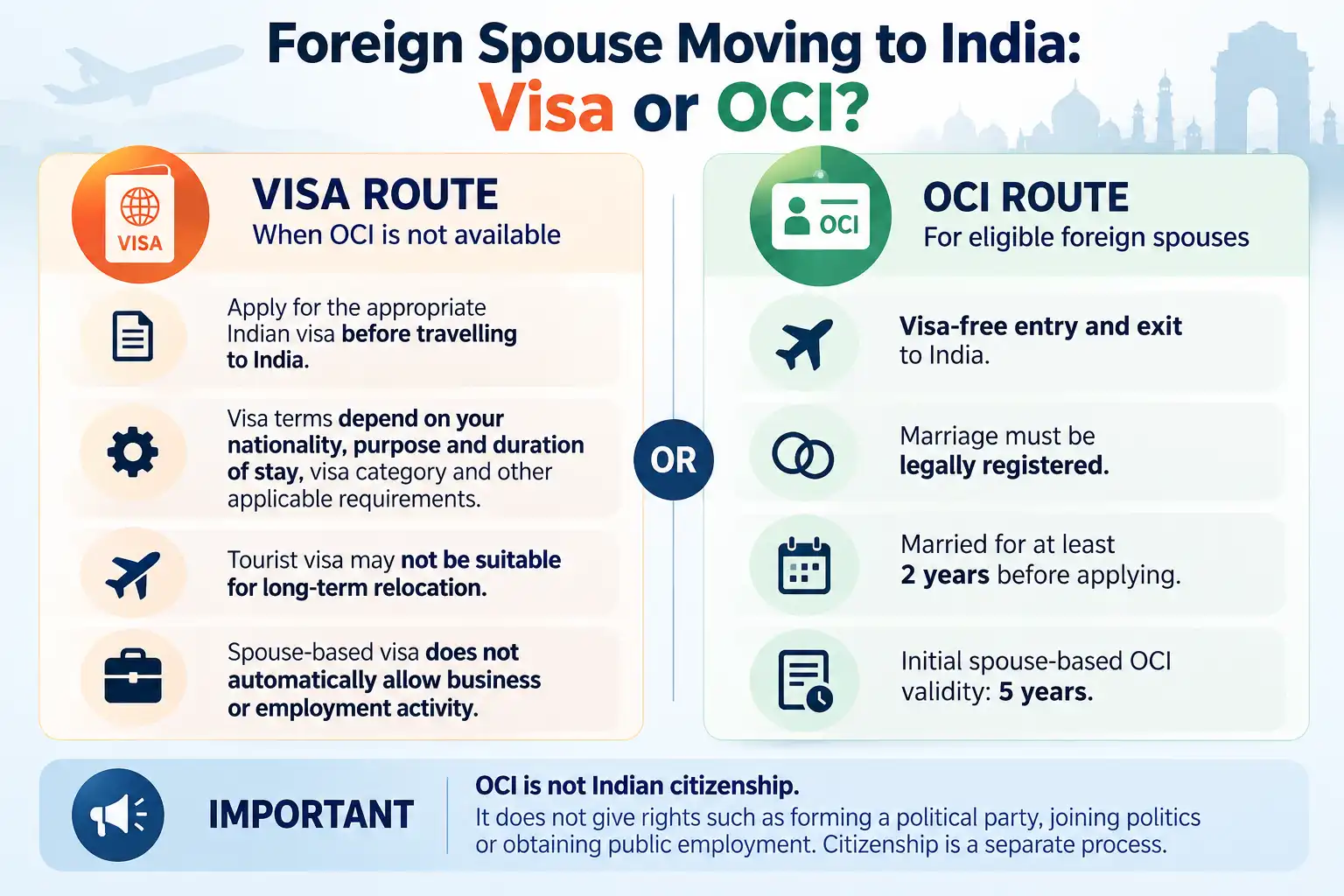
If your foreign spouse does not have an OCI card, they must apply for the appropriate visa through the relevant Indian Mission or Post before traveling to India. The validity of your foreign spouse's visa, permitted entry numbers, registration conditions, allowed activities, and extension or conversion depend on:
Do not assume that, for your permanent or long-term relocation to India, a tourist visa is an appropriate option for your foreign spouse. Also, a spouse-based visa does not automatically allow business or employment activity in India.
Further, unless your foreign spouse holds lawful status like OCI, they need a valid passport and an Indian visa to travel to India.
Overseas Citizenship of India (OCI) card offers free entry and exit to India without applying for an Indian visa. However, many people mistake it for Indian citizenship, but it is not. A foreign spouse of an Indian citizen or eligible OCI cardholder can apply for the card after marriage if:
Further, you do not get the OCI card immediately after submitting the application. The spouse-based OCI eligibility process includes security clearance, document verification, and applicable nationality or ancestry exclusions. Also, according to the official OCI FAQ, an OCI card initially issued to a foreign spouse is valid for five years.
Note: An OCI card is not Indian citizenship. As a result, holding it does not give you the rights to form a political party, join politics, or obtain public employment available to Indian citizens. Applying for Indian citizenship is a different process. Marrying an Indian citizen or obtaining an OCI card does not grant you citizenship.
So, when moving back to India with a foreign spouse, choosing between OCI and a visa depends on your circumstances. Moving ahead, let's look at the documents you need before departing for India.
You and your foreign spouse need the following documents before departing to India:
Across all the documents, names, DOB, passport details, and marriage date should match. This is because even a small spelling mistake can delay the visa, OCI, KYC, PAN, or banking process.
Additionally, apostille and attestation requirements depend on the issuing and receiving country. Also, you don't need to register your foreign marriage certificate in India just because you are moving here. However, your marriage should be legally valid and supported by the documents required for the application.
These are the documents you require before departing for India. Moving further, let's know about foreign assets and tax reporting.
Before moving back to India with a foreign spouse, prepare a list of foreign assets and income. Additionally, review the list again after determining the residential status of your foreign spouse moving to India. Include the following things in the list:
Further, foreign asset disclosure and income reporting depend on your and your spouse's residential status. If you are an RNOR, you generally do not need to report foreign assets in Schedule FA, and foreign income accruing outside India is generally not taxable in India unless it is received or deemed to be received in India, or is derived from a business controlled in India or a profession set up in India. Also, if you are an ROR, you must report your applicable foreign assets and pay tax on your global income in India.
Apart from this, the reporting requirements also depend on where you received the money. For instance, money you first received overseas is not treated the same as money you received directly in India.
Moving to the next section, let's look at when you can claim a foreign tax credit and tax relief.
You can claim a foreign tax credit and treaty relief when you are liable to pay tax on the same income in two different countries. Considering this, to claim the foreign tax credit under the DTAA between your foreign country and India, you need to submit the following documents:
The tax relief for double taxation is not automatically provided. This depends on the applicable DTAA treaty article, income classification, foreign taxes paid, and Indian tax filing requirements.
Foreign asset reporting on Schedule FA applies to returning NRIs classified as ROR. Considering this, the foreign asset reporting requirement does not apply to individuals holding NRI and RNOR status.
It is not a tax; it is a foreign asset disclosure requirement that helps the Indian government in tracking the assets held by Indian residents. Schedule FA is a part of ITR-2 and ITR-3 forms. You need to fill out this schedule when your residential status changes to ROR.
Here's how you can review your foreign income, assets, and tax reporting requirements. Now, moving forward, let's review bank updates and PAN requirements after returning to India.
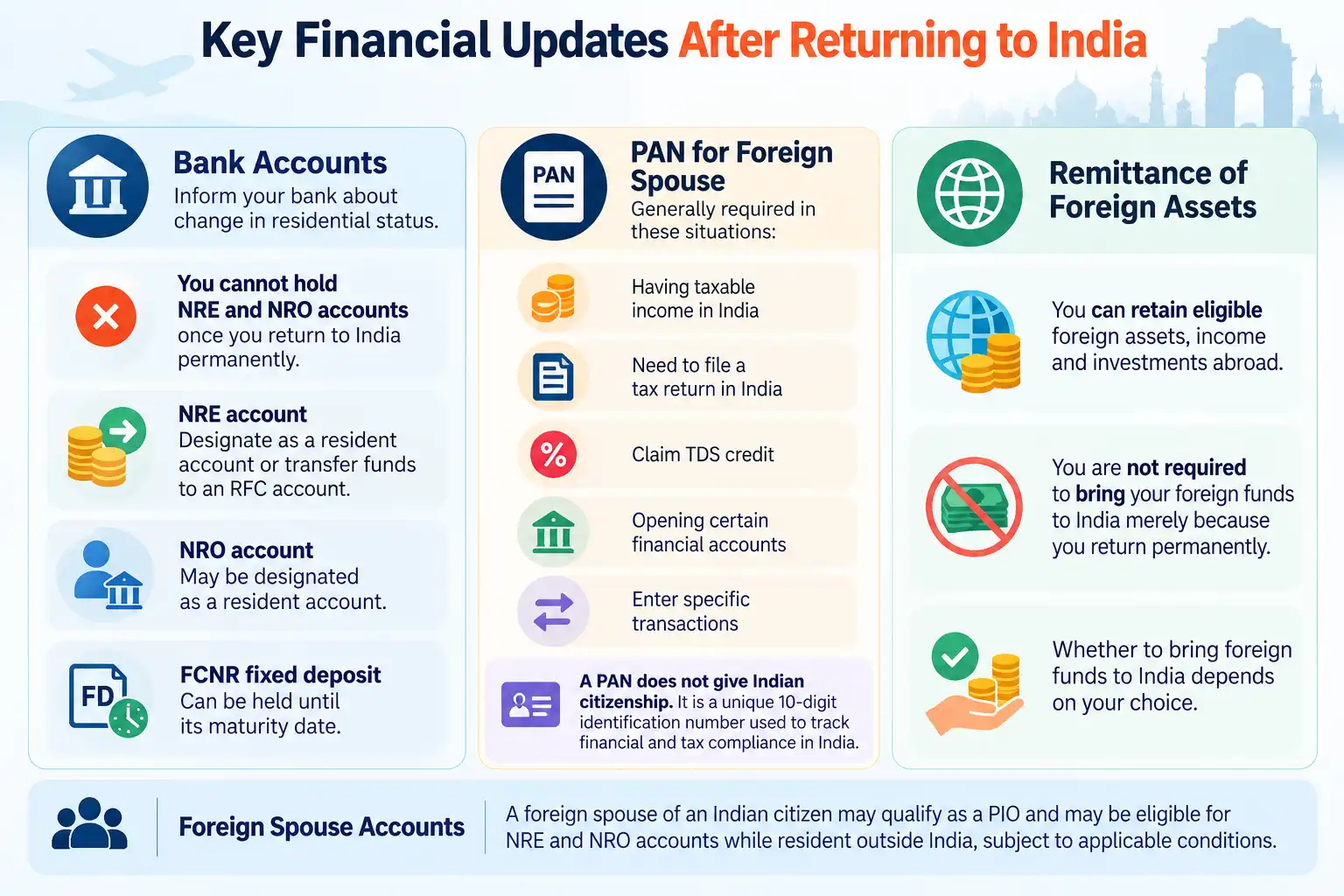
Once you return to India under FEMA rules, you must inform your banks of your change in residential status. FEMA and income tax law have different residency rules. For instance, under Indian income tax laws, your residential status changes based on your physical presence in India, whereas under FEMA, it depends on the applicable FEMA residential-status conditions and your purpose and intention of stay.
Given this, you cannot hold an NRE and NRO account once you return to India permanently. NRE accounts should be designated as resident accounts or the funds may be transferred to an RFC account. NRO accounts may be designated as resident accounts. Further, under FEMA rules, you can hold an FCNR fixed deposit until its maturity date.
For a detailed overview of the NRI accounts, read our guide on NRE, NRO and resident accounts. Additionally, separately review the bank account eligibility of your foreign spouse. This is because a foreign spouse of an Indian citizen may qualify as a Person of Indian Origin (PIO) under FEMA rules and may be eligible for NRE and NRO accounts while resident outside India, subject to applicable conditions.
A PAN for a foreign national spouse is generally required in the following situations:
A PAN does not give a foreign spouse Indian citizenship. It is a unique 10-digit identification number the Indian government uses to track an individual's financial and tax compliance in India.
Returning NRIs can generally retain eligible foreign assets, income, and investments abroad and are not required to bring their foreign funds to India merely because they return permanently. Additionally, they are not required to bring their foreign funds to India; it depends entirely on their choice. Further, for a complete overview, read our "Returning NRI Financial Guide."
This was all about foreign bank accounts, PAN, and transferring foreign assets. Next, let's cover work and registration restrictions after moving to India.
Obtaining permission to enter India does not mean your foreign spouse is allowed to work, practice a profession, run a business, or engage in any restricted activity. Considering this, before your foreign spouse starts working in India, check the following information:
Business registration can depend on your foreign spouse's nationality, visa category, validity, length of stay, and visa endorsement. Also, working in India in breach of immigration conditions can result in visa cancellation or curtailment, penalties, an order to leave India, or other actions.
This was all about work and registration restrictions for returning NRIs in India. Now, let's take a quick overview of moving back to India with a foreign spouse through a checklist.
Here is a quick checklist that you should follow when moving back to India with a foreign spouse:
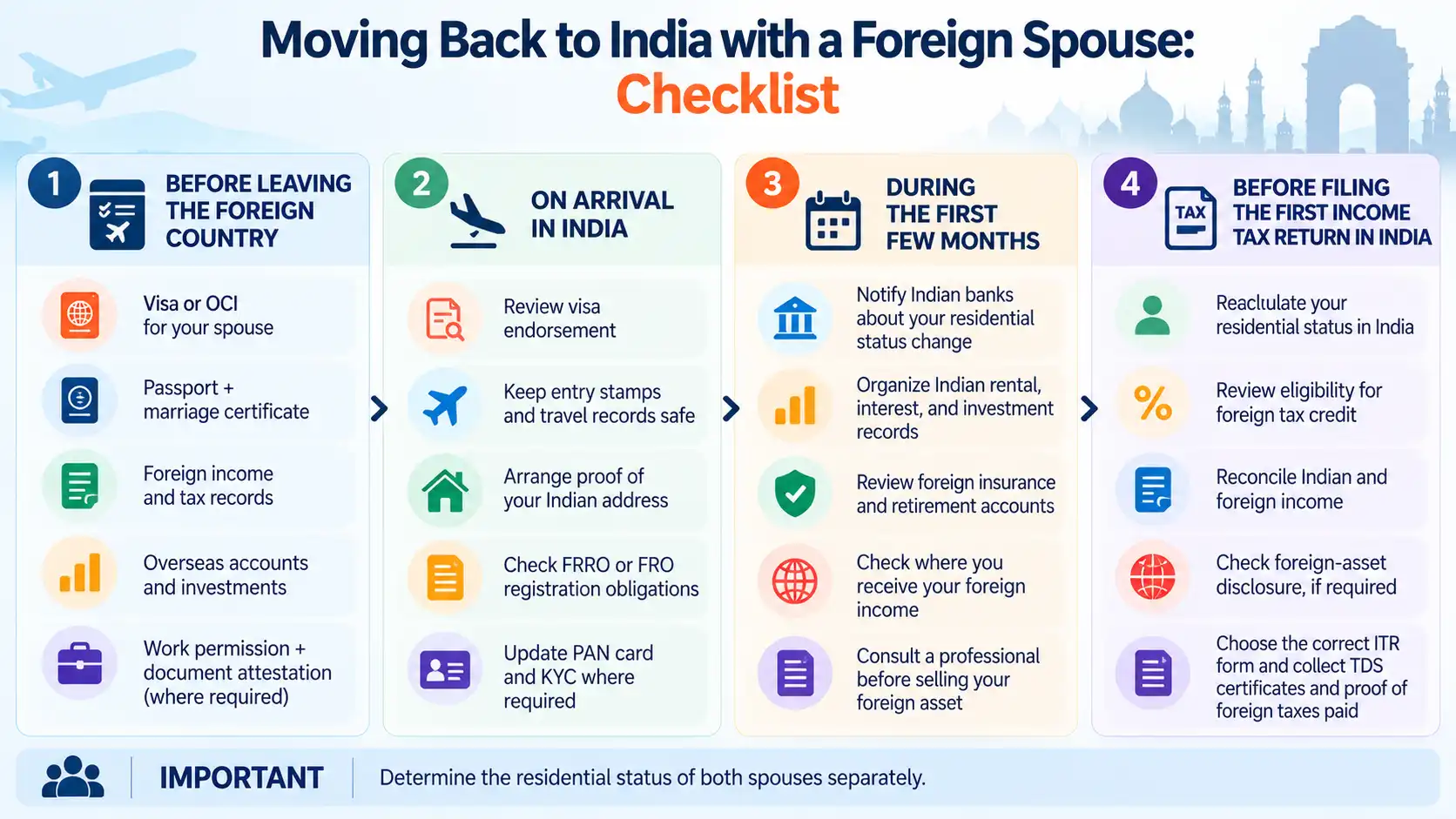
This was a quick checklist that you can consider when moving back to India with a foreign spouse. In the next section, we'll look at what your first month in India will look like through a 30-day action plan.
Connect with Savetaxs and plan your smooth return to India while meeting the Indian and foreign tax obligations.
The table below showcases a 30-day action plan for returning NRIs in India with a foreign spouse:
| Days | Actions |
|---|---|
| Days 1-7 | Check the immigration status of the foreign spouse, visa endorsement, documents, registration requirements, and evidence of an Indian address |
| Days 8-15 | Notify Indian banks; update PAN and KYC, and list income, tax, and travel records |
| Days 16-23 | Review foreign bank accounts, salary, investments, pensions, Indian rent, and planned remittances |
| Days 24-30 | Obtain a preliminary residency review to know whether your foreign spouse may start the proposed business activity or work |
The above plan is for informational purposes only.
Lastly, when moving back to India with a foreign spouse, focus on three things: how your spouse can remain lawfully in India, your and your spouse's residential tax status, and how, under FEMA, you will manage your accounts and cross-border money. Resolve these queries before moving to India and plan accordingly.
If you need assistance in planning your return to India, connect with Savetaxs. Our team includes cross-border financial and tax experts. They provide personalized guidance based on your financial goals and investment returns.
This article is for general informational purposes only and does not constitute tax, legal, financial, or investment advice. Laws, regulations, rates, and procedures may change over time and may vary based on individual circumstances.
While SaveTaxs makes reasonable efforts to keep the information accurate and up to date, readers should verify applicable rules with official authorities or consult a qualified professional before making decisions based on this information.
Vipul Jain is the Co-Founder of SaveTaxs and a tax expert with experience in Indian and NRI taxation. He advises individuals, NRIs, and businesses on tax filing, tax planning, capital gains, DTAA, and compliance matters. He focuses on making complex tax concepts simple and helping taxpayers make informed, compliant decisions. See Full Bio
Want to read more? Explore Blogs
_1779454749573.webp&w=828&q=75)
_1778504462654.webp&w=828&q=75)