
US Tax Filing and Compliance
FBAR Filing Deadline 2026: October 15 Extension & RulesFBAR Filing Deadline 2026: October 15 Extension & Rules
Written by Shubham Jain


When filing an FBAR for the first time, the question that comes to mind for most NRIs is whether the FBAR reporting threshold applies to multiple accounts or to an individual account. The simple answer is that the FBAR $10,000 threshold applies to the total value of your foreign financial accounts. Considering this, if your one account holds a small amount and you exceed the $10,000 threshold limit, you need to report that account as well. So, multiple foreign accounts are reported under FBAR.
But now the question is how to calculate the $10,000 FBAR threshold for multiple foreign accounts. This guide explains how to calculate the FBAR threshold when you hold multiple foreign financial accounts.
The $10,000 FBAR threshold is determined under a two-step process:
If the combined value of your foreign accounts is more than $10,000 at any point during the calendar year, you need to file FinCEN Form 114. FBAR works differently from a per-account estimate. Considering this, it does not matter if a single account does not come close to $10,000; the aggregate value matters.
This is the most common mistake made by first-time FBAR filers with multiple accounts. They believe the $10,000 FBAR threshold applies to a single foreign account and, as a result, fail to file an FBAR. To get a better idea of when you need to file an FBAR, read our guide: FBAR filing requirements for NRIs and know how to proceed further when you meet the requirements.
This was all about how the $10,000 FBAR threshold works. Moving ahead, let's determine whether each foreign account needs to cross $10,000.
No, not each foreign account needs to exceed the $10,000 FBAR threshold. As mentioned earlier, this is the most common confusion among first-time FBAR filers. Considering this, not every foreign financial account needs to exceed the threshold; the combined value of all your foreign accounts should exceed it. Let's better understand this with an example:
| Foreign Account Type | Value |
|---|---|
| NRE Account | $4,000 |
| NRO Account | $3,500 |
| Foreign Brokerage Account | $4,000 |
| Total Aggregate Value | $11,500 |
Here, none of the foreign accounts separately exceed the FBAR threshold. However, when summed, their total of $11,500 exceeds the $10,000 threshold. Considering this, you need to report these three accounts when filing the FBAR, not only the account with the highest value.
The FBAR $10,000 threshold applies to a person's combined foreign account balance, so it does not apply on a per-account or per-bank basis. Now, moving further, let's see which accounts are included in the FBAR threshold calculation.
Get personalized guidance according to your tax situation from professionals and stay compliant with cross-border obligations.
The foreign financial accounts that should be included in the FBAR threshold calculation include:
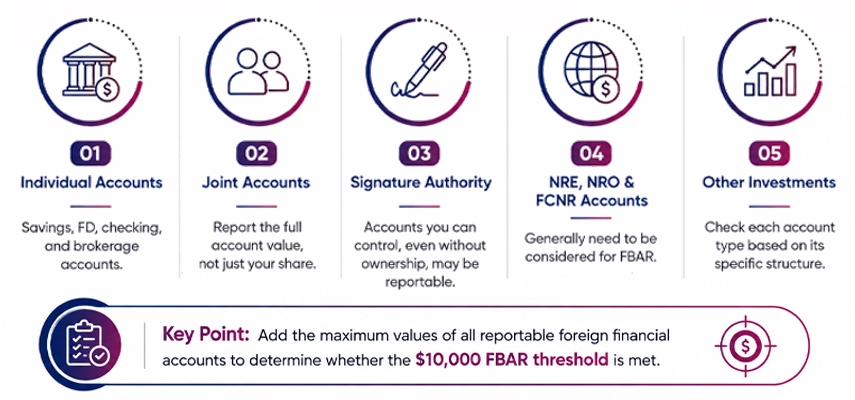
These are foreign financial accounts that you need to include in the FBAR threshold calculation. Moving ahead, let's know how to calculate the FBAR threshold.
Here is the step-by-step process to calculate the FBAR threshold:
So, this is how you can calculate the FBAR threshold for your foreign financial accounts. Moving further, let's know which exchange rate you should use for FBAR.
Use the Treasury Reporting Rate of Exchange for December 31 of that year to convert the local currency into U.S. dollars once you determine the maximum value of your foreign financial account during the year. In case there is no Treasury rate stated for your local currency, you can use another verifiable exchange rate and keep a record of that source. Given this, you cannot use the exchange rate when your account reaches its maximum value.
This was just an overview of the FBAR exchange rate. If you want to know more about FBAR exchange rate selection and examples related to it, read our blog on FBAR maximum account value and get detailed information.
Now, moving forward, let's better understand the FBAR reporting threshold with an example.
The table below demonstrates the calculation of multiple Indian accounts crossing $10,000 threshold:
| Account | Maximum Value (INR) | USD Value |
|---|---|---|
| NRE Savings | 3,50,000 | $4,200 |
| NRO Account | 2,50,000 | $3,000 |
| FCNR Deposit | Equivalent Value | $4,000 |
| Total | - | $11,200 |
Here, the mentioned U.S. value is just to provide you with an overview of how the exchange rate works. In practice, the amount may differ from the stated value above. So, use the applicable year-end exchange rate.
This was an example of multiple Indian accounts crossing the $10,000 threshold. Moving ahead, let's consider what if the accounts cross $10,000 on a single day.
Even if your foreign financial account balance crosses $10,000 only for one day, you still need to file an FBAR. The FBAR rule applies when the aggregate value exceeds the threshold at any point during the year, not whether it stays or not. For instance, suppose that in June the total combined balance of your foreign financial account was $10,500 and, at year-end (December 31), it dropped to $6,000; you still need to file an FBAR for that calendar year.
So, even if your foreign financial accounts exceed $10,000 at any point in time during a calendar year, you need to file an FBAR. Now, moving further, let's see what happens if the money is transferred between your foreign accounts.
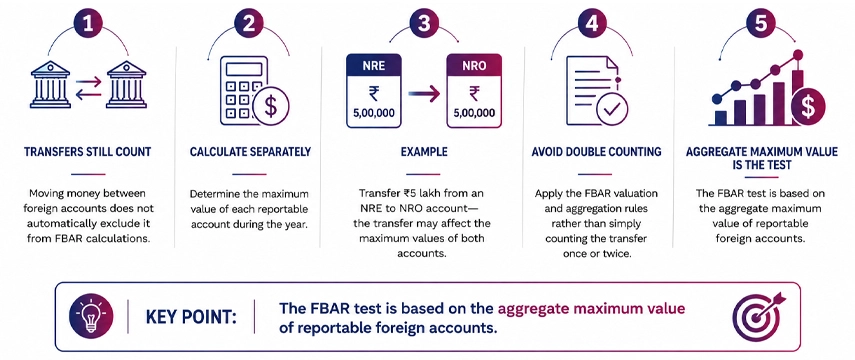
This confuses first-time FBAR filers more than anything else. Suppose you transfer INR 5,00,000 from your NRE account to your NRO account. When calculating the threshold for FBAR filing, adding the maximum account amount separately results in the same transferred amount being counted twice.
A transfer between two foreign financial accounts does not automatically mean that the transferred funds are excluded from the FBAR calculation. For FBAR purposes, determine the maximum value of each reportable account separately and then apply the aggregate-value test. Therefore, a transfer from your NRE account to your NRO account may affect the maximum values of both accounts during the year. Do not automatically assume that the transferred amount should be counted only once or twice without applying the applicable FBAR valuation and aggregation rules.
Now, moving forward, let's review the difference between the FBAR $10,000 threshold and the Form 8938 threshold.
When reporting foreign financial accounts and assets, people often get confused about the difference between the FBAR $10,000 threshold and the Form 8938 threshold. Although both serve different purposes and have different requirements. To give you an idea, here is an overview of the difference between the FBAR $10,000 threshold and the Form 8938 threshold.
| FBAR | Form 8938 |
|---|---|
| $10,000 aggregate value | Depending on the filing status and residence, it imposes a higher threshold |
| Foreign financial accounts | Consists of a wider category of specified foreign financial assets |
| FinCEN Form 114 | IRS Form 8938 |
| FBAR is filed in the BSA E-Filing System separately and is not attached to the U.S. federal income tax return. | Attached to your U.S. income tax return |
Further, to get a detailed idea of it, read our blog FBAR vs Form 8938. Now, moving ahead, let's know what to do if you missed FBAR filings for previous years.
If you missed an FBAR, the appropriate corrective procedure depends on the facts. If the FBAR was simply delinquent and no special compliance procedure is required, the delinquent FBAR should generally be filed as soon as possible. However, taxpayers who also failed to report foreign income or other international information may need to consider the IRS streamlined filing compliance procedures or another appropriate disclosure procedure. The Streamlined Foreign Offshore Procedures have specific eligibility requirements, including non-willful conduct and applicable foreign-residency requirements.
To know more about this process in detail and in what circumstances it is applicable, read our blog on "Missed FBAR filings." Now, moving further, let's know the common FBAR threshold calculation mistakes that you should avoid.
Savetaxs helps you accurately calculate the aggregate value of your foreign accounts and determine your FBAR filing requirement.
Common FBAR threshold calculation mistakes that you should avoid are as follows:
These are some common mistakes that you should avoid during FBAR multiple accounts reporting.
Lastly, the $10,000 FBAR reporting threshold does not apply to a single foreign financial account; it applies to the aggregate value. Considering this, to calculate the threshold, you first need to identify the maximum value of each foreign financial account you hold during the year, convert them into dollars using the correct exchange rate, and add them together. If you are a U.S. person and the aggregate maximum value of your reportable foreign financial accounts exceeds $10,000 at any time during the calendar year, you generally have an FBAR filing obligation, subject to applicable exceptions.
Further, if you are facing issues in calculating the FBAR threshold or are unsure about the FBAR obligation, connect with Savetaxs. The experts on our team will review your foreign financial accounts, help you accurately calculate the numbers, check whether you cross the threshold, and file the FBAR correctly. Reach out to us and stay compliant with the FBAR reporting process.
This article is for general informational purposes only and does not constitute tax, legal, financial, or investment advice. Laws, regulations, rates, and procedures may change over time and may vary based on individual circumstances.
While SaveTaxs makes reasonable efforts to keep the information accurate and up to date, readers should verify applicable rules with official authorities or consult a qualified professional before making decisions based on this information.
Shubham Jain is the Founder of SaveTaxs and has extensive experience in Indian and NRI taxation. He advises individuals, NRIs, and businesses on tax filing, tax planning, capital gains, DTAA benefits, fund repatriation, and compliance matters. He regularly writes about taxation and related financial topics. His focus is on making complex tax concepts easy to understand. Through his articles, he helps taxpayers stay informed, avoid common mistakes, and stay compliant with Indian tax laws. See Full Bio

Want to read more? Explore Blogs

-for-401(k)_1790057066765.webp&w=828&q=75)