US Tax Filing and Compliance
FBAR Filing Deadline 2026: Important Dates, Automatic Extension & Filing GuideFBAR Filing Deadline 2026: Important Dates, Automatic Extension & Filing Guide
Written by Shubham Jain

Even after you filed a federal tax extension on April 15, if you missed the October 15 tax deadline, that is something you cannot take lightly. You may face tax penalties, interest on your unpaid taxes, and you may receive a tax notice from the IRS. After that, you generally can't file another extension, although qualifying taxpayers living abroad may have been able to request a discretionary additional extension in certain circumstances. Additionally, you do not get a general grace period.
Good news? Although missing an extended tax deadline isn't ideal, you can take proactive steps to fix your mistake and reduce penalties.
Want to know what they are? This blog provides you with complete information on what happens if you miss the filing deadline and the available options you can take to correct your mistake. So read on and gather all the information.
If you missed the October 15 tax deadline, the best thing you can do is to file your federal tax return as soon as possible to reduce your penalties and interest. Additionally, the IRS imposes two separate penalties: failure to file and failure to pay. Although these penalties operate separately, when both apply in the same month, the IRS reduces the failure-to-file penalty.
This is the most immediate consequence you face after you miss the extended filing deadline. Generally, a failure-to-file penalty is 5% of the unpaid federal taxes for each month or part of a month you file your tax return late, up to 25%. Therefore, a taxpayer can:
If your federal tax return is more than 60 days late, you either pay $525 (in 2026) or 100% of your due taxes, whichever is less.
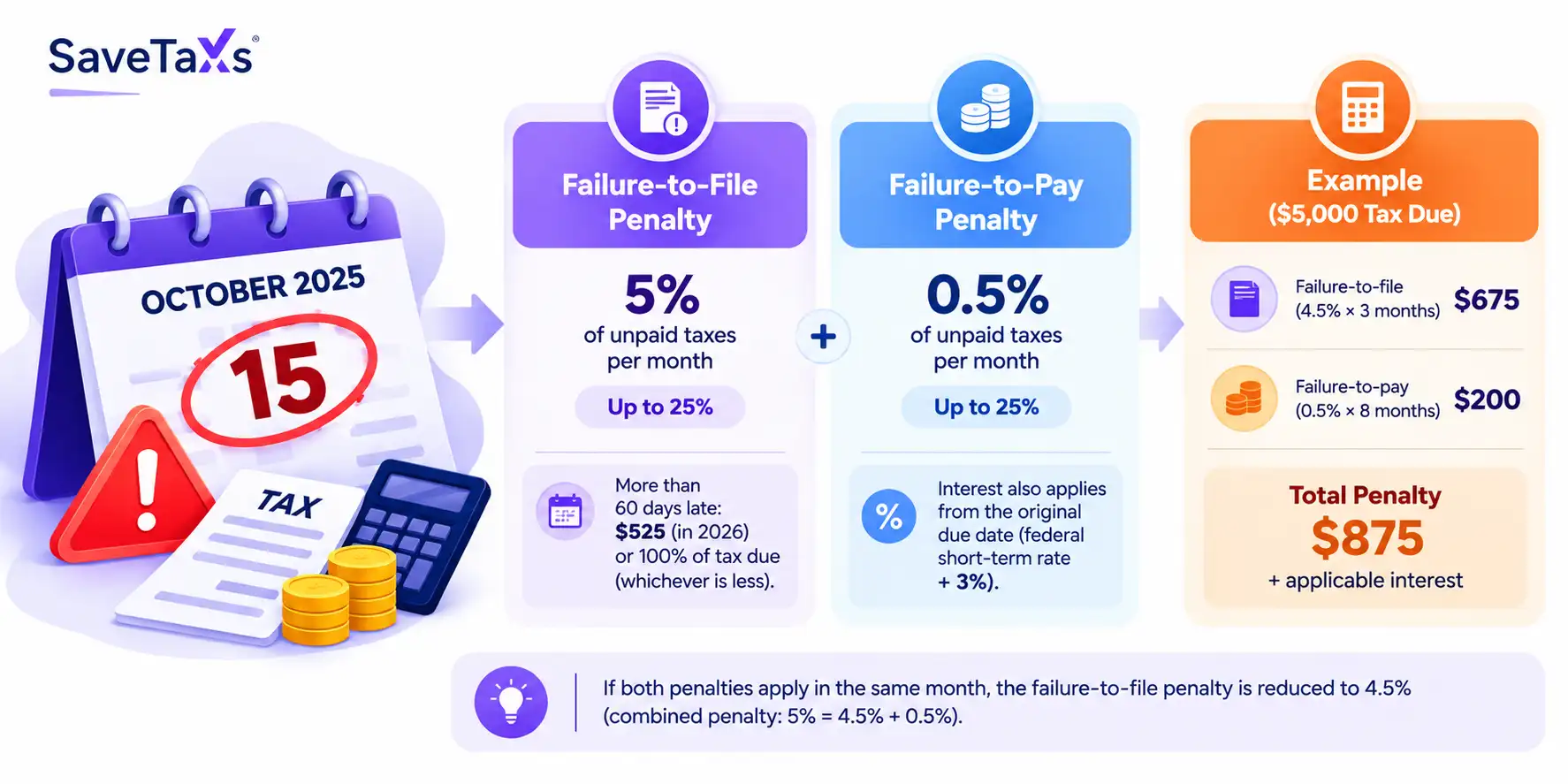
If you also owe taxes, you face a failure-to-pay penalty that is 0.5% per month or part of a month added to your unpaid amount. Tax interest is also imposed on your unpaid taxes at the applicable IRS underpayment rate, which is generally the federal short-term rate plus 3%. The failure-to-pay penalty is generally capped at 25%.
Unlike the failure-to-file penalty, interest starts accruing before October 15 because Form 4868 does not extend your payment deadline. Interest generally continues to accrue on unpaid tax, although limited interest-abatement rules may apply in certain circumstances.
suppose you file Form 4868 and extend your tax filing deadline until October 15. You also owe $5,000 in taxes. Now, when the extended tax deadline comes, you forget about your federal tax return and file it on December 1, 2025. Now, here is how the tax penalty will be imposed:
Failure-to-file: 4.5% (0.045) × $5,000 × 3 months = $675
Failure-to-pay: 0.5% (0.005) × $5,000 × 8 months = $200
Total IRS penalty = $875 plus applicable interest
Additionally, if you face both tax penalties in the same month, the IRS reduces your failure-to-file penalty from 5% to 4.5%. The combined IRS penalty is 5% (4.5% + 0.5%).
So, if you missed the October 15 tax deadline, you face a failure-to-file penalty and a failure-to-pay penalty, plus interest until you pay the taxes. So, moving ahead, let's look at the special considerations for taxpayers living abroad.
At Savetaxs, we provide you with personalized guidance based on your tax obligations and residency status in the US
Qualifying U.S. taxpayers (citizens or resident aliens) who work and live abroad receive an automatic two-month extension to file and pay federal taxes, i.e., June 15. For this extension, they do not need to file Form 4868, but they should attach a statement to their return explaining why they qualify for the automatic two-month extension. However, even if the tax extension is automatic:
Further, the June 15 automatic tax extension does not apply to every U.S. taxpayer living overseas. To qualify, you must meet specific requirements. Also, while living abroad, you should check whether your late federal tax return contains, where applicable:
Also, if you hold foreign financial assets, consider the FBAR filing deadline, as missing it can result in penalties.
The June 15 automatic tax extension is one special consideration U.S. taxpayers may receive when living abroad. Additionally, it is only available if they meet the specific two-month automatic extension conditions.
If you are an NRI who files Form 1040-NR as a nonresident alien, check the separate filing and extension rules that apply to your situation, as your applicable due date may differ.
Moving forward, let's know what you should do if you miss the extended tax deadline.
You should take the following steps after you missed the October 15 tax deadline:
This is what you should do after you missed the extended tax deadline. Now, moving ahead, let's see whether you can get IRS penalty relief if you file a late tax return after October 15.
Not in every case can you receive IRS penalty relief for filing a late tax return after October 15. This entirely depends on your situation. Based on that, there are three potential ways to get IRS penalty relief:
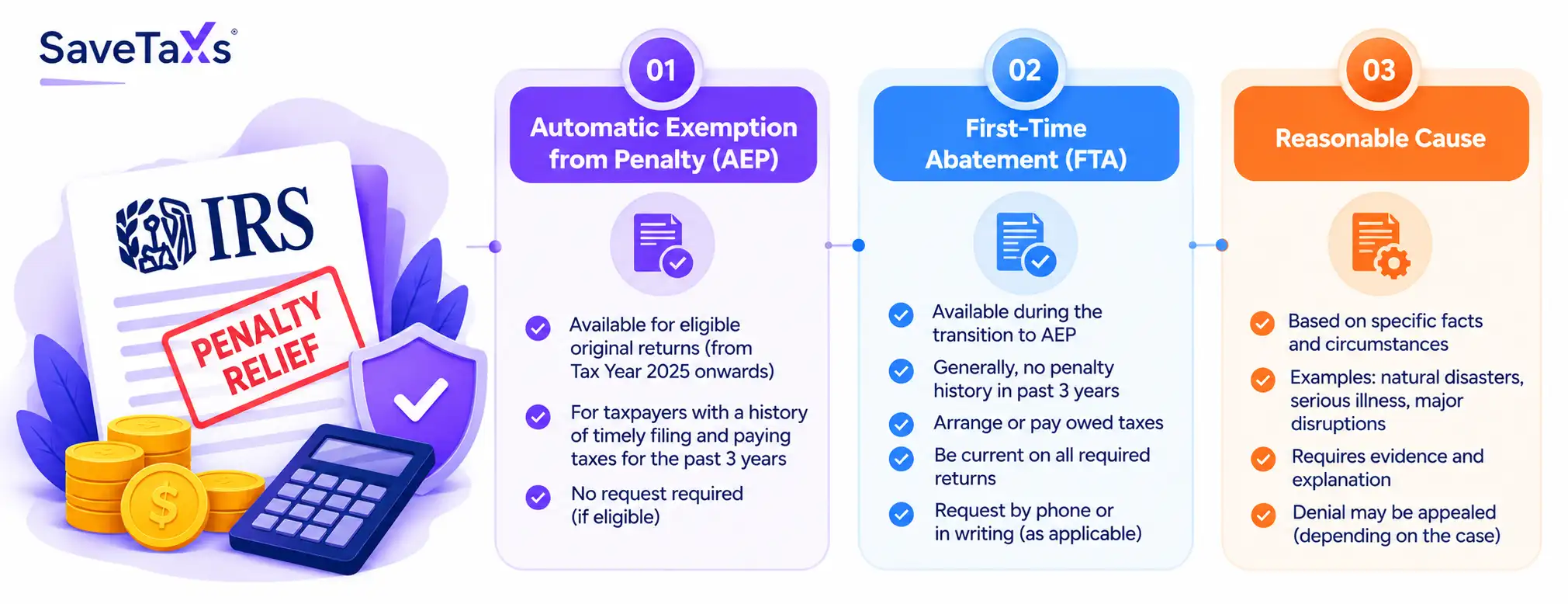
This is an automatic IRS penalty relief program available to eligible original returns beginning with tax year 2025 and subsequent eligible tax periods. Taxpayers generally qualify if they have a history of timely filing and paying taxes for the three prior years. Eligible taxpayers do not need to request this relief.
This is an IRS penalty relief option that remains relevant during the transition to the Automatic Exemption from Penalty (AEP) program for eligible periods. It is available to U.S. taxpayers who meet the applicable conditions, including:
The IRS is transitioning from First-Time Abatement toward its Automatic Exemption from Penalty (AEP) program for eligible periods. FTA remains relevant during the transition, subject to the applicable IRS rules.
An FTA request may be handled by the IRS by phone or in writing, depending on the circumstances and penalty involved.
This IRS penalty relief is based on specific facts and circumstances of the taxpayer:
Compared to FTA, reasonable cause relief is fact-specific, as it requires showing that the taxpayer exercised ordinary care and prudence. It may require a written explanation and supporting documents depending on the penalty and IRS process. If your request is denied, you may have appeal rights depending on the circumstances.
So, this is how you can get IRS penalty relief after you missed the October 15 tax deadline. Moving forward, let's look at the common mistakes you should avoid after you miss the extended tax deadline.
Connect with Savetaxs, file your tax return quickly, and reduce penalties and interest.
You should avoid the following things after you miss the October 15 tax deadline:
These are some common mistakes to avoid after you miss the October 15 tax deadline.
Lastly, if you missed the October 15 tax deadline, you may face serious consequences, including interest charges, tax penalties, tax notices, and potential IRS action. Additionally, IRS late-filing and late-payment penalties can significantly increase your tax balance, so try to avoid this mistake by filing on time.
However, if you missed the extended tax deadline, professional advice is the best way to correct your mistake. At Savetaxs, we help you stay compliant with U.S. taxes while minimizing your tax obligation and increasing your savings opportunities. Our cross-border tax experts also help you set up an IRS payment plan and take immediate action on late tax filings so you face minimal penalties.
This article is for general informational purposes only and does not constitute tax, legal, financial, or investment advice. Laws, regulations, rates, and procedures may change over time and may vary based on individual circumstances.
While SaveTaxs makes reasonable efforts to keep the information accurate and up to date, readers should verify applicable rules with official authorities or consult a qualified professional before making decisions based on this information.
Hatim Dudhiyawala is a Certified Public Accountant (CPA) with SaveTaxs and specializes in Indian and NRI taxation. He advises individuals, NRIs, and businesses on income tax filing, capital gains taxation, DTAA benefits, fund repatriation, and tax compliance. With experience in cross-border tax matters, Hatim helps taxpayers understand complex regulations and make informed decisions. Through his articles, he shares practical insights to help readers stay compliant and manage their tax obligations with confidence. See Full Bio

Want to read more? Explore Blogs
-for-401(k)_1790057066765.webp&w=828&q=75)