US Tax Filing and Compliance
What Happens If You Miss the October 15 U.S. Tax Deadline?What Happens If You Miss the October 15 U.S. Tax Deadline?
Written by Hatim Dudhiyawala

Being a US taxpayer, if you hold foreign financial accounts, the FBAR filing deadline is something you cannot miss. You must file this form if the aggregate value of your foreign financial accounts exceeds the $10,000 threshold at any point during the calendar year. It is not just a compliance formality; it is a Bank Secrecy Act reporting requirement that helps you avoid potential FBAR penalties and report your foreign financial accounts properly.
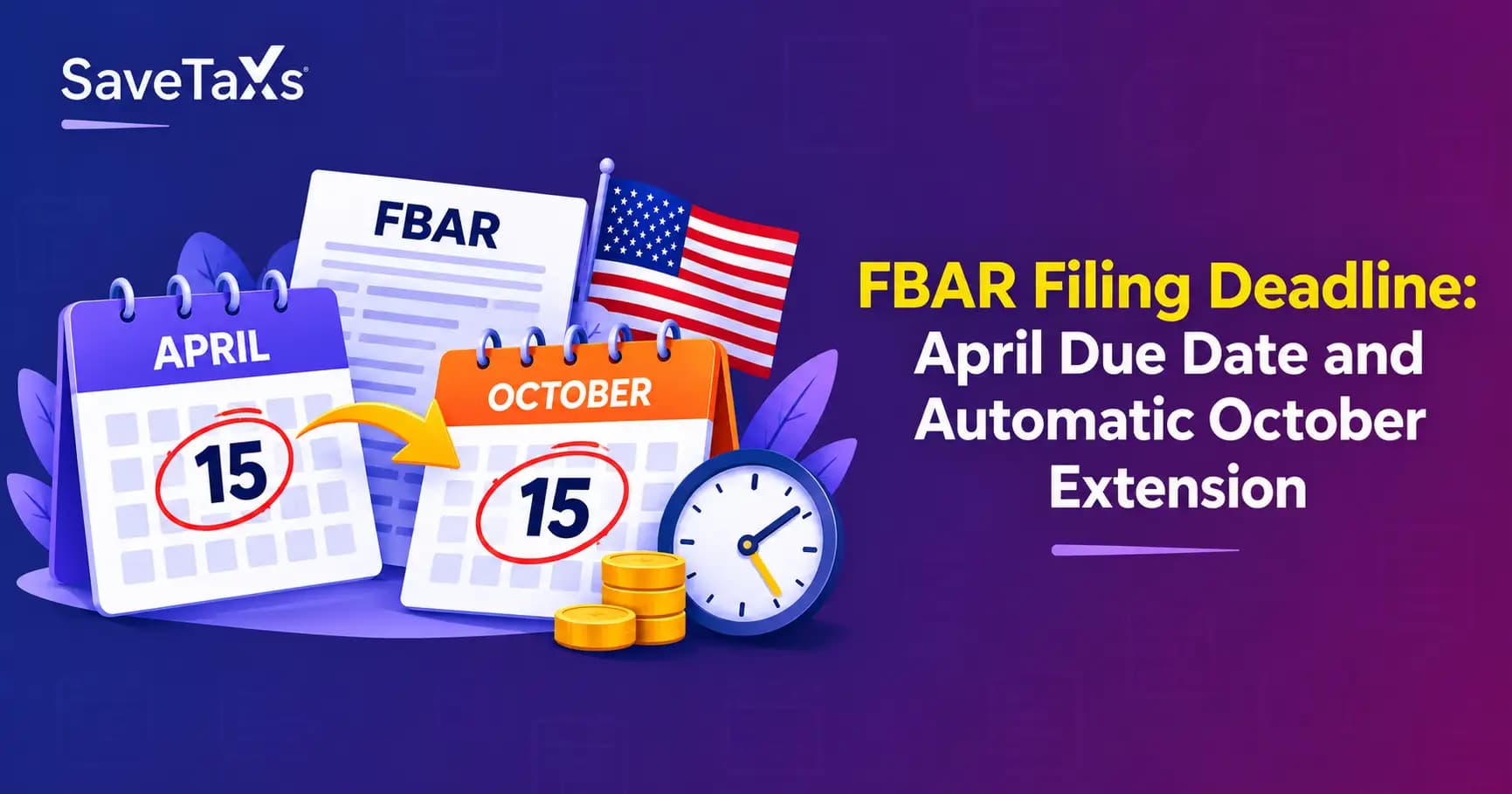
Generally, you need to file FinCEN Report 114 by April 15. However, if you miss the deadline, do not worry, as the FBAR automatic extension provides you with time to rectify your mistake till October 15. For this extra time, you do not need to file any form or request anything from the IRS.
This was a quick overview of the FBAR filing deadline. For a brief overview, read the blog below.
The FBAR is an annual calendar-year report of foreign financial accounts.
April 15, 2026, was the deadline to report the 2025 financial accounts you held overseas.
However, FinCEN provides an automatic six-month extension, i.e., October 15. You do not need to request this extension or file any form to receive it.
The April 15 deadline generally remains the FBAR filing deadline every year. However, if that date falls on a weekend or legal holiday, the filing deadline shifts to the next business day. Special extensions may also apply in certain circumstances.
Therefore, filing the FBAR from April 16 to October 15 is generally considered timely under the automatic extension.
Managing US taxes can be complex, but Savetaxs makes it easy. Our team ensures you file taxes on time, with complete accuracy, and avoid penalties.
You generally need to file an FBAR if:
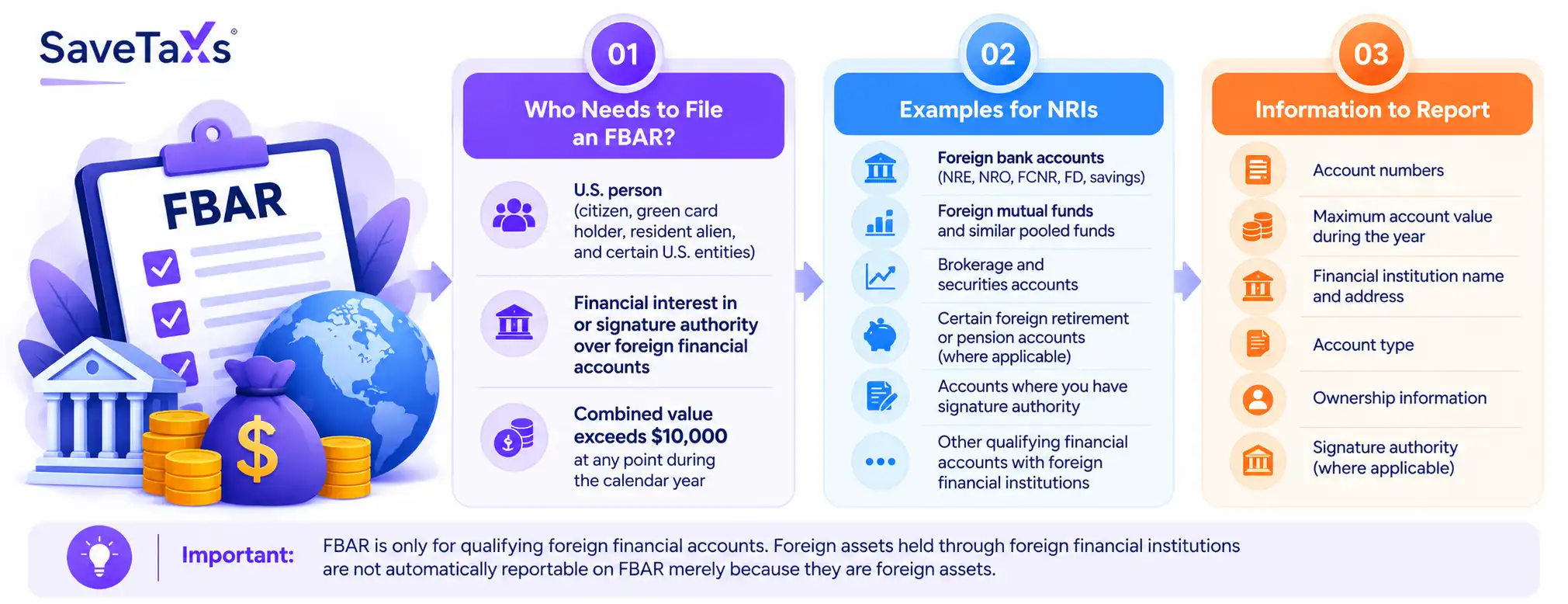
For NRIs, this can include:
You may need to report details such as:
Remember, FBAR is specifically for qualifying foreign financial accounts. Foreign assets held through foreign financial institutions are not automatically reportable on FBAR merely because they are foreign assets.
The regular FBAR filing deadline is April 15. However, the automatic reporting extension provides you with an extra six months, moving the FBAR deadline to October 15.
You do not need to:
The automatic extension is available without submitting a separate request.
FBAR is a reporting obligation for your financial accounts, not a form for income tax payments. So you do not calculate or pay income tax through the FBAR.
No. The FBAR filing and automatic extension deadlines generally remain the same for U.S. taxpayers, whether they live in the U.S. or another country, subject to any special FinCEN extensions or disaster relief.
June 15 is not an FBAR deadline. It is an automatic two-month extension for qualifying U.S. citizens and resident aliens living abroad to file and pay their federal income tax.
A qualifying U.S. citizen or resident alien living and working abroad gets this extension if they meet the applicable conditions.
Therefore, do not confuse:
If you are an NRI who is a U.S. person and hold Indian NRE, NRO, FCNR, or other qualifying foreign financial accounts, you should determine whether those accounts are reportable under FBAR rules.
Many U.S. taxpayers confuse the FBAR extension with the federal income tax return extension.
Form 4868 is an IRS form used to request additional time to file a federal individual income tax return.
The key difference is:
| Requirement | FBAR | Federal Income Tax Return |
|---|---|---|
| Filing Authority | FinCEN | IRS |
| Form | FinCEN Report 114 | Form 1040 or Form 1040-NR, as applicable |
| Regular Deadline | April 15 | Generally April 15, subject to applicable rules |
| Extension Method | Automatic extension till October 15 | Form 4868 for additional extension |
| Separate Request Required | No | Yes |
| Filed with Tax Return | No | No |
Further, Form 4868 for taxpayers abroad and in the US provides additional time to file their federal income tax return, but it does not extend the time to pay tax.
Additionally, failing to file Form 4868 does not affect the automatic FBAR extension to October 15.
You can file the FBAR electronically through FinCEN's BSA E-Filing System.
Remember that the FBAR is separate from your federal income tax return. You do not attach FinCEN Report 114 to Form 1040 or Form 1040-NR.
Before filing, gather the following information:
You should carefully enter the information, submit the FBAR, save the filing confirmation, and keep a copy of the filed report for your records.
If a tax professional files the FBAR on your behalf, confirm that they have the appropriate authorization and that the filing has been completed successfully.
If you miss the October extension deadline, it is generally considered a late FBAR filing unless an applicable relief provision or special extension applies.
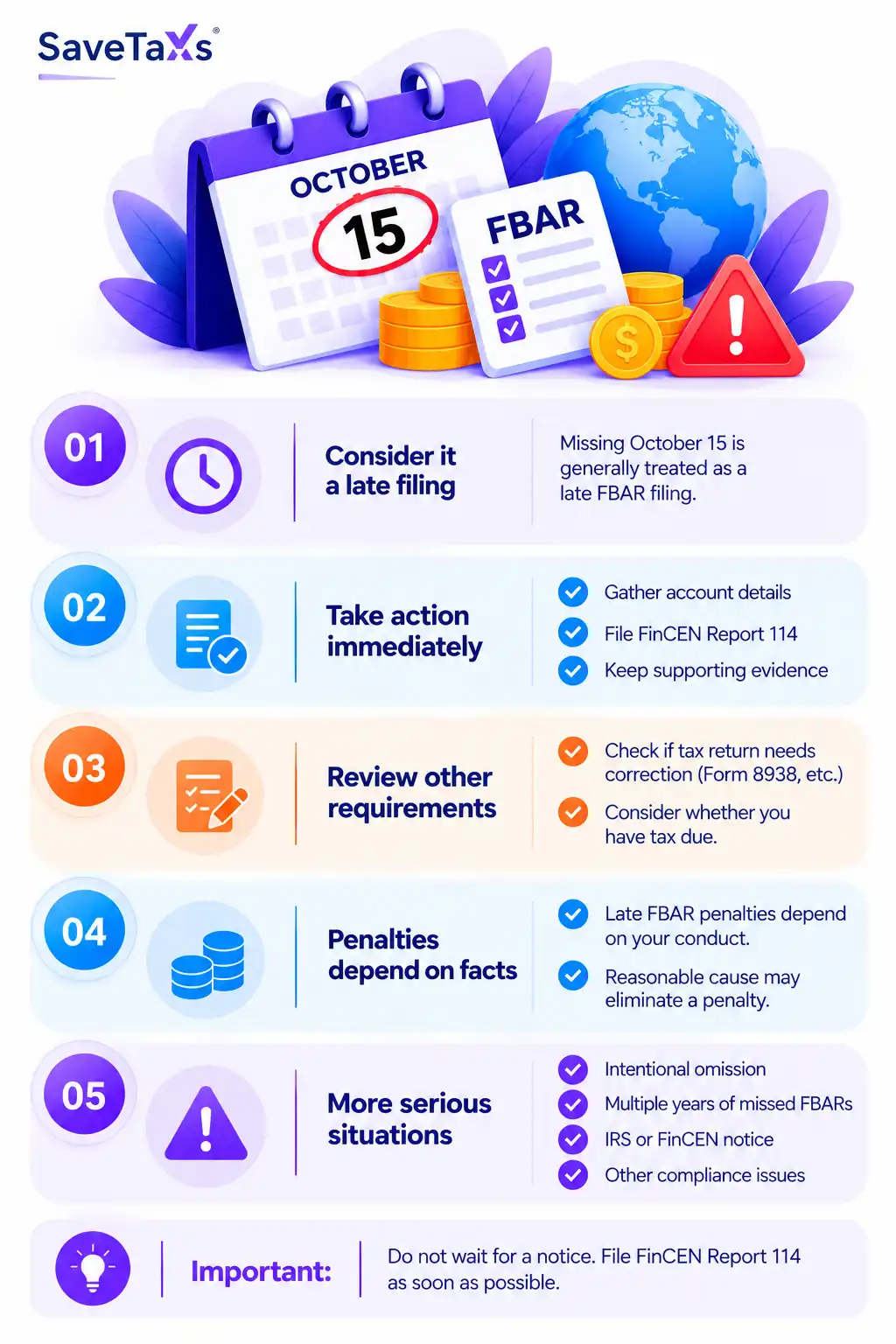
Do not wait for a notice before taking action. Instead:
Late-filing FBAR penalties depend on your conduct and facts, and reasonable cause may eliminate a penalty when the account is properly reported.
If you intentionally omitted a foreign financial account, have multiple years of missed FBARs, have received an IRS or FinCEN notice, or have other compliance issues, the consequences and available relief may differ.
Generally, in the case of a disaster, FinCEN may provide additional FBAR filing relief for taxpayers affected by it. However, do not assume the federal income tax disaster extension automatically applies to FBAR filing.
If you are affected by a disaster, check:
Always check the applicable FinCEN or IRS disaster-relief announcement before assuming that your FBAR deadline has changed.
At Savetaxs, our tax experts help you report your foreign financial accounts on FinCEN Form 114 accurately and on time.
You should avoid the following common mistakes:
Lastly, the FBAR filing deadline is generally April 15, with an automatic six-month extension to October 15. If you missed your FBAR April 15 deadline, you can still report your foreign financial accounts by October 15 under the automatic extension without being considered late for FBAR filing purposes.
Additionally, the FBAR filing date for taxpayers abroad generally remains the same as for taxpayers living in the US.
However, if you miss the October 15 deadline, you should file FinCEN Report 114 as soon as possible and review whether any applicable relief may be available.
At Savetaxs, we help NRIs and U.S. taxpayers manage their cross-border tax and foreign financial account reporting requirements so they can stay compliant with applicable U.S. tax rules.
This article is for general informational purposes only and does not constitute tax, legal, financial, or investment advice. Laws, regulations, rates, and procedures may change over time and may vary based on individual circumstances.
While SaveTaxs makes reasonable efforts to keep the information accurate and up to date, readers should verify applicable rules with official authorities or consult a qualified professional before making decisions based on this information.
Shubham Jain is the Founder of SaveTaxs and has extensive experience in Indian and NRI taxation. He advises individuals, NRIs, and businesses on tax filing, tax planning, capital gains, DTAA benefits, fund repatriation, and compliance matters. He regularly writes about taxation and related financial topics. His focus is on making complex tax concepts easy to understand. Through his articles, he helps taxpayers stay informed, avoid common mistakes, and stay compliant with Indian tax laws. See Full Bio

Want to read more? Explore Blogs
-for-401(k)_1790057066765.webp&w=828&q=75)