


_1785327342628.webp&w=828&q=75)
NRI Banking Services
What Should NRIs Know Before Choosing an NRI Account?What Should NRIs Know Before Choosing an NRI Account?
Written by Shubham Jain

For most NRIs, investing in India is not only a financial decision, but it is also emotional. However, there is one factor that many individuals overlook, i.e., currency exchange rates. Here is the truth: exchange rate movements can subtract or add 15-20% to your investment returns over three years. This is more than the interest you earn on your account deposits. Yet 80% of NRIs do not understand the impact of exchange rates on their deposits and make the currency conversion decision at the wrong time.
Further, to help you out, in this blog, you will get to know the impact of exchange rates on NRI account deposits, and when the timing actually matters, additionally, about the specific strategies you can implement in this situation. So read on and get all the information.
Currency exchange rates, in simple words, represent the value of the currency of one country in terms of the currency of another country. It dictates how much one currency you can exchange for another and is fundamental to global finance, international trade, and tourism.
For instance, 1 USD = INR 80, and later it becomes INR 85. Here, against the dollar, the value of the rupee has depreciated. Depending on the direction, this situation can either reduce or boost your returns. Additionally, the rate you see online and on the app is not the exchange rate that your banks provide you.
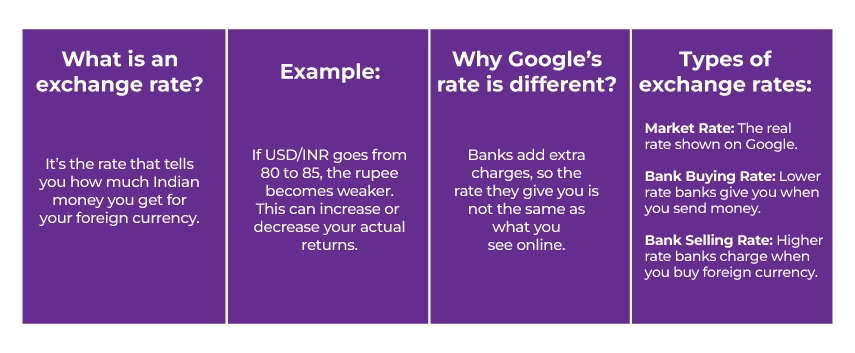
Further, let's know about the three types of exchange rates:
This was all about the currency exchange rates. Moving ahead, let's know the impact of currency conversion on NRIs and their bank accounts.
Depending on the NRI bank account type, the impact of the currency exchange rate varies. Confused, let's understand this in detail.
In your NRE account, when you deposit your foreign currency at the prevailing exchange rate, it immediately gets converted to INR. This states your exposure to currency risk. Confused? Let's understand this with an example.
For instance, when USD/INR = 82.00, you deposited $10,000. Now:
If USD/INR moved to 78.00:
Here, the same INR 7% interest rate based on currency movement provides you with completely different USD returns.
NRO accounts, for currency exposure, work similarly to NRE accounts. However, these accounts have some additional tax complications.
Here, the key difference is that, on the earned interest, 30.90% TDS is charged unless you are eligible to claim the DTAA benefits. Additionally, you can only repatriate up to $1 million per financial year.
FCNR (Foreign Currency Non-Resident) deposits are maintained in foreign currency. Considering this, your principal and interest remain in the original deposited currency. This further eliminates the risk of exchange rate risk.
So, this is how currency exchange rates affect NRE, NRO, and FCNR accounts. Moving on, let's look at the hidden costs and bank charges.
With our expert guidance, fulfill your NRI tax obligations on time without any hassle.
The hidden cost of currency conversion is that, without realizing it, many NRIs lose their money. Through multiple layers of changes, many banks earn significant profits from currency conversion.
Bank spread can be defined as the difference between the buying and selling rates of the bank. Generally, it ranges between 0.25% to 2% of the transaction amount. Further, let's see the cost breakdown for converting $25,000:
The table below showcases the comparison of different Indian banks according to their currency conversion rates:
| Bank | General Spread | Large Amount Discount | Negotiation Scope |
|---|---|---|---|
| Axis Bank | 0.45 - 1.20% | Yes, above INR 30,00,000 | Moderate |
| HDFC Bank | 0.50 - 1.25% | Yes, above INR 25,00,000 | Moderate |
| SBI Bank | 0.75 - 1.75% | Limited | Low |
| ICICI Bank | 0.40 - 1.10% | Yes, above INR 20,00,000 | Good |
From the above table, it is clear that ICICI Bank generally offers the best combination of flexibility and rates for large-amount conversions.
The service charges and additional fees include:
This was all about the hidden costs and bank charges involved in the exchange rate. Moving ahead, let's explore smart strategies NRIs can implement to increase the value of their NRE.

There are several strategies through which NRIs can minimize the impact of exchange rate fluctuations. These are as follows:
In this, you pay a premium for a minimum guarantee exchange rate while having upside potential. For instance, if you deposit $50,000, you may need to pay at least $25,000 to get a minimum conversion rate of 87.50. In this scenario, if the rate decreases to 86.00, you still receive 87.50. However, if the rate increases to 90.00, you can exchange at higher rates.
Further, it generally makes sense in uncertain economic periods when you have large deposits.
It is an agreement to exchange the currency on a future date at a fixed rate. It works like this: if you agree to convert $50,000 at an exchange rate of 88.5. In this, three months from now, no matter where the market moves, you will have to exchange that currency on that fixed rate.
Further, the minimum amount should be $25,000. Additionally, the exchange rate cost is between 0.10% and 0.25%. The option is available at ICICI, HDFC, Axis Bank, and Standard Chartered.
Under this option, instead of converting your every asset to INR, it advises maintaining it in foreign currency. Confused? Let's understand this with a practical approach:
Instead of lump sums, create fixed monthly amounts. For instance, instead of converting the whole $60,000 at once, convert $5,000 for 12 months. Further, using the SIP, you get the following benefits:
However, while using SIP, you can miss out on essential moves that are favorable for you.
So, this is how using the strategies as mentioned above can reduce the impact of exchange rates on NRI account deposits. Moving further, let's know the tax implications for NRIs.
Get CA-approved NRI investment strategies tailored to your financial goals.
Tax implications are the most vital information that most NRIs overlook until it is time to file taxes. Considering this, let's examine the currency gains for tax purposes.
Here, the tax is imposed as per the INR value at the time of deposit vs withdrawal. Confused, let's understand this with an example.
For instance, when USD/INR was 75.00, in your NRO FD, you deposited $100,000. After three years, when USD/INR = 83.00, you withdraw the amount. Here:
Further, through DTAA benefits you can avoid paying tax on the same income twice. Additionally, there are other benefits as well that DTAA offers to NRI individuals, such as:
However, before claiming the DTAA benefits, first check whether your resident country has signed this agreement with India or not. Also, while claiming the DTAA benefits, you need to submit the following documents:
So, this was all about the tax implications that NRIs face during the currency exchange in India.
Lastly, you may think of currency exchange rates as a technical topic; however, the impact of it on NRI investment is very real. Considering this, whether you are investing for income, repatriation, or long-term growth, monitoring the currency exchange trades assists you in making the right decision.
Further, if you are reviewing or planning your NRI portfolio, taking guidance from financial experts like Savetaxs can help you maximize your income returns while handling currency exposure. Additionally, we can also assist you with your tax obligations.
This article is for general informational purposes only and does not constitute tax, legal, financial, or investment advice. Laws, regulations, rates, and procedures may change over time and may vary based on individual circumstances.
While SaveTaxs makes reasonable efforts to keep the information accurate and up to date, readers should verify applicable rules with official authorities or consult a qualified professional before making decisions based on this information.
Shubham Jain is the Founder of SaveTaxs and has extensive experience in Indian and NRI taxation. He advises individuals, NRIs, and businesses on tax filing, tax planning, capital gains, DTAA benefits, fund repatriation, and compliance matters. He regularly writes about taxation and related financial topics. His focus is on making complex tax concepts easy to understand. Through his articles, he helps taxpayers stay informed, avoid common mistakes, and stay compliant with Indian tax laws. See Full Bio

Want to read more? Explore Blogs


_1784120197435.webp&w=828&q=75)