


_1785327342628.webp&w=828&q=75)
NRI Banking Services
What Should NRIs Know Before Choosing an NRI Account?What Should NRIs Know Before Choosing an NRI Account?
Written by Shubham Jain
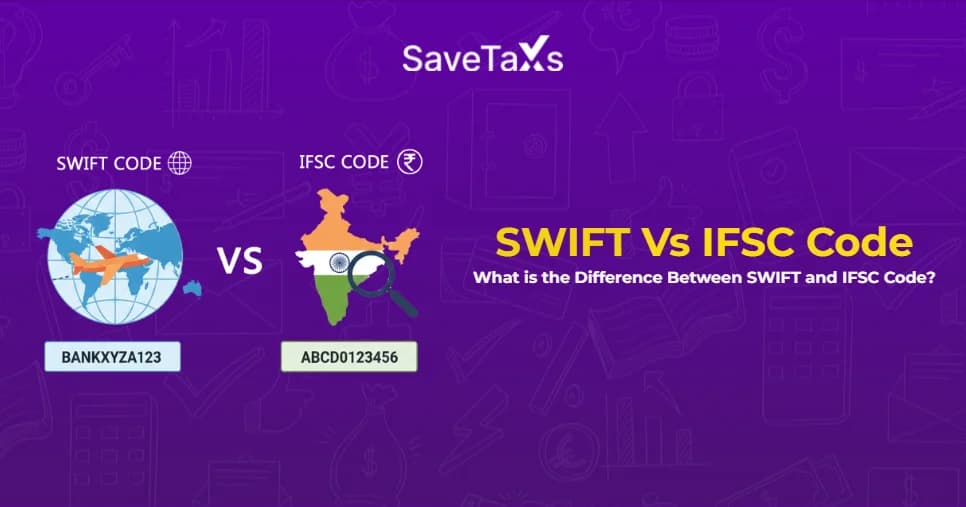
A SWIFT code (Society for Worldwide Interbank Financial Telecommunication) is an 8-11-character code, also known as a BIC (Bank Identifier Code). It is used to identify and verify the identity of banks and financial institutions worldwide for international transactions. It is issued by the SWIFT network and can be found on the bank's official website, in the bank statement, or via the BIC/SWIFT search tool.
An IFSC (Indian Financial System Code) is a 11 character alphanumeric code that identifies each bank branch in India. These codes are assigned by the RBI to ensure that your fund is transferred to the right place every time. It is essential for every online domestic fund transfer, including NEFT, RTGS, and IMPS. It can be found on your cheque book and passbook, the bank's official website, or by contacting your bank branch or visiting in person.
In this blog, we will cover everything you need to know about SWIFT code and IFSC code.
The table below lists the key differences between IFSC code and SWIFT Code:
| Particulars | Swift Code | IFSC Code |
|---|---|---|
| Full form | SWIFT code stands for Society for Worldwide Interbank Financial Telecommunication. It is a systematic code used to identify financial institutions worldwide. | IFSC code stands for Indian Financial System Code. It's a unique code used to identify bank branches within India. |
| Characters | It consists of 8 to 11 characters, including numbers and letters. | It consists of 11 characters, including letters and numbers. |
| Managed By | The Society for Worldwide Interbank Financial Telecommunication (SWIFT) network manages and generates SWIFT codes. | The Reserve Bank of India (RBI) manages and generates IFSC Codes. Additionally, it's also a part of the NEFT (National Electronic Fund Transfer System) |
| Usage | SWIFT Code is used for international fund transfers and is essential for communication between financial institutions in different countries. | IFSC Code is used for domestic fund transfers and is crucial for interbank transactions within India. |
| Role | It is important for transferring funds across borders, including foreign currency transfers and international transfers. | It plays a vital role in transferring funds within India. It includes RTGS (Real Time Gross Settlement), NEFT (National Electronic Fund Transfer), IMPS (Immediate Payment Service), etc. |
| Purpose | It is required for international trade and commerce that includes fund transfer in different currencies. | It is essential for interbank settlements, bill payments, electronic fund transfer, and other banking operations within the Indian banking system. |
| Format Example | AAAA- BB- CC- 123 | AAAA-0-123456 |
SWIFT code stands for Society for Worldwide Interbank Financial Telecommunication. It is generated by the SWIFT network (Society for Worldwide Interbank Financial Telecommunication). It is a unique code used to identify and locate banks worldwide. SWIFT code ensures secure and accurate communication for routing international fund transfers among financial institutions worldwide.
It is essential to ensure that funds are remitted to the designated financial institutions and to prevent the risk of misrouting. All regulatory authorities use SWIFT codes to facilitate and secure international fund transfers across borders and currencies.
SWIFT codes are unique identifiers for banks, used in international transfers to verify a bank's identity, which is why they're also called BIC (Bank Identifier Code). It ensures that the funds are transferred to the right place to ensure safe financial transactions. BIC is an alphanumeric code used by more than 200 countries and 11,000 institutions in the world.
The system processes the code to identify the designated bank where the transfer is intended. Hence, you will be required to furnish a BIC or SWIFT code whenever you make international fund transfers.
Let Savetaxs handle your NRI tax filing.
A SWIFT code is an 8 - 11 alphanumeric character. Each character represents specific identifying factors. Below is an example for SWIFT Code format:
AAAA- BB- CC- 123. In this example,
Checking bank-related documents, such as bank statements or bank account details from your online banking profile, is the best way to find your SWIFT/BIC code. Alternatively, you can also use the digital BIC or SWIFT search tool if you are not able to find the SWIFT code.
These search tools will help you find the SWIFT code by providing a few key details, such as your bank location and the country you are in.
IFSC stands for Indian Financial System Code. It is a unique alphanumeric code assigned by the RBI to identify and verify each bank branch in India. It ensures that the money reaches the designated destination within the Indian banking system.
An IFSC code reduces the risk of remitting funds across banks in India. Whenever you transfer funds domestically, you will be asked to provide important details about the sender and receiver banks, including their IFSC codes.
Financial institutions use IFSC codes to locate specific bank branches while transferring funds. The RBI (Reserve Bank of India) also uses these codes for electronic fund transfers within the country. The IFSC code ensures easy fund transfer across various financial institutions.
However, these codes are only specified for banks operating in India. It's only designed to track domestic transactions, not global transactions.
An IFSC code consists of exactly 11 alphanumeric characters. Each character denotes specific identifying factors. Here is an IFSC code format example:
AAAA-0-123456. In this example,
You can find your IFSC code on bank statements, passbooks, and cheques issued by your bank's branch. Additionally, you can also check account details through your online banking profile. However, if you still can't find the IFSC code, you can contact your bank branch or visit it in person to resolve your queries.
Expert assistance for all your banking needs.
Understanding the difference between SWIFT code and IFSC code is not confusing. Although both are alphanumeric codes used to identify banks for fund transfers. The main difference between them is their scope. The SWIFT code is used globally, while the IFSC code is used within India. Using the wrong code will lead to payment failure, delays, extra charges, or other inconveniences. Make sure to understand the difference clearly and use the right code to ensure successful transfers.
Additionally, for any kind of tax or banking-related issues, contact the experts at Savetaxs. We have a team of experts who can simplify compliance, regulatory, and procedural requirements for NRI taxation and banking operations. Our team can help you with opening NRE/NRO accounts, repatriation and fund transfers, FEMA compliance, TDS management and refunds, and much more. Reach out to us right away, as we are serving our clients 24/7 across all time zones.
This article is for general informational purposes only and does not constitute tax, legal, financial, or investment advice. Laws, regulations, rates, and procedures may change over time and may vary based on individual circumstances.
While SaveTaxs makes reasonable efforts to keep the information accurate and up to date, readers should verify applicable rules with official authorities or consult a qualified professional before making decisions based on this information.
Vipul Jain is the Co-Founder of SaveTaxs and a tax expert with experience in Indian and NRI taxation. He advises individuals, NRIs, and businesses on tax filing, tax planning, capital gains, DTAA, and compliance matters. He focuses on making complex tax concepts simple and helping taxpayers make informed, compliant decisions. See Full Bio

Want to read more? Explore Blogs
_1784120197435.webp&w=828&q=75)