NRI Income Tax Compliance
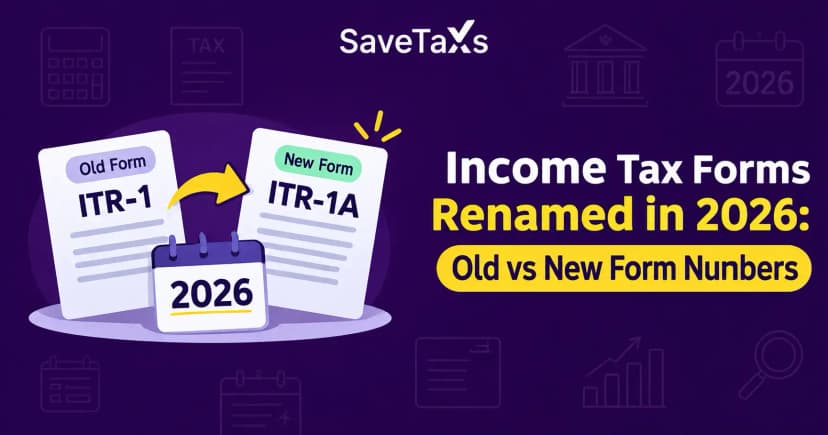
Income Tax Forms Renamed in 2026: Old vs New Form NumbersIncome Tax Forms Renamed in 2026: Old vs New Form Numbers
Written by Vipul Jain
_1779713772515.webp&w=3840&q=75)
FAST-DS stands for Foreign Assets of Small Taxpayers Disclosure Scheme. FAST-DS 2026 is a proposed voluntary disclosure framework discussed in the Finance Bill 2026 for foreign asset compliance. This scheme helps eligible Indians, NRIs, and RNORs to declare their hidden foreign income or assets from past years and pay a reduced tax amount. Additionally, get relief from penalties and prosecution stated under the Black Money Act 2015 and the Income Tax Act, 1961.
Confused? Want to know more about this scheme? Then you are on the right destination. Read on the blog and get your answers.
|
Note: Although the FAST-DS 2026 was announced in the Financial Bill, 2026, the start date has not yet been mentioned by the Indian Government. Considering this, any declarations made before this start date will not be considered valid. |
The FAST-DS 2026, discussed earlier, is a Foreign Assets of Small Taxpayers- Disclosure Scheme 2026. This scheme was introduced by the Central Government of India through Clauses 114-128 of the Finance Bill, 2026. It provides a one-time six-month voluntary window for eligible Indian residents, returning NRIs, and RNORs to disclose their foreign income or assets that were never reported or taxed in the ITR.
Upon disclosure and payment of the stated fee or tax, this scheme provides relief to individuals from penalty and prosecution mentioned in the Black Money Act (Undisclosed Foreign Income and Assets) Imposition of Tax Act, 2015. The relief is automatic, which is granted by the Indian law once you make the payment.
The FAST-DS scheme specifically targets small taxpayers and NRIs who failed to report their certain foreign income or assets in past years. The intent behind it is:
Further, unlike past disclosures that target willful tax evasion, this scheme recognizes that many cases arose from:
However, this scheme does not apply to any criminal proceedings or large-scale offshore tax evasion.
This was all about the FAST-DS 2026 scheme. Moving ahead, let's know the eligibility criteria for it.
Eligibility for FAST-DS 2026 focuses on genuine and low-risk cases. Any individual who "was" or who "is" an Indian resident in the relevant financial year and who fulfills the conditions of the scheme is eligible for it. It also includes a returning NRI who currently holds resident but not ordinarily resident (RNOR) status, but was a resident in India when the undisclosed foreign asset or income was acquired.
Furthermore, the scheme specifically targets the following categories:
This was all about eligibility criteria for FAST-DS 2026. Moving forward, let's discuss the assets and income that can be disclosed under this scheme.
Before you state anything under the FAST-DS 2026, you should know what NRIs disclose foreign assets in India. To help you out, here is a simple breakdown to stay compliant and avoid mistakes:
|
Discloseable Assets |
Non-Disclosable Assets |
|
Foreign shares, stocks, mutual funds, ETFs |
Assets acquired from income that has already been taxed in India. |
|
Foreign bank accounts (current, savings, deposits) |
Assets you disclosed earlier in Schedule FA when filing ITR. |
|
Overseas partnerships or business ownership |
Assets held by NRIs (if they do not qualify as residents) |
|
Foreign real estate (land, property, house) |
Assets below the stated small-value threshold (if tax-exempt) |
|
Insurance policies issued outside India |
Illegal/ Benami assets not stated under the scheme |
|
Foreign assets where you are the owner/beneficiary |
Assets already under legal dispute or investigation |
|
Foreign retirement accounts (like pensions, 401(k) |
Domestic (Indian) Assets |
|
Any other financial asset held outside India |
Assets associated with criminal activities |
These are the assets that you can disclose in the FAST-DS 2026 scheme. Moving further, let's know the categories and penalty structure of this scheme.
The FAST-DS 2026 has two different categories with distinct cost implications:
|
Feature |
Category A |
Category B |
|
Who is included |
Foreign assets or income that have never been reported or taxed. |
|
|
Monetary Limit |
As of March 31, 2026, the aggregate value is less than or equal to more than INR 1 crore. |
As of March 31, 2026, the value is less than or equal to INR 5 crore. |
|
Tax/ Fee Payable |
30% tax + additional (100% of tax) = 60% of income/ asset value |
Flat fee of INR 1,00,000 |
|
Immunity Granted |
Under the Black Money Act Imposition Act, 2015, you get full immunity from prosecution and penalty |
Full immunity from penalty and prosecution. |
This was all about the categories and penalty structure for the FAST-DS 2026 scheme. Moving forward, let's know the consequences of non-disclosure under this scheme.
The consequences of non-disclosure on FAST-DS 2026 are as follows:
Confused? Let's better understand this with an example.
For instance, you are an NRI returning to India. You hold INR 80,00,000 in your foreign bank account that you never disclosed. Considering this, foreign assets taxed under the Black Money Act, you face the following consequences:
It is more than the undisclosed asset you own. Additionally, you could also face legal action and notices.
Now, let's compare this with the Foreign Asset Disclosure Scheme- 2026.
Under this scheme, on the Fair Market Value (FMV) of your asset, you pay 30% tax. Plus 30% extra charge (penalty). So the total is 60% of the asset value, which is half of your financial burden. This further helps people in declaring their assets without the fear of paying more penalties.
Now, moving ahead, let's know which ITR form should be submitted for foreign ESOP disclosure.
You can use the following forms for foreign ESOP disclosure:
|
Schedule/ Form |
Purpose |
Who Can Avail |
|
ITR 2 |
It is for individuals with no professional or business income. |
Salaried employees with RSUs/ ESOPs and no business income. |
|
ITR 3 |
It is for individuals with professional or business income. |
Self-employed or freelancers with foreign assets. |
|
Schedule FA |
Until the asset is sold, it is mandatory to disclose the foreign asset every year. |
All residents, including returning NRIs who again become Indian residents and have any foreign asset (shares, bank accounts, property insurance, ESOPs). |
|
Schedule FSI |
It reports the income earned from foreign sources. |
Anyone earning rental income, dividends, or interest from foreign assets. |
|
Schedule TR |
Foreign Tax Relief/ Tax credit claimed for paid taxes. |
Anyone who paid tax in a foreign country on the same income. |
|
Form 67 |
Under the DTAA, claim a foreign tax credit. |
Required before filing tax return if claiming DTAA. Missing it can result in tax credit denial. |
So these forms you can use for Foreign ESOP disclosure.
Connect with Savetaxs and get clarity from CA, and know how the new tax provision impacts your tax obligation.
Lastly, FAST-DS 2026 is not a scheme for serious tax evasion. It is a corrective tool for taxpayers who are facing issues between complex disclosure rules and global income. Considering this, if you are a returning NRI with overseas accounts, ESOPs, or foreign-held life insurance, then you also need to pay attention to the foreign asset disclosure. It provides you with the chance to reduce long-term risk, reset compliance, and move ahead with clarity.
Furthermore, if you are facing difficulty with the Foreign Asset Disclosure Scheme 2026 filing, connect with Savetaxs. We have a team of top CAs who guide you on tax planning, ITR filing, and consultancy. Contact us and get personalized tax services as per your tax situation.
This article is for general informational purposes only and does not constitute tax, legal, financial, or investment advice. Laws, regulations, rates, and procedures may change over time and may vary based on individual circumstances.
While SaveTaxs makes reasonable efforts to keep the information accurate and up to date, readers should verify applicable rules with official authorities or consult a qualified professional before making decisions based on this information.
Vipul Jain is the Co-Founder of SaveTaxs and a tax expert with experience in Indian and NRI taxation. He advises individuals, NRIs, and businesses on tax filing, tax planning, capital gains, DTAA, and compliance matters. He focuses on making complex tax concepts simple and helping taxpayers make informed, compliant decisions. See Full Bio
Want to read more? Explore Blogs