NRI Income Tax Compliance
Income Tax Forms Renamed in 2026: Old vs New Form NumbersIncome Tax Forms Renamed in 2026: Old vs New Form Numbers
Written by Vipul Jain

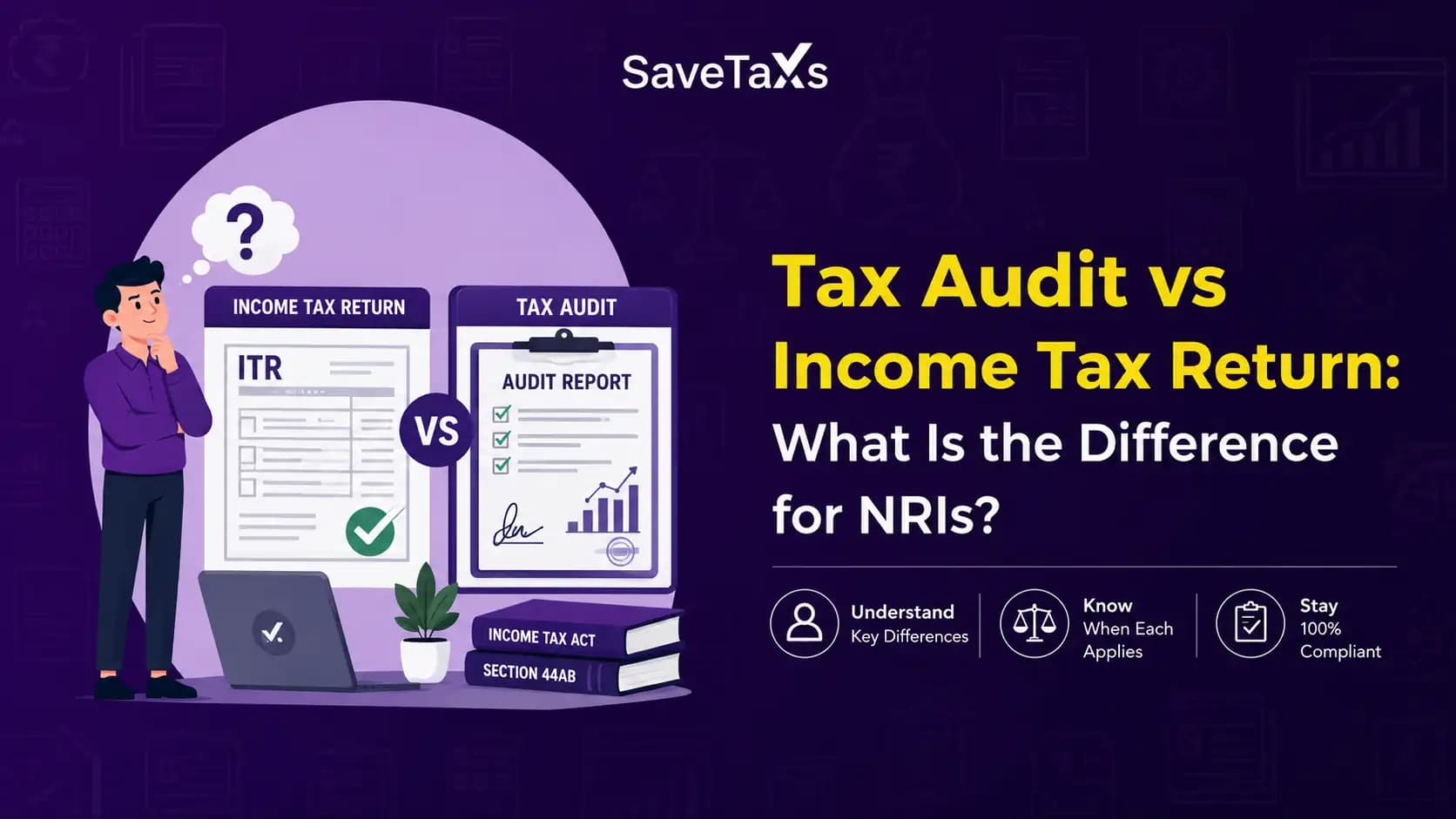
If you earn income in India while living abroad, you've probably already considered whether you need to file an Indian income tax return. However, an ITR and a tax audit are different compliance requirements, and confusing them can lead to unnecessary work or missed obligations. In this guide, we'll explain the difference between an ITR and tax audit for NRIs, when each may apply, and what to do if both requirements affect you.
An Income Tax Return (ITR) reports a taxpayer's income, deductions, tax liability, and other required information to the Income Tax Department.
A tax audit involves examination and reporting on specified books or accounts when the applicable conditions under Indian tax law are met.
ITR filing and tax-audit obligations are separate questions; filing an ITR does not automatically mean an NRI needs a tax audit.
NRI status alone does not determine tax-audit applicability; the nature and scale of the taxpayer's business or professional activity are important.
Section 44AB contains tax-audit requirements under the Income Tax Act, 1961, with corresponding provisions under the Income Tax Act, 2025.
Business and professional income requires closer review because turnover, receipts, cash transactions, and presumptive-taxation choices can affect audit requirements.
NRIs should assess their individual facts and verify current statutory requirements before deciding whether an ITR, tax audit, or both are required.
An Income Tax Return (ITR) is a tax filing that reports required income and tax information to the Income Tax Department, while a tax audit is an examination of specified accounts and reporting by an eligible tax auditor when the law requires it. The two serve different purposes and should not be treated as interchangeable.
First, an ITR tells the tax department about your taxable income and relevant financial information for the year. For example, an NRI earning taxable rental income or capital gains from India may have an ITR filing obligation even when no tax audit applies.
At the same time, a tax audit examines specified books and financial information and reports prescribed particulars to the tax authorities. The Income Tax Department states that a tax audit involves the tax auditor's opinion on the correctness of specified factual details and requires prescribed reporting through the applicable audit forms.
For NRIs, the key point is simple: having to file an ITR does not by itself mean having to undergo a tax audit.
The ITR-versus-audit distinction matters because the filing obligation and audit obligation arise from different rules. An NRI should therefore determine each requirement separately instead of assuming that one automatically triggers the other.
Moreover, the distinction becomes particularly important when an NRI operates a business or profession in India. For example, an NRI with Indian rental income may primarily need to evaluate the applicable ITR requirements, while an NRI carrying on a business may also need to examine the tax-audit provisions.
The Income Tax Department's current guidance confirms that taxpayers required to obtain an audit under Section 44AB use prescribed audit-report forms in addition to their income-tax return compliance.
An NRI income tax return is the return through which a non-resident reports taxable income and other required information to India's Income Tax Department. The appropriate ITR form depends on the taxpayer's income sources and circumstances.
First, NRIs should not automatically assume that the simplest ITR forms available to resident taxpayers are suitable for them. For example, the Income Tax Department specifically states that ITR-1 cannot be filed by a Non-Resident Indian, while ITR-2 is available for eligible individuals without income from business or profession.
For example, an NRI with Indian property income, interest income, or eligible capital gains may need to determine whether ITR-2 ITR-3 is appropriate. The correct form depends on the complete income profile rather than NRI status alone.
A tax audit is a statutory examination and reporting process for taxpayers whose accounts are required to be audited under applicable income-tax provisions. Under the Income Tax Act, 1961, Section 44AB contains the principal tax-audit requirements for specified business and professional cases.
At the same time, the applicable audit framework is not limited to one simple turnover test. The Income Tax Department's current guidance identifies thresholds for business and profession and also covers certain situations involving presumptive taxation.
For FY 2025–26 and AY 2026–27, the Income Tax Department states that the tax-audit threshold is generally ₹1 crore for business, increased to ₹10 crore where cash receipts and cash payments each remain within the specified 5% condition, while the professional gross-receipts threshold is ₹50 lakh, subject to the applicable provisions and exceptions. — Source: Income Tax Department, 2026.
A tax audit examines specified accounts and provides prescribed audit reporting, whereas an ITR communicates the taxpayer's income and tax information to the Income Tax Department. This distinction can be summarized as follows:
| Factor | Income Tax Return | Tax Audit |
|---|---|---|
| Main purpose | Report income and tax information | Examine specified accounts and report prescribed particulars |
| Applies to | Taxpayers who meet applicable ITR filing requirements | Taxpayers who meet applicable audit conditions |
| Primary professional | Taxpayer or authorized tax professional | Chartered Accountant/tax auditor |
| Main output | Applicable ITR form | Prescribed audit report and particulars |
| Relationship | May be required independently | May accompany the relevant tax-return compliance |
| NRI status | Does not by itself determine the form or obligation | Does not by itself create an audit obligation |
Moreover, the Income Tax Department provides Form 3CA-3CD and Form 3CB-3CD for tax audits under the Income Tax Act, 1961, depending on whether the accounts are audited under another law.
Tax-audit requirements can apply to an NRI when the taxpayer falls within the statutory conditions for audit, particularly in relevant business or professional situations. Therefore, the analysis should focus on the activity and applicable provisions rather than simply asking whether the person is an NRI.
First, an NRI carrying on a business in India should examine turnover, gross receipts, cash transactions, and any applicable presumptive-tax provisions. For example, a business crossing the relevant audit threshold may require an audit even though the owner is a non-resident.
Second, an NRI providing professional services in India should separately consider the professional-receipts threshold and other applicable conditions. The Income Tax Department currently identifies ₹50 lakh as the general gross-receipts threshold for the professional category under the applicable tax-audit framework.
Importantly, Section 44AB does not mean every NRI must obtain a tax audit. Its application depends on whether the taxpayer falls within the relevant statutory circumstances.
An NRI with ordinary Indian-source income may need an ITR without necessarily needing a tax audit. For example, consider an NRI who owns an apartment in India and earns rental income in India but does not operate a business or profession that triggers audit provisions.
Next, consider an NRI operating an Indian business with substantial turnover. That taxpayer may have both an ITR obligation and a separate tax-audit requirement, depending on the applicable threshold and other statutory conditions.
Finally, consider an NRI providing professional services in India. Professional gross receipts and the applicable tax provisions should be reviewed separately from the ITR filing question, because the professional activity can create additional audit considerations.
An NRI who may be subject to a tax audit should determine applicability first, complete the required audit process, and then address the related income-tax return compliance. The exact sequence and deadlines should be checked for the relevant assessment year.
At the same time, the practical process can be organized into five steps:
Identify your Indian income sources and determine whether you have business or professional activity.
Assess your ITR filing obligation and identify the appropriate return form.
Separately test tax-audit applicability using the relevant statutory conditions.
Engage a qualified Chartered Accountant if an audit is required and provide the necessary books and financial information.
Complete the applicable audit reporting and ITR filing within the prescribed deadlines.
For FY 2025–26, the Income Tax Department states that the tax-audit report due date for AY 2026–27 is 30 September 2026. — Source: Income Tax Department, 2026.
The Income Tax Department's e-filing portal is the primary official resource for checking current ITR forms, tax-audit forms, and filing guidance. Using official guidance is particularly important because India's income-tax framework is transitioning from the Income Tax Act, 1961 to the Income Tax Act, 2025.
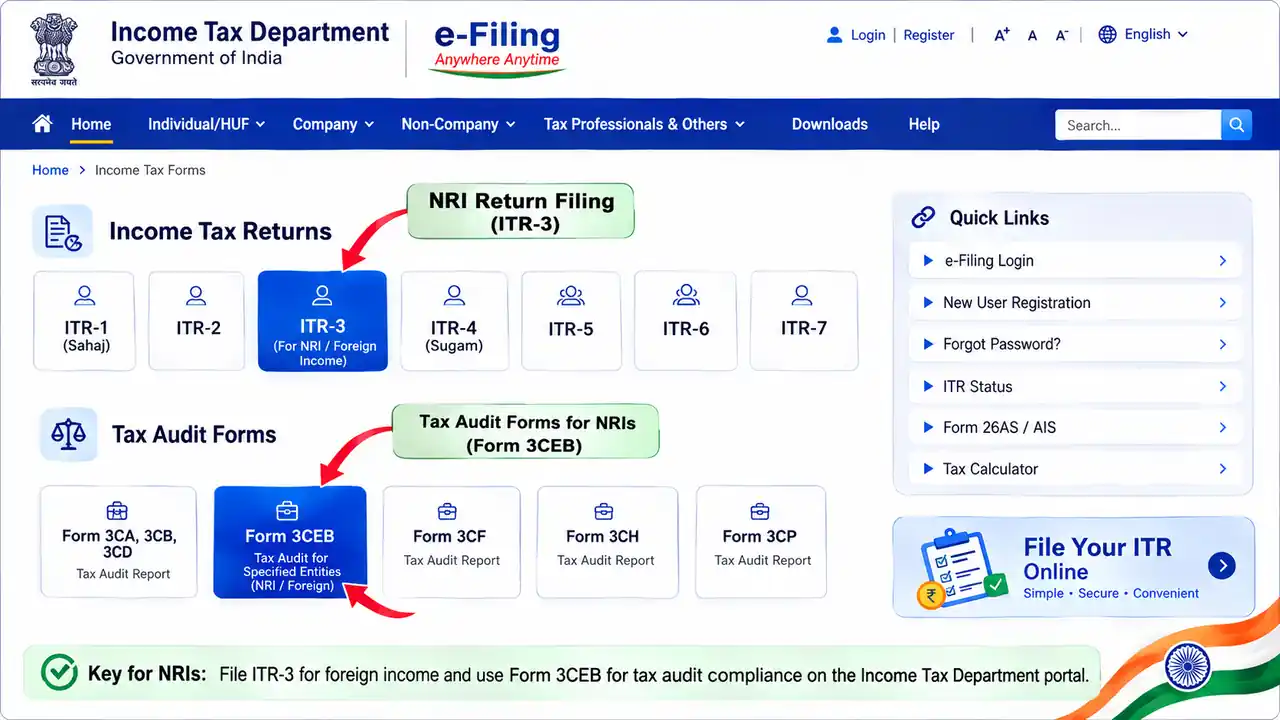
For example, the department's current forms guidance lists Form 3CA-3CD and Form 3CB-3CD for tax audits under the 1961 Act.
You can also use an NRI Tax Calculator to estimate potential tax liability, but a calculator does not determine whether a statutory tax audit applies.
The next step is to evaluate your ITR obligation and tax-audit obligation separately using your actual Indian income and activities. Avoid assuming that NRI status alone determines either requirement.
First, list your Indian income sources and identify whether you have business or professional receipts. Next, determine the appropriate ITR and independently review whether the tax-audit provisions apply. If you need practical filing guidance, see how to file ITR for an NRI.
Finally, seek professional tax advice when your case involves business income, professional receipts, presumptive taxation, complex transactions, or multiple Indian income sources. A qualified professional can help interpret the applicable provisions using your specific facts.
An ITR and a tax audit are separate Indian tax-compliance requirements for NRIs. An ITR reports income and tax information, while a tax audit examines specified accounts and provides prescribed reporting when the statutory conditions are satisfied.
Moreover, an NRI can have an ITR filing obligation without being subject to a tax audit. Conversely, an NRI conducting a business or profession may need to evaluate both requirements, including the applicable provisions corresponding to Section 44AB.
Ultimately, the right question is not simply "Does an NRI need a tax audit?" but "Do my income sources and activities meet the applicable audit conditions?" By separating the two compliance questions and checking current official rules, you can approach your Indian tax obligations with greater clarity and fewer compliance surprises.
This article is for general informational purposes only and does not constitute tax, legal, financial, or investment advice. Laws, regulations, rates, and procedures may change over time and may vary based on individual circumstances.
While SaveTaxs makes reasonable efforts to keep the information accurate and up to date, readers should verify applicable rules with official authorities or consult a qualified professional before making decisions based on this information.
Vipul Jain is the Co-Founder of SaveTaxs and a tax expert with experience in Indian and NRI taxation. He advises individuals, NRIs, and businesses on tax filing, tax planning, capital gains, DTAA, and compliance matters. He focuses on making complex tax concepts simple and helping taxpayers make informed, compliant decisions. See Full Bio
Want to read more? Explore Blogs