NRI Income Tax Compliance
Income Tax Forms Renamed in 2026: Old vs New Form NumbersIncome Tax Forms Renamed in 2026: Old vs New Form Numbers
Written by Vipul Jain

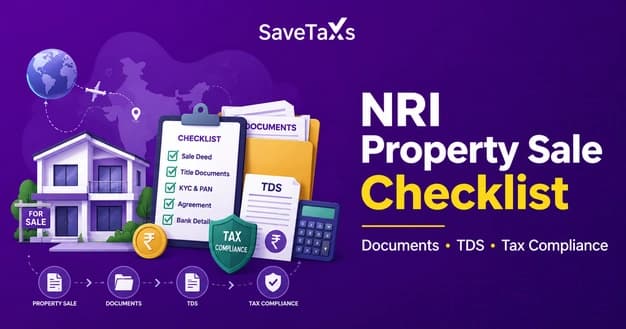
If you've been planning to sell property in India while living overseas, you've probably already started gathering your property papers and discussing the sale with a buyer. However, NRI property sales involve additional TDS, tax, documentation, and banking considerations that can affect the transaction. In this guide, you'll find the essential NRI property sale checklist to follow before, during, and after the sale.
NRI property sales require more than a sale deed, including ownership, identity, tax, TDS, and banking documentation.
The buyer's TDS obligation is separate from your final tax liability, so the amount withheld should not automatically be treated as your final tax.
Property acquisition documents affect capital-gains calculations, making previous sale deeds, purchase records, and eligible improvement expenses important.
Lower or nil withholding certificates can be relevant when the prescribed TDS deduction does not reflect the seller's expected tax liability.
TDS records should be preserved so eligible tax deducted can be properly claimed in the seller's tax compliance.
Repatriating sale proceeds can require additional FEMA and banking documentation, depending on how the property was acquired.
Current tax and regulatory rules should always be verified before completing the transaction because applicable provisions can change.
An NRI property sale checklist is a structured list of documents, tax requirements, TDS checks, and banking formalities that an NRI should verify before and after selling property in India.
First, the checklist helps you identify documentation gaps before the sale reaches the registration stage. For example, an inherited property may require inheritance-related documents in addition to the property's title records.
Moreover, the exact requirements can vary according to property type, ownership structure, acquisition history, residential status, and the intended use of the sale proceeds. A jointly owned property, for example, may require documentation from multiple owners.
An NRI property sale checklist matters because incomplete documentation or incorrect tax treatment can create avoidable problems during or after the transaction.
First, TDS, capital gains, and repatriation are separate compliance considerations. For example, the amount deducted by a buyer at the time of payment may not equal the seller's eventual capital-gains tax liability.
In addition, preparing documents before signing the sale agreement gives you time to resolve title, KYC, banking, or tax issues. This is particularly useful when you live outside India and rely on a representative or Power of Attorney.
The documents required for an NRI property sale generally include ownership documents, identity documents, tax records, banking information, and transaction-specific supporting documents.
First, prepare the following core documents:
| Document | Why it may be needed | When to prepare |
|---|---|---|
| Sale/title deed | Establishes ownership | Before negotiations |
| PAN | Required for tax compliance | Before sale |
| Passport/KYC documents | Establishes identity | Before sale |
| Previous purchase documents | Supports acquisition history and tax computation | Before tax review |
| Property tax records | Supports property-related compliance | Before closing |
| Inheritance/gift documents | Supports ownership acquired through inheritance or gift | Where applicable |
| Power of Attorney | Authorizes a representative to act for the NRI | Where applicable |
| Bank details | Supports receipt of sale proceeds | Before payment |
| Sale agreement | Records commercial terms | Before closing |
| TDS/tax records | Supports tax credit and reporting | During and after sale |
Second, keep previous acquisition records and eligible improvement expense documents wherever available. For example, invoices for qualifying improvements may be relevant when determining the taxable capital gain.
Third, verify whether your state, property type, lender, housing society, or registrar requires additional documents. Local registration requirements can differ from central income-tax requirements.
NRI Power of Attorney for Property Sale
TDS on an NRI property sale is a withholding obligation that applies to payments to a non-resident where the amount is chargeable to tax under the applicable provisions. The current Income Tax Department guidance places payments to non-residents under the relevant non-resident withholding framework.
First, do not automatically use the resident-seller property TDS process for an NRI seller. The Income Tax Department specifically notes that Form 26QB used for resident-seller property transactions is not applicable when the seller is non-resident.
For example, if you are an NRI selling an Indian property, the buyer should address the applicable non-resident TDS procedure before making the relevant payment.
Second, TDS deducted from the sale proceeds is not necessarily the same as your final tax liability. The final liability depends on the applicable income-tax provisions and your transaction-specific capital gain.
A lower or nil withholding certificate allows eligible taxpayers to have tax deducted at a lower rate or at nil rate when the estimated income supports such treatment. Under the Income Tax Act, 2025, the corresponding provision is Section 395(1); certificates issued under the earlier Section 197 can continue to have relevance for qualifying periods.
For example, if the prescribed withholding would substantially exceed the tax ultimately expected to be payable, the seller may explore whether a lower or nil withholding certificate is appropriate.
Moreover, this should be addressed before the relevant payment is made, because withholding treatment can affect the amount the seller receives at closing. A tax professional can assess the transaction and determine whether an application is appropriate.
Capital gains tax on an NRI property sale depends on the property's acquisition and transfer details and the tax provisions applicable to the transaction.
First, determine the property's relevant acquisition history, including when and how you acquired it. For example, inherited property may require additional records to establish the previous owner's acquisition details and the property's tax basis.
Second, gather supporting records for purchase cost, eligible improvement expenses, transfer expenses, and other relevant amounts. These records help establish the taxable gain rather than simply comparing the original purchase price with the sale price.
In addition, determine whether the gain receives short-term or long-term treatment under the rules applicable to your transaction. Do not rely on an old holding-period rule or generic online calculator without checking the current provisions.
Post-sale NRI tax compliance generally involves preserving transaction records, reporting the applicable income, and claiming eligible TDS credit.
First, keep copies of the executed sale documents, payment records, TDS documentation, acquisition records, and supporting expense documents. For example, these records can help substantiate the capital-gains calculation if the transaction is later reviewed.
Second, determine whether an income-tax return is required and report the transaction correctly. Your final tax position can depend on the property, gain, other income, exemptions, and applicable tax provisions.
Third, reconcile the TDS reflected against your tax records before filing. This helps prevent discrepancies between tax deducted by the buyer and the credit claimed by you.
An NRI should confirm the applicable FEMA, RBI, tax, and authorised-dealer-bank requirements before transferring Indian property-sale proceeds overseas.
First, the repatriation route depends partly on how the property was acquired and how the sale proceeds are held. RBI guidance provides different conditions for property acquired through foreign exchange and property acquired from rupee funds or through inheritance.
Second, RBI rules provide a USD 1 million per financial year facility in specified circumstances for eligible NRI/PIO remittances from NRO accounts or sale proceeds of assets, subject to applicable conditions and documentation.
For example, an NRI selling inherited property may need documentary evidence supporting the inheritance and additional certification for the remittance process.
Repatriation of Property Sale Proceeds
Also, certain remittances to non-residents can involve Form 145 and, where applicable, Form 146. The Income Tax Department states that Form 146 is a CA certificate used in specified chargeable remittances exceeding ₹5 lakh when the relevant assessing-officer certificate is not obtained.
A transaction-specific document checklist, tax calculation, and professional review are the most useful tools for an NRI property sale.
First, create a simple document folder containing your title documents, acquisition records, PAN, KYC documents, sale agreement, bank records, and tax papers. For example, separating pre-sale, transaction, and post-sale documents makes later tax and banking checks easier.
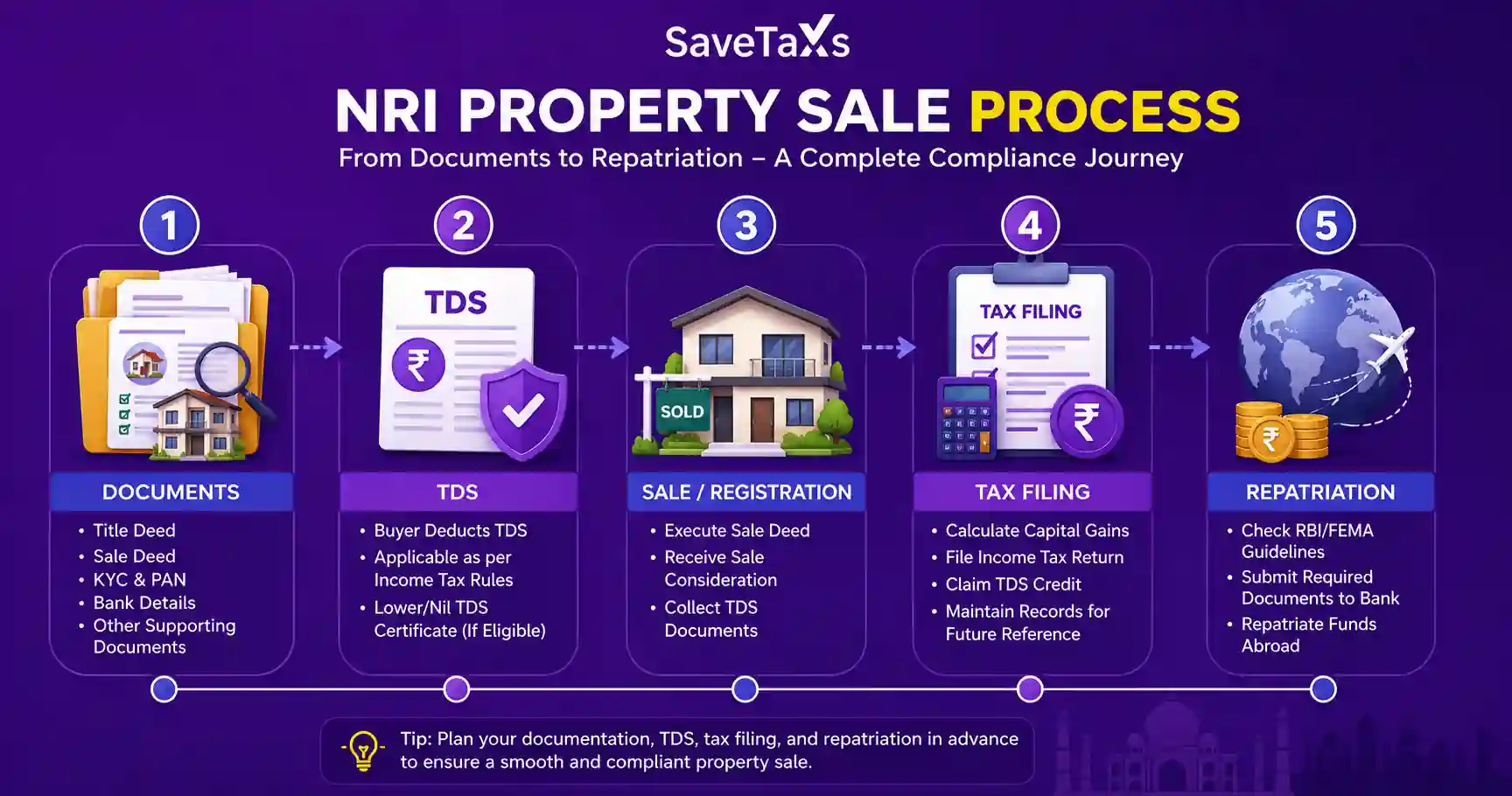
Second, use the official Income Tax Department resources for current forms and tax procedures rather than relying on outdated articles. For transaction-specific calculations, consider having an NRI tax professional review the computation before closing.
The next step is to complete the documentation, TDS, tax, and banking checks before the property sale is finalized.
First, work through this sequence:
Verify your residential status and PAN.
Collect and review ownership and acquisition documents.
Confirm the sale agreement and payment structure.
Determine the applicable NRI TDS process before closing.
Calculate the expected capital gain and tax liability.
Prepare the documents required by your authorised dealer bank.
Complete applicable tax reporting and preserve TDS records.
Confirm repatriation requirements before transferring funds overseas.
Finally, obtain professional advice where the transaction involves inherited property, multiple owners, substantial capital gains, Power of Attorney, unusual acquisition history, or significant overseas remittance.
An NRI property sale checklist helps you coordinate documents, TDS, capital gains, tax reporting, and repatriation requirements before completing an Indian property sale. The most important step is to resolve tax and documentation issues before closing rather than trying to correct them afterward.
Moreover, TDS and final tax liability should be treated separately, while repatriation should be checked with the authorised dealer bank under the applicable RBI/FEMA framework. By preparing your records early and verifying the current rules, you can make the property-sale process more structured and reduce avoidable compliance issues.
This article is for general informational purposes only and does not constitute tax, legal, financial, or investment advice. Laws, regulations, rates, and procedures may change over time and may vary based on individual circumstances.
While SaveTaxs makes reasonable efforts to keep the information accurate and up to date, readers should verify applicable rules with official authorities or consult a qualified professional before making decisions based on this information.
Shubham Jain is the Founder of SaveTaxs and has extensive experience in Indian and NRI taxation. He advises individuals, NRIs, and businesses on tax filing, tax planning, capital gains, DTAA benefits, fund repatriation, and compliance matters. He regularly writes about taxation and related financial topics. His focus is on making complex tax concepts easy to understand. Through his articles, he helps taxpayers stay informed, avoid common mistakes, and stay compliant with Indian tax laws. See Full Bio
Want to read more? Explore Blogs