US Tax Filing and Compliance
How to Calculate the $10,000 FBAR Threshold for Multiple Foreign AccountsHow to Calculate the $10,000 FBAR Threshold for Multiple Foreign Accounts
Written by Shubham Jain

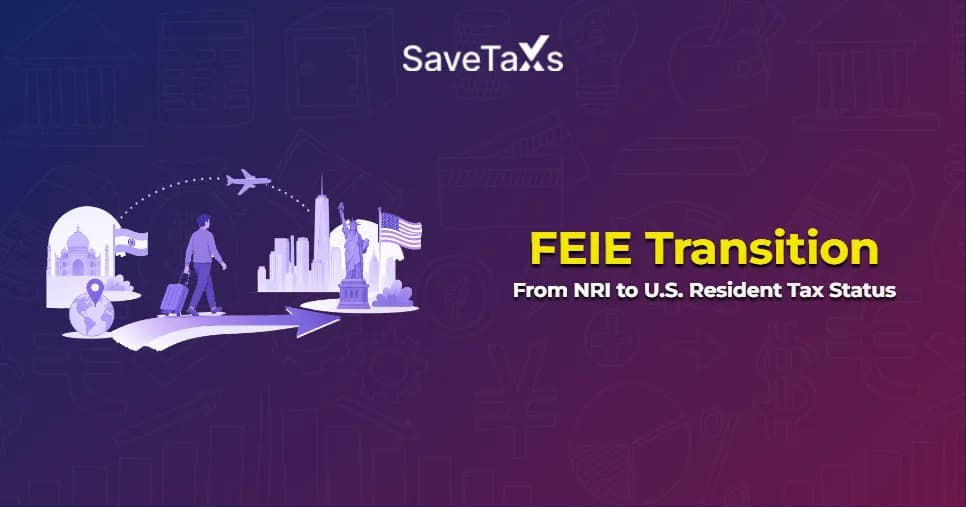
Moving back to the U.S. after working and living in India for several years may change how you calculate and report your taxes there. For instance, while living in India, you depend on the Foreign Earned Income Exclusion (FEIE) to avoid double taxation on your foreign-earned income in the U.S. Here, the question is: after returning to the U.S., do you lose this exclusion?
There is no simple answer to this. The FEIE transition depends on several factors, such as your foreign tax home, foreign earned income, qualifying period, and whether you meet the Physical Presence Test or the Bona Fide Residence Test. Considering this, if you are eligible only for a specific part of the year based on the qualifying days, the exclusion amount may be reduced.
Confused about how the FEIE transition works once you return to the U.S. in detail? This blog answers all your queries about FEIE, how you interact with U.S. tax residency, and what you should consider when filing your tax return. So read on and gather all the information.
When you return to the U.S., the Foreign Earned Income Exclusion does not automatically remove from your foreign earned income. This is because FEIE does not apply based on whether you consider yourself an NRI or live outside the country for most of the year. To claim FEIE, you need to fulfill the following conditions:
You can still claim the FEIE when you return to the US for foreign income during the year you return, as long as you pass any of the mentioned tests. However, the exclusion amount is prorated. Hence, to claim FEIE after you move back to the U.S., you need to review when the qualifying period ends. Confused? Let's understand it with an example.
Suppose that from January to July you lived and worked in India, and in August you permanently moved to the U.S. For that financial year, you can claim the FEIE if you meet the requirements.
This was all about what happens to FEIE when you move back to the U.S. Now, moving forward, let's look at how U.S. tax residency affects the transition.
The year you return to the U.S. after several years of working and living abroad is considered a transition year. You are a U.S. citizen for the whole year. This means you are liable to pay taxes on your global income using Form 1040. However, this does not mean you cannot claim expat benefits for the period you were abroad. This works as two phases within the same tax return:
The IRS defines a "dual-status" taxpayer as a person who was a non-resident alien in the mid-year and became a U.S. citizen in the same year. For instance, someone who became a green card holder during a calendar year. The dual-taxpayer status does not apply to U.S. citizens who have returned from overseas, as they already hold citizenship in that country. This tax status is relevant to U.S. resident aliens who depart or arrive during the year in the U.S.
Considering this, if you are a U.S. citizen who has been living and working in India for several years and now moves to the U.S., then you need to file your standard Form 1040 for the entire year and, to claim FEIE for the qualifying period, you use Form 2555.
Moreover, if you are a green card holder who, before moving abroad, surrendered the card and are now returning to the U.S. on a different immigration status, different rules apply to you.
So, this is how U.S. tax residency affects the transition. Moving further, let's know why having a tax home matters in FEIE.
Your tax home is where you work indefinitely or permanently, not where your family lives. According to the IRS, a tax home is generally the area where your main business place, employment, or post of duty is located. It can be different from where your family lives.
For FEIE purposes, your tax home should be outside the US. Considering this, if your tax home is not located outside the country, even if you pass the physical presence test or the bona fide residence test, you still do not qualify for FEIE. This is why you cannot rely on the number of days you stay outside the country.
For instance, on August 1, you move to Chicago and return in December. During that period, you work for a U.S. employer. You cannot claim FEIE on your August to December salary just because you spent more than 330 days outside the country, since the income you earned originated in the U.S.
So, this is why tax home matters when you claim FEIE. Now, moving forward, let's know whether you can claim FEIE for part of the year when you were outside the U.S.
Yes, you can claim FEIE for part of the year when you were earning and living outside the U.S. According to the IRS, when the qualifying period covers only the part of the year you were outside the U.S., the exclusion amount is adjusted based on the number of your qualifying days. The general calculation is:
*Part-year FEIE limit = Annual FEIE Limit for the year x Qualifying number of days/days in the tax year.
*In case of a leap year, the days in the tax year are stated as 366.
Let's understand the calculation with an example.
For instance, in 2026, your qualifying days are 200. Additionally, the FEIE amount is $132,900. So, the calculation will be as follows:
Part-year FEIE limit = $132,900 x 200/ 365 = $72,822.
Further, the actual exclusion amount is based on your qualifying foreign-earned income. So do not exclude the prorated amount from your global income if it is less than your foreign-earned income.
So, yes, you can claim FEIE for part of the year you live outside the U.S. Now, moving ahead, let's know the difference between the physical presence test and the bona fide residency test.
The table below shows the key difference between the physical presence test and the bona fide residence test:
| Basis | Physical Presence Test | Bona Fide Residence Test |
|---|---|---|
| Time requirement | Complete 330 days in any consecutive 12-month period | Complete financial year (January 1 to December 31) |
| Start date | Can start on any day of any month | Should align with the tax year |
| Allowed trips to the U.S. | During a 12-month period, can stay for a maximum of 35 days in the U.S. | Unlimited trips as long as you maintain your foreign residence |
| Residency Requirement | Freely move between multiple countries | Should have established residency in one country |
| Who can use it | U.S. citizens and resident aliens | U.S. citizens and resident aliens |
| Suitable for | Temporary assignments, corporate expats, digital nomads, and contractors | Permanent moves, retirees abroad, and long-term expats. |
| Qualifying period | Requalify each year by meeting the 330-day requirement | Under a bona fide resident, you can claim FEIE for all time |
| Employment type | Any foreign employment including self-employment | Any foreign employment, including self-employment |
| Disqualification risk | Only at risk if you spend more than 35 days in the U.S. in a 12-month period | Could lose the status if you plan to return to the U.S. |
So, this is how the physical presence test differs from the bona fide residence test. Further, the test you pass depends on your circumstances. Moving forward, let's know what happens to your foreign salary after you return to the U.S.
This depends on where you performed the services and whether your income falls within the FEIE qualifying period. To better understand this, here is a simplified timeline:
| Period | Location | General FEIE Consideration |
|---|---|---|
| January to July | India | The foreign earned income may qualify for FEIE |
| August Onwards | U.S. | Generally, not considered foreign earned income for FEIE purposes |
For instance, if you received income while living in India for services performed there, that income may qualify for FEIE if you meet its requirements. After that, when you return to the U.S. and start working in Chicago, you cannot claim the FEIE for that income because it is part of the U.S.
In most cases, if you fulfill the FEIE requirements when you return to the U.S. with foreign salary, you get an exclusion. Additionally, for a smooth FEIE transition, it is advisable to keep information about your employment dates, compensation records, travel records, and return date when moving to the U.S.
Now, moving ahead, let's know what happens to Form 2555.
After returning to the U.S., if you are still claiming the FEIE for that year's qualifying period, you need to complete Form 2555. This is an IRS form that helps you claim the foreign earned income exclusion on your foreign earned income. It is filed with your Form 1040 or Form 1040X. You need to include the same information on Form 2555 when you file it outside the U.S. These are as follows:
If you are mentioning the physical presence test, you need to mention the number of days and travel dates in the form.
So, if you are returning to the U.S. and claiming the FEIE, you need to complete Form 2555 and attach it to your U.S. tax return. Now, moving further, let's know about Form 1040.
When you return to the U.S., you need to file a tax return using the IRS Form 1040 and pay tax on your global income. Considering this, even if you are claiming the FEIE, you still need to report your foreign earned income in your tax return and claim the exclusion by filing Form 2555.
The IRS strictly stated that excluding your foreign earned income does not mean that you do not mention it in your U.S. tax return. This is an important point to consider:
Report the income in your U.S. tax return→ determine whether your income qualifies for FEIE → calculate the exclusion → correctly claim it using Form 2555.
Here, do not assume that "excluded" means you do not report it in your tax return.
Now, moving forward, let's know whether you can claim the foreign tax credit after returning to the U.S.
With Savetaxs, simply understand your U.S. tax obligations with personalized guidance and file your tax return on time.
Yes, you can claim the foreign tax credit even after returning to the U.S. This is because moving back to the U.S. does not remove your eligibility to claim the FTC. For instance, after returning to the U.S., you still hold income from Indian investments, rental income, or more.
FTC is generally applied to passive income and helps you claim a tax credit when you have already paid taxes in a foreign country on the same income. This helps you reduce your U.S. tax obligations on foreign source income and investments.
Further, from prior years, if you have a foreign tax credit, you can carry it forward for up to 10 years. This is beneficial for your tax return year and the year after, since you can offset the foreign tax credit against your U.S. source income and reduce your tax obligation. Let's better understand this with an example:
For instance, Anjali is a U.S. citizen who has lived and worked in India for several years. Now, on August 1, 2026, she moved to Chicago and started working there. Her transition looks like this:
Here is the important point to consider: Anjali can claim the FEIE on Indian source income only on a partial basis and cannot exclude her full 2026 salary because she has lived overseas for several years.
So, you can claim the foreign tax credit even after returning to the U.S. if you have foreign source income. Moving ahead, let's know the common FEIE transition mistakes you should avoid.
Here are some common FEIE transition mistakes that returning U.S. residents should avoid:
These are common mistakes that returning U.S. residents should avoid when claiming the FEIE. Moving further, let's know what you should do before filing your transition-year return.
Before filing your transition-year return, you should make a timeline containing the following information:
These will help you file your U.S. taxes simply. Additionally, if the facts include treaty positions, self-employment, multiple countries, complicated residency dates, or compensation received after performing services, it is advisable to seek help from a professional tax expert.
Savetaxs helps returning U.S. expats coordinate their final expat tax return, foreign income reporting, and their first-year tax filing as a U.S. resident again.
Lastly, the year you return to the U.S. is often the most complex one of your expat journey. However, moving back to the U.S. after working and living overseas does not automatically remove FEIE eligibility. You can claim FEIE on your foreign source income if you meet its requirements, but instead of the full exclusion amount, you receive only the adjusted amount based on the qualifying period.
Furthermore, if you are having issues claiming the FEIE after returning to the U.S. and need assistance, contact Savetaxs. We have a team of financial experts who can help you claim an exclusion on your foreign-earned income and file your U.S. taxes.
Note: This guide is for information purposes only. The views expressed in this guide are personal and do not constitute the views of Savetaxs. Savetaxs or the author will not be responsible for any direct or indirect loss incurred by the reader for taking any decision based on the information or the contents. It is advisable to consult either a CA, CS, CPA or a professional tax expert from the Savetaxs team, as they are familiar with the current regulations and help you make accurate decisions and maintain accuracy throughout the whole process.
Hatim Dudhiyawala is a Certified Public Accountant (CPA) with SaveTaxs and specializes in Indian and NRI taxation. He advises individuals, NRIs, and businesses on income tax filing, capital gains taxation, DTAA benefits, fund repatriation, and tax compliance. With experience in cross-border tax matters, Hatim helps taxpayers understand complex regulations and make informed decisions. Through his articles, he shares practical insights to help readers stay compliant and manage their tax obligations with confidence. See Full Bio

Want to read more? Explore Blogs
_1787824670298.webp&w=828&q=75)