US Tax Filing and Compliance
Is an S Corporation Worth It? Costs, Tax Benefits and Decision ChecklistIs an S Corporation Worth It? Costs, Tax Benefits and Decision Checklist
Written by Shubham Jain

Missing a deadline is stressful, especially if it is a tax deadline. But what if you previously did not know about it? Many NRIs who become U.S. tax residents do not realize that they may have to report their foreign financial accounts on an FBAR. Generally, a U.S. person must file an FBAR if the aggregate value of reportable foreign financial accounts exceeds $10,000 at any time during the calendar year. FBAR (Foreign Bank and Financial Account Report) is an essential reporting requirement for U.S. citizens and residents who hold foreign financial accounts.
If you missed an FBAR, the appropriate compliance option depends on your complete filing history. Taxpayers with broader non-willful offshore noncompliance may qualify for the Streamlined Filing Compliance Procedures, while a taxpayer who only has a late FBAR should first review the current IRS late-FBAR guidance.
Want to know how it works and how you can file a late FBAR in the U.S.? Read the blog for complete information.
If you have missed the FBAR deadline, first confirm whether you qualify for it or not. Here is how you can do so:
If you are not a U.S. person, do not have any reportable foreign financial accounts or authority over them, or your aggregate reportable foreign account value did not exceed $10,000 at any time during the calendar year, you may not have an FBAR filing obligation. However, specific exceptions can apply, so review the FBAR rules before concluding that no filing is required.
So, if you missed the FBAR deadline, first confirm whether you are eligible to file it, then proceed. Now, moving ahead, let's know which date is considered a late FBAR.
The FBAR is due April 15 following the calendar year being reported. However, FinCEN automatically extends the filing deadline to October 15, so an FBAR filed by October 15 is generally considered timely without requesting an extension. This is because the standard FBAR filing deadline is April 15, and it comes with an automatic extension to October 15. Given this, if you file your FBAR on or between these dates, such as April 17 or October 15, it will not be considered late.
It is vital to know this, as many NRIs get worried when they realize they missed the April 15 deadline, but the reality is that they have time until October 15 to file the FBAR. The "missed FBAR" situations are applicable when you missed the October 15 deadline for the relevant year.
So, if you are filing your FBAR on or between April 15 and October 15, you are not late, and you have no missed FBAR deadline. Moving forward, let's determine which late FBAR compliance option may apply to your situation.
At Savetaxs, we help you file your U.S. taxes correctly on time and help you reduce or eliminate tax penalties.
The late FBAR filing procedures available for late filing depend on your situation. Here is an overview of them:
| Streamlined Filing Compliance Procedures | Who It Is For | Penalty | What to File |
|---|---|---|---|
| Delinquent FBAR Submission (DFSP) | Correctly filed 1040, only missed FBAR | If eligible, zero penalty | Missed FBARs can be filed using the FinCEN BSA e-filing system |
| Streamlined Foreign Offshore (SFOP) | Lived outside the U.S. for 330 days in at least 1 of the last three years | Zero offshore penalty | 3 years amended 1040 tax returns + 6 years FBAR filings + Form 14653 |
| Streamlined Domestic Offshore (SDOP) | Living in the US on an H-1B visa, green card holder, or passed the substantial presence test | 5% of highest aggregate balance | 3 years amended 1040 tax returns + 6 years FBAR filings + Form 14654 |
| Voluntary Disclosure Practice (VDP) | FBAR filing was willful | Higher negotiated penalties | Complete disclosure package with IRS |
Let's know about the late FBAR filing procedures available for these situations.
If you discover that you were required to file an FBAR for a previous year, you should file the delinquent FBAR electronically through FinCEN's BSA E-Filing System as soon as possible. The current IRS guidance does not provide the former Delinquent FBAR Submission Procedures as a separate penalty-free program. If reasonable cause applies, the taxpayer should preserve and present the relevant facts and documentation supporting that position.
** 2026 Update: The IRS no longer lists the former Delinquent FBAR Submission Procedures as a current compliance procedure. The FBAR filing requirement itself has not changed. If you discover a late FBAR, the IRS currently instructs you to file it as soon as possible. Penalty relief may still be available where the facts support reasonable cause, but late filing does not automatically qualify for penalty relief.
SFOP may be available to an eligible U.S. taxpayer who satisfies the IRS non-residency requirements and was physically outside the United States for at least 330 full days in one or more of the most recent three tax years for which the applicable U.S. tax return due date has passed. The offshore penalty for missed FBAR filing is 0%. Although you are still liable to pay back taxes and interest on your unreported foreign income. Indian tax or TDS paid on foreign income may be relevant when determining the U.S. tax and any available foreign tax credit, subject to U.S. tax rules. However, payment of Indian tax does not by itself determine or eliminate the Streamlined offshore penalty. Ensuring your missed FBAR filing was non-willful, using this method, you can file three years of amended Form 1040 / Form 1040X, six years of FBARs, and Form 14653.
SDOP may be available to eligible U.S. taxpayers residing in the United States who satisfy the program's requirements and certify that their failure to report foreign financial assets, income, and required information returns was non-willful. An H-1B visa or green card alone does not determine eligibility. The offshore penalty is 5% of the highest total balance across all unreported foreign financial accounts in a calendar year of the covered period. Under SDOP, you need to complete Form 14654 along with your U.S. tax return and 6 years of FBARs.
Voluntary Disclosure Practice (VDP) is intended for taxpayers whose tax or tax-related noncompliance was willful and may involve criminal exposure. A timely, truthful and complete voluntary disclosure may help resolve the noncompliance and may result in the IRS not recommending criminal prosecution, but it does not automatically guarantee immunity from prosecution.
These are the late FBAR compliance options you can choose from, depending on your situation. Moving ahead, let's know how to file a late FBAR in 2026.
Here is how you can file a late FBAR in 2026:
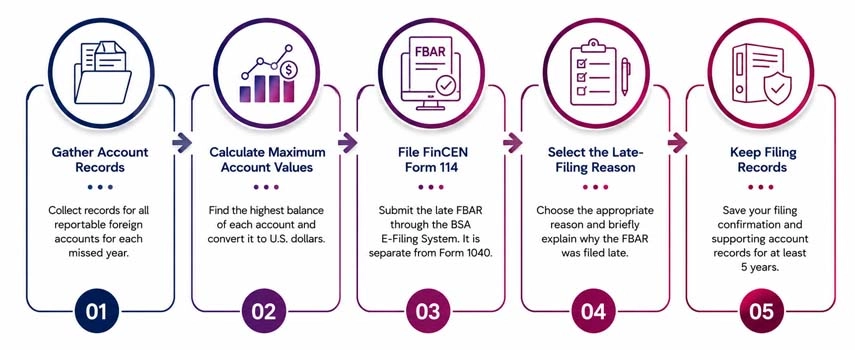
Gather records for all foreign financial accounts that may be reportable for each relevant calendar year, including Indian NRE, NRO, FCNR and brokerage accounts. Review each account under the FBAR rules because reportability depends on the account, ownership or authority, aggregate value and applicable exceptions. Providing a genuine and accurate explanation documents the circumstances that caused the late filing. However, the explanation itself does not guarantee penalty relief. If you are relying on reasonable cause, the IRS evaluates whether the facts and circumstances support that position.
Using your bank statements, find out the highest balance of every financial account during the missed filing years and convert them to U.S. dollars. If you want information about it, read our blog on FBAR exchange rates and maximum account value.
Fill out the FinCEN Form 114 using the BSA e-filing system. The FBAR reporting is separate from your U.S. tax returns. Therefore, you do not need to attach it to Form 1040.
When filing your missed FBAR, you need to choose the appropriate reason according to your situation. The electronic filing system of FinCEN includes a field asking you for the reason for your late or missed FBAR filing, with an option to explain it briefly.
Once you fill out the form, retain the confirmation and supporting financial account records for at least five years. This is because these documents serve as proof if the IRS ever questions you about your late filings.
So, here is how to file a late FBAR in 2026. Now, moving further, let's know what you should write as the reason for a late FBAR filing.
You should mention the actual reason for the late FBAR filing. This field exists so that you can explain your situation and why you missed the deadline. For instance, you can write that you were not aware of the FBAR requirement or learned about it recently when you were checking your foreign financial account.
Providing a genuine and accurate explanation helps document why the FBAR was filed late. However, the explanation itself does not guarantee penalty relief; whether a penalty applies depends on the facts and circumstances, including whether reasonable cause is established.
Further, providing a reasonable cause does not guarantee elimination of your penalty; it depends on a fact-specific determination. There is no specific phrase or checkbox that states guaranteed relief from penalty. Here, what matters is what you do when you find out about your late FBAR filing, how this happened, and what steps you took to overcome it. Considering this, if your situation is complex, it is advisable to seek help from a cross-border tax expert before filing the FBAR.
So, mention the actual reason with facts describing why you filed the FBAR late. Moving forward, let's know which method you should opt for if you missed your FBAR filing and failed to report your foreign income on your U.S. tax returns.
If you missed your FBAR and also failed to report foreign income or other required foreign information, the Streamlined Filing Compliance Procedures may be available if your conduct was non-willful and you satisfy the applicable SFOP or SDOP eligibility requirements. It is a formal IRS program designed to help you with your missed FBAR filings.
Considering this, if you genuinely believe that the reason for missing FBAR filings was misunderstanding, not your willful choice, you can opt for this option.
Depending on the situation and location, these are of two types: SFOP and SDOP. Want to know more about it and how you can apply for this process? Read our blog on Streamlined Filing Compliance Procedures for NRIs: SFOP vs SDOP Explained and gather all the information.
Now, moving ahead, let's know how many years of late FBARs you may need to file.
This depends on the late FBAR filing method you choose based on your situation. Considering this:
These are two different processes with different requirements and scopes. The missed FBAR filing of the six-year rule does not apply to every situation. So before choosing a method, review your complete foreign account history. Now, moving further, can you face penalties for filing FBAR late?
The penalty for filing FBAR late depends on whether it was willful or non-willful. Considering this, here is how it works:
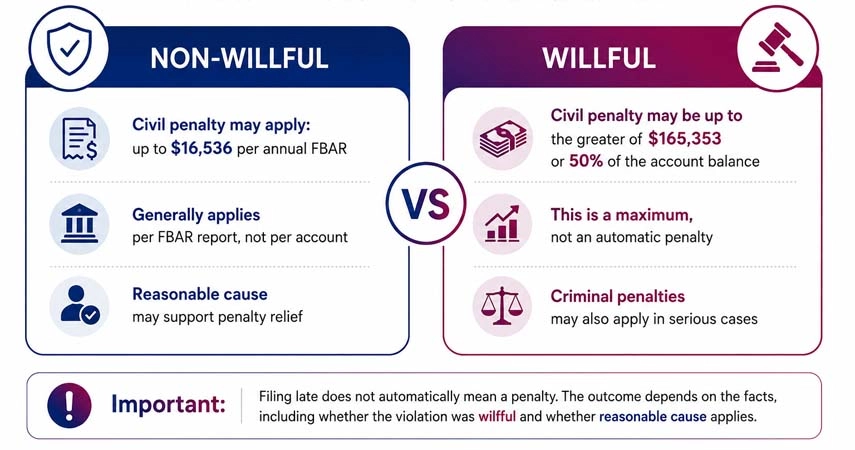
Further, late FBAR filing does not automatically guarantee a penalty or no penalty; it depends on your situation, including whether you act before getting a notice from the IRS. Looking for a complete breakdown of how the willful and non-willful distinction works and penalty amounts? Read our blog on FBAR penalties and gather all the information.
Moving ahead, let's know the difference between a late FBAR and an amended FBAR.
The table below showcases the difference between a late FBAR and an amended FBAR:
| Basis | Late FBAR | Amended FBAR |
|---|---|---|
| Underlying Issue | FBAR was never filed | Filed FBAR contains errors or it was incomplete |
| What you do | File the missing FBAR | File the complete and correct FBAR and mark it as "amended" |
| Common trigger | Not knowing about the FBAR filing requirement | Realizing you mentioned the wrong amount or left off an account |
When filing an amended FBAR, clearly mention "amended" at the top. This states that you make the correction to your filed FBAR that contains errors or incomplete information. Additionally, if you filed an FBAR before but unknowingly missed reporting of your one or two foreign financial accounts, instead of a late FBAR, opt for an amended FBAR.
Now, moving ahead, let's know the common late FBAR mistakes NRIs should avoid.
Here are the common late FBAR mistakes that NRIs should avoid:
These are the common late FBAR mistakes NRIs should avoid. Moving further, let's understand late FBAR filing with an example.
Priya recently became a green card holder. While reviewing her tax returns and foreign financial accounts, she realized she had missed FBAR filings for the past 3 years. During this period, the combined balance of her NRE and NRO accounts exceeded $10,000. However, she had correctly reported this information on her tax returns and paid the taxes due on it.
Here, Priya should review her facts and filing history and file the three delinquent FBARs electronically as soon as possible. Because she reported the foreign income correctly and acted before receiving an IRS notice, she should also evaluate whether reasonable cause supports penalty relief and whether any other current IRS compliance option applies. The appropriate treatment depends on her complete facts and circumstances.
To file her missed FBARs for the past three years, she gathered account statements of her NRE and NRO accounts for all three years, determined the highest value for each year, and used the BSA e-filing system to electronically file the FBAR. Additionally, in her form, she stated the reason for the late filing, honestly explaining that she was unaware that, with her tax return, she also needed to report her foreign account on the FBAR.
The above example of Priya shows a favorable fact pattern and is meant to describe the information mentioned in the blog. Further, the consequences of missing an FBAR filing for NRIs may vary depending on the circumstances.
With Savetaxs, catch up on your missed FBAR filings without facing IRS penalties.
Lastly, filing late FBAR and missing the FBAR deadline are among the most common and fixable mistakes for NRIs. Depending on your facts, you may need to file delinquent FBARs through FinCEN's BSA E-Filing System and separately evaluate whether reasonable cause or a current IRS compliance procedure applies. Eligible taxpayers with broader non-willful offshore noncompliance may consider the Streamlined Filing Compliance Procedures, while taxpayers with potential willful or criminal exposure should obtain appropriate professional advice before making a disclosure. However, the non-compliance should be non-willful, and you should act before getting a notice from the IRS.
Further, if you need any help in catching up with your missed FBAR deadline, connect with Savetaxs. We have a team of cross-border experts who help NRIs and U.S. tax expats like you with late foreign bank account reporting and multiple years of missed FBAR filings. So connect with us, and resolve your late FBAR filing mistake.
This article is for general informational purposes only and does not constitute tax, legal, financial, or investment advice. Laws, regulations, rates, and procedures may change over time and may vary based on individual circumstances.
While SaveTaxs makes reasonable efforts to keep the information accurate and up to date, readers should verify applicable rules with official authorities or consult a qualified professional before making decisions based on this information.
Shubham Jain is the Founder of SaveTaxs and has extensive experience in Indian and NRI taxation. He advises individuals, NRIs, and businesses on tax filing, tax planning, capital gains, DTAA benefits, fund repatriation, and compliance matters. He regularly writes about taxation and related financial topics. His focus is on making complex tax concepts easy to understand. Through his articles, he helps taxpayers stay informed, avoid common mistakes, and stay compliant with Indian tax laws. See Full Bio

Want to read more? Explore Blogs