

US Tax Filing and Compliance
How to Report Indian Rental Property on Schedule EHow to Report Indian Rental Property on Schedule E
Written by Hatim Dudhiyawala

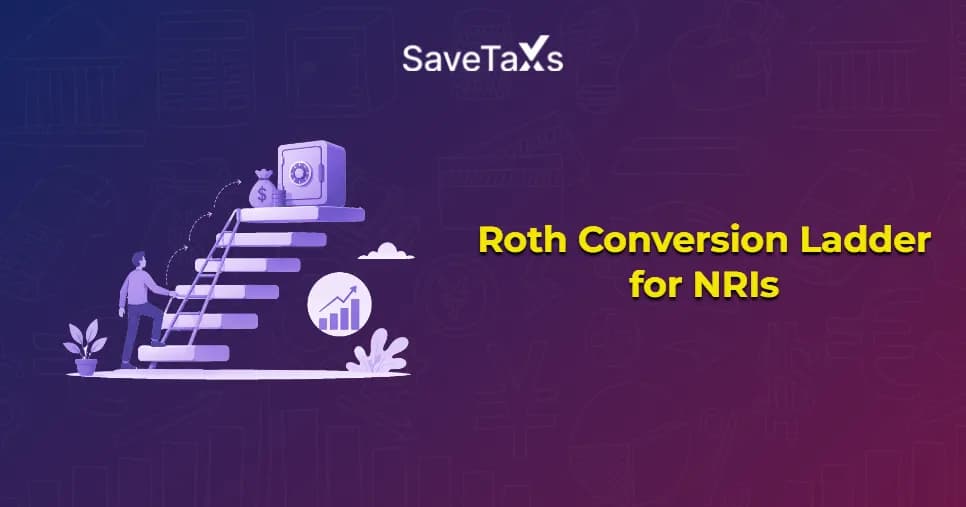
If you are planning to retire earlier, a Roth IRA conversion ladder could be a big help. It lets you potentially access converted amounts from your tax-deferred retirement account before you reach age 59½, subject to the applicable Roth IRA distribution rules and exceptions to the 10% additional tax. In the Roth conversion ladder, you move your money from tax-deferred retirement accounts, such as a 401(k) or traditional IRA, into a Roth IRA.
This conversion is slightly different from standard Roth IRA conversions, as here you can convert multiple times over a span of several years. If done correctly, the converted funds may be withdrawn without the 10% additional tax once the applicable five-year conversion period has been satisfied, although the rules for qualified Roth IRA distributions are separate.
Specifically, for NRIs living and working in the United States, this strategy needs to be a bit more careful because the U.S. tax treatment and the Indian tax treatment might not always line up. However, the key point of concern here is that the Roth conversion can create taxable income in the United States in the year of conversion. Later, the withdrawal may receive different treatment depending on the type of amount and whether the applicable five-year rule is satisfied.
The basic concept of the Roth Conversion Ladder is a retirement income strategy in which you, step by step, move money from a Traditional IRA to a Roth IRA over multiple years.
The Traditional IRA in the United States is a retirement account in which the contributions and earnings are often treated on a tax-deferred basis. A Roth IRA works in a different manner because qualified withdrawals are generally tax-free for U.S. federal income tax purposes.
Here, the concept is simple:
Doing so creates a significant series of conversion amounts that become available at varied times.
The entire strategy here is related to the early retirement phase because it provides access to the savings set aside for retirement before you actually hit the age of retirement, subject to the applicable Roth IRA distribution rules.
However, here the ladder of conversion is not automatically tax-free. Meaning the conversion itself produces taxable income on the taxable portion, and the early distributions can incur the 10% additional tax under certain circumstances.
Savetaxs helps NRIs file their US Taxes with complete guidance and help.
The following is the process of how the Roth Conversion Ladder for NRIs and individuals with India–U.S. tax connections works:
The very first step in the process is to transfer a portion of the traditional IRA balance to a Roth IRA.
Further, the IRS allows different methods for completing a Roth conversion or rollover, depending on the retirement account involved, including trustee-to-trustee transfers and other permitted rollover methods.
Assume an Indian citizen who is a U.S. tax resident has $100,000 in his traditional IRA and decides to convert about $20,000.
The $20,000 conversion does not necessarily mean that the entire $100,000 traditional IRA must be converted. The NRI is also allowed to convert the amount they want, subject to the applicable tax and retirement-plan rules.
The taxable portion of the conversion generally becomes part of the gross income for the year of conversion when the Traditional IRA amount would otherwise have been taxable. Form 8606 is generally used to report Roth conversions and determine the taxable amount when applicable.
This is why many NRIs generally use the smaller annual conversion rather than converting a large retirement balance into the Roth IRA in a single year.
The Roth conversion ladder executes by separating the conversions over multiple years.
For instance:
| Year | Conversion | Intended Withdrawal |
|---|---|---|
| Year 1 | $20,000 | After the applicable five-year period for the conversion |
| Year 2 | $20,000 | After the applicable five-year period for the conversion |
| Year 3 | $20,000 | After the applicable five-year period for the conversion |
| Year 4 | $20,000 | After the applicable five-year period for the conversion |
| Year 5 | $20,000 | After the applicable five-year period for the conversion |
For every conversion, you have a separate five-year period. The period is for evaluating whether the 10% additional tax may apply to certain early distributions attributable to that conversion.
The five-year tax period will start on the first day of the calendar year, which is January 1 of the tax year in which the conversion is made.
This further means that the conversion made during the particular tax year does not require you to count five years from the exact date on which the money was transferred.
For example, a conversion made during 2026 generally has a conversion five-year period beginning January 1, 2026, rather than beginning on the actual transfer date.
Generally, the waiting period is one of the most important segments of the strategy. However, here a very common mistake is to think that every withdrawal you make with respect to the Roth IRA needs to wait for five years. This is not the right concept to think about, as the IRS has a different regulatory framework for:
The five-year rule for the conversion is applicable or relevant to the 10% additional tax imposed on early distributions. The five-year rule for qualified Roth IRA distributions has different requirements. Hence, an NRI must track each of their conversions separately.
Once the applicable requirements are fulfilled, the individual can use the converted amounts as part of their retirement income strategy.
Further, the specific set of ordering rules is followed by the Roth IRA distributions. Generally, regular contributions are treated as distributed first, followed by conversion and rollover contributions on a first-in, first-out basis, and then earnings. Within conversion and rollover amounts, the taxable portion is generally treated as distributed before the nontaxable portion.
This order matters when an NRI takes money out before the Roth IRA distributes it in a qualified manner. Hence, this is not sufficient to use as the total Roth IRA balance. However, here, the history of conversions and contributions also matters.
The very first question to ask is: "Is the conversion taxable?"
Well, for U.S. tax purposes, converting from a Traditional IRA to a Roth IRA makes the untaxed portion taxable in the conversion year. Further, the IRS states that the Roth conversion will result in taxes being applicable on the untaxed amount in the Traditional IRA.
Let us understand why the conversion year matters with an example:
Assume that an NRI converts $25,000 of the untaxed Traditional IRA funds into the Roth IRA.
The $25,000 can increase the taxable income for the tax year in the United States.
This increase can impact the overall tax liability of the person in the United States.
For this very reason, the amount of the conversion each year must be considered alongside the other income for that year.
If, during the applicable five-year period, the converted amount is withdrawn, the additional 10% tax may apply to the taxable portion of that conversion, unless an exception applies.
This is entirely different from ordinary income tax. Henceforth, as an NRI, you must not assume that paying the applicable tax on the original conversion will automatically make every withdrawal after that penalty-free.
There are two different five-year concepts that are particularly important when planning a Roth conversion ladder.
These rules can overlap, but they answer different tax questions.
The Roth conversion ladder and the direct Traditional IRA withdrawals are not the same strategy.
| Factor | Roth Conversion Ladder | Traditional IRA Withdrawal |
|---|---|---|
| The Initial action | Convert the funds to a Roth IRA | Withdraw funds directly |
| US tax on the initial transaction | The taxable segment of the conversion is generally included in income | The taxable segment is generally included in income |
| Five-year conversion tracking | Yes | Not applicable |
| Early distribution considerations | May apply to the converted amounts | May apply to the early withdrawals |
| Planning approach | Spread conversions over several years | Take the withdrawals when needed |
| Potential use | Early retirement income planning | Direct retirement income |
The distribution of a Traditional IRA is generally treated as ordinary income to the extent it is taxable; the early withdrawal is taxable and may also be subject to the 10% additional tax unless an exception applies.
The conversion ladder is used to move the money into the Roth IRA first, then to build a planned trail of withdrawals in the future.
This makes the overall strategy a bit more complicated, but it may provide better flexibility for someone planning early retirement.
A Roth conversion ladder can be useful for NRIs planning early retirement, but it also requires careful tax and retirement planning.
Overall, a Roth conversion ladder can offer flexibility for early retirement, but NRIs should evaluate the U.S. tax cost, withdrawal timing, Indian tax implications, and expected residential status before using the strategy.
With respect to the India-US tax consideration for Roth conversions, the NRI situation becomes more complicated.
The United States tax treatment of a Roth IRA conversion is established under United States rules. However, an NRI generally has Indian tax obligations depending on their residential status and the nature of their income.
The India-U.S. tax treaty includes provisions on annuities and pensions. Article 20 addresses private pensions and annuities, but a Roth IRA conversion should not automatically be treated as a conventional pension or annuity payment.
Although a Roth IRA conversion is generally not the same as receiving a conventional pension annuity, the treaty provisions and Indian domestic tax rules need to be evaluated based on the individual's specific circumstances.
Hence, you must not assume that the pension and annuity provisions will automatically make a Roth conversion tax-free in India.
For NRIs, the Indian tax treatment may depend on their residential status, the nature and timing of the transaction, and the applicable provisions of Indian law and the India-U.S. tax treaty.
Another important question that arises in the planning phase is: what happens when an NRI becomes an Indian tax resident?
As an NRI, if you return to India and become an Indian tax resident, the Indian reporting and taxation position may change.
Under the current guidance of the Income Tax Department, the Schedule FA is used to report foreign assets and foreign income, while the current ITR-2 guidance states that the Schedule FA need not be filed by a non-resident or an RNOR.
This simply means that the Indian residential status will affect reporting and analysis.
For a person returning to India with U.S. retirement accounts, it is important to review the accounts before assuming that the U.S. tax treatment will produce the same result in India.
Assume that an Indian citizen who works in the United States every year accumulates a retirement account of around $150,000 in a Traditional IRA.
The person then returns to India but plans to keep the U.S. retirement account. Further, he was considering a Roth IRA conversion ladder for NRIs to fund his early retirement.
Now, instead of converting the entire $150,000 at once, he plans to convert a segment each year. However, the impact of U.S. taxation must be determined for each conversion year.
After returning to India, the NRI also needs to analyze their residential status in India and then understand how Indian taxation will treat the relevant retirement account and any income arising from it.
If the NRI becomes a resident of India, the reporting of his foreign assets may also become relevant. Under the current guidance of the Income Tax Department, there is specific guidance for foreign asset reporting via Schedule FA for applicable residents.
An essential point here is that the retirement strategy must be planned well before the cross-border movement, not only for the person becoming an Indian resident.
Our experts will provide end-to-end foolproof assistance on how Roth Conversion for NRIs works.
A Roth conversion ladder is quite sensible for NRIs who are having:
It tends to be less suitable for the person who is close to retirement, expects to move between the countries frequently, or has a complex retirement account history.
The decisions also need to take into account other income sources, expected tax rates, the timeline for the resources, changes in residence, and the types of retirement accounts involved.
When the NRIs are in the procedures, the question is not simply "Can I use a Roth conversion ladder?"
The better question here is:
"Will each conversion and the withdrawals be taxed in both countries based on where I am a tax resident at each stage?"
And this is where cross-border tax advice becomes particularly useful.
Savetaxs is one of those professionals who provide expert assistance and help you with your Roth Conversion Ladder for NRIs, NRI retirement planning, management of foreign retirement accounts, and more.
Connect with us as we serve our clients 24/7 across all time zones.
This article is for general informational purposes only and does not constitute tax, legal, financial, or investment advice. Laws, regulations, rates, and procedures may change over time and may vary based on individual circumstances.
While SaveTaxs makes reasonable efforts to keep the information accurate and up to date, readers should verify applicable rules with official authorities or consult a qualified professional before making decisions based on this information.
Shubham Jain is the Founder of SaveTaxs and has extensive experience in Indian and NRI taxation. He advises individuals, NRIs, and businesses on tax filing, tax planning, capital gains, DTAA benefits, fund repatriation, and compliance matters. He regularly writes about taxation and related financial topics. His focus is on making complex tax concepts easy to understand. Through his articles, he helps taxpayers stay informed, avoid common mistakes, and stay compliant with Indian tax laws. See Full Bio

Want to read more? Explore Blogs

_1788419836913.webp&w=828&q=75)
_1788418477564.webp&w=828&q=75)