US Tax Forms
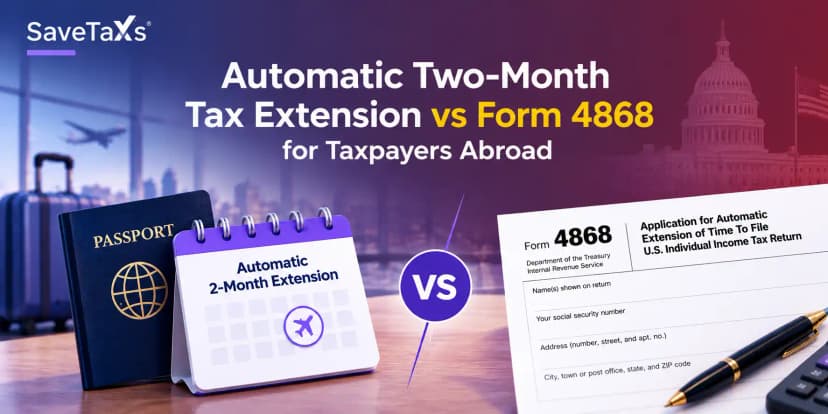
Automatic Two-Month Tax Extension vs Form 4868 for Taxpayers AbroadAutomatic Two-Month Tax Extension vs Form 4868 for Taxpayers Abroad
Written by Vipul Jain
U.S. citizens and resident aliens who move abroad midyear often face unusual tax situations. To reduce their U.S. tax obligations, they may want to claim the foreign earned income exclusion (FEIE), but they may not yet meet the requirements of the bona fide residence test or physical presence test. In this complicated situation, IRS Form 2350 comes to the rescue.
This form gives eligible U.S. citizens and resident aliens living overseas additional time to meet the physical presence test or bona fide residence test to qualify for the FEIE and certain foreign housing benefits. The extension generally runs up to 30 days after the date you expect to meet the physical presence test or the bona fide residence test.
Want to know more about IRS Form 2350? Then you are on the right page. Read the blog and know everything about this form.
IRS Form 2350 is an application for a time extension to file a U.S. federal tax return. It is a specialized IRS extension for U.S. taxpayers living abroad who need additional time to meet the Foreign Earned Income Exclusion (FEIE) requirements.
This form is specifically designed for U.S. expats facing a tax-year mismatch while living overseas. Generally, their tax return due date is June; however, until then, they do not qualify for the FEIE. Without this IRS form, you must choose between filing without the FEIE exclusion and paying more tax, or filing late and paying IRS penalties.
Additionally, unlike IRS Form 4868, which generally provides up to six months of additional time from the original April deadline to file your U.S. tax return, Form 2350 extends the filing deadline based on when you meet your FEIE requirements. It can extend the deadline to October, November, or even the following year.
This was all about IRS Form 2350. Moving ahead, let's determine who should file this form.
Savetaxs provides personalized guidance based on your tax situation and files your return on time with complete accuracy.
You should file Form 2350 only if you meet all the following requirements:
| Requirement | What It Means |
|---|---|
| You are a U.S. citizen, or resident alien | You are a U.S. citizen or resident alien for U.S. federal tax purposes |
| You expect to meet either the physical presence test or the bona fide residence test | You expect to qualify for the relevant test |
| You expect to qualify for the relevant test after your return is due | You need additional time because you will meet the test after your return is due |
| You need the extension to meet the relevant residency test | You need the extension to meet the applicable test |
| You have a tax home overseas | It should remain in a foreign country or countries throughout the qualifying period |
This form is not for someone who needs additional time to gather tax documents or complete a complicated U.S. tax return.
For instance, Mr. A moved to Singapore on July 1, 2025. To claim the FEIE exclusion, he opted to meet the physical presence test requirements (330 days). His first full qualifying day is July 2, 2025. Under the Form 2350 instructions, he would generally request an extension date 12 months and 30 days from his first full day in the foreign country, which would be August 1, 2026. He filled out Form 2350 to request an extension until August 1, 2026, to meet the physical presence test and claim the FEIE exclusion.
So, this was all about who should file IRS Form 2350. Moving further, let's know about the due date of the form.
The Form 2350 due date is on or before the applicable deadline of your Form 1040 or Form 1040-SR. Confused? Let's better understand this with an example. For a 2025 calendar year, you filed the tax return in 2026. So, the Form 2350 due date will be as follows:
| Your Situation | Form 2350 Deadline |
|---|---|
| Filing tax returns on the original date | April 15, 2026 |
| Qualify for the automatic two-month extension while living overseas | June 15, 2026 |
| Military, disaster, or combat-zone relief | Under the applicable relief, you get the new deadline |
In simple words, the Form 2350 deadline is the same as your tax filing deadline. Also, don't wait until the last day to file this form. Filing out the form early provides you time to prepare and submit your tax return in case the IRS does not approve your extension request.
Now, moving forward, let's look at how long the Form 2350 extension lasts.
IRS Form 2350 doesn't give every applicant the same fixed deadline. Generally, the Form 2350 extension runs until 30 days after the date you expect to meet the physical presence test or bona fide residence test. Let's better understand this with examples.
In simple terms, Form 2350 generally gives you additional time based on the date you expect to meet the applicable qualifying test. Moving ahead, let us know how to fill out this form.
You can file Form 2350 electronically through tax preparation software that supports the form or through an authorized IRS e-file provider. Follow the steps below to fill out Form 2350 electronically:
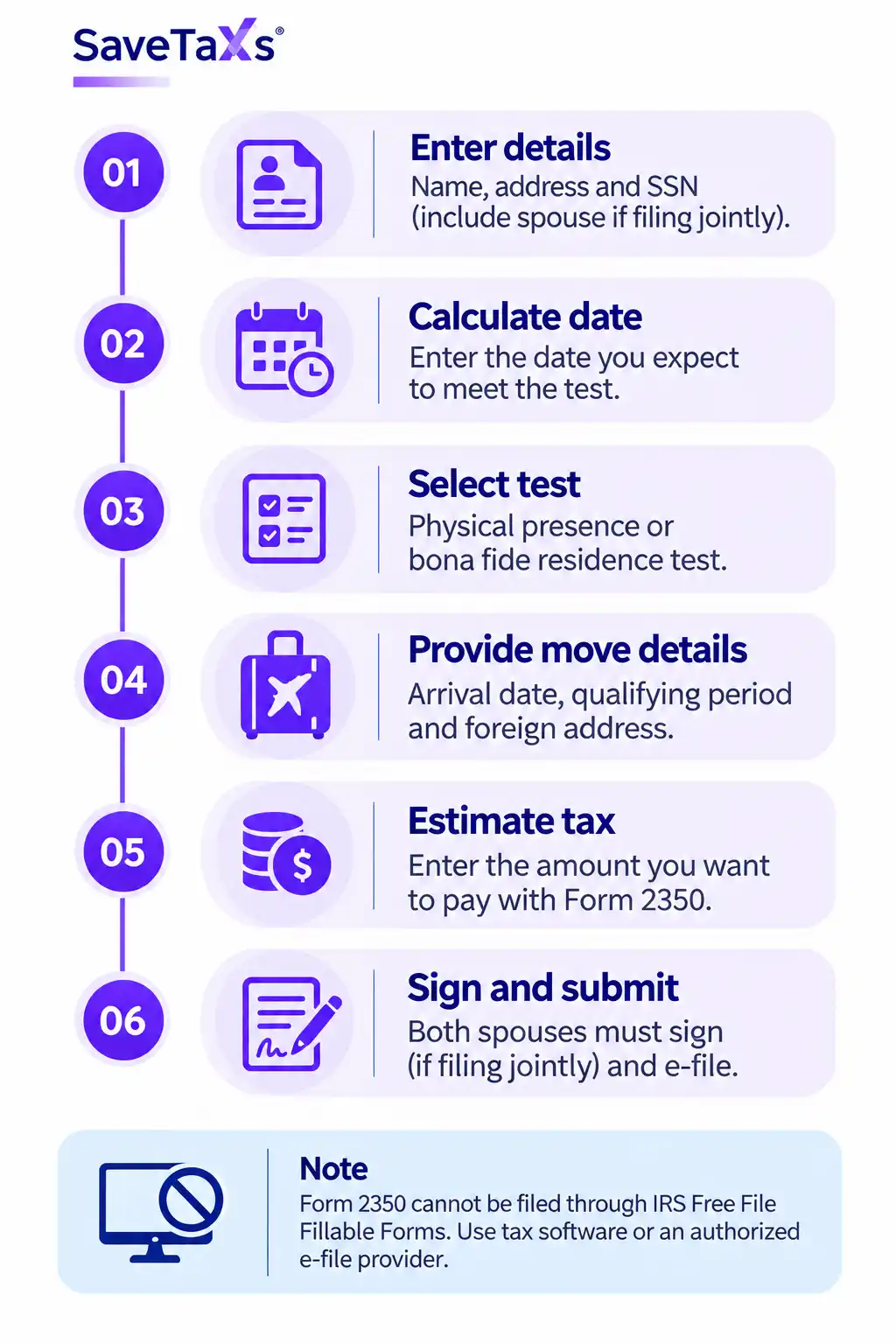
Enter your name, address, and Social Security number. If you file your taxes jointly, include the information of your spouse in the same way as you mention in your tax return.
Mention the calculated date under the form's instructions. This is generally based on the date you expect to meet the applicable physical presence or bona fide residence test.
State whether you expect to qualify under:
You need to mention the following information in your IRS Form 2350:
Determine the amount of income tax you want to pay with Form 2350 and enter it on line 5.
When you file the form jointly, you and your spouse both need to sign the form. Submit Form 2350 electronically using the chosen option.
If you file Form 2350 electronically, you must first execute Form 8878, IRS e-file Signature Authorization, to authorize the electronic return originator to sign Form 2350 using your PIN.
Additionally, IRS Free File Fillable Forms does not support Form 2350. Therefore, don't confuse this with your e-file Form 2350. It is advisable to check the current Form 2350 and instructions before filing.
This is how you can fill out Form 2350 electronically. Moving further, let's know whether this form extends the tax-payment deadline.
No, IRS Form 2350 does not extend the tax-payment deadline; it only extends the time to file your US tax return for a specific purpose. As a result, interest on unpaid income taxes starts accruing from the original tax filing date (April 15), even if you qualify for a two-month automatic tax extension.
Additionally, you may face a penalty for unpaid taxes if tax remains unpaid after the applicable payment deadline. If you qualify for the automatic two-month overseas extension, the late-payment penalty generally begins after June 15, although interest continues to accrue from April 15. Before filing Form 2350, you should review your tax obligation and pay as much tax as possible by the relevant deadline. The current Form 2350 allows you to fill out the form electronically and make the payment online at the same time.
When you file your eventual tax return, the payment you submitted with Form 2350 should be entered on Schedule 3 (Form 1040), line 10.
So, Form 2350 does not extend your payment deadline; it only extends your filing deadline. Moving forward, let us know what happens after you fill out this form.
Once the IRS approves your Form 2350, you can file your US federal tax return at any point before your extended deadline. Considering this, when you file your US taxes, include the following things:
Further, if you meet both the qualification tests, use the test you actually meet to claim the exclusion. However, if the new test provides a later qualifying date than the approved IRS date, you need to request a new extension.
If the IRS rejects your extension request, you may get a 45-day grace period. The approval and rejection states the applicable treatment. Additionally, if unexpected events prevent you from meeting any of the residence tests, file your taxes as soon as possible. You cannot claim a tax exclusion that you do not meet. This is because outstanding tax may continue to accumulate interest after you miss the regular payment deadline.
This is what happens after you fill out Form 2350. Now, moving ahead, let's look at the common mistakes you should avoid when filling out this form.
At Savetaxs, our tax experts help you determine whether Form 2350 fits your situation and assist you with your US tax obligations.
You should avoid the following mistakes when filing Form 2350:
So, when filing Form 2350, avoid these mistakes and prevent your application from being rejected.
Lastly, filing IRS Form 2350 needs proper planning and calculation. The hard part isn't filing the form; it's choosing the right qualifying period, confirming you have a tax home overseas, and determining your tax obligation before you claim the exclusion. A minor mistake in day calculation can cost you thousands.
At Savetaxs, we help you determine, based on your situation, whether you need to file Form 2350 or Form 4868, calculate the date you qualify, and prepare the tax extension with your tax return. So connect with us and stay compliant with US taxes without any issues.
This article is for general informational purposes only and does not constitute tax, legal, financial, or investment advice. Laws, regulations, rates, and procedures may change over time and may vary based on individual circumstances.
While SaveTaxs makes reasonable efforts to keep the information accurate and up to date, readers should verify applicable rules with official authorities or consult a qualified professional before making decisions based on this information.
Hatim Dudhiyawala is a Certified Public Accountant (CPA) with SaveTaxs and specializes in Indian and NRI taxation. He advises individuals, NRIs, and businesses on income tax filing, capital gains taxation, DTAA benefits, fund repatriation, and tax compliance. With experience in cross-border tax matters, Hatim helps taxpayers understand complex regulations and make informed decisions. Through his articles, he shares practical insights to help readers stay compliant and manage their tax obligations with confidence. See Full Bio

Want to read more? Explore Blogs