
IRS Form 1040, officially called the U.S. Individual Income Tax Return, is the main federal income tax return used by individual taxpayers in the United States. It is used to report income, claim eligible deductions and credits, calculate federal income tax, and determine whether you owe additional tax or are entitled to a refund.
For Indians and NRIs with U.S. tax connections, one point is particularly important: being an NRI under Indian tax law does not automatically mean you should file Form 1040-NR in the United States. Your U.S. tax status must be determined separately.
This guide explains what Form 1040 is, who generally files it, what information it contains, the schedules that may accompany it, and the filing deadline.
- IRS Form 1040 is the main annual U.S. individual federal income tax return.
- U.S. citizens and U.S. resident aliens generally use Form 1040 when required to file.
- Form 1040-SR is an optional alternative for taxpayers age 65 or older.
- A nonresident alien generally uses Form 1040-NR when required to file instead of Form 1040.
- Form 1040 reports income, deductions, tax, credits, payments, and the resulting refund or balance due.
- Additional schedules may be required depending on the taxpayer's income and circumstances.
- For 2025 calendar-year returns, the regular Form 1040 filing deadline is April 15, 2026. Certain U.S. citizens and resident aliens living abroad may qualify for an automatic two-month extension to file and pay, generally until June 15, 2026. Interest may apply to unpaid tax from the original April 15 deadline.
What Is IRS Form 1040?
Form 1040 is the federal individual income tax return used by U.S. taxpayers to report their annual income and calculate their federal income tax liability.
The form brings together information about your income, deductions, tax, credits, withholding, estimated tax payments, and other applicable amounts.
For example, depending on your circumstances, your return may include:
- Wages and salary
- Interest and dividends
- Retirement income
- Capital gains or losses
- Business income
- Rental income
- Adjustments to income
- Standard or itemized deductions
- Tax credits
- Federal income tax already withheld
After these items and any required schedules are completed, Form 1040 determines whether you have additional federal tax to pay or are entitled to a refund.
Who Needs to File Form 1040?
Not every person has the same federal tax-return filing requirement.
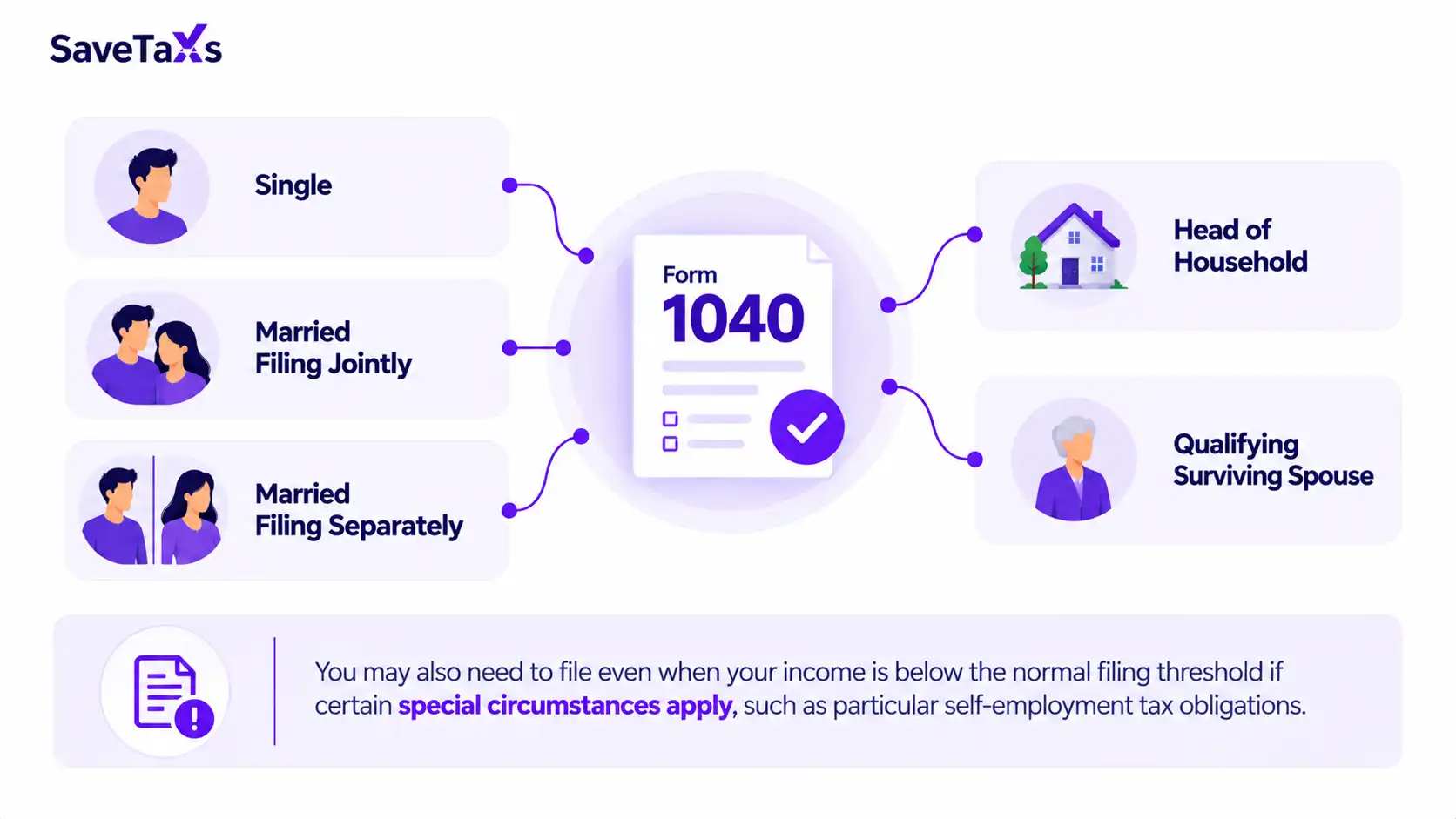
Whether you must file generally depends on factors such as your filing status, age, gross income, and whether special filing requirements apply.
Common filing statuses include:
- Single
- Married Filing Jointly
- Married Filing Separately
- Head of Household
- Qualifying Surviving Spouse
You may also need to file even when your income is below the normal filing threshold if certain special circumstances apply, such as particular self-employment tax obligations.
What About NRIs and Indians in the U.S.?
For NRIs, Indian tax residency and U.S. tax residency are determined under different rules.
Your status as a non-resident under Indian income-tax law does not determine your U.S. tax residency.
For U.S. federal tax purposes, an Indian citizen may qualify as a U.S. resident alien under U.S. tax-residency rules and therefore file Form 1040. A person who remains a nonresident alien for U.S. tax purposes may instead need Form 1040-NR.
Therefore, determine your U.S. tax status first rather than choosing between Form 1040 and Form 1040-NR solely on the basis of your Indian NRI status.
Form 1040 vs Form 1040-SR vs Form 1040-NR
These forms serve different taxpayers.
| Form | Generally used by |
|---|---|
| Form 1040 | U.S. citizens and resident aliens required to file an individual federal income tax return |
| Form 1040-SR | Optional alternative to Form 1040 for taxpayers age 65 or older |
| Form 1040-NR | Nonresident aliens required to file a U.S. income tax return |
The IRS states that Form 1040-SR is an optional alternative to Form 1040 for taxpayers who are 65 or older, and it uses the same schedules and instructions as Form 1040.
Form 1040-NR is different. It is intended for applicable nonresident aliens and has its own filing requirements and instructions.
Example: An Indian citizen working in the U.S. who meets the U.S. tax-residency requirements may need Form 1040 even though they remain an NRI under Indian law. Another Indian citizen who is a nonresident alien for U.S. tax purposes may need Form 1040-NR instead.
The detailed rules for Form 1040-NR should be considered separately when determining whether you qualify as a nonresident alien.
What Information Is Reported on Form 1040?
Form 1040 combines the main information required to calculate your individual U.S. federal income tax.
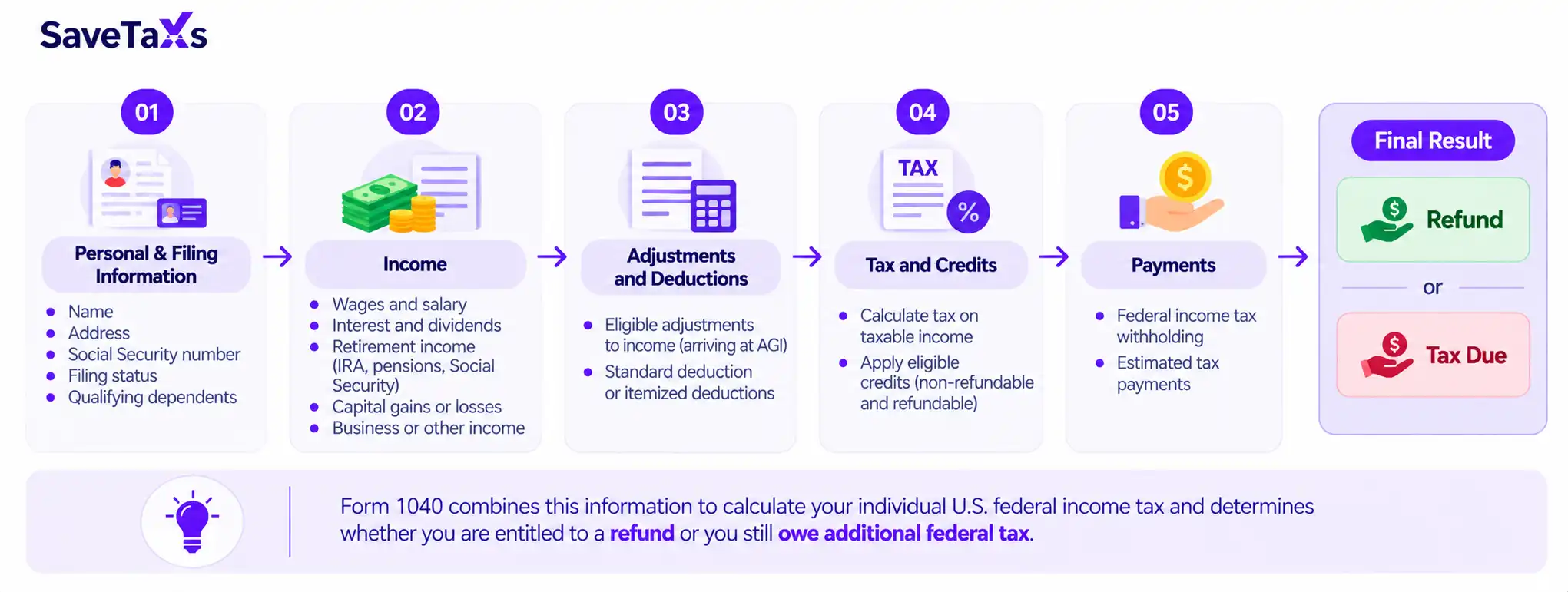
Personal and Filing Information
You generally provide identifying information such as your name, address, Social Security number, filing status, and information about qualifying dependents.
Income
Different types of income can flow into Form 1040 directly or through supporting schedules.
Depending on your circumstances, this can include wages, interest, dividends, IRA distributions, pensions, Social Security benefits, capital gains, and business or other income.
Adjustments and Deductions
Eligible adjustments can reduce income in arriving at adjusted gross income (AGI).
You then generally claim either the applicable standard deduction or itemized deductions, subject to the relevant rules.
Tax and Credits
After taxable income is determined, the return calculates tax and incorporates applicable credits.
Certain credits may reduce your tax liability, while refundable credits can potentially increase your refund if their requirements are satisfied.
Payments, Refund, or Amount Owed
Form 1040 also accounts for amounts such as federal income tax withholding and applicable estimated tax payments.
The final calculation determines whether:
- You are entitled to a refund; or
- You still owe federal income tax.
Common Schedules Used With Form 1040
Form 1040 may not contain enough space or detail to report every type of income, deduction, credit, or additional tax. Depending on your circumstances, you may need one or more schedules.
The IRS maintains both numbered and lettered schedules for Form 1040.
| Schedule | Main Purpose |
|---|---|
| Schedule 1 | Additional income and adjustments to income |
| Schedule 1-A | Certain additional deductions available for 2025 |
| Schedule 2 | Additional taxes |
| Schedule 3 | Additional credits and payments |
| Schedule A | Itemized deductions |
| Schedule B | Interest and ordinary dividends |
| Schedule C | Profit or loss from a sole proprietorship |
| Schedule D | Capital gains and losses |
| Schedule E | Supplemental income and loss, including certain rental, partnership and S corporation income |
For example, Schedule C is used to report income or loss from a business operated or profession practiced as a sole proprietor, while Schedule D is used for applicable capital gains and losses. Schedule E covers certain supplemental income, including rental property and partnership income.
You only complete schedules that apply to your tax situation.
Some taxpayers with international finances may also have separate reporting or tax forms. These can include Form 1116 for certain foreign tax credit claims, Form 8621 for certain PFIC interests, and Form 8938 for specified foreign financial assets when applicable. These forms have their own eligibility and reporting rules and should not be treated as ordinary Form 1040 schedules.
How to File Form 1040
Filing Form 1040 generally involves the following process:
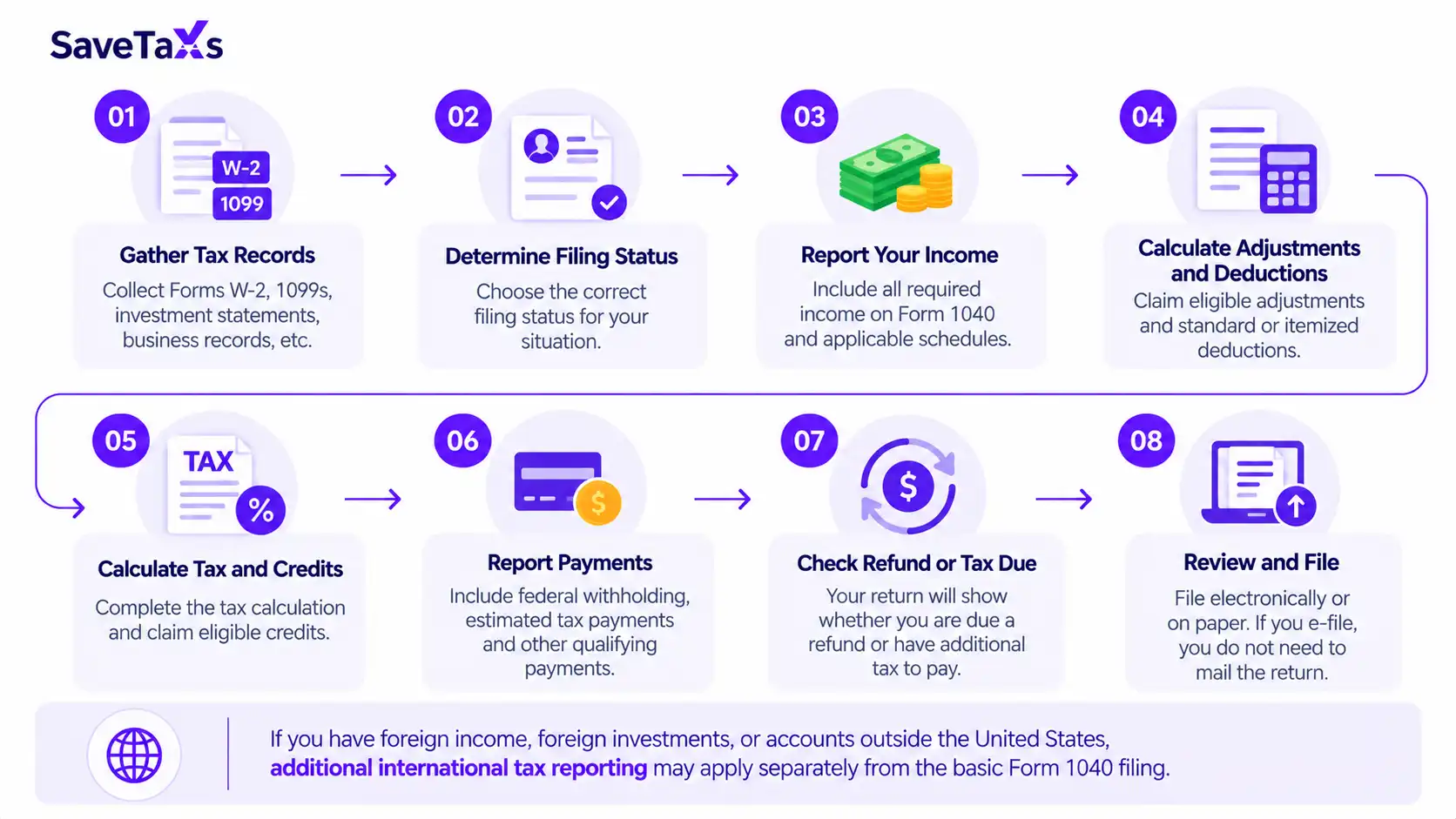
- Gather your tax records. Collect relevant documents such as Forms W-2, 1099s, investment statements, business records, and other tax information applicable to you.
- Determine your filing status. Your filing status can affect filing requirements, deductions, and tax calculations.
- Report your income. Include the income required on Form 1040 and any applicable supporting schedules.
- Calculate adjustments and deductions. Claim eligible adjustments and determine whether the standard deduction or itemized deductions apply.
- Calculate tax and applicable credits. Complete the tax calculation and claim credits for which you qualify.
- Report payments already made. Include applicable federal withholding, estimated tax payments, and other qualifying payments.
- Determine your refund or balance due. The completed return will show whether you are due a refund or have additional tax to pay.
- Review and file the return. Form 1040 can generally be filed electronically or on paper. The IRS notes that taxpayers who e-file do not need to mail the return.
For taxpayers with foreign income, foreign investments, or accounts outside the United States, additional international tax reporting may apply separately from the basic Form 1040 filing.
Form 1040 Filing Deadline
For individuals filing on a calendar-year basis, the regular deadline for the 2025 Form 1040 is April 15, 2026. Certain U.S. citizens and resident aliens living abroad may qualify for an automatic two-month extension to file and pay, generally until June 15, 2026. If you cannot file by the applicable deadline, you can generally request an additional extension by filing Form 4868 by the applicable due date. Interest may apply to unpaid tax from the original April 15 deadline, and the additional filing extension does not extend the time to pay.
Certain taxpayers abroad and taxpayers affected by other special circumstances may have different filing rules or additional time. Those rules should be checked separately based on the taxpayer's circumstances.
Conclusion
IRS Form 1040 is the main U.S. federal individual income tax return. It brings together your income, deductions, tax, credits, payments, and final refund or balance due.
For Indians and NRIs with U.S. tax connections, the most important first step is determining your U.S. tax status. Indian NRI status alone does not tell you whether Form 1040 or Form 1040-NR applies.
Once Form 1040 is the correct return, the schedules and additional forms you need depend on your income, investments, deductions, credits, and other tax circumstances.

Hatim Dudhiyawala is a Certified Public Accountant (CPA) with SaveTaxs and specializes in Indian and NRI taxation. He advises individuals, NRIs, and businesses on income tax filing, capital gains taxation, DTAA benefits, fund repatriation, and tax compliance. With experience in cross-border tax matters, Hatim helps taxpayers understand complex regulations and make informed decisions. Through his articles, he shares practical insights to help readers stay compliant and manage their tax obligations with confidence. See Full Bio

Frequently Asked Questions
The 1040 tax form is known as the U.S. individual income tax return form and is used by U.S. taxpayers, both residents and citizens, to report their annual income, claim eligible tax deductions, and calculate their tax liability and tax refund. The form must be filed with the IRS by every financial user.
Every US individual must file Form 1040 if their income exceeds the IRS threshold. This includes wages, salary, capital gains, interest, self-employment income, or, if you have specific income, obligations like health account contributions, self-employment tax, and more.
Information included in Form 1040 includes personal information, such as name, SSN, filing status of the taxpayer, and the dependents. The type of income sources being reported, including eligible deductions, tax credits, and more.
The variants of Form 1040 are Form 1040-SR, Form 1040-NR, and Form 1040-X.
- Form 1040-SR is for taxpayers aged 65 and above, as it features a simple layout and larger fonts.
- Form 1040-NR: This form is used by nonresident aliens who are earning in the United States.
- Form 1040-X: This form is filed to amend previously submitted 1040s.
The supporting schedules are Schedules 1, 2, and 3.