US Tax Forms
IRS Form 2350: Extension to File U.S. Tax Return for FEIEIRS Form 2350: Extension to File U.S. Tax Return for FEIE
Written by Hatim Dudhiyawala

U.S. citizens, green card holders, and resident aliens living overseas generally get an automatic two-month tax extension to file their tax return, i.e., June 15. However, they often confuse the automatic two-month extension with IRS Form 4868 for taxpayers living abroad.
Like the two-month extension, IRS Form 4868 is not an automatic extension unless you file the form. This is because, to get this additional four-month extension to file the U.S. tax return, they must complete Form 4868 before their two-month automatic tax extension date. The IRS makes this form available on its official website. The form, along with the two-month extension, gives U.S. taxpayers a total six-month extension until October 15 for calendar-year taxpayers to file U.S. taxes.
Still confused and want to know about all this in detail? You are on the right page; this blog provides you with complete information about the automatic two-month tax extension and Form 4868 for U.S. taxpayers living overseas.
The table below provides a quick overview of the automatic two-month extension and Form 4868 available to U.S. taxpayers living overseas.
| Basis | Automatic Two-Month Extension | IRS Form 4868 |
|---|---|---|
| Key Purpose | Provide additional time to file federal tax returns to U.S. citizens and resident aliens living overseas who meet the applicable IRS conditions. | Offers additional time to file U.S. tax returns to eligible U.S. taxpayers living overseas |
| Separate Request Required | No | Yes |
| 2026 Filing Deadline | June 15, 2026 | October 15, 2026 |
| Form 4868 Deadline for Qualifying Overseas Taxpayers | Not needed for automatic tax extension | Generally June 15, 2026 |
| Qualifying Statement | Attached to the U.S. federal tax return | Where applicable, indicate the overseas status in the form |
| Additional Time to Pay | Generally, till June 15, subject to interest | Does not provide any additional time for payment |
| Interest on Unpaid Taxes | Starts on April 15 | Starts on April 15 |
Further, both automatic two-month tax extensions and six-month extensions start from the April 15 federal tax deadline. So, if you are a U.S. taxpayer living abroad, you can get four months of extra time through Form 4868 for U.S. federal taxes, in addition to the two-month automatic extension.
Now, moving ahead, let's see who qualifies for the automatic two-month tax extension.
Connect with Savetaxs and pay your US taxes on time with complete confidence.
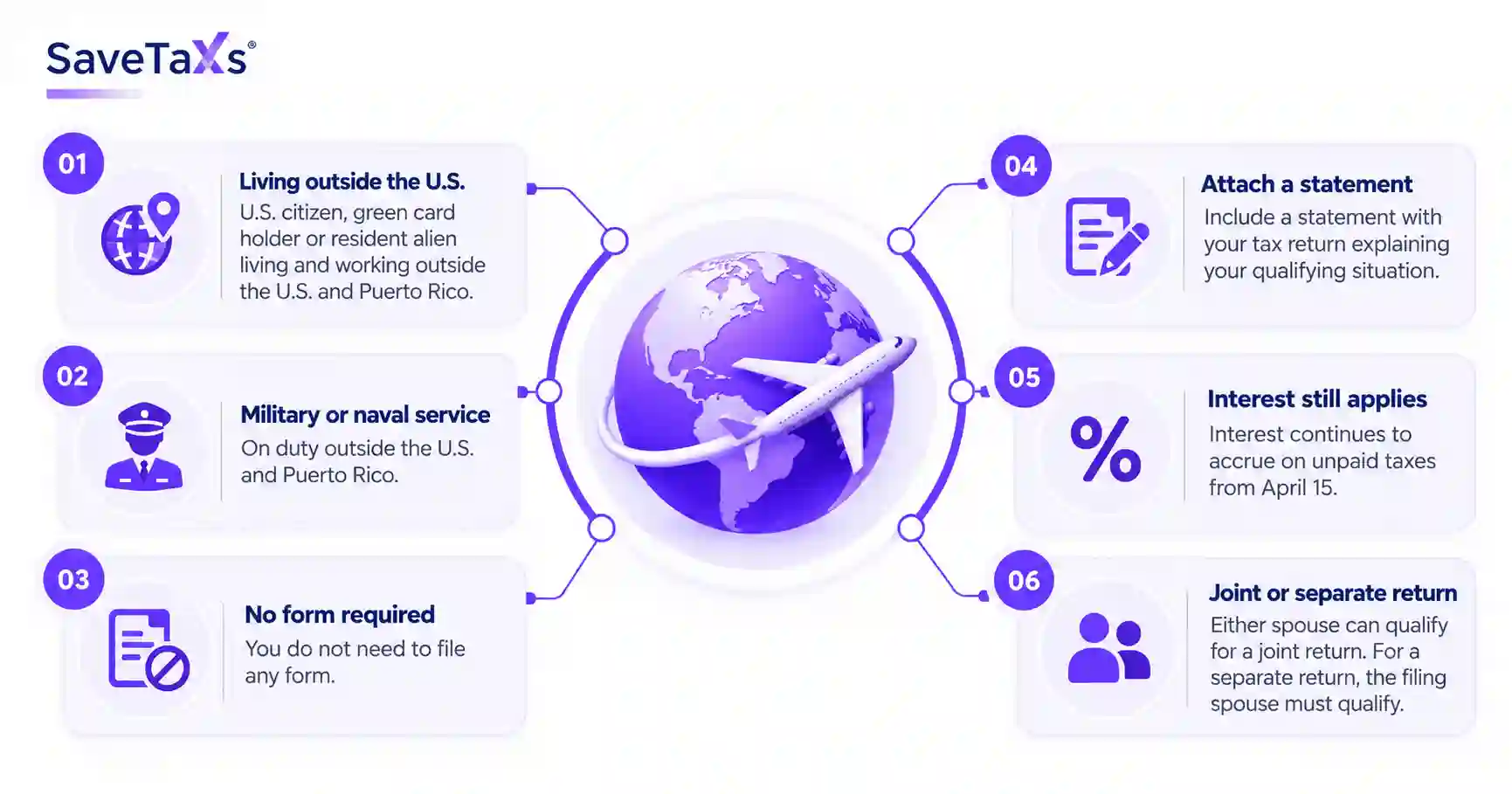
According to the IRS, you qualify for an automatic two-month extension if you are a U.S. citizen, green card holder, or resident alien and meet the following conditions:
Eligibility for an automatic two-month extension depends on whether you live outside the U.S. and Puerto Rico and your main place of business or post of duty is outside the U.S. and Puerto Rico, or whether you are in military or naval service on duty outside the U.S. and Puerto Rico. It does not depend only on your residential status. Considering this, being physically present in the U.S. on April 15 does not automatically disqualify you if you otherwise meet the IRS definition of being “out of the country.”
You do not need to fill out any form or request this extension if you meet the stated conditions. However, when you file your tax return, attach a statement explaining that you qualify for this extension. Apart from this, the automatic two-month extension does not prevent accruing interest on unpaid taxes from April 15. If married taxpayers file jointly, either spouse can qualify for the automatic extension for the joint return. If you file separately, the extension applies to the spouse who meets the conditions.
Further, to qualify for the extension, you do not need to stay abroad for the whole year. Additionally, a short trip overseas is not the same as working or living overseas.
This was all about who qualifies for the automatic two-month extension. Moving further, let's look at when you should file Form 4868.
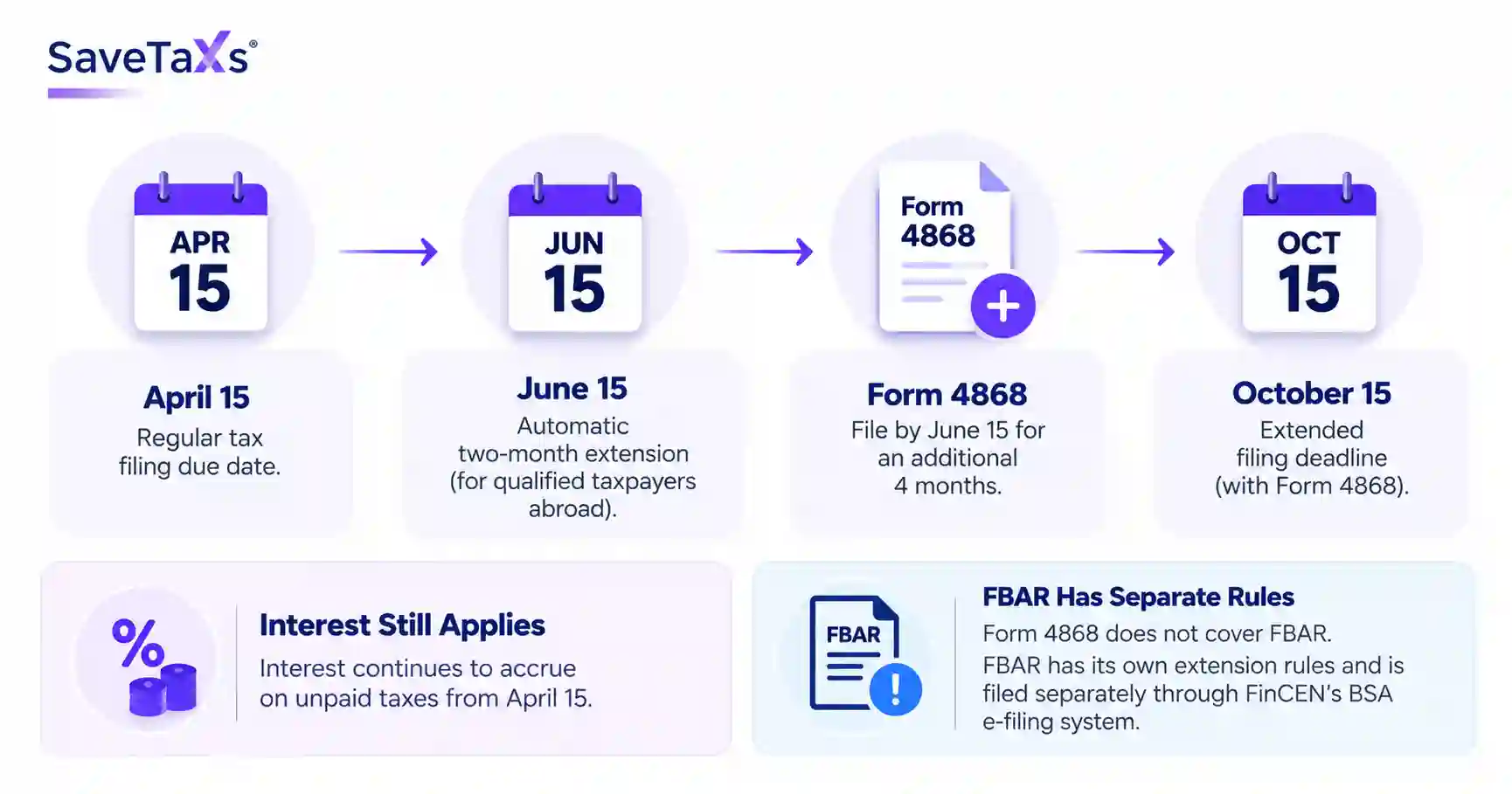
While living overseas, if you simply need more time beyond the automatic two-month tax extension, you can file Form 4868 to file your U.S. tax returns. In simple terms, Form 4868 for taxpayers living overseas extends the filing deadline from June 15 to October 15. However, it does not start a new six-month extension from June.
You should file this U.S. tax filing extension form by June 15, not April 15, if you qualify for the automatic two-month overseas extension. You can find Form 4868 on the official IRS website. When you file your federal tax return using Form 1040 on October 15, you do not need to attach a copy of Form 4868 to your tax return. Also, IRS Form 4868 only extends the time to file your U.S. tax return; it does not stop interest from accruing on your unpaid taxes.
Additionally, Form 4868 does not cover your FBAR filing requirements. FBAR has its own extension rules, different from this form. It is separate from your tax return filing and is filed online through FinCEN's BSA e-filing system. Additionally, the FBAR filing deadline includes an automatic extension to October 15, with no requirement to file a form.
So, when you need extra time beyond your two-month automatic extension, you can file Form 4868. Now, moving forward, which extension provides you with more time to pay?
This is where the automatic two-month tax extension and the Form 4868 extension differ.
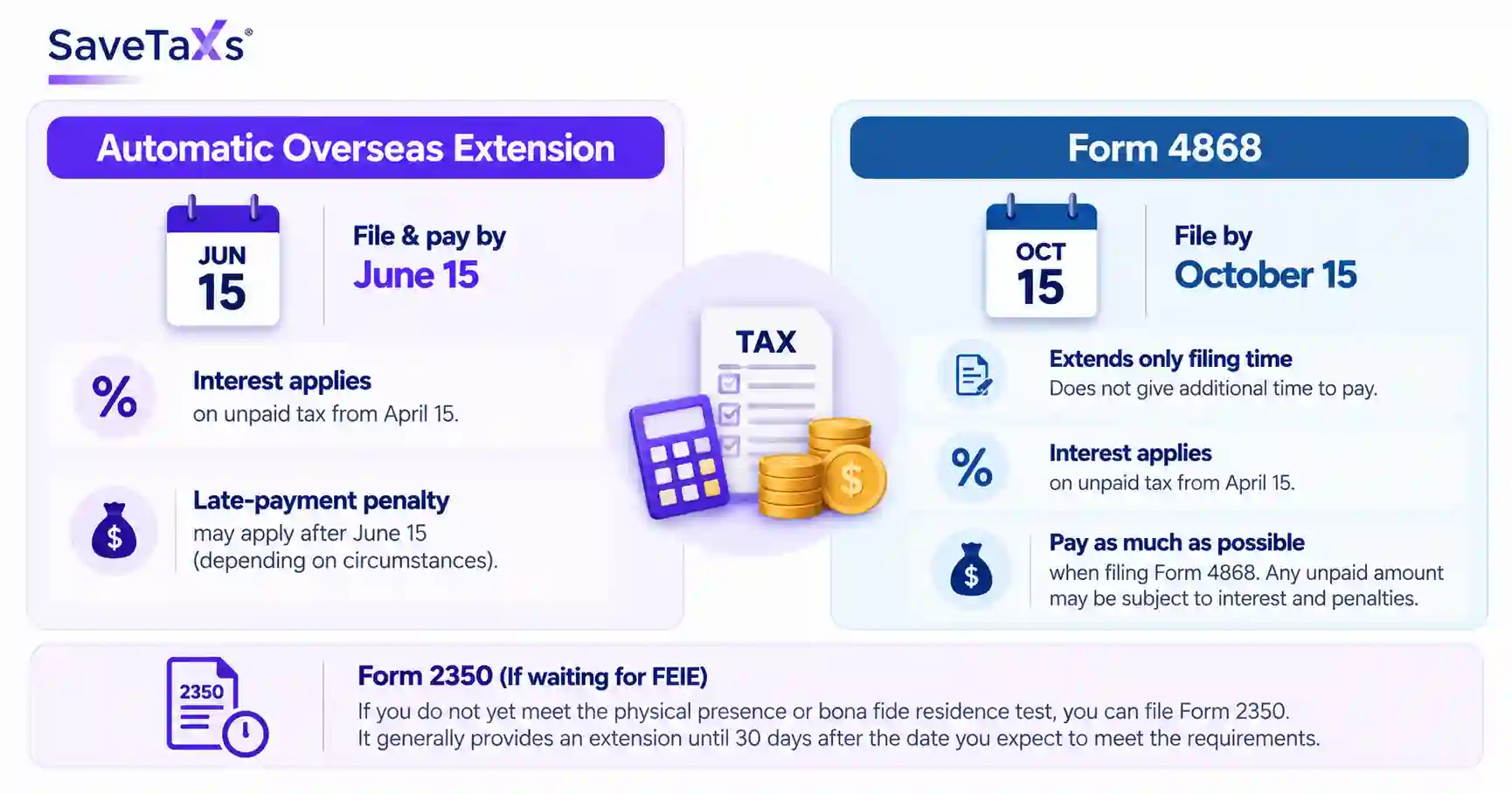
The automatic two-month extension (June 15) is available to eligible U.S. taxpayers living abroad. However, you still owe interest on unpaid federal income tax from the usual April 15 tax deadline. Additionally, the late payment penalty may apply after the June 15 payment deadline, although special reasonable-cause rules may apply depending on your payments and circumstances.
For instance, you are a U.S. citizen living in India, and in 2025 you owe $4,000 in U.S. taxes. You pay your U.S. taxes on June 10, 2026. In this situation, your June 10 payment is made within the automatic payment extension period. However, interest on your unpaid taxes starts accruing from April 15 until your payment date.
Form 4868 provides you with extra time to file your taxes, not to pay them. If you request the October 15 filing deadline, it does not mean you need to pay the full tax on that date. You should determine your tax obligation and pay as much as possible when filing Form 4868. Any unpaid amount may be subject to interest and applicable penalties.
However, if you are waiting to qualify for the foreign earned income exclusion (FEIE) and do not yet meet the physical presence test or bona fide residence test, you can file Form 2350. This form generally provides an extension until 30 days after the date you expect to meet the applicable requirements. For a detailed overview, read our blog on Form 2350.
So, if you need more time to file beyond the June 15 automatic extension, fill out Form 4868. This gives you additional time to file, but not additional time to pay the tax. Determine your total tax obligation, pay as much as possible by the applicable payment deadline, and file your tax return or extension on time. Also, file your tax return or extension on time, even if you cannot make the full payment. If you don't file because you can't meet your tax obligation, you may still face a failure-to-file penalty.
Moving further, let's look at the common extension mistakes made by U.S. taxpayers living abroad.
Here is the list of common mistakes made by U.S. taxpayers living abroad when filing U.S. tax returns:
So, when filing your U.S. tax return from overseas, avoid these mistakes.
At Savetaxs, we help you manage your tax deadlines, payments, and filing obligations from start to end, based on your circumstances.
Lastly, U.S. taxpayers (resident aliens, citizens, or green card holders) living and working overseas can use the automatic two-month tax extension if they meet the applicable IRS conditions. For this extension, you do not have to file any IRS form. However, you must attach an overseas extension statement to your Form 1040. If you need more time to file your U.S. tax return, you must file Form 4868 by June 15 if you qualify for the automatic two-month extension. It gives you until October 15, and you do not need to attach a copy of the filed form to your U.S. tax return.
If you are confused about your U.S. tax deadline, contact Savetaxs. Our team of cross-border tax experts can help you determine whether you qualify for an automatic two-month extension, identify the tax payment due, and file Form 4868 for an additional extension. We can also help you prepare and plan your taxes.
This article is for general informational purposes only and does not constitute tax, legal, financial, or investment advice. Laws, regulations, rates, and procedures may change over time and may vary based on individual circumstances.
While SaveTaxs makes reasonable efforts to keep the information accurate and up to date, readers should verify applicable rules with official authorities or consult a qualified professional before making decisions based on this information.
Vipul Jain is the Co-Founder of SaveTaxs and a tax expert with experience in Indian and NRI taxation. He advises individuals, NRIs, and businesses on tax filing, tax planning, capital gains, DTAA, and compliance matters. He focuses on making complex tax concepts simple and helping taxpayers make informed, compliant decisions. See Full Bio

Want to read more? Explore Blogs