


US Tax Forms
IRS Form 1116 for NRIs: Foreign Tax Credit Filing GuideIRS Form 1116 for NRIs: Foreign Tax Credit Filing Guide
Written by Vipul Jain
As an NRI living and working in the United States, Form 8962 may be required as part of your U.S. tax filing if you received Advance Premium Tax Credit (APTC) or are claiming the Premium Tax Credit (PTC) for qualifying Marketplace health insurance. The purpose of Form 8962 is to calculate the Premium Tax Credit and then reconcile it with any advance premium tax credit (APTC) paid on your behalf during the tax year.
However, for NRIs, things do not end here, as there is an additional layer to consider. That layer includes your U.S. tax residency status, filing status, family situation, household income, lawful-presence status, and access to other types of health coverage that may affect your eligibility, regardless of whether you claim the credit.
The important point here is that having Marketplace insurance does not automatically mean that you qualify for the credit. Form 8962 may still be required if APTC was paid, even if you ultimately are not eligible for the PTC. In this blog, we will cover all the important aspects of IRS Form 8962.
In a nutshell, Form 8962 is used for calculating the PTC, which is the Premium Tax Credit (PTC), and reconciles that credit with the Advance Premium Tax Credit (APTC) received during the year.
The Premium Tax Credit is a tax credit that generally helps eligible taxpayers pay for qualifying health insurance purchased through the U.S. Health Insurance Marketplace, also known as the Exchange.
The APTC is an advance payment of the estimated Premium Tax Credit.
Rather than waiting until the annual U.S. tax return is filed, an estimated credit amount is paid to the insurance company on your behalf during the year to reduce the amount you pay toward your monthly premium.
At tax time, the IRS reconciles the APTC with the actual PTC you are allowed to claim based on your tax-return information.
Hence, this is where you need to complete and attach Form 8962 when the filing requirements apply.
Let us assume that an NRI named Riya received $4,800 in APTC during the year. After she is done filing Form 8962, the taxpayer's actual PTC can be as much as $4,500.
The $300 difference generally represents excess APTC and may have to be repaid, subject to the applicable repayment rules.
If the actual premium tax credit is $5,100 instead, Riya may be entitled to an additional $300 PTC, which can reduce her tax liability or increase her refund.
So Form 8962 brings the advance credit and the final credit essentially together.
Savetaxs helps NRIs in the United States file their IRS return under expert guidance.
Form 8962 is applicable to NRIs specifically when an NRI has qualifying Marketplace coverage and either claims the PTC or has received APTC.
With respect to the instructions provided by the IRS, Form 8962 is used when a taxpayer is claiming the premium tax credit or when the advance premium tax credit was paid for the taxpayer or another person in the taxpayer's tax family.
However, NRIs must not assume that merely having Marketplace insurance makes them eligible for the PTC.
As a non-negotiable, there are additional rules to consider. Let us understand those.
The IRS has specific rules for taxpayers filing Form 1040-NR.
For NRAs, the PTC has additional eligibility requirements. Starting with:
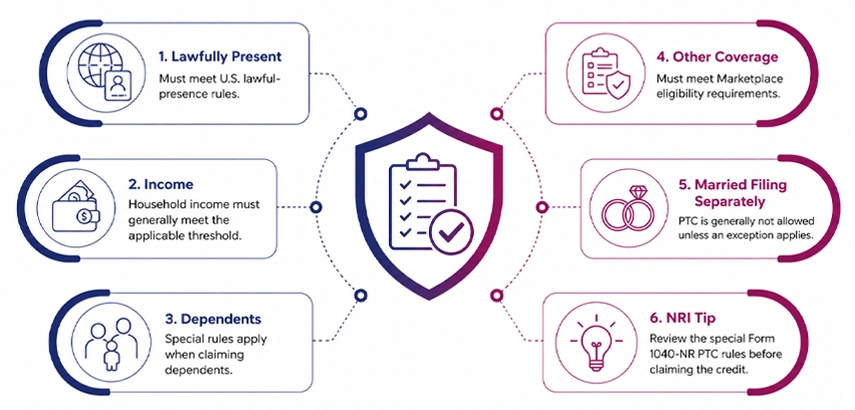
Form 1040-NR filers should also review the special rules for claiming the PTC for dependents. The IRS states that a Form 1040-NR filer generally can claim the PTC for dependents only in specific circumstances, including certain U.S. nationals, residents of Canada, Mexico, or South Korea, or eligible students or business apprentices covered by the U.S.–India treaty provisions.
Let us understand what PTC and APTC are:
The premium tax credit is a tax credit specifically for individuals who are eligible for qualifying health coverage through the Marketplace.
Now, to be eligible for the PTC, you must meet the applicable requirements, which can include the following:
The amount of the credit is based on different factors such as household circumstances, income, and the cost of qualifying Marketplace coverage. Just ensure that the credit is not simply a refund of the health insurance premium you paid.
The advance premium tax credit is an estimated amount of the Premium Tax Credit paid during the year to your insurance company on your behalf. Instead of receiving the full credit when you file your tax return, you can have advance payments made toward the Marketplace insurance premium.
These are called advance credit payments.
The Marketplace uses the information available when coverage is obtained to estimate the amount.
As your circumstances change, the final PTC may differ from the APTC you received; hence, the reconciliation is necessary.
The exact calculation depends on your circumstances; however, it involves a few steps you should follow.
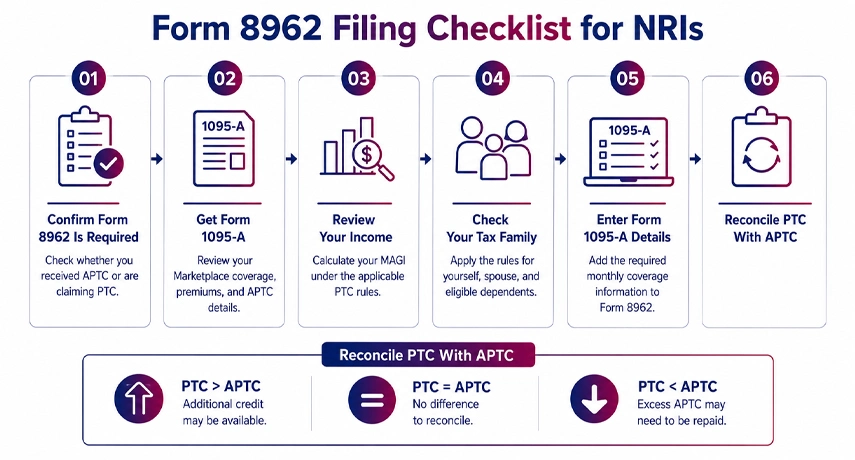
Starting with, you need to determine whether you received the APTC or are claiming the PTC. The IRS instructions identify these as circumstances requiring Form 8962.
An NRI should also confirm whether or not they are filing Form 1040 or Form 1040-NR.
Here, the filing status matters because the premium tax credit rules can differ depending on the taxpayer's filing status and whether the taxpayer is filing Form 1040 or Form 1040-NR.
Form 1095-A stands for the Marketplace health coverage statement, and this reports information that is associated with the taxpayer's qualifying Marketplace coverage.
The form has monthly information about the policy, premiums, and APTC.
Further, the IRS states that Form 1095-A is provided to taxpayers so they can use the information to claim the PTC and reconcile advance payments when completing Form 8962.
Before you enter the information into Form 8962, carefully check the statement.
If, while reviewing or amending, something incorrect appears to you, contact the Marketplace or the appropriate issuer rather than simply changing the figures all by yourself.
The premium tax credit calculations use modified adjusted gross income (MAGI) as determined under the PTC rules.
Talking specifically about NRI, this step deserves particular attention.
The cross-border taxpayer will have income from multiple sources, and the income information used for the PTC calculation may not have to be identical to the income figures that the taxpayer may initially give to the Marketplace.
The final calculation may be affected by merely a change in income during the year. Changes in household income can cause the final PTC to differ from the APTC estimated by the Marketplace.
Form 8962 contains information about your tax family and household. As an NRI, this can be a more complicated affair for you because Form 1040-NR has special rules regarding dependents.
This does not include every family member automatically who lives with you or, in fact, is financially dependent on you. The applicable tax law of the United States determines who can and cannot be included.
When completing your Form 8962, you shall use the relevant information from your Form 1095-A statement. However, the computation is performed using monthly coverage information.
This generally matters when your Marketplace coverage started, ended, or changed during the year.
For the last step, you shall compare the calculated PTC with the APTC paid on your behalf.
| The Situation | Result |
|---|---|
| The PTC is higher than the APTC | Additional credit may be available. |
| The PTC is equal to the APTC | There is no difference to reconcile. |
| The PTC is lower than the APTC | The excess APTC may have to be repaid, subject to the applicable rules. |
However, determining the actual tax result depends on the Form 8962-related calculations and the rules applicable to your situation.
The main reason Form 1095-A matters is that it provides the information needed to calculate and reconcile the PTC.
If you have received Marketplace coverage during only a portion of the year, the statement contains the applicable monthly coverage information.
This is particularly relevant to NRIs who move to or from the United States or otherwise have Marketplace coverage for only part of the year.
Amit is an Indian citizen who works in the United States for part of the year. For United States tax purposes, Amit is treated as a non-resident alien and files Form 1040-NR. In the United States, he purchased Marketplace insurance.
Then the Marketplace determined that Amit is eligible for the APTC and further applied the advance credit towards his monthly premiums.
Now that he has experienced a change in his income, the final PTC may differ from the amount of APTC paid on his behalf.
At tax time, Amit received Form 1095-A.
Amit just cannot think of the fact that the APTC received during the year is the final amount of credit available to him.
Now, he needs to complete Form 8962 using his final tax-return information and the information reported on Form 1095-A.
Now, suppose that the Marketplace paid the APTC of $5,000 during the year, but the final amount figures show that Amit was entitled to $4,700 of the PTC.
The $300 difference might result in an excess APTC amount that must be addressed on his return. The amount may need to be repaid, subject to the applicable repayment rules.
However, before making the calculation, Amit should identify whether he fully complies with the PTC rules applicable to his nonresident status and filing position.
This example illustrates why an NRI's U.S. tax status matters.
The calculation:
Marketplace insurance + APTC ≠ automatically the final tax credit
Form 8962 reconciles the APTC with the PTC actually allowed under the applicable rules.
However, the financial details will be based on the application eligibility and reconciliation rules.
The following are the common mistakes related to Form 8962 that NRIs should avoid.
Having U.S. health insurance does not directly mean that you are eligible for the PTC.
The credit here is now tied to qualifying Marketplace coverage and certain eligibility criteria.
APTC is generally an advance payment, not the final amount of the credit you are entitled to claim. Form 8962 will include advance payments in the final Premium Tax Credit calculation and reconciliation.
If your income changes during the year substantially, the Marketplace's original estimate may no longer reflect your final household income, which can affect the reconciliation.
As a taxpayer who also has employer coverage, you may receive Form 1095-C.
However, this does not mean that it is a substitute for Form 1095-A when Marketplace coverage is involved.
Form 1095-A reports Marketplace coverage, while Form 1095-C generally reports information about employer-sponsored health coverage.
As an NRI filing Form 1040-NR, you shall not apply the same assumption that is used by a U.S. resident filing their own respective Form 1040.
The following are key considerations for a non-resident.
An individual who is not lawfully present in the United States is not eligible for the PTC for their own Marketplace coverage. However, a tax family can include both lawfully present and not-lawfully-present individuals, and special Form 8962 rules can apply.
For Form 1040-NR filers, special rules also apply to dependents and married taxpayers. For example, the IRS provides specific circumstances in which a Form 1040-NR filer can claim the PTC for a dependent.
Do not assume that an F-1 student is automatically eligible or ineligible for the PTC simply because of the F-1 visa or the first five calendar years. The PTC rules focus on lawful presence and other eligibility requirements, while the substantial-presence-test rules used to determine U.S. tax residency are a separate issue.
For tax year 2026, taxpayers should use the rules applicable to the 2026 tax year rather than relying on older 2021–2025 guidance. In particular, the temporary expansion that removed the 400% federal-poverty-line ceiling applied through tax year 2025; the IRS's current guidance states that the general 100%–400% framework applies again, subject to applicable exceptions and current-law changes.
If you are not eligible for the PTC but have received the APTC for coverage for which you are not eligible, the amount may have to be repaid under the Form 8962 rules.
The IRS offers certain limitations or exceptions for individuals filing Form 1040-NR. Hence, verify your eligibility before you go ahead and claim the credit.
Got served with an IRS notice or are you concerned about a Form? Connect with our experts on a call and get end-to-end assistance.
An NRI who has moved to or from the United States during the year may have Marketplace coverage for only specific months.
Now, those amounts need to be carefully reviewed using the monthly information provided on Form 1095-A and entered into Form 8962 according to the applicable instructions.
For NRIs living and working in the United States, Marketplace coverage may create a Form 8962 filing requirement when APTC was paid or the taxpayer is claiming the PTC. NRIs may have a nonresident filing status, changing household income, foreign income, or a Form 1040-NR filing requirement, all of which can make the PTC rules more important to review carefully.
Savetaxs helps NRIs provide expert guidance on U.S. tax filing positions, Form 8962 requirements, and relevant Marketplace information.
This article is for general informational purposes only and does not constitute tax, legal, financial, or investment advice. Laws, regulations, rates, and procedures may change over time and may vary based on individual circumstances.
While SaveTaxs makes reasonable efforts to keep the information accurate and up to date, readers should verify applicable rules with official authorities or consult a qualified professional before making decisions based on this information.
Shubham Jain is the Founder of SaveTaxs and has extensive experience in Indian and NRI taxation. He advises individuals, NRIs, and businesses on tax filing, tax planning, capital gains, DTAA benefits, fund repatriation, and compliance matters. He regularly writes about taxation and related financial topics. His focus is on making complex tax concepts easy to understand. Through his articles, he helps taxpayers stay informed, avoid common mistakes, and stay compliant with Indian tax laws. See Full Bio

Want to read more? Explore Blogs
_1786539671275.webp&w=828&q=75)
Yes, a nonresident alien may qualify for the PTC if the applicable eligibility requirements are met, including lawful presence. However, being a nonresident alien for U.S. tax purposes does not by itself establish eligibility for the PTC.
The key pointers here are: